
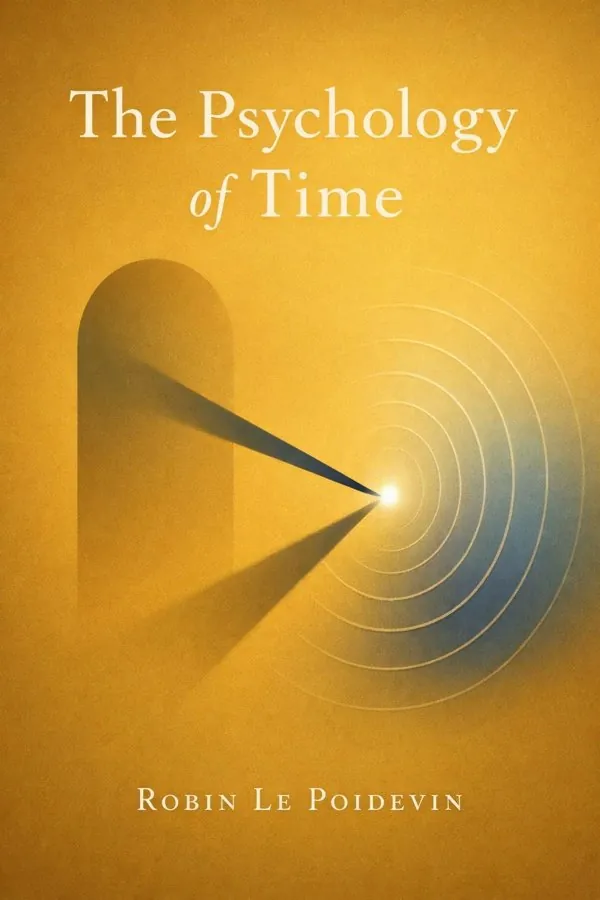
The Psychology of Time: Summary & Key Insights
 10 min9 chaptersAudio available
What Is The Psychology of Time About?
The Psychology of Time by Robin Le Poidevin is a cognition book spanning 9 pages. This book explores how humans perceive and experience time, examining psychological, philosophical, and cognitive dimensions. Le Poidevin investigates how temporal awareness shapes memory, anticipation, and identity, bridging insights from philosophy of mind and experimental psychology.
This FizzRead summary covers all 9 key chapters of The Psychology of Time in approximately 10 minutes, distilling the most important ideas, arguments, and takeaways from Robin Le Poidevin's work. Also available as an audio summary and Key Quotes Podcast.
The Psychology of Time
This book explores how humans perceive and experience time, examining psychological, philosophical, and cognitive dimensions. Le Poidevin investigates how temporal awareness shapes memory, anticipation, and identity, bridging insights from philosophy of mind and experimental psychology.
Who Should Read The Psychology of Time?
This book is perfect for anyone interested in cognition and looking to gain actionable insights in a short read. Whether you're a student, professional, or lifelong learner, the key ideas from The Psychology of Time by Robin Le Poidevin will help you think differently.
- ✓Readers who enjoy cognition and want practical takeaways
- ✓Professionals looking to apply new ideas to their work and life
- ✓Anyone who wants the core insights of The Psychology of Time in just 10 minutes
Want the full summary?
Get instant access to this book summary and 100K+ more with Fizz Moment.
Get Free SummaryAvailable on App Store • Free to download
Key Chapters
If we close our eyes and attend to the moment’s unfolding, we sense a continuous stream rather than a succession of frozen instants. This sense of passage — the idea that time ‘flows’ — forms the foundation of temporal consciousness. Yet upon examining it closely, we find this notion perplexing. In physical theory, all moments simply coexist; there is no universal motion of time sweeping them forward. So where does our felt passage emerge? The answer lies in perception itself: our minds synthesize experience across short intervals, producing the illusion of continuity. When music plays, we do not hear isolated tones but a melody — an ordered succession that our neural processing smooths into fluid progression.
The phenomenal present, therefore, is not razor-thin but extended; it includes traces of the immediate past and expectations of the near future. Our consciousness, in constantly updating sensory input and integrating memory, generates the impression that time moves. What we call flow is really the operation of temporal binding — the brain’s effort to stitch transient sensations into coherent experience. The subjective sense of duration arises from this integration, revealing that temporal passage is a psychological construction rather than a cosmic fact.
From this realization follow profound implications about free will and persistence. If the flow we perceive is generated internally, then consciousness itself is the architect of time’s movement in our lives. The world presents us with change, but it is our minds that give that change rhythm and continuity. Thus, time becomes an emergent property of perception, a mirror for the way awareness interacts with reality.
To have a past is to remember it. Our sense of time’s direction — its arrow — depends on memory’s ability to classify and organize experience. Without recollection, all moments would dissolve into an eternal now. The psychological study of memory reveals that we do not passively store events but actively construct narratives. Each act of remembering involves selection, interpretation, and emotional coloring. Consequently, our personal timeline is not a fixed record but an ever-shifting composition, rewritten by present needs and desires.
In examining how temporal order emerges, I trace how episodic memory allows us to situate ourselves within a sequence. The mind’s capacity to encode temporal relations — what came before, what followed — forms the cognitive skeleton of chronology. Yet distortions are frequent: memories can compress years or stretch seconds, depending on their emotional weight. We remember turning points vividly but forget the long intervals between them, giving our lives uneven temporal texture.
Through this dynamic, remembrance acts as identity’s architect. Our continuity across time depends on the coherence of our remembered past, and psychological studies confirm that disruptions in autobiographical memory fragment selfhood. Through memory, we craft both the feeling that time has passed and the narrative that defines who we have become.
+ 7 more chapters — available in the FizzRead app
All Chapters in The Psychology of Time
About the Author
Robin Le Poidevin is a British philosopher and professor at the University of Leeds, known for his work on metaphysics, philosophy of time, and the philosophy of religion. He has authored several influential books on temporal experience and the nature of reality.
Get This Summary in Your Preferred Format
Read or listen to the The Psychology of Time summary by Robin Le Poidevin anytime, anywhere. FizzRead offers multiple formats so you can learn on your terms — all free.
Available formats: App · Audio · PDF · EPUB — All included free with FizzRead
Download The Psychology of Time PDF and EPUB Summary
Key Quotes from The Psychology of Time
“If we close our eyes and attend to the moment’s unfolding, we sense a continuous stream rather than a succession of frozen instants.”
“Our sense of time’s direction — its arrow — depends on memory’s ability to classify and organize experience.”
Frequently Asked Questions about The Psychology of Time
The Psychology of Time by Robin Le Poidevin is a cognition book that explores key ideas across 9 chapters. This book explores how humans perceive and experience time, examining psychological, philosophical, and cognitive dimensions. Le Poidevin investigates how temporal awareness shapes memory, anticipation, and identity, bridging insights from philosophy of mind and experimental psychology.
You Might Also Like

A Field Guide to Lies: Critical Thinking in the Information Age
Daniel J. Levitin
10 min
A Theory of Cognitive Dissonance
Leon Festinger
10 min
Black-And-White Thinking: The Burden of a Binary Brain in a Complex World
Kevin Dutton
10 min
Born Liars: Why We Can’t Live Without Deceit
Ian Leslie
10 min
Collective Illusions: Conformity, Complicity, and the Science of Why We Make Bad Decisions
Todd Rose
10 min
Concrete Mathematics: A Foundation for Computer Science
Ronald L. Graham, Donald E. Knuth, Oren Patashnik
10 minBrowse by Category
Ready to read The Psychology of Time?
Get the full summary and 100K+ more books with Fizz Moment.