
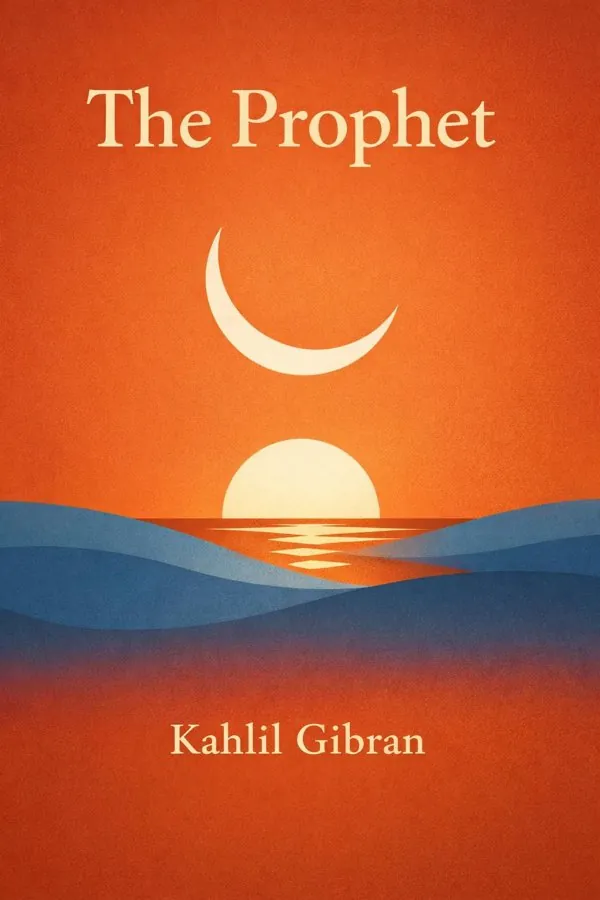
The Prophet: Summary & Key Insights
 10 min8 chaptersAudio available
What Is The Prophet About?
The Prophet by Kahlil Gibran is a eastern_wisdom book spanning 8 pages. A collection of poetic essays that explore themes of love, freedom, work, joy, sorrow, and spirituality through the words of the prophet Almustafa, who shares his wisdom with the people of Orphalese before departing on a journey. Written in lyrical prose, the book reflects Gibran’s blend of Eastern mysticism and Western literary style.
This FizzRead summary covers all 8 key chapters of The Prophet in approximately 10 minutes, distilling the most important ideas, arguments, and takeaways from Kahlil Gibran's work. Also available as an audio summary and Key Quotes Podcast.
The Prophet
A collection of poetic essays that explore themes of love, freedom, work, joy, sorrow, and spirituality through the words of the prophet Almustafa, who shares his wisdom with the people of Orphalese before departing on a journey. Written in lyrical prose, the book reflects Gibran’s blend of Eastern mysticism and Western literary style.
Who Should Read The Prophet?
This book is perfect for anyone interested in eastern_wisdom and looking to gain actionable insights in a short read. Whether you're a student, professional, or lifelong learner, the key ideas from The Prophet by Kahlil Gibran will help you think differently.
- ✓Readers who enjoy eastern_wisdom and want practical takeaways
- ✓Professionals looking to apply new ideas to their work and life
- ✓Anyone who wants the core insights of The Prophet in just 10 minutes
Want the full summary?
Get instant access to this book summary and 100K+ more with Fizz Moment.
Get Free SummaryAvailable on App Store • Free to download
Key Chapters
When the people of Orphalese gathered to ask of love, Almustafa spoke as one who had tasted both its sweetness and its fire. Love, he said, crowns you even as it crucifies you. Its arrows pierce not to destroy but to open the closed chambers of the heart. In his vision, love is no gentle pastime—it is the essence of being, the power that lifts man beyond himself.
I wrote these words knowing that the heart must learn to accept both joy and suffering from love’s hand. For love does not seek comfort; it seeks transformation. It demands that we give ourselves wholly, that we be willing to burn in its light until only truth remains. The lovers of the world wish for security, yet true love offers none—it offers only the chance to become more alive.
Through love, we touch what is infinite. When we love, we no longer measure nor possess; we live in the divine exchange between soul and soul. Almustafa reminds the listeners that one cannot command love, nor should one strive to imprison it with promises. Love moves of its own accord, and those who follow it walk the sure path of growth. The pain of love is the pruning that makes the spirit bear fruit. Thus love is both the teacher and the test.
In speaking of marriage, Almustafa did not offer rules but vision. He teaches that two souls joined in matrimony must stand together yet not too near—like pillars that hold one temple roof but do not lean upon each other. The essence of his words is balance: union without the loss of self.
I have seen that many love seek ownership as proof of affection. Yet in truth, love’s highest expression is freedom within unity. In marriage, each soul is a sea whose waves meet without blending entirely. To be one does not mean dissolution, but harmony of distinct notes. Let each partner find strength in solitude, that their meeting may be renewal rather than refuge.
This teaching reflects the spiritual architecture of life itself. The universe is woven of opposites that sustain one another—light and shadow, silence and song. So too must marriage embody complementary growth. In laboring together, raising children, and sharing sorrow, each discovers not the other’s completion but the inward revelation of their own divine nature. Through such love, the home becomes a living temple.
+ 6 more chapters — available in the FizzRead app
All Chapters in The Prophet
About the Author
Kahlil Gibran (1883–1931) was a Lebanese-American writer, poet, and artist. Born in Bsharri, Lebanon, he emigrated to the United States as a child. Gibran’s works, written in both English and Arabic, often explore themes of love, spirituality, and the human condition. He is best known for 'The Prophet', which has been translated into over 100 languages and remains one of the best-selling books of all time.
Get This Summary in Your Preferred Format
Read or listen to the The Prophet summary by Kahlil Gibran anytime, anywhere. FizzRead offers multiple formats so you can learn on your terms — all free.
Available formats: App · Audio · PDF · EPUB — All included free with FizzRead
Download The Prophet PDF and EPUB Summary
Key Quotes from The Prophet
“When the people of Orphalese gathered to ask of love, Almustafa spoke as one who had tasted both its sweetness and its fire.”
“In speaking of marriage, Almustafa did not offer rules but vision.”
Frequently Asked Questions about The Prophet
The Prophet by Kahlil Gibran is a eastern_wisdom book that explores key ideas across 8 chapters. A collection of poetic essays that explore themes of love, freedom, work, joy, sorrow, and spirituality through the words of the prophet Almustafa, who shares his wisdom with the people of Orphalese before departing on a journey. Written in lyrical prose, the book reflects Gibran’s blend of Eastern mysticism and Western literary style.
More by Kahlil Gibran
You Might Also Like
A New Earth
Eckhart Tolle
10 min
The Daily Stoic
Ryan Holiday, Stephen Hanselman
10 min
Buddhism: Plain and Simple
Steve Hagen
10 min
Enchiridion
Epictetus
10 min
The Book of Tea
Kakuzō Okakura
10 min
The Light We Give: How Sikh Wisdom Can Transform Your Life
Simran Jeet Singh
10 minBrowse by Category
Ready to read The Prophet?
Get the full summary and 100K+ more books with Fizz Moment.