
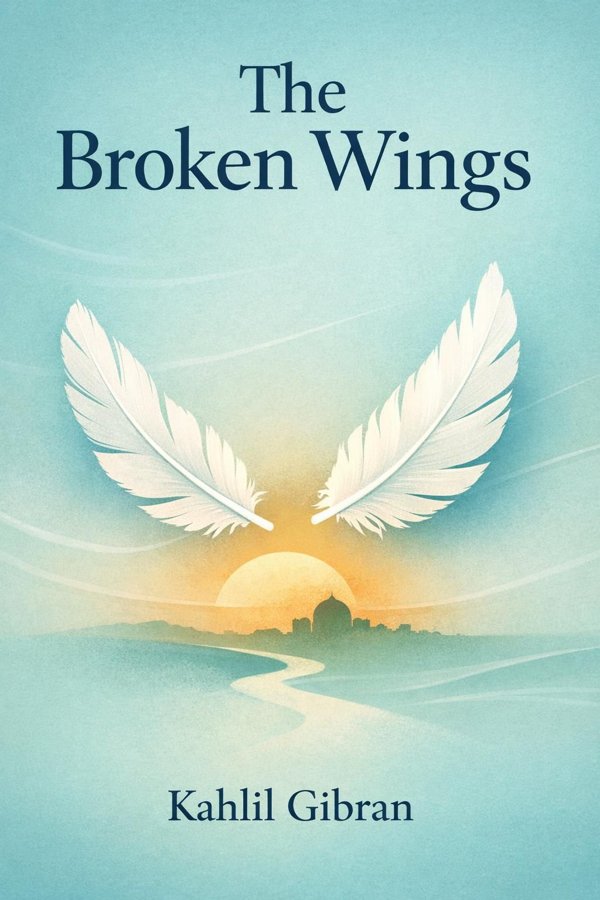
The Broken Wings: Summary & Key Insights
 10 min10 chaptersAudio available
Key Takeaways from The Broken Wings
Some encounters do not simply change our feelings; they change our entire way of seeing the world.
A society reveals itself by what it permits people to love—and what it forbids.
Marriage can be a shelter for love, but without freedom it becomes a decorated prison.
One of the most powerful truths in The Broken Wings is that unjust societies often preserve themselves through the suffering of women.
Selma’s life is shaped by decisions made in the name of parental duty and social advantage.
What Is The Broken Wings About?
The Broken Wings by Kahlil Gibran is a classics book spanning 8 pages. The Broken Wings is Kahlil Gibran’s lyrical, heartbreaking novella about first love, spiritual awakening, and the crushing force of social power. First published in Arabic in 1912 and set in turn-of-the-century Beirut, it follows a young narrator whose life is transformed when he meets Selma Karamy, a woman of rare grace and intelligence. Their bond feels destined, yet the world around them is ruled not by truth or tenderness, but by greed, custom, and religious authority. Selma is pushed into a marriage that serves family ambition rather than human happiness, and the lovers are left to confront what remains when love cannot become a shared life. What makes The Broken Wings endure is not merely its tragic romance, but its moral clarity. Gibran uses a personal story to expose the ways institutions can wound the soul, especially the souls of women. At the same time, he elevates love into something larger than possession: a force that reveals who we are, even when it leaves us broken. Gibran’s authority comes from his singular voice—part poet, part mystic, part social critic—capable of turning intimate sorrow into timeless insight.
This FizzRead summary covers all 10 key chapters of The Broken Wings in approximately 10 minutes, distilling the most important ideas, arguments, and takeaways from Kahlil Gibran's work. Also available as an audio summary and Key Quotes Podcast.
The Broken Wings
The Broken Wings is Kahlil Gibran’s lyrical, heartbreaking novella about first love, spiritual awakening, and the crushing force of social power. First published in Arabic in 1912 and set in turn-of-the-century Beirut, it follows a young narrator whose life is transformed when he meets Selma Karamy, a woman of rare grace and intelligence. Their bond feels destined, yet the world around them is ruled not by truth or tenderness, but by greed, custom, and religious authority. Selma is pushed into a marriage that serves family ambition rather than human happiness, and the lovers are left to confront what remains when love cannot become a shared life.
What makes The Broken Wings endure is not merely its tragic romance, but its moral clarity. Gibran uses a personal story to expose the ways institutions can wound the soul, especially the souls of women. At the same time, he elevates love into something larger than possession: a force that reveals who we are, even when it leaves us broken. Gibran’s authority comes from his singular voice—part poet, part mystic, part social critic—capable of turning intimate sorrow into timeless insight.
Who Should Read The Broken Wings?
This book is perfect for anyone interested in classics and looking to gain actionable insights in a short read. Whether you're a student, professional, or lifelong learner, the key ideas from The Broken Wings by Kahlil Gibran will help you think differently.
- ✓Readers who enjoy classics and want practical takeaways
- ✓Professionals looking to apply new ideas to their work and life
- ✓Anyone who wants the core insights of The Broken Wings in just 10 minutes
Want the full summary?
Get instant access to this book summary and 100K+ more with Fizz Moment.
Get Free SummaryAvailable on App Store • Free to download
Key Chapters
Some encounters do not simply change our feelings; they change our entire way of seeing the world. In The Broken Wings, love is presented not as convenience, attraction, or social compatibility, but as a revelation of the soul. When the narrator meets Selma, he does not merely fall in love with a beautiful woman. He feels as if a hidden chamber inside him has opened. Love becomes a light by which everything else is newly illuminated—beauty, suffering, longing, memory, and even God.
Gibran’s point is that real love awakens us to our deepest capacities. It makes us more aware, more vulnerable, and more alive. Yet this awakening is inseparable from pain. Love lifts the lovers above ordinary life, but it also exposes them to loss because anything sacred can be threatened by a profane world. That duality is central to the book: love is both blessing and wound.
In practical terms, this idea challenges modern assumptions that successful love must always be easy, efficient, or socially approved. Some of the most meaningful relationships in life are powerful precisely because they reveal truth, even if they do not become permanent partnerships. A friendship, a first love, or a brief connection can mark us forever by showing us what tenderness and recognition feel like.
Gibran invites readers to ask not only, “Did this love last?” but also, “What did this love awaken in me?” That shift matters. It transforms love from a measure of possession into a measure of inner growth.
Actionable takeaway: Think of one relationship that deeply changed you, and write down what it awakened in your character, values, or spiritual life rather than judging it only by how it ended.
A society reveals itself by what it permits people to love—and what it forbids. In The Broken Wings, the tragedy does not arise because the lovers are insincere or weak. It arises because external forces are stronger than individual desire. Family pressure, religious influence, inheritance, reputation, and patriarchal customs combine to decide Selma’s future without her true consent. Her inner truth is sacrificed to public arrangement.
Gibran’s critique is sharp. He shows that institutions often speak the language of duty while serving the interests of power. The arranged marriage at the center of the novel is not portrayed as a noble tradition preserving stability. It is shown as a mechanism that treats a woman’s life as negotiable property. The result is not merely personal sadness; it is a moral corruption of the entire social order.
This remains strikingly relevant. Even today, many people feel compelled to choose careers, relationships, identities, or lifestyles based on family expectation, cultural scripts, or fear of judgment. The pressure may not look identical to Selma’s circumstances, but the conflict between private truth and public conformity persists. We still see people staying in loveless relationships to preserve appearances, accepting life paths they did not choose, or silencing themselves to remain acceptable.
The novel reminds us that tragedy often begins long before visible suffering. It begins the moment a person’s authentic voice is denied legitimacy. A culture that ignores that voice may seem orderly, but it creates quiet devastation beneath the surface.
Actionable takeaway: Identify one area of your life where outside approval is shaping a major decision, and ask whether that pressure is protecting your well-being or silencing your truth.
Marriage can be a shelter for love, but without freedom it becomes a decorated prison. Although The Broken Wings is a romantic tragedy, it is also a serious meditation on what marriage should mean. Gibran rejects the idea that marriage is a transaction joining families, properties, or social advantages. For him, a true union must preserve the individuality of each person. Two people may share a life, but they must not erase one another.
Selma’s fate shows the opposite. She is given into a marriage shaped by power, ambition, and male authority. There is no equality in the arrangement, no honoring of her inner world, no mutual recognition of personhood. This is why the marriage is tragic before it is even consummated. It lacks the basic condition that gives marriage dignity: free consent.
Gibran’s insight extends beyond legal marriage into all committed bonds. Any relationship—romantic, familial, even professional—becomes harmful when closeness is confused with control. People often justify domination in the language of care: “I know what is best for you,” “This is for your good,” or “This is how things must be done.” But a relationship that demands self-betrayal in exchange for belonging is not love.
Modern readers can apply this by rethinking what healthy partnership looks like. Strong couples do not fuse into one will. They support one another’s individuality, growth, conscience, and freedom. Shared purpose matters, but so do separate thoughts, private dreams, and moral autonomy.
Actionable takeaway: In your closest relationship, name one way you can better honor the other person’s independence—by listening more deeply, allowing difference, or refusing controlling habits disguised as care.
One of the most powerful truths in The Broken Wings is that unjust societies often preserve themselves through the suffering of women. Selma is not merely an individual heroine trapped in bad luck. She stands for countless women whose bodies, inheritance, choices, and futures are controlled by systems built to favor male authority. Gibran presents her with tenderness, but also with moral seriousness: her suffering is not sentimental decoration; it is an indictment.
The novel makes clear that women are frequently expected to carry the burden of family honor, social respectability, and religious compliance. Men negotiate, inherit, command, and decide, while women are told to endure nobly. Selma’s tragedy is therefore personal and structural at once. Her pain belongs to her, yet it also exposes a broader cultural pattern in which women’s desires are treated as secondary to institutional convenience.
This idea remains urgent. Around the world, women still face pressures around marriage, sexuality, obedience, caregiving, and sacrifice. The forms may differ—economic dependence, social shaming, legal restrictions, moral double standards—but the underlying logic is familiar: preserve order by limiting female agency.
Gibran’s sympathy for Selma becomes a call for readers to examine where such assumptions still survive. Do we expect women to be endlessly accommodating? Do we praise their silence more than their freedom? Do we romanticize sacrifice when we should question the structure demanding it?
Actionable takeaway: Notice one gendered expectation in your family, workplace, or community that seems “normal,” and challenge whether it quietly asks women to surrender more freedom than men.
The Broken Wings is filled with parental influence, inheritance, and family expectation, which makes one of Gibran’s enduring insights especially relevant: children are not possessions to be arranged, but souls entrusted for a time. Selma’s life is shaped by decisions made in the name of parental duty and social advantage. The older generation believes it has the right to direct the younger generation’s fate. Yet the novel reveals the damage that follows when love for a child becomes ownership over that child’s future.
Gibran suggests that true care is not domination. Parents may guide, protect, and teach, but they cannot rightfully script another person’s destiny. To do so is to confuse authority with wisdom. Families often believe they are acting out of concern when they pressure children into certain marriages, professions, beliefs, or lifestyles. But concern without respect for individuality becomes coercion.
This lesson applies to modern life in obvious ways. A parent may insist on a prestigious career path while ignoring a child’s gifts. A family may discourage a relationship because it does not fit class, religion, or status. Even among adults, emotional manipulation can masquerade as love: disappointment is weaponized, obedience is rewarded, and autonomy is framed as betrayal.
Healthy family bonds require a different mindset. To love someone deeply is not to mold them into your preferred image. It is to help them become fully themselves. That can feel risky because freedom may lead to choices we would not make. But freedom is the condition of a real life.
Actionable takeaway: If you are influencing someone younger or more dependent on you, ask whether your guidance is helping them discover themselves or pushing them to satisfy your fears and ambitions.
Material ambition becomes dangerous when it begins to dictate the worth of human lives. In The Broken Wings, wealth and status lurk behind the central tragedy. Marriage is not treated by the powerful as a sacred union of souls, but as a strategic arrangement that secures influence, inheritance, and social position. Gibran is not condemning work or material stability in themselves. He is condemning the moment money stops serving life and starts governing it.
This is one reason the novel feels larger than a love story. It asks what happens when institutions reward greed while speaking in the language of propriety. Characters and authorities justify exploitative decisions as respectable, prudent, or necessary. Yet beneath those polished justifications lies a willingness to sacrifice truth for advantage.
Readers can apply this idea far beyond marriage. A company may speak of “efficiency” while exhausting workers. A family may prioritize appearances over emotional health. An individual may pursue success so relentlessly that relationships become instrumental. Gibran reminds us that labor is sacred only when it participates in life, service, and dignity. Wealth becomes corrupting when it blinds us to the humanity of others.
The challenge is not to reject worldly responsibilities but to place them in proper proportion. Security matters, but not at the cost of conscience. Achievement matters, but not if it requires us to treat people as tools.
Actionable takeaway: Review one major decision you are making about money, status, or career, and ask whether it aligns with your deepest values or merely rewards what society happens to praise.
Not every law is just, and not every custom deserves obedience. One of the quiet radicalisms of The Broken Wings is its distinction between outer order and inner freedom. The society in the novella is full of rules, roles, and institutions. It appears organized. Yet that order often protects domination rather than justice. Gibran asks readers to consider whether a life governed by convention can still be spiritually false.
The novel does not call for chaos or selfish rebellion. Instead, it suggests that law should serve the flourishing of human beings, not demand their moral suffocation. When rules destroy compassion, deny consent, or trap people in falsehood, they lose their ethical authority. This is especially clear in the treatment of women and in the use of religious standing to legitimize private exploitation.
Modern readers face similar tensions. A workplace policy may be technically correct but dehumanizing. A cultural expectation may be widely accepted but deeply unfair. A family rule may preserve peace on the surface while perpetuating silence and fear. Gibran’s insight is that conformity is not the same as goodness. We must test external systems against the life of the soul.
This requires courage because social approval is seductive. It feels safer to obey inherited scripts than to ask whether they deserve our loyalty. But maturity demands that we distinguish between discipline that shapes character and control that diminishes personhood.
Actionable takeaway: Choose one rule or expectation you follow automatically, and examine whether it truly serves justice, dignity, and love—or whether you obey it mainly because questioning it feels uncomfortable.
Suffering does not automatically make people wiser, but honestly endured suffering can reveal truths comfort often hides. In The Broken Wings, pain strips away illusion. The narrator’s heartbreak becomes a form of initiation. Through loss, he sees more clearly the cruelty of social convention, the fragility of beauty, and the sacred depth of human feeling. Selma, too, becomes luminous in suffering; her dignity under oppression reveals a spiritual strength untouched by the forces controlling her outward life.
Gibran is careful here. He does not glorify injustice or suggest that pain is good because it teaches us something. The tragedy remains tragic. Yet he insists that when suffering comes—and it will—human beings retain the power to transform it into insight rather than bitterness. That transformation is one of the book’s most enduring gifts.
This is deeply practical. Most people eventually face disappointment that cannot be fixed: a relationship ends, a dream collapses, a betrayal changes our trust, or a loss rewrites our future. In those moments, we can ask only destructive questions—“Why me?” or “How do I erase this?”—or we can also ask, “What is this pain showing me about life, love, and myself?” The second question does not remove grief, but it gives grief meaning.
Pain becomes illumination when it deepens compassion, sharpens conscience, and humbles the ego. It makes us less superficial and more capable of recognizing hidden suffering in others.
Actionable takeaway: The next time you face emotional pain, spend ten minutes journaling not only about what hurts, but about what this experience is teaching you about your values, needs, and capacity to endure.
In Gibran’s world, beauty is never merely decorative; it is a doorway to the sacred. The Broken Wings is suffused with images of gardens, silence, moonlight, churches, and the subtle radiance of presence. These are not ornamental details added to a love story. They express one of the novella’s deepest convictions: that moments of genuine beauty draw the soul toward prayer, and moments of genuine prayer sharpen our capacity to perceive beauty.
The narrator’s love for Selma is partly spiritual because he experiences her not just as a person to desire, but as a presence that awakens reverence. This does not mean she is idealized into abstraction. Rather, she becomes a site where earthly affection and spiritual longing meet. Gibran suggests that the highest forms of love teach us to recognize the divine in ordinary human encounter.
For modern readers, this idea offers a useful corrective to restless, distracted living. We often move through life too quickly to notice what nourishes us inwardly: a quiet conversation, a piece of music, sunlight in a familiar room, a moment of genuine attention. Prayer, in Gibran’s broader sense, is not only formal religion. It is the posture of inward openness that lets beauty reach us.
To live spiritually, then, is not simply to believe certain doctrines. It is to cultivate receptivity—to become less numb, less hurried, less cynical. Beauty becomes a teacher when we slow down enough to receive it.
Actionable takeaway: Create a small daily ritual of stillness—five minutes without screens, noise, or tasks—and use it to notice one beautiful thing that reconnects you to gratitude, humility, or wonder.
All Chapters in The Broken Wings
About the Author
Kahlil Gibran (1883–1931) was a Lebanese-American writer, poet, essayist, and visual artist whose work bridged Arabic and English literary traditions. Born in Bsharri, in present-day Lebanon, he emigrated to the United States as a child and later studied art and literature in both Boston and Paris. Gibran became famous for blending spiritual reflection, poetic language, and social criticism in works that explored love, freedom, suffering, faith, and human dignity. His best-known book, The Prophet, achieved worldwide influence and remains one of the most quoted works of modern literature. Yet his shorter works, including The Broken Wings, reveal the same signature gifts: emotional intensity, mystical depth, and moral courage. Gibran’s writing continues to resonate across cultures because it speaks to both the wounds and the aspirations of the human soul.
Get This Summary in Your Preferred Format
Read or listen to the The Broken Wings summary by Kahlil Gibran anytime, anywhere. FizzRead offers multiple formats so you can learn on your terms — all free.
Available formats: App · Audio · PDF · EPUB — All included free with FizzRead
Download The Broken Wings PDF and EPUB Summary
Key Quotes from The Broken Wings
“Some encounters do not simply change our feelings; they change our entire way of seeing the world.”
“A society reveals itself by what it permits people to love—and what it forbids.”
“Marriage can be a shelter for love, but without freedom it becomes a decorated prison.”
“One of the most powerful truths in The Broken Wings is that unjust societies often preserve themselves through the suffering of women.”
“Selma’s life is shaped by decisions made in the name of parental duty and social advantage.”
Frequently Asked Questions about The Broken Wings
The Broken Wings by Kahlil Gibran is a classics book that explores key ideas across 10 chapters. The Broken Wings is Kahlil Gibran’s lyrical, heartbreaking novella about first love, spiritual awakening, and the crushing force of social power. First published in Arabic in 1912 and set in turn-of-the-century Beirut, it follows a young narrator whose life is transformed when he meets Selma Karamy, a woman of rare grace and intelligence. Their bond feels destined, yet the world around them is ruled not by truth or tenderness, but by greed, custom, and religious authority. Selma is pushed into a marriage that serves family ambition rather than human happiness, and the lovers are left to confront what remains when love cannot become a shared life. What makes The Broken Wings endure is not merely its tragic romance, but its moral clarity. Gibran uses a personal story to expose the ways institutions can wound the soul, especially the souls of women. At the same time, he elevates love into something larger than possession: a force that reveals who we are, even when it leaves us broken. Gibran’s authority comes from his singular voice—part poet, part mystic, part social critic—capable of turning intimate sorrow into timeless insight.
More by Kahlil Gibran
You Might Also Like

Browse by Category
Ready to read The Broken Wings?
Get the full summary and 100K+ more books with Fizz Moment.