
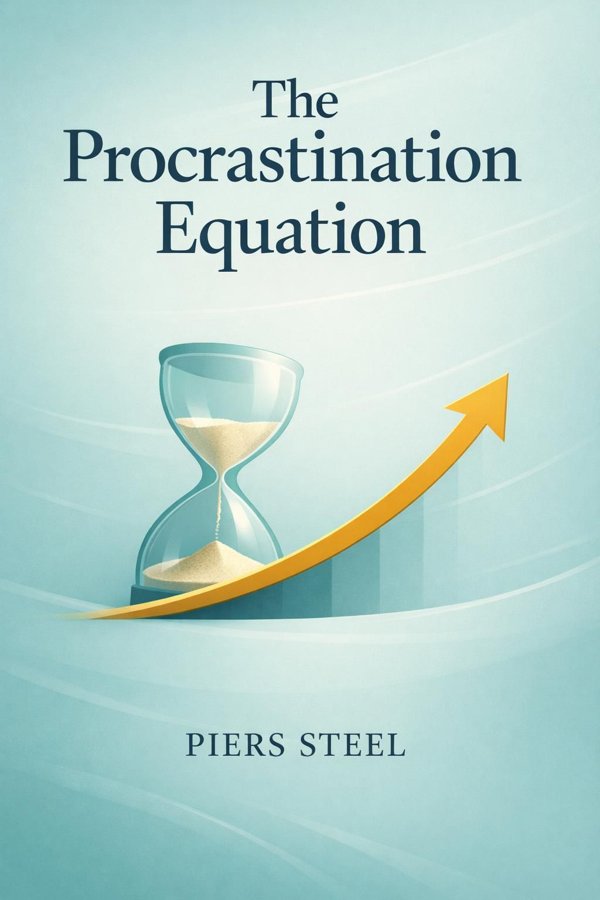
The Procrastination Equation: How to Stop Putting Things Off and Start Getting Stuff Done: Summary & Key Insights
by Piers Steel
 10 min9 chaptersAudio available
Key Takeaways from The Procrastination Equation: How to Stop Putting Things Off and Start Getting Stuff Done
Procrastination feels personal, but one of Steel’s most important insights is that it is also lawful.
People rarely rush into tasks they believe will expose their inadequacy.
We do not merely procrastinate because tasks are difficult; we procrastinate because many tasks feel emotionally flat.
One of the book’s sharpest observations is that procrastination is often not a planning problem but a temptation problem.
A distant deadline can be as dangerous as no deadline at all.
What Is The Procrastination Equation: How to Stop Putting Things Off and Start Getting Stuff Done About?
The Procrastination Equation: How to Stop Putting Things Off and Start Getting Stuff Done by Piers Steel is a productivity book spanning 6 pages. Why do intelligent, ambitious, well-meaning people keep delaying the very things they say matter most? In The Procrastination Equation, psychologist Piers Steel tackles that question with unusual rigor. Rather than treating procrastination as laziness, moral failure, or poor character, he shows that it is a predictable pattern rooted in how motivation works. Drawing from psychology, behavioral economics, neuroscience, and decades of empirical research, Steel presents a clear formula for understanding why we act now, delay action, or never begin at all. At the heart of the book is a powerful idea: motivation rises when we expect success and value the outcome, but falls when we are impulsive and when rewards feel far away. This simple equation explains why deadlines suddenly create urgency, why distractions are so seductive, and why long-term goals often lose to immediate comforts. Steel combines scientific insight with practical strategies for reshaping habits, environments, and expectations. The result is a book that is both intellectually satisfying and deeply useful for students, professionals, creators, and anyone tired of postponing meaningful work.
This FizzRead summary covers all 9 key chapters of The Procrastination Equation: How to Stop Putting Things Off and Start Getting Stuff Done in approximately 10 minutes, distilling the most important ideas, arguments, and takeaways from Piers Steel's work. Also available as an audio summary and Key Quotes Podcast.
The Procrastination Equation: How to Stop Putting Things Off and Start Getting Stuff Done
Why do intelligent, ambitious, well-meaning people keep delaying the very things they say matter most? In The Procrastination Equation, psychologist Piers Steel tackles that question with unusual rigor. Rather than treating procrastination as laziness, moral failure, or poor character, he shows that it is a predictable pattern rooted in how motivation works. Drawing from psychology, behavioral economics, neuroscience, and decades of empirical research, Steel presents a clear formula for understanding why we act now, delay action, or never begin at all.
At the heart of the book is a powerful idea: motivation rises when we expect success and value the outcome, but falls when we are impulsive and when rewards feel far away. This simple equation explains why deadlines suddenly create urgency, why distractions are so seductive, and why long-term goals often lose to immediate comforts. Steel combines scientific insight with practical strategies for reshaping habits, environments, and expectations. The result is a book that is both intellectually satisfying and deeply useful for students, professionals, creators, and anyone tired of postponing meaningful work.
Who Should Read The Procrastination Equation: How to Stop Putting Things Off and Start Getting Stuff Done?
This book is perfect for anyone interested in productivity and looking to gain actionable insights in a short read. Whether you're a student, professional, or lifelong learner, the key ideas from The Procrastination Equation: How to Stop Putting Things Off and Start Getting Stuff Done by Piers Steel will help you think differently.
- ✓Readers who enjoy productivity and want practical takeaways
- ✓Professionals looking to apply new ideas to their work and life
- ✓Anyone who wants the core insights of The Procrastination Equation: How to Stop Putting Things Off and Start Getting Stuff Done in just 10 minutes
Want the full summary?
Get instant access to this book summary and 100K+ more with Fizz Moment.
Get Free SummaryAvailable on App Store • Free to download
Key Chapters
Procrastination feels personal, but one of Steel’s most important insights is that it is also lawful. It follows patterns that can be studied, measured, and predicted. That matters because people often explain delay in moral terms: I’m lazy, undisciplined, or just bad at follow-through. Steel argues instead that procrastination is a breakdown in motivation shaped by identifiable forces. Once you understand those forces, you can stop treating procrastination like a character flaw and start treating it like a solvable problem.
Steel draws on decades of research across psychology and behavioral economics to show that procrastination is not random. People are more likely to delay when they doubt they will succeed, when a task feels boring or unpleasant, when distractions offer immediate pleasure, and when rewards are too far in the future to feel real. These patterns appear across settings: students postponing assignments, employees avoiding reports, and even leaders delaying difficult decisions. In each case, the same motivational dynamics are at work.
This evidence leads to Steel’s famous formula: motivation increases with expectancy and value, and decreases with impulsiveness and delay. The equation does not explain every nuance of human behavior, but it gives a remarkably useful map. A student who procrastinates on studying may struggle because the exam is distant, the subject feels dull, and social media offers instant stimulation. A manager delaying feedback may fear conflict, reducing confidence and increasing avoidance.
The practical power of the equation is diagnostic. Instead of asking, Why am I like this?, ask, Which variable is sabotaging me right now? Is the task too abstract? Do I expect failure? Am I surrounded by temptation? Is the payoff too distant? Actionable takeaway: when you catch yourself procrastinating, identify whether expectancy, value, impulsiveness, or delay is the main culprit, then target that factor directly rather than relying on guilt or willpower alone.
People rarely rush into tasks they believe will expose their inadequacy. Steel shows that expectancy, or your belief that effort will lead to success, is one of the strongest drivers of action. When confidence is low, starting feels risky. Delay becomes a form of emotional self-protection. If you avoid the task, you avoid the possibility of discovering that you are not capable enough, smart enough, or prepared enough.
This is why perfectionists often procrastinate. Their standards are so high that success seems uncertain unless conditions are ideal. It is also why repeated failures can create a cycle of avoidance. Someone who has missed workouts for months may stop trying because they no longer trust themselves to follow through. A writer who has been criticized may postpone writing because the blank page now feels like a test they are likely to fail.
Steel’s remedy is not blind positive thinking but calibrated confidence. Expectancy grows when goals are broken into manageable steps, when progress is visible, and when people accumulate small wins. A student overwhelmed by a research paper may feel incapable of writing twenty pages, but much more confident outlining three arguments or finding five sources. An entrepreneur intimidated by a product launch may gain momentum by first contacting three potential customers.
Social context also matters. Encouragement, accountability, and examples of similar people succeeding can raise expectancy. So can improving skills directly. If you avoid budgeting because numbers make you anxious, a short tutorial may increase both competence and confidence.
The key idea is that action often follows belief, but belief also follows action. Starting small can create evidence that you can do more. Actionable takeaway: reduce the size of the first step until success feels likely, then use each completed step as proof that the larger task is possible.
We do not merely procrastinate because tasks are difficult; we procrastinate because many tasks feel emotionally flat. Steel emphasizes that value is the second major engine of motivation. If an activity is meaningful, enjoyable, rewarding, or connected to identity, we are far more likely to do it. If it feels dull, irritating, or disconnected from what we care about, delay becomes likely even when the task is objectively important.
Value comes from several sources. Some tasks are intrinsically satisfying, like solving a puzzle, helping a client, or building something creative. Others gain value because of external rewards such as money, grades, status, or recognition. Still others matter because they support a larger personal goal, like studying for an exam to qualify for a career you care about. Problems arise when people focus only on the immediate unpleasantness of a task and lose sight of its broader significance.
Consider filing taxes, practicing scales on an instrument, or revising a presentation. None may feel fun in the moment. But the value changes when you connect the activity to freedom from penalties, mastery of a craft, or greater professional influence. Steel suggests that motivation rises when we consciously increase this sense of value. That can mean making tasks more engaging, pairing them with enjoyable conditions, turning them into challenges, or vividly imagining the benefits of completion.
A practical example: if exercise feels boring, value can be raised by choosing a sport you enjoy, tracking performance improvements, or working out with a friend. If a report feels meaningless, connect it to the impact it will have on team decisions or customer outcomes.
People persist when they feel that effort serves something that matters. Actionable takeaway: before starting a resisted task, write down why it matters right now, how completion will help you, and one way to make the process more engaging.
One of the book’s sharpest observations is that procrastination is often not a planning problem but a temptation problem. Steel argues that impulsiveness weakens motivation by making immediate rewards disproportionately attractive. Even when we care about future goals, we are drawn toward whatever offers relief, novelty, or pleasure right now. The result is a familiar substitution: instead of doing the important thing, we do the instantly gratifying thing.
This is why procrastination can feel irrational. You may genuinely want to finish a proposal, train for a race, or study for an exam, yet still drift toward email, snacks, videos, or tidying your desk. The issue is not that you changed your long-term values. It is that your brain is highly sensitive to present rewards. Immediate experiences crowd out distant consequences.
Steel connects this tendency to traits like distractibility, novelty-seeking, and poor impulse control. Some people are especially vulnerable because their environments are saturated with stimulation. A phone buzzing beside a laptop, multiple browser tabs, and social platforms engineered for engagement all intensify impulsiveness. Modern life does not merely allow procrastination; it actively invites it.
The solution is not self-condemnation but friction management. If temptations are close and effortless, you will repeatedly lose battles against them. Reduce access. Silence notifications, block distracting sites, work in a clean environment, and create precommitments. For instance, a freelancer can use an app blocker during writing hours, leave the phone in another room, and publicly commit to sending a draft by noon. Each change lowers the pull of immediate distractions.
Steel’s larger lesson is that discipline becomes easier when temptation becomes harder. Actionable takeaway: identify your top three instant-gratification traps and redesign your environment so that reaching them requires more effort than continuing your important task.
A distant deadline can be as dangerous as no deadline at all. Steel shows that delay powerfully weakens motivation because human beings discount the future. The farther away a reward or consequence lies, the less emotionally vivid it feels in the present. We may intellectually understand that an action matters, yet still fail to act because the benefits are too remote to compete with immediate comfort.
This explains why people suddenly become productive right before deadlines. The task itself has not changed much, but the timing has. As the deadline approaches, the delayed consequence becomes immediate enough to command attention. Anxiety rises, urgency appears, and motivation spikes. The student who ignored an essay for weeks may work intensely the night before submission. The employee who postponed a presentation may finally focus once the meeting is tomorrow.
Relying on this last-minute pressure is costly. It creates stress, lowers quality, and makes life feel reactive. Steel’s answer is to shorten psychological distance. Break large goals into near-term milestones, create intermediate deadlines, and build systems where consequences show up sooner. Instead of saying, I’ll write a book this year, set a target to produce 500 words by 10 a.m. each weekday. Instead of vaguely planning to save for retirement, automate weekly transfers and track monthly progress.
Visual cues can also make the future feel more concrete. Countdowns, public commitments, progress bars, calendars, and reminders all help transform abstract future outcomes into immediate prompts. For students, a planner with mini-deadlines can outperform a single due date. For teams, regular check-ins create productive urgency.
The future only changes behavior when it feels present enough to matter. Actionable takeaway: convert any long-term project into a series of short deadlines with visible progress markers, so you no longer depend on panic to create momentum.
Freedom sounds appealing, but Steel makes clear that too much unstructured freedom often invites procrastination. Many people imagine they delay because they dislike rules or pressure. In reality, they often perform better with external structure. Deadlines, schedules, accountability, and commitment devices help by reducing choice, limiting drift, and making consequences more immediate.
A commitment device is any arrangement that locks in future behavior or raises the cost of avoidance. It can be formal, like paying for a course that meets every Tuesday, or informal, like promising a colleague you will send a draft by 4 p.m. Writers often make public declarations about submission dates. Savers automate transfers so they cannot repeatedly postpone financial discipline. People trying to exercise lay out clothes the night before or pre-book classes they will lose money by missing.
These methods work because they compensate for weak future motivation. If left entirely to your in-the-moment preferences, you may choose relief over effort. But if you create a system that narrows options, the desired behavior becomes easier to execute. Even simple structure matters. Working in designated time blocks, using checklists, and assigning specific locations to specific tasks can transform vague intentions into concrete routines.
Steel does not suggest becoming rigid or mechanical. The point is not to eliminate autonomy, but to use structure intelligently. When motivation is unreliable, systems outperform moods. A freelance designer who waits to feel inspired may miss deadlines. One who starts client work every morning from 9 to 11 with internet blockers on is far more likely to deliver consistently.
Productivity is often less about heroic self-control than smart constraints. Actionable takeaway: choose one commitment device for your most delayed task this week, such as a public deadline, a scheduled work session, or a financial stake for not following through.
Some procrastination is less about distraction than self-defense. Steel highlights how people sometimes delay because delay offers an excuse. If you prepare poorly and perform badly, you can tell yourself the result does not reflect your true ability. In this way, procrastination becomes a shield for self-esteem. It is painful, but psychologically convenient.
This pattern is called self-handicapping. A student who starts studying too late can blame lack of time rather than lack of intelligence. A professional who submits a rushed proposal can say they were swamped instead of confronting whether the work was strong enough. The short-term benefit is emotional protection. The long-term cost is severe: weaker performance, chronic stress, and a life organized around avoiding definitive tests of competence.
Steel’s framework helps explain why this happens. Low expectancy reduces willingness to engage, while delay provides a built-in explanation for any poor outcome. The person preserves hope by postponing the moment of truth. Yet over time, this strategy corrodes confidence further because repeated underperformance becomes real evidence of unreliability.
Breaking this cycle requires separating worth from outcome. Failure on a task should become information, not identity. That shift makes it safer to begin early and perform honestly. Reflection also helps. Ask: am I avoiding this task because I fear the result will say something painful about me? If so, the real work may be emotional, not logistical. Supportive feedback, iterative practice, and low-stakes trials can reduce the threat.
For example, someone terrified of public speaking can start with short team updates rather than waiting for a major presentation. Gradual exposure builds skill without making each attempt feel like a verdict on their value. Actionable takeaway: whenever you delay an important task, ask what judgment you may be trying to avoid, then design a smaller, safer version of the task you can face now.
If motivation rises and falls with expectancy, value, impulsiveness, and delay, then one practical conclusion follows: you cannot rely on motivation alone. Steel points toward habits and routines as a way to bypass constant internal negotiation. Habits reduce the need to decide, debate, and emotionally prepare. When a behavior becomes automatic, procrastination has fewer openings.
This matters because many people treat every important task like a fresh referendum. Should I work out today? Should I start writing now? Should I review my budget tonight? Each decision creates space for avoidance. Habits shrink that space. If you always write from 8 to 8:30 a.m., study after lunch, or process email only at set times, the question changes from Do I feel like it? to This is simply what happens now.
Habit formation works best when cues are clear and the behavior is small enough to repeat consistently. Steel’s broader framework suggests choosing routines that reduce delay and impulsiveness while supporting expectancy. For instance, beginning with ten minutes of focused work each morning creates a low-friction entry point. Over time, the start itself becomes easier because the behavior is familiar.
Environment and identity strengthen habits further. A visible notebook on a cleared desk cues writing. Running shoes by the door cue exercise. Telling yourself I am the kind of person who starts before I feel ready can reinforce consistency. Habits need not be dramatic to matter. Tiny repeated actions often outperform ambitious but erratic bursts.
The goal is not to eliminate motivation but to make progress possible even when motivation is weak. Actionable takeaway: convert one frequently postponed activity into a fixed routine by choosing a specific cue, time, and tiny starting version that you can repeat daily for at least two weeks.
Understanding procrastination is valuable, but Steel’s deepest contribution is showing how insight becomes behavior change. The equation is not just an explanation of why people delay; it is a practical model for intervention. Once you know the four levers of motivation, you can design a personal system that makes action more likely across many areas of life.
Start by diagnosing your weak points. If you lack confidence, raise expectancy with smaller goals, better preparation, and visible wins. If a task feels pointless or miserable, raise value by connecting it to identity, meaning, rewards, or enjoyment. If distractions are defeating you, reduce impulsiveness through environmental controls and precommitment. If goals are too distant, reduce delay with milestones, deadlines, and immediate feedback. Most real-world problems involve more than one lever at once.
Imagine someone trying to complete a professional certification. They may doubt they can pass, making expectancy low. The exam date may be months away, increasing delay. Streaming platforms and messaging apps may intensify impulsiveness. And the material may feel dry, lowering value. Using Steel’s framework, they could join a study group, break the syllabus into weekly units, block distractions during study sessions, and connect the certification to promotion and career freedom. Suddenly the task becomes structurally easier to do.
What makes this approach powerful is that it respects human nature. It does not demand endless grit. It assumes we are influenced by time, temptation, emotion, and belief, then teaches us how to work with those tendencies rather than deny them. Progress becomes more sustainable because it is engineered, not wished for.
Actionable takeaway: choose one important goal and create a four-part plan that boosts expectancy, increases value, lowers impulsiveness, and shortens delay before you rely on more willpower.
All Chapters in The Procrastination Equation: How to Stop Putting Things Off and Start Getting Stuff Done
About the Author
Piers Steel, Ph.D., is a Canadian psychologist, researcher, and professor best known for his work on motivation and procrastination. He has been affiliated with the University of Calgary and has published widely in the fields of organizational behavior and psychology. Steel gained broad recognition for bringing together decades of research on self-control, goal pursuit, and delay into a clear model that explains why people procrastinate. His work stands out for blending scientific rigor with practical relevance, making complex behavioral research accessible to everyday readers. Through his writing and academic contributions, Steel has helped reframe procrastination as a measurable motivational problem rather than a simple lack of character, giving readers a more compassionate and effective way to understand and change their behavior.
Get This Summary in Your Preferred Format
Read or listen to the The Procrastination Equation: How to Stop Putting Things Off and Start Getting Stuff Done summary by Piers Steel anytime, anywhere. FizzRead offers multiple formats so you can learn on your terms — all free.
Available formats: App · Audio · PDF · EPUB — All included free with FizzRead
Download The Procrastination Equation: How to Stop Putting Things Off and Start Getting Stuff Done PDF and EPUB Summary
Key Quotes from The Procrastination Equation: How to Stop Putting Things Off and Start Getting Stuff Done
“Procrastination feels personal, but one of Steel’s most important insights is that it is also lawful.”
“People rarely rush into tasks they believe will expose their inadequacy.”
“We do not merely procrastinate because tasks are difficult; we procrastinate because many tasks feel emotionally flat.”
“One of the book’s sharpest observations is that procrastination is often not a planning problem but a temptation problem.”
“A distant deadline can be as dangerous as no deadline at all.”
Frequently Asked Questions about The Procrastination Equation: How to Stop Putting Things Off and Start Getting Stuff Done
The Procrastination Equation: How to Stop Putting Things Off and Start Getting Stuff Done by Piers Steel is a productivity book that explores key ideas across 9 chapters. Why do intelligent, ambitious, well-meaning people keep delaying the very things they say matter most? In The Procrastination Equation, psychologist Piers Steel tackles that question with unusual rigor. Rather than treating procrastination as laziness, moral failure, or poor character, he shows that it is a predictable pattern rooted in how motivation works. Drawing from psychology, behavioral economics, neuroscience, and decades of empirical research, Steel presents a clear formula for understanding why we act now, delay action, or never begin at all. At the heart of the book is a powerful idea: motivation rises when we expect success and value the outcome, but falls when we are impulsive and when rewards feel far away. This simple equation explains why deadlines suddenly create urgency, why distractions are so seductive, and why long-term goals often lose to immediate comforts. Steel combines scientific insight with practical strategies for reshaping habits, environments, and expectations. The result is a book that is both intellectually satisfying and deeply useful for students, professionals, creators, and anyone tired of postponing meaningful work.
You Might Also Like


Browse by Category
Ready to read The Procrastination Equation: How to Stop Putting Things Off and Start Getting Stuff Done?
Get the full summary and 100K+ more books with Fizz Moment.