
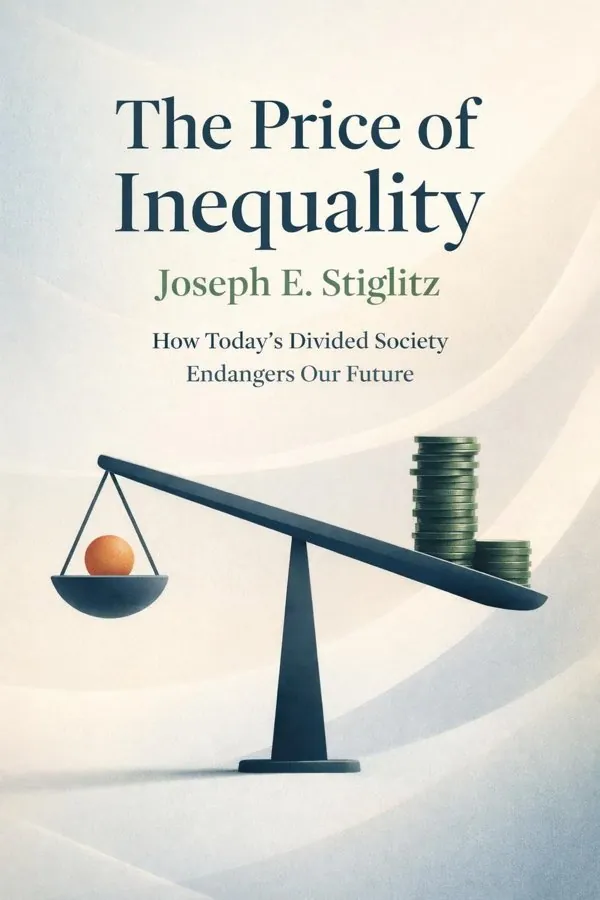
The Price of Inequality: How Today's Divided Society Endangers Our Future: Summary & Key Insights
 10 min8 chaptersAudio available
What Is The Price of Inequality: How Today's Divided Society Endangers Our Future About?
The Price of Inequality: How Today's Divided Society Endangers Our Future by Joseph E. Stiglitz is a economics book spanning 8 pages. In this influential work, Nobel Prize–winning economist Joseph E. Stiglitz examines how growing economic inequality undermines democracy, distorts markets, and threatens the stability of societies. He argues that inequality is not an inevitable result of economic forces but a consequence of political choices that favor the wealthy. Stiglitz calls for reforms to restore fairness, opportunity, and shared prosperity.
This FizzRead summary covers all 8 key chapters of The Price of Inequality: How Today's Divided Society Endangers Our Future in approximately 10 minutes, distilling the most important ideas, arguments, and takeaways from Joseph E. Stiglitz's work. Also available as an audio summary and Key Quotes Podcast.
The Price of Inequality: How Today's Divided Society Endangers Our Future
In this influential work, Nobel Prize–winning economist Joseph E. Stiglitz examines how growing economic inequality undermines democracy, distorts markets, and threatens the stability of societies. He argues that inequality is not an inevitable result of economic forces but a consequence of political choices that favor the wealthy. Stiglitz calls for reforms to restore fairness, opportunity, and shared prosperity.
Who Should Read The Price of Inequality: How Today's Divided Society Endangers Our Future?
This book is perfect for anyone interested in economics and looking to gain actionable insights in a short read. Whether you're a student, professional, or lifelong learner, the key ideas from The Price of Inequality: How Today's Divided Society Endangers Our Future by Joseph E. Stiglitz will help you think differently.
- ✓Readers who enjoy economics and want practical takeaways
- ✓Professionals looking to apply new ideas to their work and life
- ✓Anyone who wants the core insights of The Price of Inequality: How Today's Divided Society Endangers Our Future in just 10 minutes
Want the full summary?
Get instant access to this book summary and 100K+ more with Fizz Moment.
Get Free SummaryAvailable on App Store • Free to download
Key Chapters
The story of inequality in America today begins with a simple yet striking statistic: one percent of the population controls more than a fifth of the nation’s income and more than a third of its wealth. This is not an abstract figure. It shapes the way our society functions, how our democracy operates, and how opportunity is distributed. The concentration of wealth has created a feedback loop, amplifying the power of the top one percent to influence political decisions that further entrench their position.
The 1 percent are not necessarily the innovators or job creators they are often portrayed to be. Many derive their wealth from financial speculation, rent extraction, and market manipulation rather than productive enterprise. Meanwhile, the wages of ordinary workers have stagnated or declined, despite rising productivity. The 99 percent, including the once-secure middle class, face shrinking opportunities and growing insecurity.
This deep divide is not only economically unjust but also socially corrosive. When wealth translates into political influence, the principle of equality—upon which democracy is built—erodes. The top one percent can shape tax laws, labor laws, and regulatory environments to their advantage. The result is a political economy that systematically favors capital over labor, speculation over production, and privilege over effort.
But I emphasize that this is not inevitable. It reflects choices: choices to deregulate Wall Street, cut taxes for the wealthy, underfund education and infrastructure, and limit the bargaining power of workers. We can reverse these choices with different policies and priorities. The question is not whether we can afford fairness—it’s whether we can afford to continue down this path of division and dysfunction.
In economic theory, markets allocate resources efficiently when they are competitive and transparent. But the reality of modern capitalism is far removed from that ideal. In the United States, many of the most profitable sectors—finance, pharmaceuticals, telecommunications—do not make their money by creating new wealth but by extracting value through rent seeking. Rent seeking occurs when firms or individuals increase their wealth not by contributing to productivity, but by manipulating rules, regulations, or market structures in their favor.
Consider the financial industry’s pivotal role in the 2008 crisis. It thrived on complex instruments that offered private profits but imposed public risks. When the bubble burst, taxpayers footed the bill. This was not a failure of the market but the logical outcome of a market that had been rigged through deregulation and political influence. Similarly, pharmaceutical companies use patents not only to reward innovation but to block competition and keep prices artificially high.
These distortions do more than redistribute income upward—they erode trust in the economic system itself. When people see that wealth comes from lobbying rather than ingenuity, from political leverage rather than hard work, the legitimacy of capitalism is called into question. A well-functioning economy depends on fair competition; rent seeking replaces competition with exploitation.
Ending rent seeking means rewriting the rules of the game. That requires strong antitrust enforcement, financial regulation that discourages speculation, and political reforms that curb the influence of money over policy. Markets, left alone, don’t self-correct toward fairness. They reflect the values of the rules we establish. If those rules reward manipulation, inequality will grow. If they reward contribution, society prospers.
+ 6 more chapters — available in the FizzRead app
All Chapters in The Price of Inequality: How Today's Divided Society Endangers Our Future
About the Author
Joseph E. Stiglitz is an American economist and professor at Columbia University. He received the Nobel Memorial Prize in Economic Sciences in 2001 for his analyses of markets with asymmetric information. Stiglitz has served as Chief Economist of the World Bank and Chairman of the U.S. President’s Council of Economic Advisers. He is known for his critical views on globalization and market fundamentalism.
Get This Summary in Your Preferred Format
Read or listen to the The Price of Inequality: How Today's Divided Society Endangers Our Future summary by Joseph E. Stiglitz anytime, anywhere. FizzRead offers multiple formats so you can learn on your terms — all free.
Available formats: App · Audio · PDF · EPUB — All included free with FizzRead
Download The Price of Inequality: How Today's Divided Society Endangers Our Future PDF and EPUB Summary
Key Quotes from The Price of Inequality: How Today's Divided Society Endangers Our Future
“In economic theory, markets allocate resources efficiently when they are competitive and transparent.”
Frequently Asked Questions about The Price of Inequality: How Today's Divided Society Endangers Our Future
The Price of Inequality: How Today's Divided Society Endangers Our Future by Joseph E. Stiglitz is a economics book that explores key ideas across 8 chapters. In this influential work, Nobel Prize–winning economist Joseph E. Stiglitz examines how growing economic inequality undermines democracy, distorts markets, and threatens the stability of societies. He argues that inequality is not an inevitable result of economic forces but a consequence of political choices that favor the wealthy. Stiglitz calls for reforms to restore fairness, opportunity, and shared prosperity.
More by Joseph E. Stiglitz
You Might Also Like
Business Adventures
John Brooks
10 min
Nudge
Richard H. Thaler, Cass R. Sunstein
10 min
The Hitchhiker"s Guide to the Galaxy
Douglas Adams
10 minThe Muqaddimah
Ibn Khaldun
10 minThe Outsiders
William N. Thorndike
10 min
A Little History of Economics
Niall Kishtainy
10 minBrowse by Category
Ready to read The Price of Inequality: How Today's Divided Society Endangers Our Future?
Get the full summary and 100K+ more books with Fizz Moment.