
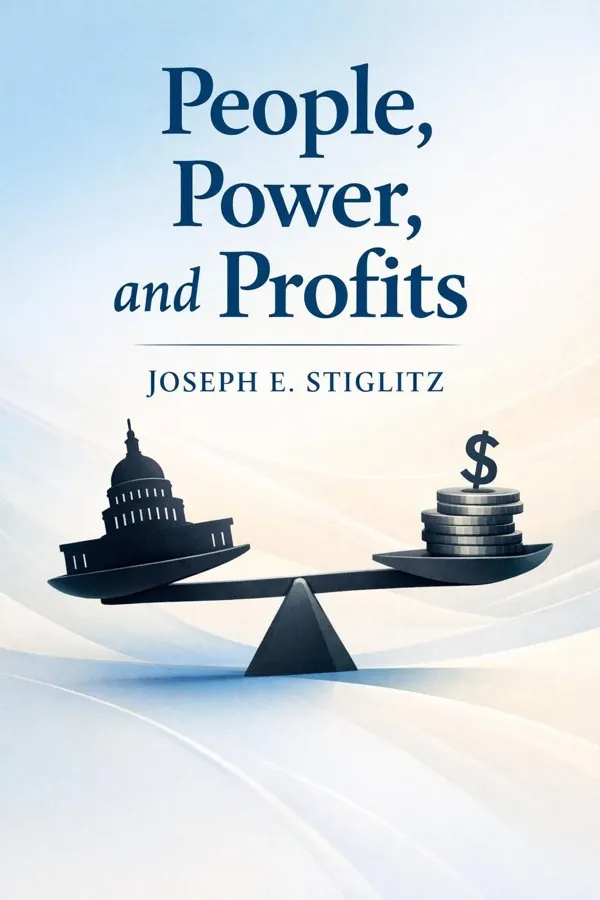
People, Power, and Profits: Progressive Capitalism for an Age of Discontent: Summary & Key Insights
 10 min7 chaptersAudio available
What Is People, Power, and Profits: Progressive Capitalism for an Age of Discontent About?
People, Power, and Profits: Progressive Capitalism for an Age of Discontent by Joseph E. Stiglitz is a economics book spanning 7 pages. In this book, Nobel Prize–winning economist Joseph E. Stiglitz argues that the United States has strayed from the principles that once made its economy strong and fair. He examines how unchecked corporate power, inequality, and political corruption have undermined democracy and prosperity. Stiglitz proposes a new form of 'progressive capitalism' that restores balance between markets, government, and civil society, emphasizing policies that promote innovation, equality, and shared growth.
This FizzRead summary covers all 7 key chapters of People, Power, and Profits: Progressive Capitalism for an Age of Discontent in approximately 10 minutes, distilling the most important ideas, arguments, and takeaways from Joseph E. Stiglitz's work. Also available as an audio summary and Key Quotes Podcast.
People, Power, and Profits: Progressive Capitalism for an Age of Discontent
In this book, Nobel Prize–winning economist Joseph E. Stiglitz argues that the United States has strayed from the principles that once made its economy strong and fair. He examines how unchecked corporate power, inequality, and political corruption have undermined democracy and prosperity. Stiglitz proposes a new form of 'progressive capitalism' that restores balance between markets, government, and civil society, emphasizing policies that promote innovation, equality, and shared growth.
Who Should Read People, Power, and Profits: Progressive Capitalism for an Age of Discontent?
This book is perfect for anyone interested in economics and looking to gain actionable insights in a short read. Whether you're a student, professional, or lifelong learner, the key ideas from People, Power, and Profits: Progressive Capitalism for an Age of Discontent by Joseph E. Stiglitz will help you think differently.
- ✓Readers who enjoy economics and want practical takeaways
- ✓Professionals looking to apply new ideas to their work and life
- ✓Anyone who wants the core insights of People, Power, and Profits: Progressive Capitalism for an Age of Discontent in just 10 minutes
Want the full summary?
Get instant access to this book summary and 100K+ more with Fizz Moment.
Get Free SummaryAvailable on App Store • Free to download
Key Chapters
To understand where we are, we must recall where we’ve been. After World War II, the United States built an economy rooted in shared prosperity, with policies that fostered education, homeownership, innovation, and a burgeoning middle class. Progressive taxation funded public infrastructure and research, labor unions safeguarded wages, and corporations understood that their health depended on thriving consumers. Growth was strong, and inequality narrowed.
This symbiotic balance—between markets disciplined by government and social systems that spread opportunity—was not accidental. It grew from lessons learned during the Great Depression: that unregulated markets can devastate nations, and that collective investment yields resilience. This period, roughly from the 1940s through the 1970s, was not perfect, but it represented a pragmatic equilibrium between efficiency and fairness.
Yet from the late 1970s onward, a counter-revolution took hold. Armed with the rhetoric of freedom and market purity, neoliberal ideologues began dismantling the very guardrails that made mid-century capitalism successful. The result, as I demonstrate, has been an economy driven less by production than by rent extraction—profits gained not through creating value but through manipulating systems. The trajectory from shared prosperity to concentrated wealth did not happen by chance; it was engineered through policy choices that favored the few over the many.
When inequality becomes extreme, it corrodes everything it touches—the economy, democracy, social trust, even individual aspiration. The data are unequivocal: over the past four decades, while GDP has risen, the vast majority of Americans have seen little improvement in living standards. Productivity gains accrue to executives and shareholders, while wages stagnate.
This is not the invisible hand at work; it’s the visible hand of deregulation, corporate lobbying, and tax policy crafted to benefit the wealthy. Supply-side economics promised that tax cuts for the rich would 'trickle down.' They did not. Instead, they fueled speculation, asset bubbles, and deficits. Meanwhile, labor protections weakened, unions lost influence, and public education and healthcare—once seen as basic rights—became viewed as personal burdens.
The erosion of equality is also moral. When markets reward exploitation over contribution, cynicism thrives. My goal in writing about these dynamics is not to lament inequality, but to expose its manufactured nature—and to remind us that just as policy created these outcomes, policy can reverse them. Progressive taxation, stronger unions, and public investment are not relics of a bygone era but instruments of renewal.
+ 5 more chapters — available in the FizzRead app
All Chapters in People, Power, and Profits: Progressive Capitalism for an Age of Discontent
About the Author
Joseph E. Stiglitz is an American economist and professor at Columbia University. He was awarded the Nobel Memorial Prize in Economic Sciences in 2001 for his analyses of markets with asymmetric information. Stiglitz has served as Chief Economist of the World Bank and Chairman of the U.S. Council of Economic Advisers. He is known for his critical views on globalization, free-market fundamentalism, and economic inequality.
Get This Summary in Your Preferred Format
Read or listen to the People, Power, and Profits: Progressive Capitalism for an Age of Discontent summary by Joseph E. Stiglitz anytime, anywhere. FizzRead offers multiple formats so you can learn on your terms — all free.
Available formats: App · Audio · PDF · EPUB — All included free with FizzRead
Download People, Power, and Profits: Progressive Capitalism for an Age of Discontent PDF and EPUB Summary
Key Quotes from People, Power, and Profits: Progressive Capitalism for an Age of Discontent
“To understand where we are, we must recall where we’ve been.”
“When inequality becomes extreme, it corrodes everything it touches—the economy, democracy, social trust, even individual aspiration.”
Frequently Asked Questions about People, Power, and Profits: Progressive Capitalism for an Age of Discontent
People, Power, and Profits: Progressive Capitalism for an Age of Discontent by Joseph E. Stiglitz is a economics book that explores key ideas across 7 chapters. In this book, Nobel Prize–winning economist Joseph E. Stiglitz argues that the United States has strayed from the principles that once made its economy strong and fair. He examines how unchecked corporate power, inequality, and political corruption have undermined democracy and prosperity. Stiglitz proposes a new form of 'progressive capitalism' that restores balance between markets, government, and civil society, emphasizing policies that promote innovation, equality, and shared growth.
More by Joseph E. Stiglitz
You Might Also Like
Business Adventures
John Brooks
10 min
Nudge
Richard H. Thaler, Cass R. Sunstein
10 min
The Hitchhiker"s Guide to the Galaxy
Douglas Adams
10 minThe Muqaddimah
Ibn Khaldun
10 minThe Outsiders
William N. Thorndike
10 min
A Little History of Economics
Niall Kishtainy
10 minBrowse by Category
Ready to read People, Power, and Profits: Progressive Capitalism for an Age of Discontent?
Get the full summary and 100K+ more books with Fizz Moment.