
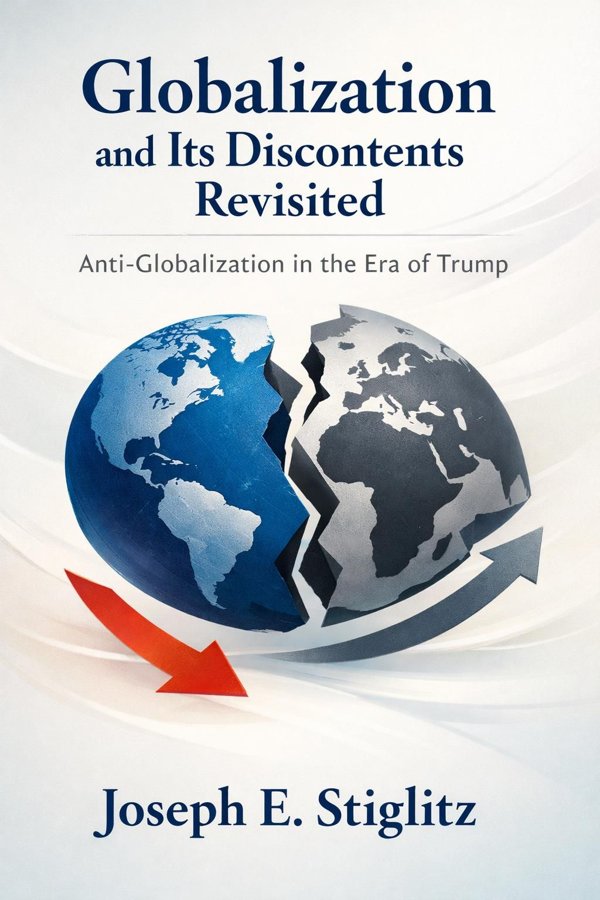
Globalization and Its Discontents Revisited: Anti-Globalization in the Era of Trump: Summary & Key Insights
 10 min11 chaptersAudio available
What Is Globalization and Its Discontents Revisited: Anti-Globalization in the Era of Trump About?
Globalization and Its Discontents Revisited: Anti-Globalization in the Era of Trump by Joseph E. Stiglitz is a economics book spanning 11 pages. In this expanded and updated edition of his influential 2002 work, Nobel laureate Joseph E. Stiglitz revisits the promises and failures of globalization. He examines how global economic policies, particularly those driven by international institutions like the IMF and World Bank, have affected developing nations and contributed to inequality. The new edition addresses the rise of populism, the backlash against globalization, and the economic policies of the Trump era, offering insights into how globalization can be reformed to serve broader social and economic justice.
This FizzRead summary covers all 11 key chapters of Globalization and Its Discontents Revisited: Anti-Globalization in the Era of Trump in approximately 10 minutes, distilling the most important ideas, arguments, and takeaways from Joseph E. Stiglitz's work. Also available as an audio summary and Key Quotes Podcast.
Globalization and Its Discontents Revisited: Anti-Globalization in the Era of Trump
In this expanded and updated edition of his influential 2002 work, Nobel laureate Joseph E. Stiglitz revisits the promises and failures of globalization. He examines how global economic policies, particularly those driven by international institutions like the IMF and World Bank, have affected developing nations and contributed to inequality. The new edition addresses the rise of populism, the backlash against globalization, and the economic policies of the Trump era, offering insights into how globalization can be reformed to serve broader social and economic justice.
Who Should Read Globalization and Its Discontents Revisited: Anti-Globalization in the Era of Trump?
This book is perfect for anyone interested in economics and looking to gain actionable insights in a short read. Whether you're a student, professional, or lifelong learner, the key ideas from Globalization and Its Discontents Revisited: Anti-Globalization in the Era of Trump by Joseph E. Stiglitz will help you think differently.
- ✓Readers who enjoy economics and want practical takeaways
- ✓Professionals looking to apply new ideas to their work and life
- ✓Anyone who wants the core insights of Globalization and Its Discontents Revisited: Anti-Globalization in the Era of Trump in just 10 minutes
Want the full summary?
Get instant access to this book summary and 100K+ more with Fizz Moment.
Get Free SummaryAvailable on App Store • Free to download
Key Chapters
Globalization was sold to the world as a vehicle for universal progress. The idea was that free trade and liberalized capital flows would allow every country to specialize, grow, and share in global prosperity. The institutional architecture—the IMF, the World Bank, the WTO—was designed to ensure this process unfolded smoothly. Yet the lived outcomes were far less equitable.
From my vantage point as Chief Economist of the World Bank, I witnessed firsthand how policy prescriptions—privatization, deregulation, rapid trade liberalization—were imposed on countries ill-equipped to absorb their shocks. These measures were justified under the doctrine that markets always self-correct. But what I saw in places like East Asia and sub-Saharan Africa contradicted this belief: communities driven into poverty, domestic industries dismantled, and governments stripped of policy autonomy. Globalization’s promise of efficiency became a pretext for a redistribution of power—from public institutions to private capital.
Even as global output rose, inequality deepened both within and between nations. Economic models underestimated the social costs of adjustment, assuming that displaced workers would simply move where opportunities arose. They rarely did. When economies opened too quickly, without safeguards or robust institutions, the vulnerable paid the price while transnational corporations harvested profits. What had been framed as ‘economic modernization’ often meant the erosion of local control and the weakening of democratic voices.
In revisiting those years, I recognize how the conversation about globalization remains polarized. Advocates insist the failures stem from insufficient globalization, not its excesses. But evidence shows otherwise: it was the asymmetry—the imbalance of rules favoring the rich countries and the financial sector—that produced disillusionment. The dream turned hollow not because people rejected openness, but because openness was managed for the few. The failure of globalization, then, is not in the idea itself but in its execution—a pattern that continues today.
The IMF, World Bank, and WTO were conceived to manage interdependence in a post-war world. Their mandate was noble: maintain financial stability, foster reconstruction, and promote equitable trade. Yet over the decades, these institutions became enforcers of an economic orthodoxy known as neoliberalism. Instead of protecting nations during crises, they often worsened them by imposing rigid programs in exchange for assistance.
The infamous ‘conditionality’ attached to IMF loans forced developing countries to cut public spending, raise interest rates, and open markets—even in times of recession. These austerity programs deepened unemployment and curtailed growth. The World Bank, while pursuing development, frequently pushed privatization schemes without adequate oversight, leading to corruption and unequal access to essential services. The WTO claimed to be the guardian of fair trade, but its rules privileged the intellectual property regimes and agricultural subsidies of wealthy nations.
I often emphasize that these outcomes are not accidental—they stem from governance gaps. Decision-making power remains concentrated among richer countries, limiting the voice of the Global South. When crises strike, it is the borrowers, not the lenders, who bear the pain. The institutions embody a paradox: while they preach global cooperation, they often implement policies that undermine it.
Reform must start with accountability. Global governance cannot function effectively when those most affected have no seat at the table. A democratized IMF and World Bank, alongside fairer trade frameworks, could realign globalization with development rather than domination. Until then, these institutions will remain symbols of imbalance—guardians of a system more responsive to financial capital than to human needs.
+ 9 more chapters — available in the FizzRead app
All Chapters in Globalization and Its Discontents Revisited: Anti-Globalization in the Era of Trump
About the Author
Joseph E. Stiglitz is an American economist and professor at Columbia University. He was awarded the Nobel Memorial Prize in Economic Sciences in 2001 for his analyses of markets with asymmetric information. Stiglitz has served as Chief Economist of the World Bank and Chairman of the U.S. President’s Council of Economic Advisers. He is known for his critical views on unregulated globalization and neoliberal economic policies.
Get This Summary in Your Preferred Format
Read or listen to the Globalization and Its Discontents Revisited: Anti-Globalization in the Era of Trump summary by Joseph E. Stiglitz anytime, anywhere. FizzRead offers multiple formats so you can learn on your terms — all free.
Available formats: App · Audio · PDF · EPUB — All included free with FizzRead
Download Globalization and Its Discontents Revisited: Anti-Globalization in the Era of Trump PDF and EPUB Summary
Key Quotes from Globalization and Its Discontents Revisited: Anti-Globalization in the Era of Trump
“Globalization was sold to the world as a vehicle for universal progress.”
“The IMF, World Bank, and WTO were conceived to manage interdependence in a post-war world.”
Frequently Asked Questions about Globalization and Its Discontents Revisited: Anti-Globalization in the Era of Trump
Globalization and Its Discontents Revisited: Anti-Globalization in the Era of Trump by Joseph E. Stiglitz is a economics book that explores key ideas across 11 chapters. In this expanded and updated edition of his influential 2002 work, Nobel laureate Joseph E. Stiglitz revisits the promises and failures of globalization. He examines how global economic policies, particularly those driven by international institutions like the IMF and World Bank, have affected developing nations and contributed to inequality. The new edition addresses the rise of populism, the backlash against globalization, and the economic policies of the Trump era, offering insights into how globalization can be reformed to serve broader social and economic justice.
More by Joseph E. Stiglitz
You Might Also Like

Business Adventures
John Brooks
10 min
Nudge
Richard H. Thaler, Cass R. Sunstein
10 min
The Hitchhiker"s Guide to the Galaxy
Douglas Adams
10 minThe Muqaddimah
Ibn Khaldun
10 minThe Outsiders
William N. Thorndike
10 min
A Little History of Economics
Niall Kishtainy
10 minBrowse by Category
Ready to read Globalization and Its Discontents Revisited: Anti-Globalization in the Era of Trump?
Get the full summary and 100K+ more books with Fizz Moment.