
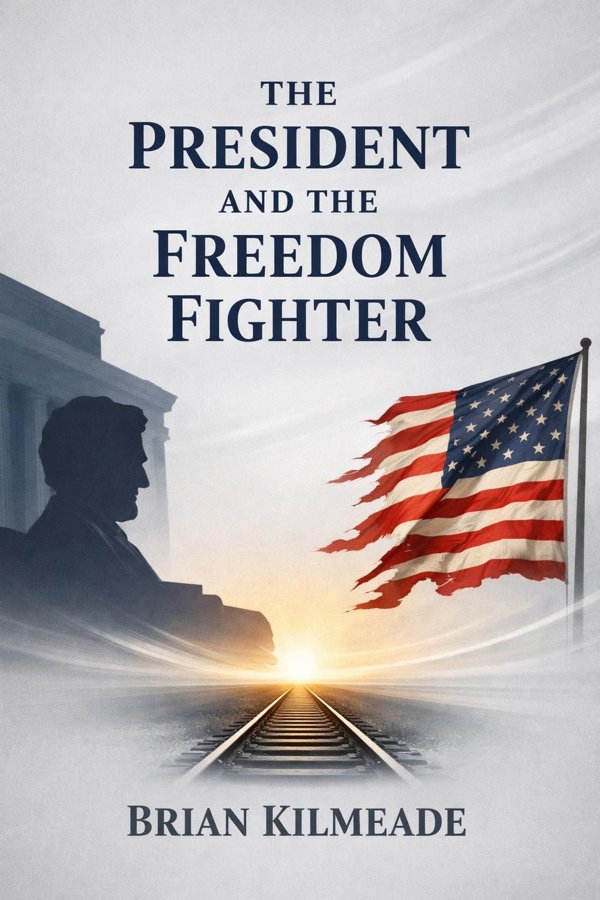
The President and the Freedom Fighter: Abraham Lincoln, Frederick Douglass, and Their Battle to Save America's Soul: Summary & Key Insights
 10 min10 chaptersAudio available
What Is The President and the Freedom Fighter: Abraham Lincoln, Frederick Douglass, and Their Battle to Save America's Soul About?
The President and the Freedom Fighter: Abraham Lincoln, Frederick Douglass, and Their Battle to Save America's Soul by Brian Kilmeade is a world_history book spanning 10 pages. This historical narrative explores the intertwined lives of Abraham Lincoln and Frederick Douglass, two men who rose from humble beginnings to shape the moral and political destiny of the United States. Kilmeade recounts how their paths converged during the Civil War, highlighting their shared commitment to liberty and equality despite differing approaches and experiences. The book portrays their evolving relationship as a symbol of America’s struggle to fulfill its founding ideals.
This FizzRead summary covers all 10 key chapters of The President and the Freedom Fighter: Abraham Lincoln, Frederick Douglass, and Their Battle to Save America's Soul in approximately 10 minutes, distilling the most important ideas, arguments, and takeaways from Brian Kilmeade's work. Also available as an audio summary and Key Quotes Podcast.
The President and the Freedom Fighter: Abraham Lincoln, Frederick Douglass, and Their Battle to Save America's Soul
This historical narrative explores the intertwined lives of Abraham Lincoln and Frederick Douglass, two men who rose from humble beginnings to shape the moral and political destiny of the United States. Kilmeade recounts how their paths converged during the Civil War, highlighting their shared commitment to liberty and equality despite differing approaches and experiences. The book portrays their evolving relationship as a symbol of America’s struggle to fulfill its founding ideals.
Who Should Read The President and the Freedom Fighter: Abraham Lincoln, Frederick Douglass, and Their Battle to Save America's Soul?
This book is perfect for anyone interested in world_history and looking to gain actionable insights in a short read. Whether you're a student, professional, or lifelong learner, the key ideas from The President and the Freedom Fighter: Abraham Lincoln, Frederick Douglass, and Their Battle to Save America's Soul by Brian Kilmeade will help you think differently.
- ✓Readers who enjoy world_history and want practical takeaways
- ✓Professionals looking to apply new ideas to their work and life
- ✓Anyone who wants the core insights of The President and the Freedom Fighter: Abraham Lincoln, Frederick Douglass, and Their Battle to Save America's Soul in just 10 minutes
Want the full summary?
Get instant access to this book summary and 100K+ more with Fizz Moment.
Get Free SummaryAvailable on App Store • Free to download
Key Chapters
Abraham Lincoln was born in 1809 in a log cabin on the Kentucky frontier—a world of hard soil, scant schooling, and endless labor. His father Thomas, a restless man of modest means, moved the family repeatedly, searching for better prospects. His mother, Nancy Hanks, gave him tenderness and moral grounding before her death when Abe was only nine. Those early losses and rough conditions molded the self-reliant, introspective boy who would one day shoulder a divided nation.
Lincoln’s education was mostly self-taught, his books few but essential: Shakespeare, the Bible, and a well-thumbed volume of law. Every word he absorbed mattered because he learned to see thought as power—the only tool that could overcome poverty and isolation. On the frontier, he developed a deep empathy for those who struggled and a fierce belief in upward mobility. He split rails, labored, and debated neighbors, mastering the art of persuasion long before entering politics.
As he matured, Lincoln’s political aspirations arose not from ambition alone but from conviction—an understanding that America’s promise must include all who toil honestly for a better life. His youthful speeches revealed a man who revered reason and legality but also felt the moral weight of inequality. The scaffold of his later leadership—the emphasis on union, law, and opportunity—was erected in those youthful years of hardship and self-education.
His early experiences among ordinary citizens taught him that democracy could not survive without fairness, that liberty must be grounded in empathy. That foundational belief in human dignity, though still bounded by the prejudices of his time, became the moral compass guiding his long climb from rural obscurity to the presidency.
Frederick Douglass’s journey began in chains. Born in 1818 on Maryland’s Eastern Shore, he never knew his father and was separated from his mother as a child. Slavery sought to erase identity, but Douglass’s hunger for knowledge became his first act of rebellion. Against the prohibitions of law and lash, he learned to read—secretly taught by his mistress in Baltimore until her conscience hardened under societal pressure. Yet what little she gave sparked an inferno that burned for freedom.
Books became Douglass’s liberation, turning his mind into a battleground for human dignity. He read newspapers and speeches, discovering in words the power to challenge tyranny. Literacy gave him the language of resistance; reading made him unfit for servitude. He realized that oppression depended not only on chains but on ignorance.
When Douglass escaped slavery at twenty, disguising himself as a sailor, he entered the world as his own creation. Every mile toward the North was a step toward identity reclaimed. In New York and later in Massachusetts, he found allies in abolitionist circles, most notably William Lloyd Garrison. But Douglass’s eloquence soon distinguished him from even his mentors. His speeches mesmerized crowds; his very presence—an articulate, dignified Black man—turned racism on its head.
His first autobiography exposed the brutality of slavery and forced America to confront the hypocrisy embedded in its founding documents. Through his pen, Douglass made abolition not just a political cause but a moral imperative. He turned his personal suffering into universal conviction, insisting that true freedom must include equality, not merely emancipation.
+ 8 more chapters — available in the FizzRead app
All Chapters in The President and the Freedom Fighter: Abraham Lincoln, Frederick Douglass, and Their Battle to Save America's Soul
About the Author
Brian Kilmeade is an American television and radio presenter, best known as a co-host of Fox & Friends. He is also a bestselling author of historical works that focus on pivotal figures and moments in American history, including 'George Washington’s Secret Six' and 'Thomas Jefferson and the Tripoli Pirates'.
Get This Summary in Your Preferred Format
Read or listen to the The President and the Freedom Fighter: Abraham Lincoln, Frederick Douglass, and Their Battle to Save America's Soul summary by Brian Kilmeade anytime, anywhere. FizzRead offers multiple formats so you can learn on your terms — all free.
Available formats: App · Audio · PDF · EPUB — All included free with FizzRead
Download The President and the Freedom Fighter: Abraham Lincoln, Frederick Douglass, and Their Battle to Save America's Soul PDF and EPUB Summary
Key Quotes from The President and the Freedom Fighter: Abraham Lincoln, Frederick Douglass, and Their Battle to Save America's Soul
“Abraham Lincoln was born in 1809 in a log cabin on the Kentucky frontier—a world of hard soil, scant schooling, and endless labor.”
“Frederick Douglass’s journey began in chains.”
Frequently Asked Questions about The President and the Freedom Fighter: Abraham Lincoln, Frederick Douglass, and Their Battle to Save America's Soul
The President and the Freedom Fighter: Abraham Lincoln, Frederick Douglass, and Their Battle to Save America's Soul by Brian Kilmeade is a world_history book that explores key ideas across 10 chapters. This historical narrative explores the intertwined lives of Abraham Lincoln and Frederick Douglass, two men who rose from humble beginnings to shape the moral and political destiny of the United States. Kilmeade recounts how their paths converged during the Civil War, highlighting their shared commitment to liberty and equality despite differing approaches and experiences. The book portrays their evolving relationship as a symbol of America’s struggle to fulfill its founding ideals.
More by Brian Kilmeade
You Might Also Like
The Age of Capital
Eric Hobsbawm
10 min
The Gulag Archipelago
Aleksandr Solzhenitsyn
10 min
Jerusalem: The Biography
Simon Sebag Montefiore
10 min
The Anglo-Saxons
James Campbell
10 min
The Boer War
Thomas Pakenham
10 min
The Industrial Revolutionaries: The Making of the Modern World 1776–1914
Gavin Weightman
10 minBrowse by Category
Ready to read The President and the Freedom Fighter: Abraham Lincoln, Frederick Douglass, and Their Battle to Save America's Soul?
Get the full summary and 100K+ more books with Fizz Moment.