
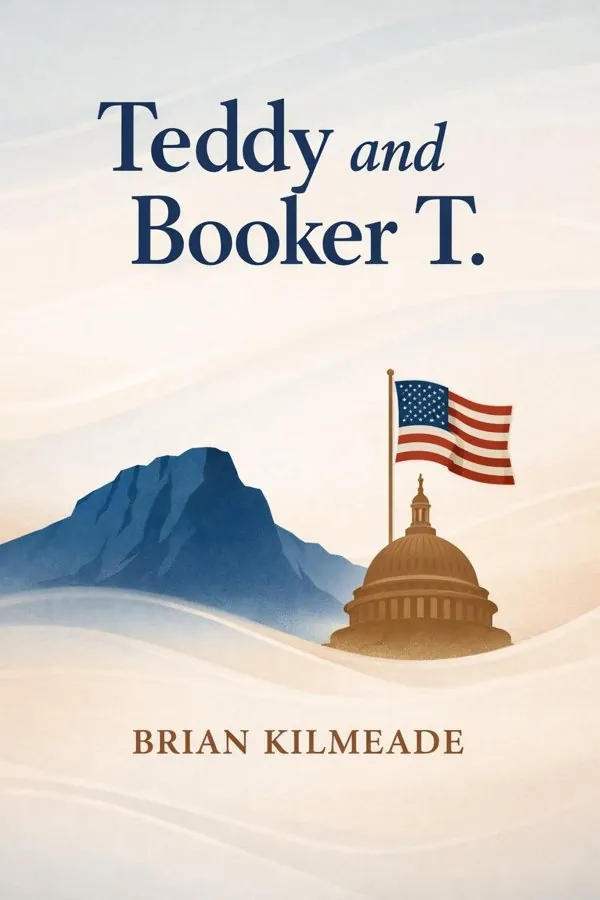
Teddy and Booker T.: How Two American Icons Blazed a Path for Racial Equality: Summary & Key Insights
 10 min9 chaptersAudio available
What Is Teddy and Booker T.: How Two American Icons Blazed a Path for Racial Equality About?
Teddy and Booker T.: How Two American Icons Blazed a Path for Racial Equality by Brian Kilmeade is a world_history book spanning 9 pages. In this historical narrative, Brian Kilmeade explores the unlikely friendship and collaboration between President Theodore Roosevelt and educator Booker T. Washington. The book recounts how their partnership helped shape early 20th-century America’s struggle toward racial equality, highlighting their shared vision of progress and mutual respect despite the racial tensions of their time.
This FizzRead summary covers all 9 key chapters of Teddy and Booker T.: How Two American Icons Blazed a Path for Racial Equality in approximately 10 minutes, distilling the most important ideas, arguments, and takeaways from Brian Kilmeade's work. Also available as an audio summary and Key Quotes Podcast.
Teddy and Booker T.: How Two American Icons Blazed a Path for Racial Equality
In this historical narrative, Brian Kilmeade explores the unlikely friendship and collaboration between President Theodore Roosevelt and educator Booker T. Washington. The book recounts how their partnership helped shape early 20th-century America’s struggle toward racial equality, highlighting their shared vision of progress and mutual respect despite the racial tensions of their time.
Who Should Read Teddy and Booker T.: How Two American Icons Blazed a Path for Racial Equality?
This book is perfect for anyone interested in world_history and looking to gain actionable insights in a short read. Whether you're a student, professional, or lifelong learner, the key ideas from Teddy and Booker T.: How Two American Icons Blazed a Path for Racial Equality by Brian Kilmeade will help you think differently.
- ✓Readers who enjoy world_history and want practical takeaways
- ✓Professionals looking to apply new ideas to their work and life
- ✓Anyone who wants the core insights of Teddy and Booker T.: How Two American Icons Blazed a Path for Racial Equality in just 10 minutes
Want the full summary?
Get instant access to this book summary and 100K+ more with Fizz Moment.
Get Free SummaryAvailable on App Store • Free to download
Key Chapters
As a young boy, Theodore Roosevelt’s battle with frailty shaped his unyielding spirit. Raised in privilege but weakened by asthma, he built his own character through willpower. The transformation from a frail child into the robust Rough Rider of San Juan Hill was no accident—it was a philosophy. Roosevelt came to believe that struggle made men, that self-improvement was the truest expression of citizenship. Long before the presidency, this belief governed his sense of justice. He despised laziness and admired effort, regardless of race or class. Yet his attitudes toward race evolved; shaped by his time, he initially carried some of the biases common to his generation. The crucible of political life changed him. As governor of New York, he began to observe that merit, not ancestry, measured a person’s worth.
When he met Booker T. Washington, Roosevelt saw in him a living embodiment of the principles he respected—discipline, education, and self-made autonomy. Washington was, in Roosevelt’s eyes, not only a representative of Black America but a symbol of what all Americans could achieve through perseverance. His early belief in the 'strenuous life' came to include moral strength as much as physical vigor. By the time he entered the presidency, Roosevelt’s vision of citizenship had broadened: fairness, he realized, must apply universally, or it meant nothing. His political instincts told him to tread carefully; his conscience demanded he act boldly. That conflict between pragmatism and idealism would define his dealings with race in public policy and his enduring friendship with Washington.
Booker T. Washington’s story began in bondage on a Virginia plantation. His earliest memories were of labor and deprivation, yet from slavery’s ashes he built a philosophy grounded in hope. After emancipation, he pursued education with almost sacred fervor, walking miles to attend Hampton Institute. There, he learned not only reading and writing but the dignity of work. This belief became central to his life's mission: the idea that vocational training and discipline could uplift his people within the constraints of an unequal world.
Founding the Tuskegee Institute in Alabama, Washington transformed a modest schoolhouse into a beacon of Black education. He taught that progress came not through confrontation but through self-reliance and moral excellence. Critics accused him of accommodationism, yet Washington’s true genius lay in strategic patience. He raised funds from white philanthropists, cultivated political connections, and built a network that gave thousands of African Americans the tools to build lives of purpose. When he met Roosevelt, he recognized a kindred spirit—a man who valued results over rhetoric. Their collaboration reflected his philosophy: change the system from within, step by step, by proving the capacity of a people long denied equality.
Through Tuskegee, Washington gave America a model of uplift anchored in education and labor. He understood that dignity was won, not bestowed, and his relationship with Roosevelt extended that ideal into the political realm.
+ 7 more chapters — available in the FizzRead app
All Chapters in Teddy and Booker T.: How Two American Icons Blazed a Path for Racial Equality
About the Author
Brian Kilmeade is an American television and radio presenter, political commentator, and author known for his works on American history, including 'George Washington’s Secret Six' and 'Sam Houston and the Alamo Avengers.'
Get This Summary in Your Preferred Format
Read or listen to the Teddy and Booker T.: How Two American Icons Blazed a Path for Racial Equality summary by Brian Kilmeade anytime, anywhere. FizzRead offers multiple formats so you can learn on your terms — all free.
Available formats: App · Audio · PDF · EPUB — All included free with FizzRead
Download Teddy and Booker T.: How Two American Icons Blazed a Path for Racial Equality PDF and EPUB Summary
Key Quotes from Teddy and Booker T.: How Two American Icons Blazed a Path for Racial Equality
“As a young boy, Theodore Roosevelt’s battle with frailty shaped his unyielding spirit.”
“Washington’s story began in bondage on a Virginia plantation.”
Frequently Asked Questions about Teddy and Booker T.: How Two American Icons Blazed a Path for Racial Equality
Teddy and Booker T.: How Two American Icons Blazed a Path for Racial Equality by Brian Kilmeade is a world_history book that explores key ideas across 9 chapters. In this historical narrative, Brian Kilmeade explores the unlikely friendship and collaboration between President Theodore Roosevelt and educator Booker T. Washington. The book recounts how their partnership helped shape early 20th-century America’s struggle toward racial equality, highlighting their shared vision of progress and mutual respect despite the racial tensions of their time.
More by Brian Kilmeade
You Might Also Like
The Age of Capital
Eric Hobsbawm
10 min
The Gulag Archipelago
Aleksandr Solzhenitsyn
10 min
Jerusalem: The Biography
Simon Sebag Montefiore
10 min
The Anglo-Saxons
James Campbell
10 min
The Boer War
Thomas Pakenham
10 min
The Industrial Revolutionaries: The Making of the Modern World 1776–1914
Gavin Weightman
10 minBrowse by Category
Ready to read Teddy and Booker T.: How Two American Icons Blazed a Path for Racial Equality?
Get the full summary and 100K+ more books with Fizz Moment.