
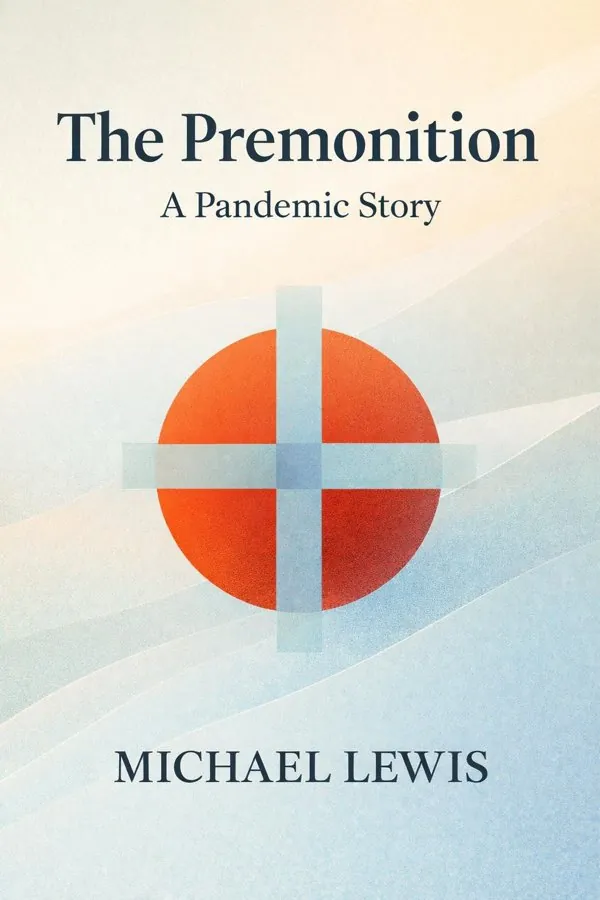
The Premonition: A Pandemic Story: Summary & Key Insights
 10 min8 chaptersAudio available
Key Takeaways from The Premonition: A Pandemic Story
Real danger often appears first in unglamorous places.
A trusted institution can become most dangerous when everyone assumes it is functioning well.
You cannot fight what you cannot see.
Some of the most important decisions in a crisis are made before the crisis begins.
When formal systems stall, informal networks often carry the truth.
What Is The Premonition: A Pandemic Story About?
The Premonition: A Pandemic Story by Michael Lewis is a bestsellers book spanning 7 pages. The Premonition: A Pandemic Story is Michael Lewis’s riveting account of the people who saw a catastrophic outbreak coming long before COVID-19 reshaped the world. Rather than writing a conventional history of the pandemic, Lewis tells the story through a small group of unconventional thinkers—scientists, physicians, modelers, and public servants—who understood that America’s public-health defenses were weaker than they appeared. They recognized the danger, built better tools, and tried to warn the system, only to collide with bureaucracy, institutional complacency, and political denial. What makes this book so powerful is that it is not only about disease. It is about how societies fail to act on uncomfortable truths, how expertise gets sidelined, and how systems designed to protect people can become obstacles to protection. Lewis brings his signature narrative skill, investigative rigor, and talent for explaining complex institutions to a story of foresight and failure. Known for books like Moneyball, The Big Short, and The Fifth Risk, he is especially suited to uncover what happens when data, human judgment, and public institutions drift apart. The result is a gripping, urgent portrait of preparedness, leadership, and the cost of ignoring reality.
This FizzRead summary covers all 8 key chapters of The Premonition: A Pandemic Story in approximately 10 minutes, distilling the most important ideas, arguments, and takeaways from Michael Lewis's work. Also available as an audio summary and Key Quotes Podcast.
The Premonition: A Pandemic Story
The Premonition: A Pandemic Story is Michael Lewis’s riveting account of the people who saw a catastrophic outbreak coming long before COVID-19 reshaped the world. Rather than writing a conventional history of the pandemic, Lewis tells the story through a small group of unconventional thinkers—scientists, physicians, modelers, and public servants—who understood that America’s public-health defenses were weaker than they appeared. They recognized the danger, built better tools, and tried to warn the system, only to collide with bureaucracy, institutional complacency, and political denial.
What makes this book so powerful is that it is not only about disease. It is about how societies fail to act on uncomfortable truths, how expertise gets sidelined, and how systems designed to protect people can become obstacles to protection. Lewis brings his signature narrative skill, investigative rigor, and talent for explaining complex institutions to a story of foresight and failure. Known for books like Moneyball, The Big Short, and The Fifth Risk, he is especially suited to uncover what happens when data, human judgment, and public institutions drift apart. The result is a gripping, urgent portrait of preparedness, leadership, and the cost of ignoring reality.
Who Should Read The Premonition: A Pandemic Story?
This book is perfect for anyone interested in bestsellers and looking to gain actionable insights in a short read. Whether you're a student, professional, or lifelong learner, the key ideas from The Premonition: A Pandemic Story by Michael Lewis will help you think differently.
- ✓Readers who enjoy bestsellers and want practical takeaways
- ✓Professionals looking to apply new ideas to their work and life
- ✓Anyone who wants the core insights of The Premonition: A Pandemic Story in just 10 minutes
Want the full summary?
Get instant access to this book summary and 100K+ more with Fizz Moment.
Get Free SummaryAvailable on App Store • Free to download
Key Chapters
Real danger often appears first in unglamorous places. In The Premonition, Charity Dean’s story begins not in Washington but in local public-health offices, where outbreaks are tracked one patient, one lab result, and one phone call at a time. Lewis presents her as a physician with an unusually sharp instinct for identifying systemic weakness. She understood that public health was not merely about treating illness after the fact; it was about seeing patterns early enough to prevent catastrophe.
Dean’s experience in California taught her that disease control depends on speed, clarity, and the willingness to act before certainty arrives. That sounds obvious, but large institutions often wait for perfect information, formal approval, or political cover. Dean repeatedly confronted a culture that rewarded caution in process more than urgency in action. She saw that if local officials failed to move quickly on outbreaks of tuberculosis or other infectious threats, the cost multiplied rapidly.
Her work also revealed a deeper lesson: frontline expertise is often undervalued because it lacks prestige. Yet people closest to the problem frequently understand it best. In any organization, those handling real-time signals usually detect trouble before senior leadership does. Businesses can see this in customer-service complaints, schools in attendance shifts, and hospitals in unusual case clusters.
Lewis uses Dean’s story to show that preparedness is not mainly a technical problem. It is a cultural one. The people who raise hard alarms are often treated as inconvenient rather than essential.
Actionable takeaway: Pay close attention to frontline observers in your field. Build habits and systems that elevate weak signals early, before they become expensive crises.
A trusted institution can become most dangerous when everyone assumes it is functioning well. Lewis examines the Centers for Disease Control and Prevention not as a villain but as a system that had grown rigid, status-conscious, and slow. The CDC still carried the reputation of America’s elite disease-fighting agency, yet reputation masked serious operational weaknesses. During a fast-moving pandemic, prestige cannot substitute for adaptability.
One of the book’s key insights is that bureaucracy often confuses procedure with competence. The CDC was built for careful science, but a pandemic demanded improvisation, decentralized problem-solving, and rapid feedback loops. Instead, layers of hierarchy made it difficult to respond with speed. The early testing failures during COVID-19 became a symbol of this dysfunction: a system designed to detect danger became an obstacle to detecting it.
Lewis shows how institutional success can create blindness. When organizations are praised for decades, they may stop questioning their assumptions. Leaders may defend established processes because changing them feels like admitting weakness. This is not unique to public health. Large corporations, universities, and governments often struggle for the same reason: they optimize for internal approval instead of external reality.
The lesson is not that expertise should be discarded. It is that expertise must remain dynamic. Institutions need people who challenge assumptions, test alternate methods, and report failure honestly. A slow-moving committee process may be acceptable in stable conditions; it becomes disastrous in a crisis.
Actionable takeaway: If you lead a team or rely on a major institution, ask a hard question regularly: are we protecting outcomes, or are we protecting procedure? Build redundancy, invite dissent, and stress-test your response before reality does.
You cannot fight what you cannot see. Joe DeRisi, one of the most fascinating figures in the book, represents the power of scientific imagination applied to real-world threats. A biochemist and inventor, he approached disease detection differently from traditional institutions. Instead of relying only on narrow, predefined tests that search for one suspected pathogen at a time, DeRisi pursued broad tools capable of identifying the unknown.
This mindset matters because novel outbreaks rarely arrive with labels attached. Conventional systems often assume they already know what they are looking for. But a new virus does not care about administrative categories. DeRisi’s work points toward a more agile model of public health: one rooted in curiosity, fast iteration, and technological openness. He saw early that surveillance and diagnostics had to evolve beyond slow, centralized methods.
Lewis uses DeRisi to illustrate a recurring theme: innovation often comes from outsiders or semi-outsiders who are not fully socialized into institutional habits. Because DeRisi was not trapped by the traditional public-health playbook, he could imagine better tools. The broader application extends far beyond epidemiology. In business, cybersecurity, education, or climate planning, systems fail when they look only for familiar threats and ignore emerging ones.
Practical application means investing in tools that detect patterns, not just expected problems. It also means supporting people who ask unusual questions. A hospital might improve surveillance by integrating multiple data streams. A company might detect market shifts by monitoring weak behavioral signals rather than quarterly summaries alone.
Actionable takeaway: Upgrade your approach from narrow diagnosis to broad detection. Don’t just ask, “What problem do we expect?” Ask, “What problem could we be missing because our tools are too limited?”
Some of the most important decisions in a crisis are made before the crisis begins. Carter Mecher’s contribution to pandemic preparedness was not flashy, but it was transformative. A physician and strategist, he helped shape the logic behind nonpharmaceutical interventions—measures such as school closures, distancing, and changes in social behavior that can slow viral spread before medicines or vaccines are available.
Lewis shows that these ideas were often resisted because they sounded disruptive, politically risky, or socially implausible. Yet Mecher understood something fundamental: exponential growth punishes hesitation. If a virus spreads quickly, waiting for overwhelming proof means acting too late. Pandemic planning therefore requires a different mindset from routine policy work. It must account for the cost of delay, not just the cost of action.
The “playbook” in the book is more than a set of instructions. It represents a disciplined way of thinking under uncertainty. Good preparation means identifying thresholds in advance, clarifying responsibilities, and deciding what actions become necessary under different scenarios. Without this, leaders improvise under pressure and often default to denial.
This lesson applies in many domains. Families create emergency plans for fires or storms because there is no time to debate basic steps once the crisis has arrived. Companies write incident-response protocols for cyberattacks for the same reason. Preparedness is the conversion of foresight into usable action.
Lewis also reveals how hard it is for systems to accept solutions that feel socially costly in the short term, even when they prevent larger damage later. That tension shaped the pandemic response at every level.
Actionable takeaway: Develop decision rules before emergencies happen. Define trigger points, responsibilities, and first actions in advance so fear and politics do not make your choices for you.
When formal systems stall, informal networks often carry the truth. One of the most compelling ideas in The Premonition is that some of the best pandemic thinking happened outside official channels. Scientists, physicians, data experts, and public servants formed loose relationships across agencies and disciplines, sharing information and warnings when institutional pathways moved too slowly.
Lewis highlights how these unofficial networks emerged not from rebellion for its own sake, but from necessity. The people involved cared less about titles and more about solving the problem. They exchanged observations, questioned assumptions, and used trust built over years to move ideas faster than bureaucracy allowed. In moments of crisis, networks based on credibility can outperform hierarchies based on rank.
This phenomenon appears everywhere. In organizations, real work often flows through people who know whom to call, whom to trust, and how to bypass delay without violating integrity. Innovation labs, startup communities, emergency rooms, and investigative teams all depend on unofficial channels of knowledge. The risk, of course, is that institutions begin to rely on heroic improvisation instead of fixing structural problems.
Lewis’s broader point is not that systems should be replaced by informal groups. It is that systems should learn from them. Healthy institutions create spaces where information can move horizontally, not just vertically. They reward collaboration across specialties and empower people to act on evidence without waiting endlessly for permission.
For readers, this is a reminder that competence is social. Who you learn from, who trusts you, and how quickly you can coordinate with others may matter as much as your formal role. In uncertain environments, resilient networks become a hidden form of preparedness.
Actionable takeaway: Build trusted cross-functional relationships before you need them. In any field, your ability to respond quickly improves when information and cooperation are not trapped inside silos.
Disaster is rarely invisible; more often, it is inconvenient. Lewis traces the earliest phase of COVID-19 to show how warning signs existed, but the people in power failed to interpret them with urgency. Signals came from clinicians, modelers, public-health observers, and reports from abroad. Yet these signals did not trigger an adequate response because acknowledging them would have required uncomfortable choices.
This is one of the book’s most unsettling lessons. Many failures do not stem from complete ignorance but from motivated inattention. Leaders may avoid bad news because it threatens political narratives, institutional pride, or economic confidence. Bureaucracies may downgrade ambiguous evidence because acting on it would expose how unprepared they are. The result is a dangerous gap between what some people know and what the system is willing to admit.
Lewis emphasizes that time is the most valuable resource in a pandemic. A few days or weeks of early action can alter the trajectory of thousands or millions of cases. Delays in testing, communication, and behavioral guidance were not minor technical errors; they were compounding failures. Exponential spread turns hesitation into tragedy.
The practical relevance goes beyond pandemics. In finance, ignored market signals become crashes. In engineering, overlooked defects become disasters. In personal life, avoiding a difficult conversation can turn a manageable issue into a crisis. The skill is not merely noticing signals but creating cultures where people can respond to them honestly.
Actionable takeaway: Treat early warning signs as opportunities, not annoyances. When a pattern seems troubling, investigate faster than feels comfortable. The cost of overreacting is often smaller than the cost of reacting too late.
Knowing the truth creates responsibility, even when others refuse to listen. Lewis gives The Premonition a moral center by focusing on the emotional and ethical burden carried by people who understood the danger before most of the public did. Experts are often imagined as detached technicians, but the book reveals something more human: foresight can be isolating, frustrating, and painful.
The scientists and public-health thinkers in the book were not merely solving technical puzzles. They were grappling with what it means to act when institutions discount evidence and lives are at stake. This burden is moral because expertise is not neutral in a crisis. If you know more, and if your knowledge could reduce harm, then silence becomes a decision too. That does not mean experts are always right, but it does mean they have obligations to communicate clearly, persist under resistance, and tell the truth without theatrical certainty.
Lewis also shows the opposite side of this burden: many societies are poor at receiving expertise. We celebrate specialists in theory, then ignore or politicize them when their conclusions are inconvenient. This weakens trust and encourages performative confidence over honest uncertainty. The most useful experts often sound less absolute, because they understand complexity.
Readers can apply this idea personally. In any domain where you hold knowledge others lack—health, finance, safety, operations—you have a duty to speak up early, explain simply, and document concerns. Leadership is often less about authority than about ethical persistence.
Actionable takeaway: If your expertise reveals a preventable risk, don’t wait for ideal conditions to raise the alarm. Communicate clearly, document what you see, and keep pressing for action with integrity.
The greatest threat in a crisis is often the inability to imagine what is about to happen. A central argument running through The Premonition is that America did not merely lack supplies or plans; it lacked practical imagination. Many institutions had scenario documents, committees, and official language around preparedness, yet they did not behave as if a true pandemic would force radical, immediate disruption.
Lewis makes clear that preparedness is not the same as paperwork. A country can have plans on shelves and still be unready if leaders have never emotionally or operationally rehearsed the consequences of failure. Real preparation requires vivid thinking: What if testing breaks? What if hospitals overflow? What if communication from the center becomes confused? What if local actors need autonomy? These questions are uncomfortable, but they are essential.
This idea applies broadly. Organizations often mistake formal compliance for resilience. A company may have a cybersecurity policy but no practice responding to a breach. A school may have a crisis manual but no realistic drill. A family may discuss emergencies in theory but never decide where to meet or whom to call. Imagination converts abstract risk into concrete action.
The book suggests that one reason certain individuals stood out was that they could picture the chain reaction before others could. They understood scale, timing, and consequence. That capacity allowed them to act earlier and more decisively.
Actionable takeaway: Stress-test your assumptions with vivid scenarios. Don’t ask only whether a plan exists; ask whether people know how it would work under pressure, confusion, and speed. Preparedness begins when risk becomes imaginable.
All Chapters in The Premonition: A Pandemic Story
About the Author
Michael Lewis is an American author, journalist, and one of the most influential writers of narrative nonfiction. He first gained attention with Liar’s Poker, a sharp account of Wall Street culture, and later became widely known for bestselling books such as Moneyball, The Blind Side, The Big Short, Flash Boys, and The Fifth Risk. His work often focuses on hidden experts, flawed institutions, and the surprising ways data and human judgment shape outcomes. Lewis has a rare ability to make complex topics accessible without losing nuance, whether he is writing about finance, sports, government, or public policy. In The Premonition, he applies that same investigative storytelling skill to public health, revealing the individuals who saw pandemic danger early and the systems that failed to respond.
Get This Summary in Your Preferred Format
Read or listen to the The Premonition: A Pandemic Story summary by Michael Lewis anytime, anywhere. FizzRead offers multiple formats so you can learn on your terms — all free.
Available formats: App · Audio · PDF · EPUB — All included free with FizzRead
Download The Premonition: A Pandemic Story PDF and EPUB Summary
Key Quotes from The Premonition: A Pandemic Story
“Real danger often appears first in unglamorous places.”
“A trusted institution can become most dangerous when everyone assumes it is functioning well.”
“Joe DeRisi, one of the most fascinating figures in the book, represents the power of scientific imagination applied to real-world threats.”
“Some of the most important decisions in a crisis are made before the crisis begins.”
“When formal systems stall, informal networks often carry the truth.”
Frequently Asked Questions about The Premonition: A Pandemic Story
The Premonition: A Pandemic Story by Michael Lewis is a bestsellers book that explores key ideas across 8 chapters. The Premonition: A Pandemic Story is Michael Lewis’s riveting account of the people who saw a catastrophic outbreak coming long before COVID-19 reshaped the world. Rather than writing a conventional history of the pandemic, Lewis tells the story through a small group of unconventional thinkers—scientists, physicians, modelers, and public servants—who understood that America’s public-health defenses were weaker than they appeared. They recognized the danger, built better tools, and tried to warn the system, only to collide with bureaucracy, institutional complacency, and political denial. What makes this book so powerful is that it is not only about disease. It is about how societies fail to act on uncomfortable truths, how expertise gets sidelined, and how systems designed to protect people can become obstacles to protection. Lewis brings his signature narrative skill, investigative rigor, and talent for explaining complex institutions to a story of foresight and failure. Known for books like Moneyball, The Big Short, and The Fifth Risk, he is especially suited to uncover what happens when data, human judgment, and public institutions drift apart. The result is a gripping, urgent portrait of preparedness, leadership, and the cost of ignoring reality.
More by Michael Lewis

You Might Also Like

The Godfather
Mario Puzo
10 min
The Handmaid's Tale
Margaret Atwood
10 min
The Hunger Games
Suzanne Collins
10 min
The Nightingale
Kristin Hannah
10 min
The Seven Husbands of Evelyn Hugo
Taylor Jenkins Reid
10 min
Backwater Justice
Fern Michaels
10 minBrowse by Category
Ready to read The Premonition: A Pandemic Story?
Get the full summary and 100K+ more books with Fizz Moment.