
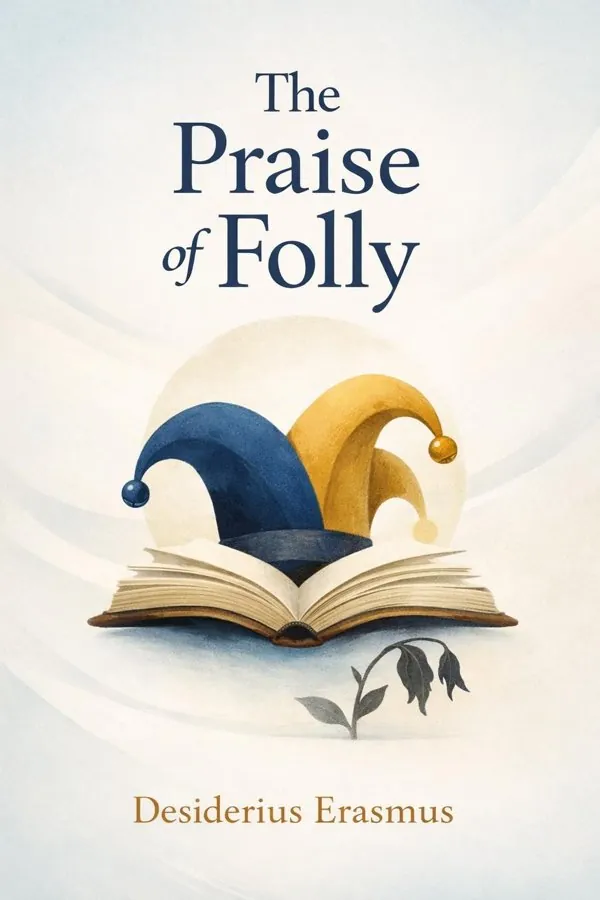
The Praise of Folly: Summary & Key Insights
 10 min10 chaptersAudio available
Key Takeaways from The Praise of Folly
A world without illusion might sound noble, but Erasmus suggests it would also be unlivable.
Much of civilization depends less on truth than on mutually agreed pretenses.
People who pride themselves most on wisdom are often the least wise.
Nowhere is Erasmus more daring than in his treatment of theologians and scholastic disputation.
Institutions built to serve the soul can easily become theaters of vanity.
What Is The Praise of Folly About?
The Praise of Folly by Desiderius Erasmus is a western_phil book spanning 11 pages. The Praise of Folly is one of the most brilliant works of satire in Western thought: playful on the surface, devastating underneath. Written by Desiderius Erasmus in 1509 and published in 1511, the book takes the form of a mock speech delivered by Folly herself, who proudly explains how deeply human life depends on illusion, vanity, self-love, and cheerful irrationality. What begins as comedy gradually becomes moral criticism. Through Folly’s witty self-praise, Erasmus exposes the pretensions of scholars, the corruption of clergy, the ambition of rulers, and the spiritual emptiness of outward religiosity. Yet the book is more than a series of attacks. It also asks a deeper question: if human beings are so prone to delusion, what would genuine wisdom look like? Erasmus, one of the greatest Christian humanists of the Renaissance, answers by pointing beyond intellectual pride toward humility, self-knowledge, moral reform, and a simpler, more sincere Christianity. The result is a short but enduring classic that remains startlingly modern in its diagnosis of status-seeking, institutional hypocrisy, and the comforting lies people tell themselves every day.
This FizzRead summary covers all 10 key chapters of The Praise of Folly in approximately 10 minutes, distilling the most important ideas, arguments, and takeaways from Desiderius Erasmus's work. Also available as an audio summary and Key Quotes Podcast.
The Praise of Folly
The Praise of Folly is one of the most brilliant works of satire in Western thought: playful on the surface, devastating underneath. Written by Desiderius Erasmus in 1509 and published in 1511, the book takes the form of a mock speech delivered by Folly herself, who proudly explains how deeply human life depends on illusion, vanity, self-love, and cheerful irrationality. What begins as comedy gradually becomes moral criticism. Through Folly’s witty self-praise, Erasmus exposes the pretensions of scholars, the corruption of clergy, the ambition of rulers, and the spiritual emptiness of outward religiosity. Yet the book is more than a series of attacks. It also asks a deeper question: if human beings are so prone to delusion, what would genuine wisdom look like? Erasmus, one of the greatest Christian humanists of the Renaissance, answers by pointing beyond intellectual pride toward humility, self-knowledge, moral reform, and a simpler, more sincere Christianity. The result is a short but enduring classic that remains startlingly modern in its diagnosis of status-seeking, institutional hypocrisy, and the comforting lies people tell themselves every day.
Who Should Read The Praise of Folly?
This book is perfect for anyone interested in western_phil and looking to gain actionable insights in a short read. Whether you're a student, professional, or lifelong learner, the key ideas from The Praise of Folly by Desiderius Erasmus will help you think differently.
- ✓Readers who enjoy western_phil and want practical takeaways
- ✓Professionals looking to apply new ideas to their work and life
- ✓Anyone who wants the core insights of The Praise of Folly in just 10 minutes
Want the full summary?
Get instant access to this book summary and 100K+ more with Fizz Moment.
Get Free SummaryAvailable on App Store • Free to download
Key Chapters
A world without illusion might sound noble, but Erasmus suggests it would also be unlivable. Folly opens her speech by presenting herself not as a mere defect in human character, but as one of the hidden forces that make life pleasant, social, and even possible. People flatter themselves, overlook one another’s faults, dream beyond reason, and stay cheerful in the face of uncertainty. Without these small absurdities, many of the bonds and ambitions that sustain human life would collapse.
This is one of the book’s most subtle arguments. Erasmus is not simply saying that humans are foolish. He is showing that some measure of self-deception oils the machinery of daily existence. Courtship, friendship, public honor, political loyalty, and personal confidence all depend, at least partly, on embellished stories people tell themselves. A parent imagines great things for a child. A young scholar assumes his work matters more than it does. A lover idealizes the beloved. These are not purely rational acts, yet they often sustain action where clear-eyed realism might produce paralysis.
In modern life, this insight remains recognizable. People post polished versions of themselves online, inflate job prospects in interviews, or maintain hopeful plans despite long odds. While these tendencies can become dangerous when detached from truth, Erasmus sees that complete disillusionment is not automatically virtue. Human beings need encouragement, imagination, and emotional cushioning.
The deeper challenge is balance. Folly helps life move forward, but when left unchecked she turns into vanity, delusion, and corruption. Erasmus invites readers to notice where comforting illusion supports healthy living and where it begins to replace honesty.
Actionable takeaway: Examine one belief that gives you confidence or comfort, and ask whether it is a helpful hope, a harmless illusion, or a self-deception that needs correction.
Much of civilization depends less on truth than on mutually agreed pretenses. Erasmus pushes this idea further by having Folly boast that marriage, friendship, commerce, and public life all require people to ignore inconvenient realities. If everyone saw every flaw clearly, trusted only what could be proven, and never acted from vanity or hope, ordinary social life would freeze.
This is not a cynical argument for lying. Rather, Erasmus highlights how human communities function through softness, selective blindness, and emotional generosity. Marriage survives because spouses forgive, overlook, and romanticize. Friendships endure because people flatter one another, avoid constant correction, and extend goodwill beyond strict merit. Public leaders gain support partly because people prefer inspiring appearances to dull truths. Even economic life often depends on confidence, speculation, and the willingness to believe in futures not yet visible.
Erasmus uses comedy to reveal an uncomfortable truth: social order is not built by reason alone. Human beings are creatures of pride, insecurity, affection, and fantasy. A manager praises a team to maintain morale. A family avoids rehearsing every old grievance in order to keep peace. A community rallies around symbolic ideals that are emotionally powerful even when imperfectly realized. These are forms of practical folly.
Yet Erasmus also warns that the same mechanisms that preserve social bonds can enable manipulation. Empty ceremony can replace justice. National pride can excuse cruelty. Personal loyalty can become blind partisanship. Folly is useful when it softens life, dangerous when it shields abuse.
The enduring lesson is that society needs more than logic, but it also needs honest moral judgment. We must learn to distinguish between gracious illusion that fosters human connection and collective self-deception that protects wrongdoing.
Actionable takeaway: In one important relationship or institution you belong to, identify a polite fiction that helps it function, then ask whether it strengthens trust or conceals a problem that should be addressed.
People who pride themselves most on wisdom are often the least wise. One of Erasmus’s sharpest satirical targets is the philosopher who values abstraction over life, reputation over truth, and severity over joy. Through Folly’s mockery, he exposes a familiar type: the learned person who appears impressive but lacks humility, warmth, and practical sense.
Erasmus is not attacking learning itself. As a scholar, he deeply valued education, classical literature, and rigorous study. What he opposes is the vanity that so often accompanies intellectual life. Scholars can become intoxicated with terminology, distinctions, and debate while losing sight of the purpose of knowledge. Instead of helping people live better, they become performers of expertise. They confuse complexity with depth and obscurity with authority.
This criticism still lands today. Academic jargon can hide weak thinking. Experts may speak with confidence outside their competence. People on social media adopt intellectual poses not to seek truth but to display superiority. Even in workplaces, some prefer sounding sophisticated to solving real problems. Erasmus reminds us that intelligence without self-awareness easily becomes another costume of Folly.
He also notices the psychological cost of this posture. Those who obsess over proving their wisdom often become rigid, anxious, and disconnected from ordinary pleasures. They cannot laugh at themselves. They cannot admit uncertainty. Their seriousness turns into a kind of captivity.
True wisdom, by contrast, includes proportion, modesty, and an awareness of human limits. It serves life rather than merely adorning the ego. Erasmus suggests that the genuinely wise person does not need to announce his wisdom constantly.
Actionable takeaway: The next time you explain an idea, try expressing it in plain language. If you cannot make it clear and useful, ask whether you are pursuing truth or merely performing intelligence.
Nowhere is Erasmus more daring than in his treatment of theologians and scholastic disputation. Folly ridicules religious experts who spend their energy on minute doctrinal puzzles, technical categories, and verbal combat while neglecting the ethical and spiritual heart of Christianity. The point is not that theology is useless, but that it becomes absurd when it mistakes intricacy for holiness.
Erasmus saw a religious culture in which some learned men delighted in argument for its own sake. They could classify sins, debate mysteries, and defend elaborate systems, yet remain untouched by the simplicity of the Gospel. In Folly’s voice, he shows how such figures can become enamored of intellectual mastery while forgetting charity, humility, and inner transformation.
This critique reaches beyond medieval scholasticism. Any tradition can turn living truth into technical performance. People may know religious vocabulary, quote authorities, and argue endlessly online while remaining harsh, vain, or spiritually shallow. A congregation may prize doctrinal precision but ignore the poor. A believer may obsess over correctness yet fail at forgiveness. Erasmus insists that religion detached from moral seriousness becomes one more arena for ego.
At the same time, he does not endorse anti-intellectual faith. He wants learning purified by piety, not abandoned. Scripture should be studied carefully, but in a way that reforms the soul. Knowledge should clarify devotion, not replace it. The final measure of religious understanding is not how many distinctions one can make, but whether one becomes more truthful, compassionate, and Christlike.
This remains a profound warning for every age: technical mastery is no substitute for spiritual integrity. The more sacred the subject, the greater the temptation to hide emptiness behind expertise.
Actionable takeaway: If you engage religious or philosophical questions, pair every hour of study with one concrete act of humility, service, or self-examination.
Institutions built to serve the soul can easily become theaters of vanity. Erasmus directs some of his most memorable satire at priests, monks, bishops, and church authorities who surround themselves with ceremony, titles, and privilege while neglecting the moral and pastoral duties of their office. Through Folly, he reveals how religion can become a mask for ambition.
His criticism is not a rejection of the Church itself, but a plea for reform. Erasmus remained a Christian humanist committed to the faith, yet he saw that clerical life often rewarded outward display more than inward holiness. Sacred garments, official formulas, and public ritual could create an impression of sanctity while concealing greed, laziness, or spiritual indifference. The very symbols meant to point toward God could be used as props in a performance of authority.
This dynamic is hardly confined to the sixteenth century. Religious leaders today can become brands. Moral language can be used to secure influence, donations, or public admiration. Institutional loyalty can pressure followers to ignore wrongdoing. Even outside religion, the same pattern appears whenever people in respected roles use noble language to protect self-interest.
Erasmus’s insight is that hypocrisy thrives where reverence discourages scrutiny. The more an office is idealized, the easier it becomes for people to confuse position with virtue. He therefore calls readers to judge leaders not by status, costume, or rhetoric, but by character and conduct. Do they serve the vulnerable? Do they practice what they preach? Do they show humility?
The satire bites because it makes a timeless point: corruption is most dangerous when it wears holy robes. Genuine reform begins when people recover the courage to compare institutional claims with lived reality.
Actionable takeaway: When evaluating any leader, religious or secular, focus less on image and titles and more on patterns of service, transparency, and integrity.
Power loves ceremony because ceremony can make emptiness look majestic. Erasmus extends his satire from the church to courts, princes, and public life, exposing how rulers and elites often rely on spectacle, flattery, and self-importance rather than wisdom or justice. Folly delights in these worlds because ambition, vanity, and illusion flourish wherever status matters most.
The critique works on two levels. First, Erasmus shows how those in power frequently believe exaggerated stories about themselves. They imagine their decisions are profound, their titles meaningful, and their public honors deserved. Second, he shows how entire societies participate in sustaining these fictions. Courtiers flatter, subjects applaud, and institutions preserve rituals that magnify authority beyond merit. Political life becomes a staged drama in which everyone knows the lines.
This analysis feels strikingly modern. Public relations, celebrity politics, image management, and performative patriotism all depend on the power of appearances. A leader may be praised for confidence rather than competence. A corporation may promote values it does not embody. Ceremonial language may distract from ordinary failures in justice or care. Folly still governs wherever display outruns substance.
Yet Erasmus does not simply sneer at public life. He warns readers that they, too, are implicated. Societies often prefer theatrical leadership because it is emotionally satisfying. People want symbols, myths, and flattering narratives. The danger is that admiration for style can make citizens passive and morally inattentive.
The remedy is not joyless suspicion toward everything public, but disciplined judgment. We should ask whether institutions serve the common good or merely celebrate their own prestige. Grandeur is not always false, but it becomes hollow when disconnected from responsibility.
Actionable takeaway: The next time you are impressed by a public figure or institution, ask one grounding question: what concrete good, beyond appearances, is actually being produced?
Human relationships survive not because people see each other perfectly, but because they love through imperfection. Erasmus gives Folly a disarming argument: affection depends on a certain blindness. Lovers idealize. Friends excuse. Families forgive. If all relationships were governed by relentless accuracy, many would collapse under the weight of disappointment.
This is one of the warmest and most psychologically insightful themes in the book. Erasmus recognizes that love is not a cold audit of strengths and defects. It involves generosity of interpretation. A spouse overlooks annoying habits. A friend chooses not to weaponize every weakness. Parents continue hoping for children who repeatedly fail. In these acts, Folly appears less as stupidity than as merciful softness.
Still, Erasmus is careful not to romanticize deception without limit. The same tendency that makes love tender can also make it unhealthy. People may ignore abuse, excuse irresponsibility, or stay loyal to destructive patterns because they confuse love with blindness. A friendship can become dishonest if no one dares speak difficult truths. A marriage can become hollow if appearances replace genuine mutual care.
The challenge, then, is to preserve the kindness of partial blindness without losing moral clarity. Healthy relationships require both acceptance and truthfulness. We need enough illusion to remain patient, hopeful, and forgiving, but enough honesty to confront serious harm. In modern terms, emotional intelligence often means knowing when to overlook and when to address.
Erasmus’s brilliance lies in recognizing that affection and illusion are intertwined. The goal is not brutal transparency at all times, but loving realism. To care well for others, we must neither idealize them completely nor reduce them to their faults.
Actionable takeaway: In one close relationship, practice a double discipline this week: overlook one minor flaw generously, and address one important issue honestly but kindly.
Satire is not merely a weapon against others; it is a mirror. As Folly claims universal rule, Erasmus gradually turns the joke back on every reader. The scholar, priest, courtier, lover, and ruler are easy to laugh at, but the deepest point is that no one stands outside the kingdom of self-deception. Pride is democratic. Everyone prefers flattering illusions to uncomfortable truths.
This is where the book moves from entertainment to moral philosophy. By exaggerating human absurdities, Erasmus trains readers to notice their own. The person who mocks intellectual vanity may secretly crave admiration. The one who condemns corrupt institutions may cherish a private hypocrisy. The devout believer may use piety to feel superior. Folly is not simply elsewhere. She speaks through our habits of self-justification.
This insight remains deeply practical. People curate their identities, rationalize failures, excuse selfishness, and reinterpret events to preserve self-esteem. We often judge ourselves by intentions and others by outcomes. We explain away our envy as principle, our cowardice as prudence, our vanity as excellence. Erasmus understands that the ego is a gifted storyteller.
His method is humane because laughter lowers defenses. Direct accusation can provoke denial, but comedy slips past pride. Once we laugh at a ridiculous type, we may begin to recognize traces of that type in ourselves. This is why the book still feels alive: it reveals moral truth through amusement rather than lecture.
For Erasmus, authentic wisdom starts with this humiliation of pride. A person who can laugh at himself is already less trapped by pretense. Self-knowledge does not require self-hatred, but it does require the courage to see how often one’s motives are mixed.
Actionable takeaway: Notice one recurring way you justify yourself too quickly, and write a more honest description of that habit without excuses or embellishment.
The book’s most surprising move is that after exposing worldly foolishness, Erasmus gestures toward a higher kind of folly: the apparent foolishness of Christian humility, simplicity, and devotion. This shift gives the work its depth. Not all folly is equal. There is trivial folly rooted in vanity, and there is divine folly that looks absurd to the proud because it rejects status, mastery, and self-exaltation.
Drawing on Pauline themes, Erasmus suggests that the Gospel overturns worldly standards of wisdom. The world admires power, eloquence, technical brilliance, and prestige. Christianity, at its best, honors meekness, repentance, charity, and trust in God. To those invested in worldly success, such virtues can seem naive or irrational. Why forgive instead of retaliate? Why serve instead of dominate? Why treasure simplicity over acclaim? In this sense, true faith appears foolish to a culture ruled by ego.
This is not an argument against reason. Erasmus was a humanist scholar, not an enemy of thought. Rather, he insists that reason must know its limits. There are dimensions of moral and spiritual truth that cannot be mastered by prideful intelligence alone. A person may win arguments yet fail to love. Another may possess little status or learning yet embody the heart of the faith more fully.
In contemporary life, this remains a challenging message. Societies still reward visibility, competitiveness, and self-promotion. Quiet integrity often seems unimpressive. Compassion may be dismissed as weakness. Erasmus calls readers to reconsider those judgments. The deepest wisdom may wear the appearance of foolishness because it resists the metrics by which the world measures success.
Actionable takeaway: Choose one humble act this week that brings no recognition, and do it deliberately as practice in valuing goodness over appearance.
Sometimes laughter tells the truth more effectively than seriousness. The lasting power of The Praise of Folly lies not only in what Erasmus says, but in how he says it. By letting Folly praise herself, he creates an ironic structure in which critique emerges indirectly. Readers are entertained even as they are exposed. The result is satire with a reforming purpose.
This method matters. Open denunciation often hardens those being criticized. Satire, by contrast, disarms through pleasure. It invites recognition rather than immediate resistance. When Folly boasts that she governs scholars, priests, lovers, and princes, the exaggeration is funny, but it also reveals how deeply irrational motives shape respectable life. Humor becomes a philosophical instrument.
Erasmus inherited classical rhetorical techniques and adapted them to Christian moral concerns. He knew that wit could puncture pretension better than solemn rebuke. Even today, comedians, essayists, and cultural critics often succeed where formal argument fails because they reveal contradictions people already sense but rarely admit. A well-aimed joke can expose vanity, hypocrisy, and institutional absurdity in a way that facts alone cannot.
But Erasmus also shows the ethical responsibility of satire. Its purpose should not be cruelty for its own sake. The target is inflated pride, deadened conscience, and corruption, not the dignity of ordinary human weakness. Good satire aims to heal by shaming falsehood and recalling people to reality.
For readers, this means The Praise of Folly is not just a historical artifact. It is a lesson in critical reading and moral perception. It teaches us to look beneath official narratives, to distrust pomp, and to use laughter as a path toward honesty.
Actionable takeaway: When you encounter something ridiculous in public or personal life, do not stop at amusement; ask what deeper truth the absurdity is revealing.
All Chapters in The Praise of Folly
About the Author
Desiderius Erasmus of Rotterdam (c. 1466–1536) was a Dutch scholar, priest, theologian, and the leading voice of Christian humanism during the Renaissance. Educated in the classical tradition, he devoted his life to the study of language, Scripture, ethics, and education. Erasmus believed that Christianity should be renewed through learning, moral sincerity, and a return to the teachings of Christ rather than through empty ritual or intellectual vanity. His works, including The Praise of Folly and his influential Greek New Testament, shaped religious and intellectual debate across Europe. Although he sharply criticized corruption within the Church, he remained committed to reform from within and avoided aligning fully with the Protestant Reformation. He remains one of the most important moral and literary thinkers of early modern Europe.
Get This Summary in Your Preferred Format
Read or listen to the The Praise of Folly summary by Desiderius Erasmus anytime, anywhere. FizzRead offers multiple formats so you can learn on your terms — all free.
Available formats: App · Audio · PDF · EPUB — All included free with FizzRead
Download The Praise of Folly PDF and EPUB Summary
Key Quotes from The Praise of Folly
“A world without illusion might sound noble, but Erasmus suggests it would also be unlivable.”
“Much of civilization depends less on truth than on mutually agreed pretenses.”
“People who pride themselves most on wisdom are often the least wise.”
“Nowhere is Erasmus more daring than in his treatment of theologians and scholastic disputation.”
“Institutions built to serve the soul can easily become theaters of vanity.”
Frequently Asked Questions about The Praise of Folly
The Praise of Folly by Desiderius Erasmus is a western_phil book that explores key ideas across 10 chapters. The Praise of Folly is one of the most brilliant works of satire in Western thought: playful on the surface, devastating underneath. Written by Desiderius Erasmus in 1509 and published in 1511, the book takes the form of a mock speech delivered by Folly herself, who proudly explains how deeply human life depends on illusion, vanity, self-love, and cheerful irrationality. What begins as comedy gradually becomes moral criticism. Through Folly’s witty self-praise, Erasmus exposes the pretensions of scholars, the corruption of clergy, the ambition of rulers, and the spiritual emptiness of outward religiosity. Yet the book is more than a series of attacks. It also asks a deeper question: if human beings are so prone to delusion, what would genuine wisdom look like? Erasmus, one of the greatest Christian humanists of the Renaissance, answers by pointing beyond intellectual pride toward humility, self-knowledge, moral reform, and a simpler, more sincere Christianity. The result is a short but enduring classic that remains startlingly modern in its diagnosis of status-seeking, institutional hypocrisy, and the comforting lies people tell themselves every day.
More by Desiderius Erasmus
You Might Also Like
A Little History of Philosophy
Nigel Warburton
10 min
Areopagitica
John Milton
10 min
How To Think Like A Philosopher: Essential Principles For Clear Thinking
Peter Cave
10 min
Language, Truth and Logic
A. J. Ayer
10 min
The Age of Reason
Thomas Paine
10 min
The Essays
Michel De Montaigne
10 minBrowse by Category
Ready to read The Praise of Folly?
Get the full summary and 100K+ more books with Fizz Moment.