
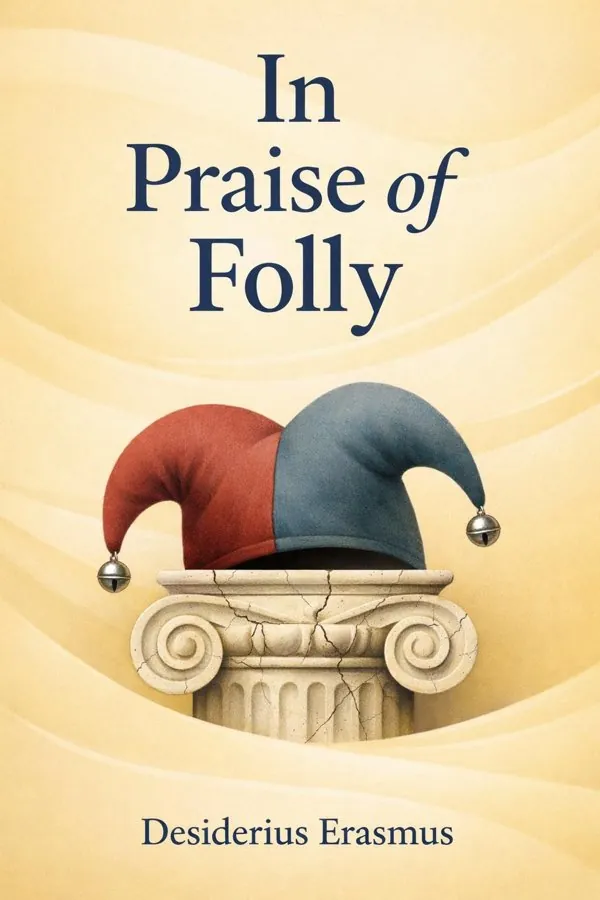
In Praise of Folly: Summary & Key Insights
 10 min6 chaptersAudio available
What Is In Praise of Folly About?
In Praise of Folly by Desiderius Erasmus is a western_phil book spanning 6 pages. In Praise of Folly is a satirical essay by Desiderius Erasmus of Rotterdam, first printed in 1511. Written in Latin as Moriae Encomium, it humorously critiques the superstitions and corrupt practices of the Church and society of Erasmus’s time. Through the personification of Folly, Erasmus delivers a witty and ironic commentary on human nature, intellectual pretensions, and moral hypocrisy.
This FizzRead summary covers all 6 key chapters of In Praise of Folly in approximately 10 minutes, distilling the most important ideas, arguments, and takeaways from Desiderius Erasmus's work. Also available as an audio summary and Key Quotes Podcast.
In Praise of Folly
In Praise of Folly is a satirical essay by Desiderius Erasmus of Rotterdam, first printed in 1511. Written in Latin as Moriae Encomium, it humorously critiques the superstitions and corrupt practices of the Church and society of Erasmus’s time. Through the personification of Folly, Erasmus delivers a witty and ironic commentary on human nature, intellectual pretensions, and moral hypocrisy.
Who Should Read In Praise of Folly?
This book is perfect for anyone interested in western_phil and looking to gain actionable insights in a short read. Whether you're a student, professional, or lifelong learner, the key ideas from In Praise of Folly by Desiderius Erasmus will help you think differently.
- ✓Readers who enjoy western_phil and want practical takeaways
- ✓Professionals looking to apply new ideas to their work and life
- ✓Anyone who wants the core insights of In Praise of Folly in just 10 minutes
Want the full summary?
Get instant access to this book summary and 100K+ more with Fizz Moment.
Get Free SummaryAvailable on App Store • Free to download
Key Chapters
I begin by announcing my lineage and splendor. Born of Wealth and Youth, raised among the gods themselves, I am the one who brings delight not only to the common man but to Olympus as well. Without my company, existence would be tedious. My smiling presence spins the gray cloth of labor and discipline into a festival of living energy.
Erasmus uses this self-praise to invert moral seriousness. In my voice, he suggests that life gains its sweetness from the play of illusion—from the sparks of vanity and pleasure that bind society. The workers who imagine future success, the lovers blinded by charm, the artists nourished by fame, all partake in folly’s banquet. Absent such illusions, mankind would sink into despair.
From the start, my tone is jubilant yet cutting. I confess my universal rule: I make marriage joyful, friendship affectionate, and ambition colorful. Even the gods, bored with eternal perfection, need folly to entertain them. This paradox—that foolishness sustains both divine and human existence—undermines the pompous ideal of pure rationality. Erasmus writes through me to remind learned Europe that human happiness depends less on logic than on the heart’s playful errors.
Once I have established my dominion, I turn my gaze toward those who claim to oppose me—the philosophers and scholars. How solemnly they parade their systems, measuring the universe by syllogism, convinced that by thinking grimly they approach truth. Yet their wisdom isolates them; it drains the warmth from life. I declare with triumphant mockery that ignorance brings more contentment than their sterile intelligence.
Erasmus, through my voice, attacks the intellectual pretension of his time. The grammar masters, endlessly parsing language, bound themselves in pedantic chains. The rhetoricians, obsessed with eloquence, use ornament instead of substance. Poets, resounding with self-love, compose verses to gain applause rather than insight. They all wear masks of wisdom—and I, Folly, rip those masks away.
I show that true joy lies not in abstract speculation but in cheerful participation in the world. Simplicity, laughter, even error, preserve our humanity. By ridiculing the so-called learned, Erasmus is not destroying learning itself—he was a scholar, after all—but cleansing it of arrogance. He calls for humility within intellect, reminding scholars that a little foolishness, like yeast, keeps the mind alive.
+ 4 more chapters — available in the FizzRead app
All Chapters in In Praise of Folly
About the Author
Desiderius Erasmus (1466–1536) was a Dutch Renaissance humanist, theologian, and classical scholar. He was one of the most influential figures of the Northern Renaissance, known for his critical editions of the New Testament, his advocacy of religious tolerance, and his promotion of humanist learning.
Get This Summary in Your Preferred Format
Read or listen to the In Praise of Folly summary by Desiderius Erasmus anytime, anywhere. FizzRead offers multiple formats so you can learn on your terms — all free.
Available formats: App · Audio · PDF · EPUB — All included free with FizzRead
Download In Praise of Folly PDF and EPUB Summary
Key Quotes from In Praise of Folly
“I begin by announcing my lineage and splendor.”
“Once I have established my dominion, I turn my gaze toward those who claim to oppose me—the philosophers and scholars.”
Frequently Asked Questions about In Praise of Folly
In Praise of Folly by Desiderius Erasmus is a western_phil book that explores key ideas across 6 chapters. In Praise of Folly is a satirical essay by Desiderius Erasmus of Rotterdam, first printed in 1511. Written in Latin as Moriae Encomium, it humorously critiques the superstitions and corrupt practices of the Church and society of Erasmus’s time. Through the personification of Folly, Erasmus delivers a witty and ironic commentary on human nature, intellectual pretensions, and moral hypocrisy.
More by Desiderius Erasmus
You Might Also Like
A Little History of Philosophy
Nigel Warburton
10 min
Areopagitica
John Milton
10 min
How To Think Like A Philosopher: Essential Principles For Clear Thinking
Peter Cave
10 min
Language, Truth and Logic
A. J. Ayer
10 min
The Age of Reason
Thomas Paine
10 min
The Essays
Michel De Montaigne
10 minBrowse by Category
Ready to read In Praise of Folly?
Get the full summary and 100K+ more books with Fizz Moment.