
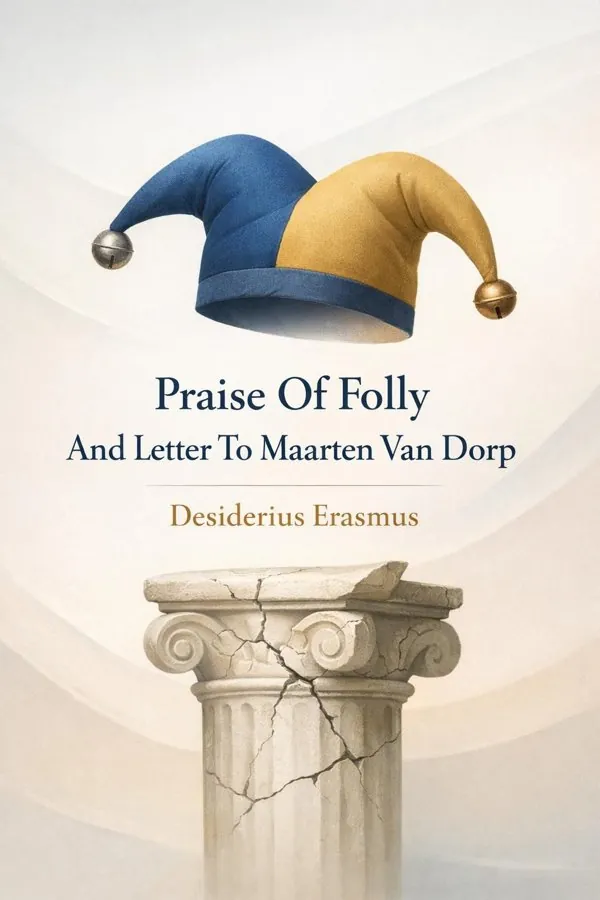
Praise Of Folly And Letter To Maarten Van Dorp: Summary & Key Insights
 10 min9 chaptersAudio available
Key Takeaways from Praise Of Folly And Letter To Maarten Van Dorp
The most dangerous falsehoods rarely arrive looking frightening; they arrive charming, familiar, and flattering.
People often imagine that rationality governs life, but Erasmus argues that human affairs are sustained just as much by misjudgment, hope, vanity, and emotional blindness.
Education can liberate the mind, but it can also inflate the ego.
Few sections of Praise Of Folly are as bold as Erasmus’s satire of theologians.
Institutions founded for spiritual discipline can gradually become attached to symbols, routines, and status markers that outlive their original purpose.
What Is Praise Of Folly And Letter To Maarten Van Dorp About?
Praise Of Folly And Letter To Maarten Van Dorp by Desiderius Erasmus is a classics book spanning 9 pages. Few classics are as playful, daring, and unexpectedly modern as Desiderius Erasmus’s Praise Of Folly. On its surface, the book is a comic speech delivered by Folly herself, who boasts that she governs human happiness, ambition, love, learning, and religion. Yet beneath the wit lies a sharp moral critique. By allowing Folly to praise herself, Erasmus exposes the vanity of scholars, the pretensions of theologians, the corruption of church officials, and the self-deceptions of ordinary people. Laughter becomes a tool of truth. The companion piece, Letter To Maarten Van Dorp, deepens that truth. In it, Erasmus defends his use of satire and explains that criticism, when guided by learning and goodwill, can serve reform rather than destruction. Together, these works reveal the heart of Christian humanism: a belief that education, humility, and moral seriousness should renew both individuals and institutions. Erasmus matters because he stood at a turning point in European thought, just before the Reformation reshaped Christendom. His authority comes not from dogmatism but from scholarship, classical learning, and a rare ability to combine humor with ethical urgency. This book remains essential because it shows that folly is timeless—and so is the need to confront it honestly.
This FizzRead summary covers all 9 key chapters of Praise Of Folly And Letter To Maarten Van Dorp in approximately 10 minutes, distilling the most important ideas, arguments, and takeaways from Desiderius Erasmus's work. Also available as an audio summary and Key Quotes Podcast.
Praise Of Folly And Letter To Maarten Van Dorp
Few classics are as playful, daring, and unexpectedly modern as Desiderius Erasmus’s Praise Of Folly. On its surface, the book is a comic speech delivered by Folly herself, who boasts that she governs human happiness, ambition, love, learning, and religion. Yet beneath the wit lies a sharp moral critique. By allowing Folly to praise herself, Erasmus exposes the vanity of scholars, the pretensions of theologians, the corruption of church officials, and the self-deceptions of ordinary people. Laughter becomes a tool of truth.
The companion piece, Letter To Maarten Van Dorp, deepens that truth. In it, Erasmus defends his use of satire and explains that criticism, when guided by learning and goodwill, can serve reform rather than destruction. Together, these works reveal the heart of Christian humanism: a belief that education, humility, and moral seriousness should renew both individuals and institutions.
Erasmus matters because he stood at a turning point in European thought, just before the Reformation reshaped Christendom. His authority comes not from dogmatism but from scholarship, classical learning, and a rare ability to combine humor with ethical urgency. This book remains essential because it shows that folly is timeless—and so is the need to confront it honestly.
Who Should Read Praise Of Folly And Letter To Maarten Van Dorp?
This book is perfect for anyone interested in classics and looking to gain actionable insights in a short read. Whether you're a student, professional, or lifelong learner, the key ideas from Praise Of Folly And Letter To Maarten Van Dorp by Desiderius Erasmus will help you think differently.
- ✓Readers who enjoy classics and want practical takeaways
- ✓Professionals looking to apply new ideas to their work and life
- ✓Anyone who wants the core insights of Praise Of Folly And Letter To Maarten Van Dorp in just 10 minutes
Want the full summary?
Get instant access to this book summary and 100K+ more with Fizz Moment.
Get Free SummaryAvailable on App Store • Free to download
Key Chapters
The most dangerous falsehoods rarely arrive looking frightening; they arrive charming, familiar, and flattering. Erasmus begins Praise Of Folly by giving the stage to Folly herself, and this is more than a clever literary trick. It allows criticism to appear in the disarming form of self-celebration. Folly praises her own power over the world, claiming that nearly all pleasure, confidence, friendship, and social harmony depend on some degree of illusion. Her speech is comic, but the comedy performs serious work: it lowers the reader’s defenses and invites self-recognition.
Instead of denouncing vice directly, Erasmus lets Folly boast about the very habits people usually excuse in themselves. Vanity becomes self-esteem. Self-deception becomes emotional survival. Social pretense becomes politeness. In doing so, the text reveals how people collaborate with their own illusions because truth, though noble, can be painful. Folly is persuasive not because she is entirely wrong, but because she mixes obvious absurdity with uncomfortable truth.
This strategy still feels modern. Think about how people present polished identities online, exaggerate competence at work, or avoid difficult conversations to preserve comfort. We rarely call these behaviors folly; we call them confidence, branding, or tact. Erasmus asks us to notice how often we love the stories that spare our pride.
What makes this opening powerful is its ambiguity. Folly is ridiculous, yet she is not simply an enemy. Human life, Erasmus suggests, cannot be lived without some illusions. The question is not whether folly exists, but whether we can recognize when harmless self-forgetfulness turns into moral blindness.
Actionable takeaway: Pay attention to the beliefs that make you feel pleasantly secure. Ask yourself which of them are harmless comforts and which are preventing honesty, growth, or accountability.
People often imagine that rationality governs life, but Erasmus argues that human affairs are sustained just as much by misjudgment, hope, vanity, and emotional blindness. After her opening self-praise, Folly surveys the whole arc of existence—birth, youth, adulthood, ambition, marriage, aging—and shows that nearly every stage depends on her influence. Infants are cherished because they are helpless and charming rather than rational. Young lovers leap into commitments with more passion than wisdom. Parents idealize their children. The elderly cling to flattering memories. Society keeps moving because people believe what they need to believe.
This is not merely cynicism. Erasmus is probing a difficult truth: if everyone saw themselves and others with perfect clarity, many human attachments might weaken. Friendships often survive because people overlook faults. Families function because affection softens judgment. Political life depends on hopeful narratives. Even everyday motivation often requires a confidence greater than the evidence fully supports.
In modern life, useful illusions appear everywhere. Entrepreneurs begin projects with optimism that outsiders might call unrealistic. Couples commit before they can know every future difficulty. Teachers encourage students with confidence the students have not yet earned. These forms of folly can nurture growth. Yet the same mechanism becomes dangerous when leaders ignore reality, institutions conceal failure, or individuals mistake wishful thinking for wisdom.
Erasmus’s insight is that folly is woven into ordinary humanity, not confined to spectacular errors. He does not ask us to become cold realists stripped of affection. Rather, he urges discernment. Some illusions sustain life; others corrupt it. The task is to distinguish generous hope from self-serving deception.
Actionable takeaway: Examine one important area of your life—work, family, ambition, or self-image—and identify where optimism is helping you act courageously and where it may be keeping you from facing necessary truths.
Education can liberate the mind, but it can also inflate the ego. One of Erasmus’s sharpest targets is the scholar who accumulates knowledge without gaining judgment, humility, or humanity. Through Folly’s mock praise, he portrays intellectuals as people delighted by obscure arguments, endless classification, pedantic disputes, and displays of superiority. Their problem is not learning itself; Erasmus was one of Europe’s greatest scholars. The problem is learning severed from purpose.
He exposes a familiar temptation: the belief that complexity proves depth. Scholars can become so attached to technical language, reputation, and minute controversies that they lose sight of truth and usefulness. The result is a kind of intellectual theater in which winning arguments matters more than illuminating reality. Folly delights in such people because they are easy to flatter. They mistake admiration for insight and difficulty for importance.
This critique applies well beyond Renaissance classrooms. Professionals can hide weak thinking behind jargon. Public experts may value appearing informed more than admitting uncertainty. Students sometimes pursue credentials more eagerly than understanding. Even avid readers can collect ideas as ornaments rather than use them to become wiser or kinder.
Erasmus does not reject study; he insists that genuine learning should refine the character. Knowledge worthy of respect should make a person more modest, not more arrogant. It should improve moral judgment, deepen clarity, and serve the common good. In this way, humanist learning becomes a means of reform rather than self-display.
A practical example is workplace expertise. The best experts usually explain difficult matters simply, revise their views when evidence changes, and avoid contempt for non-specialists. The worst use complexity to protect status.
Actionable takeaway: The next time you learn something impressive, ask not only “Do I understand this?” but also “Can I explain it clearly, use it ethically, and hold it without becoming vain?”
Few sections of Praise Of Folly are as bold as Erasmus’s satire of theologians. He does not mock faith itself; rather, he criticizes religious thinkers who turn sacred truths into occasions for vanity, rivalry, and needless abstraction. Folly praises those who delight in subtle distinctions, speculative puzzles, and technical debates so intricate that they seem detached from spiritual life. In her mouth, admiration becomes exposure. Theologians appear less like guides to wisdom and more like performers in a contest of cleverness.
Erasmus’s concern is moral as much as intellectual. When religious authorities become obsessed with defending systems, ranking opinions, and policing terminology, they may neglect the central demands of Christianity: humility, charity, repentance, and inward transformation. Theology becomes a game of prestige rather than a discipline ordered toward living well before God. The scholar of doctrine can then become spiritually shallow while publicly appearing profound.
This insight remains relevant wherever institutions reward expertise detached from lived integrity. One can know the right language, quote revered authorities, and still miss the heart of a tradition. In religious communities today, people may argue intensely about minor doctrinal nuances while ignoring mercy, justice, and personal honesty. In secular settings, the same pattern appears when principles are discussed endlessly but rarely practiced.
Erasmus is especially careful in the accompanying Letter To Maarten Van Dorp to show that criticism of theologians is not hostility to theology. He defends learned inquiry while warning against sterile scholasticism and defensiveness. His ideal is a scholarship that serves piety, moral reform, and intelligible truth.
Actionable takeaway: When evaluating any teacher, institution, or belief system, ask whether its complexity is helping people live better—or merely helping experts maintain authority and avoid self-examination.
Institutions founded for spiritual discipline can gradually become attached to symbols, routines, and status markers that outlive their original purpose. Erasmus’s treatment of monks and religious orders highlights this drift. Through Folly, he satirizes those who measure holiness by external observances—special clothing, ritual precision, formal recitations, dietary rules, and inherited customs—while neglecting the inward virtues these practices were meant to cultivate.
The target is not sincere devotion. Erasmus knows that communal discipline and habit can support moral life. His complaint is that religious identity can harden into a theatrical performance. People begin to trust in visible marks of belonging rather than conversion of heart. Mechanical obedience replaces thoughtful piety. A person can feel righteous because the forms are intact, even when charity, humility, and self-knowledge are absent.
This pattern is not confined to monasteries. Any community can substitute appearance for substance. A company may celebrate its mission statement while exploiting employees. A school may prize tradition while neglecting actual learning. Individuals may adopt the signals of seriousness—books displayed, values professed, causes advertised—without corresponding discipline in private life.
Erasmus’s satire helps readers distinguish tools from ends. Rules, rituals, and traditions can be valuable, but only when they point beyond themselves. Once they become badges of superiority, they serve Folly. The irony is that structures designed to restrain pride can become vehicles for pride.
A useful modern example is wellness culture. Practices like meditation, exercise, journaling, or clean eating can genuinely improve life, but they can also become moral performances used to signal worth. The practice remains, while the spirit is lost.
Actionable takeaway: Review the habits and rituals you most value. Ask whether they are genuinely shaping your character or whether they have become identity markers that make you feel virtuous without requiring deeper change.
Satire becomes most dangerous when it approaches power, and Erasmus does exactly that in his critique of the clergy and the papacy. Folly gleefully praises church leaders who enjoy authority, ceremony, wealth, titles, and legal privilege while neglecting the pastoral and moral burdens of their office. The point is not to deny the importance of leadership, but to expose how easily sacred office becomes entangled with ambition and self-interest.
Erasmus understood that institutions often justify themselves by grandeur. The more elaborate the hierarchy, the easier it becomes to confuse visible splendor with spiritual legitimacy. Clergy can become managers of influence rather than servants of souls. Religious rulers may defend dignity, rights, and precedence while forgetting sacrifice, teaching, and care for the vulnerable. In Folly’s speech, such figures become comic because they are so invested in status that they fail to see the contradiction.
The relevance extends beyond religion. Political office, executive leadership, academic rank, and cultural influence all create temptations to protect image over duty. Leaders may begin to believe that the institution exists to magnify them rather than that they exist to steward the institution. Ceremony then conceals decay.
Erasmus’s criticism is reformist, not nihilistic. He does not argue that leadership is worthless, but that authority must be judged by its faithfulness to its stated purpose. The higher the office, the greater the need for humility and self-scrutiny. Satire becomes a tool to puncture the self-seriousness that allows corruption to flourish unchecked.
A practical test for any institution is simple: does leadership produce service, transparency, and moral seriousness, or pageantry, defensiveness, and privilege?
Actionable takeaway: When assessing leaders—religious or secular—look past prestige and presentation. Judge them by whether their power is used for responsibility, truthfulness, and care rather than self-protection.
The deepest turn in Praise Of Folly comes when Erasmus moves from mocking worldly foolishness to confronting a higher paradox: Christianity itself contains a kind of holy folly. After exposing vanity in scholars, clergy, and institutions, the work points toward a wisdom that the world often misjudges. Simplicity, humility, trust, self-denial, and love of God can appear irrational in a culture driven by ambition, reputation, and control. In that sense, the true Christian may seem foolish by worldly standards.
Here Erasmus draws on the biblical theme that divine wisdom overturns human pride. The person consumed by success, calculation, and self-importance cannot easily understand a life shaped by surrender, mercy, and inward transformation. What looked like weakness may be strength. What appeared naive may be spiritually clear-sighted. Folly’s speech, which began as satire, now folds into a theological meditation on the limits of worldly intelligence.
This is what gives the book its unusual richness. It is not simply laughing at human stupidity. It is distinguishing between destructive folly and redemptive foolishness. The first is self-deception in service of ego. The second is a willingness to abandon ego for truth and love. To modern readers, this may resemble the difference between performative cleverness and genuine moral courage.
A practical example is forgiveness. In competitive environments, forgiving an enemy can look weak or foolish. Yet it may express greater inner strength than retaliation. Likewise, choosing integrity over gain often appears impractical until one sees the human cost of cynicism.
Actionable takeaway: Notice where your fear of appearing naive, weak, or unsophisticated may be preventing you from choosing humility, compassion, or integrity—the very qualities that might represent a higher wisdom.
Great satire does not merely expose others; it leaves the reader uncomfortably implicated. As Praise Of Folly draws toward its conclusion, Erasmus shifts from broad social comedy toward a more reflective and spiritually charged tone. The laughter remains, but it becomes less easy. Readers who began by enjoying attacks on scholars, monks, theologians, or prelates gradually realize that Folly’s kingdom includes everyone. The point was never simply that institutions are ridiculous. It is that human beings are unreliable judges of themselves.
This ending matters because it prevents the book from becoming smug. A purely satirical work can tempt readers into superiority: we enjoy seeing others criticized while imagining we have escaped the critique. Erasmus resists this. The transition toward Christian paradox and inward reflection reveals that the proper response to satire is not mockery alone but reform of the self. The book’s moral force comes from this movement from entertainment to conscience.
In practical terms, this is how serious humor works best. A workplace joke about bureaucracy becomes useful only if it leads to better systems. A critique of public hypocrisy becomes meaningful only if it sharpens private honesty. Erasmus’s laughter is medicinal. It stings in order to heal.
Modern readers can apply this by treating satire as a mirror rather than a weapon. It is easy to read Praise Of Folly and identify all the foolish people in politics, media, religion, or academia. It is harder—and more fruitful—to ask where one’s own habits resemble what is being mocked: defensiveness, vanity, status-seeking, or moral complacency.
Actionable takeaway: After encountering criticism that feels accurate, resist the urge to apply it only to others. Write down one way the critique also touches your own behavior, and choose one concrete correction.
The Letter To Maarten Van Dorp is essential because it shows Erasmus not as a playful mocker hiding behind irony, but as a serious humanist explaining why satire matters. Responding to criticism, he argues that exposing faults through wit is not an attack on religion or learning. Properly used, satire is a moral instrument. It reveals pretension, punctures vanity, and invites correction without the bluntness that often provokes immediate resistance. Laughter, in Erasmus’s hands, becomes a means of reform.
The letter also clarifies Erasmus’s intellectual position. He is not a destroyer of institutions but a critic who loves what he thinks has gone astray. He defends scholarship, theology, and the Church while insisting that these must remain open to scrutiny. This is the essence of Christian humanism: reverence joined to learning, and loyalty joined to honest criticism. He believes that truth has nothing to fear from examination.
Erasmus further suggests that readers must distinguish malicious ridicule from corrective irony. Satire becomes unjust when it distorts, humiliates, or seeks chaos. It becomes constructive when it targets recognizable abuses and aims at moral renewal. This distinction remains highly relevant today, when public criticism often collapses into outrage, tribal mockery, or bad-faith attack. The letter models a more responsible ethic of disagreement.
In workplaces, classrooms, and public life, reform often fails because people either stay silent or attack destructively. Erasmus offers a third path: criticism delivered with intelligence, proportion, and humane purpose.
Actionable takeaway: When you criticize a person or institution, ask three questions first: Is the problem real? Am I describing it fairly? And is my goal humiliation—or improvement?
All Chapters in Praise Of Folly And Letter To Maarten Van Dorp
About the Author
Desiderius Erasmus (c. 1466–1536) was a Dutch Renaissance humanist, theologian, philologist, and one of Europe’s most influential scholars. Educated in monastic and clerical settings, he became renowned for his elegant Latin style, his editions and translations of classical and Christian texts, and his belief that education should lead to moral improvement. Erasmus championed what is often called Christian humanism: a return to scripture, clarity of thought, and inward piety rather than empty ritual or scholastic excess. Though critical of corruption and hypocrisy within the Church, he favored reform through learning, moderation, and persuasion rather than violent rupture. His most famous work, Praise Of Folly, made him a leading voice of intellectual and religious criticism. Erasmus’s writings helped shape debates around faith, scholarship, and reform on the eve of the Reformation.
Get This Summary in Your Preferred Format
Read or listen to the Praise Of Folly And Letter To Maarten Van Dorp summary by Desiderius Erasmus anytime, anywhere. FizzRead offers multiple formats so you can learn on your terms — all free.
Available formats: App · Audio · PDF · EPUB — All included free with FizzRead
Download Praise Of Folly And Letter To Maarten Van Dorp PDF and EPUB Summary
Key Quotes from Praise Of Folly And Letter To Maarten Van Dorp
“The most dangerous falsehoods rarely arrive looking frightening; they arrive charming, familiar, and flattering.”
“People often imagine that rationality governs life, but Erasmus argues that human affairs are sustained just as much by misjudgment, hope, vanity, and emotional blindness.”
“Education can liberate the mind, but it can also inflate the ego.”
“Few sections of Praise Of Folly are as bold as Erasmus’s satire of theologians.”
“Institutions founded for spiritual discipline can gradually become attached to symbols, routines, and status markers that outlive their original purpose.”
Frequently Asked Questions about Praise Of Folly And Letter To Maarten Van Dorp
Praise Of Folly And Letter To Maarten Van Dorp by Desiderius Erasmus is a classics book that explores key ideas across 9 chapters. Few classics are as playful, daring, and unexpectedly modern as Desiderius Erasmus’s Praise Of Folly. On its surface, the book is a comic speech delivered by Folly herself, who boasts that she governs human happiness, ambition, love, learning, and religion. Yet beneath the wit lies a sharp moral critique. By allowing Folly to praise herself, Erasmus exposes the vanity of scholars, the pretensions of theologians, the corruption of church officials, and the self-deceptions of ordinary people. Laughter becomes a tool of truth. The companion piece, Letter To Maarten Van Dorp, deepens that truth. In it, Erasmus defends his use of satire and explains that criticism, when guided by learning and goodwill, can serve reform rather than destruction. Together, these works reveal the heart of Christian humanism: a belief that education, humility, and moral seriousness should renew both individuals and institutions. Erasmus matters because he stood at a turning point in European thought, just before the Reformation reshaped Christendom. His authority comes not from dogmatism but from scholarship, classical learning, and a rare ability to combine humor with ethical urgency. This book remains essential because it shows that folly is timeless—and so is the need to confront it honestly.
More by Desiderius Erasmus
You Might Also Like






Browse by Category
Ready to read Praise Of Folly And Letter To Maarten Van Dorp?
Get the full summary and 100K+ more books with Fizz Moment.