
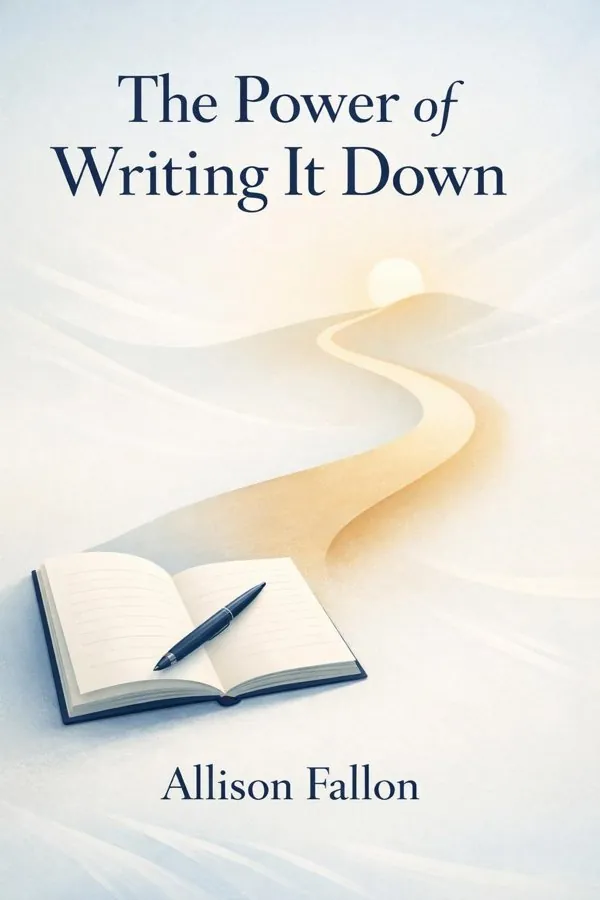
The Power of Writing It Down: A Simple Habit to Unlock Your Brain and Reimagine Your Life: Summary & Key Insights
 10 min11 chaptersAudio available
What Is The Power of Writing It Down: A Simple Habit to Unlock Your Brain and Reimagine Your Life About?
The Power of Writing It Down: A Simple Habit to Unlock Your Brain and Reimagine Your Life by Allison Fallon is a writing book spanning 11 pages. In this book, author and writing coach Allison Fallon explores how the simple act of writing can transform your thinking, emotional health, and personal growth. Drawing from neuroscience, psychology, and her own coaching experience, Fallon shows readers how daily writing can help clarify goals, process emotions, and unlock creativity. The book provides practical guidance for developing a consistent writing habit that leads to greater self-awareness and life satisfaction.
This FizzRead summary covers all 11 key chapters of The Power of Writing It Down: A Simple Habit to Unlock Your Brain and Reimagine Your Life in approximately 10 minutes, distilling the most important ideas, arguments, and takeaways from Allison Fallon's work. Also available as an audio summary and Key Quotes Podcast.
The Power of Writing It Down: A Simple Habit to Unlock Your Brain and Reimagine Your Life
In this book, author and writing coach Allison Fallon explores how the simple act of writing can transform your thinking, emotional health, and personal growth. Drawing from neuroscience, psychology, and her own coaching experience, Fallon shows readers how daily writing can help clarify goals, process emotions, and unlock creativity. The book provides practical guidance for developing a consistent writing habit that leads to greater self-awareness and life satisfaction.
Who Should Read The Power of Writing It Down: A Simple Habit to Unlock Your Brain and Reimagine Your Life?
This book is perfect for anyone interested in writing and looking to gain actionable insights in a short read. Whether you're a student, professional, or lifelong learner, the key ideas from The Power of Writing It Down: A Simple Habit to Unlock Your Brain and Reimagine Your Life by Allison Fallon will help you think differently.
- ✓Readers who enjoy writing and want practical takeaways
- ✓Professionals looking to apply new ideas to their work and life
- ✓Anyone who wants the core insights of The Power of Writing It Down: A Simple Habit to Unlock Your Brain and Reimagine Your Life in just 10 minutes
Want the full summary?
Get instant access to this book summary and 100K+ more with Fizz Moment.
Get Free SummaryAvailable on App Store • Free to download
Key Chapters
When I first became curious about why writing was so powerful, I turned to the growing body of research in psychology and neuroscience. What I found was clear evidence that writing externally structures our internal world. The human brain is built to process story; our memories, emotions, and even our problem-solving capacities rely on narrative. When we put experiences into words, the brain organizes and integrates them, giving us distance from painful emotions while strengthening neural connections between the logical left hemisphere and the emotional right.
Researchers in expressive writing, like Dr. James Pennebaker, have demonstrated that writing regularly about emotions can lower stress, boost immune function, and improve cognitive clarity. Why? Because language gives name and order to what is otherwise an unregulated swarm of sensations. Writing slows your thinking, separating the emotional charge from the reflective act. You begin to see not just what happened, but what it means. Over time, this practice changes brain activity: more coherence across hemispheres, stronger prefrontal regulation, and more adaptive responses to stress. Writing is, in this sense, a form of neuroplastic training—rewiring your brain for integration and wellness.
Beyond neuroscience, psychology affirms that journaling supports self-regulation and narrative identity. We all construct stories about ourselves, and when those stories remain unexamined, they govern our choices unconsciously. Writing brings those internal scripts to light. By articulating them, you take ownership of your internal narrative instead of being controlled by it. The page becomes a safe container where chaos turns to order and memory becomes insight.
So when you sit down to write, don’t think of it as recording life’s trivia. Think of it as activating your brain’s natural repair mechanisms. Each sentence you form gives structure to the emotional and cognitive processes that shape the rest of your life.
Every human life runs on story. We make sense of who we are by the narratives we tell about what has happened to us. But not all stories are created equal; some stories liberate, others imprison. The question is not whether you have a story—it’s whether your story serves the person you are becoming.
For years, I coached people who felt stuck in patterns they couldn’t explain. As they wrote, certain sentences would surface—phrases like, “I’m not good enough,” or “Things never work out for me.” These were not facts but inherited storylines. Once they saw them in writing, they could question them and choose another language altogether. Writing your story makes it visible. It gives you the tools to revision it.
The act of storytelling in writing is deeply connected to identity formation. When you write your memories, you’re not just chronicling what happened; you are actively shaping how those events live in your mind. Versions of yourself that felt powerless can be re-seen as resilient. Painful endings can be revealed as turning points. In my own life, writing was the way I made peace with transitions I never asked for—losses, disappointments, and rerouted dreams. The more I wrote, the more compassion I found for who I had been.
Writing your story is not about self-indulgence; it’s about self-coherence. When your internal narrative aligns with your truth, you feel grounded. You begin to act from intention instead of reaction. Through writing, you become both author and character of your life, bridging the gap between who you were and who you want to be.
+ 9 more chapters — available in the FizzRead app
All Chapters in The Power of Writing It Down: A Simple Habit to Unlock Your Brain and Reimagine Your Life
About the Author
Allison Fallon is an author, speaker, and writing coach who has helped thousands of people use writing as a tool for personal transformation. She is the founder of Find Your Voice, a company dedicated to helping individuals tell their stories and discover their purpose through writing.
Get This Summary in Your Preferred Format
Read or listen to the The Power of Writing It Down: A Simple Habit to Unlock Your Brain and Reimagine Your Life summary by Allison Fallon anytime, anywhere. FizzRead offers multiple formats so you can learn on your terms — all free.
Available formats: App · Audio · PDF · EPUB — All included free with FizzRead
Download The Power of Writing It Down: A Simple Habit to Unlock Your Brain and Reimagine Your Life PDF and EPUB Summary
Key Quotes from The Power of Writing It Down: A Simple Habit to Unlock Your Brain and Reimagine Your Life
“When I first became curious about why writing was so powerful, I turned to the growing body of research in psychology and neuroscience.”
“We make sense of who we are by the narratives we tell about what has happened to us.”
Frequently Asked Questions about The Power of Writing It Down: A Simple Habit to Unlock Your Brain and Reimagine Your Life
The Power of Writing It Down: A Simple Habit to Unlock Your Brain and Reimagine Your Life by Allison Fallon is a writing book that explores key ideas across 11 chapters. In this book, author and writing coach Allison Fallon explores how the simple act of writing can transform your thinking, emotional health, and personal growth. Drawing from neuroscience, psychology, and her own coaching experience, Fallon shows readers how daily writing can help clarify goals, process emotions, and unlock creativity. The book provides practical guidance for developing a consistent writing habit that leads to greater self-awareness and life satisfaction.
You Might Also Like

The Art of Perspective
Christopher Castellani
10 min
Making a Point: The Persnickety Story of English Punctuation
David Crystal
10 min
The Elements Of Eloquence: How To Turn The Perfect English Phrase
Mark Forsyth
10 min
The Pocket Muse: Ideas and Inspirations for Writing
Monica Wood
10 min
A Little Book on Form: An Exploration into the Formal Imagination of Poetry
Robert Hass
10 min
Adventures In The Screen Trade: A Personal View Of Hollywood And Screenwriting
William Goldman
10 minBrowse by Category
Ready to read The Power of Writing It Down: A Simple Habit to Unlock Your Brain and Reimagine Your Life?
Get the full summary and 100K+ more books with Fizz Moment.