
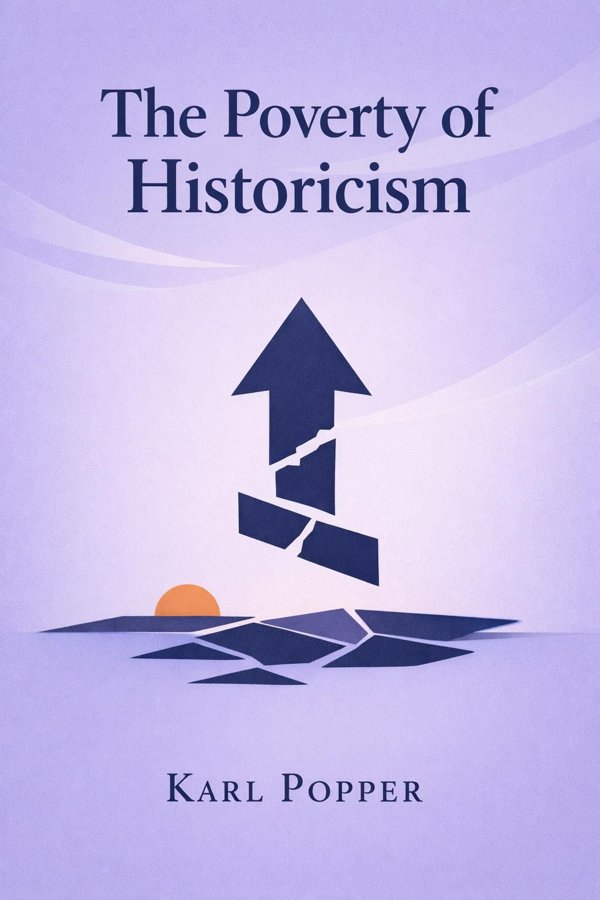
The Poverty of Historicism: Summary & Key Insights
by Karl Popper
 10 min9 chaptersAudio available
Key Takeaways from The Poverty of Historicism
One of Popper’s most provocative claims is that bad political thinking often begins with bad ideas about method.
The desire to predict history is not just intellectually ambitious; it is psychologically seductive.
A powerful explanation does not have to be a prophecy.
The more total a theory sounds, the more suspicious Popper wants us to become.
Popper does not throw out the idea of social regularities; he carefully limits what they can mean.
What Is The Poverty of Historicism About?
The Poverty of Historicism by Karl Popper is a western_phil book spanning 9 pages. What if the biggest political mistakes begin with the claim that history has a script? In The Poverty of Historicism, Karl Popper challenges one of the most influential assumptions in modern philosophy and politics: the belief that history unfolds according to discoverable laws that allow us to predict the future of society. Against thinkers who claim to foresee inevitable stages of human development, Popper argues that social life is too open, complex, and shaped by changing knowledge to be captured by historical prophecy. This is not merely an abstract debate. For Popper, historicism has dangerous consequences because it encourages political movements to treat their programs as historically necessary, and dissent as irrational or reactionary. The result can be dogmatism, coercion, and even totalitarianism. Popper writes with the authority of one of the twentieth century’s most important philosophers of science and defenders of liberal democracy. Drawing on his broader commitment to critical rationalism, he shows why social inquiry should aim not at prophecy but at explanation, criticism, and cautious reform. The book remains essential for anyone interested in politics, history, social science, and the defense of an open society.
This FizzRead summary covers all 9 key chapters of The Poverty of Historicism in approximately 10 minutes, distilling the most important ideas, arguments, and takeaways from Karl Popper's work. Also available as an audio summary and Key Quotes Podcast.
The Poverty of Historicism
What if the biggest political mistakes begin with the claim that history has a script? In The Poverty of Historicism, Karl Popper challenges one of the most influential assumptions in modern philosophy and politics: the belief that history unfolds according to discoverable laws that allow us to predict the future of society. Against thinkers who claim to foresee inevitable stages of human development, Popper argues that social life is too open, complex, and shaped by changing knowledge to be captured by historical prophecy. This is not merely an abstract debate. For Popper, historicism has dangerous consequences because it encourages political movements to treat their programs as historically necessary, and dissent as irrational or reactionary. The result can be dogmatism, coercion, and even totalitarianism. Popper writes with the authority of one of the twentieth century’s most important philosophers of science and defenders of liberal democracy. Drawing on his broader commitment to critical rationalism, he shows why social inquiry should aim not at prophecy but at explanation, criticism, and cautious reform. The book remains essential for anyone interested in politics, history, social science, and the defense of an open society.
Who Should Read The Poverty of Historicism?
This book is perfect for anyone interested in western_phil and looking to gain actionable insights in a short read. Whether you're a student, professional, or lifelong learner, the key ideas from The Poverty of Historicism by Karl Popper will help you think differently.
- ✓Readers who enjoy western_phil and want practical takeaways
- ✓Professionals looking to apply new ideas to their work and life
- ✓Anyone who wants the core insights of The Poverty of Historicism in just 10 minutes
Want the full summary?
Get instant access to this book summary and 100K+ more with Fizz Moment.
Get Free SummaryAvailable on App Store • Free to download
Key Chapters
The desire to predict history is not just intellectually ambitious; it is psychologically seductive. People want reassurance that the chaos of events conceals an intelligible pattern. Historicism promises exactly that by claiming that history unfolds according to discoverable laws, enabling prophets of society to forecast revolutions, collapses, or final stages of development. Popper thinks this promise is deeply misguided. The future of society depends in part on the future growth of human knowledge, and future knowledge cannot be predicted in advance without contradiction. If we could already know tomorrow’s discoveries today, they would no longer count as genuinely new discoveries.
This insight undercuts the central aspiration of historicism. Technological inventions, scientific breakthroughs, moral shifts, and cultural transformations reshape social possibilities in ways no grand theory can foresee. Few could have predicted how the internet would alter politics, work, relationships, and attention. Likewise, earlier societies could not have anticipated the exact consequences of industrialization, antibiotics, or nuclear weapons. Since knowledge changes history, and since knowledge grows unpredictably, history as a whole cannot be scientifically prophesied.
Popper does not deny that some forecasts are possible. We can predict eclipses far better than elections, and we can often estimate the probable effects of a policy under defined conditions. But those are conditional, limited predictions, not revelations of destiny.
In everyday life, this matters whenever people treat trend analysis as certainty. A company may assume automation will inevitably eliminate one class of jobs, or a political movement may insist demographic change guarantees victory. Such claims overlook feedback effects, innovation, adaptation, and surprise.
Actionable takeaway: replace deterministic forecasts with conditional thinking. Instead of asking, “What must happen?” ask, “What might happen under these specific assumptions, and what could disrupt them?”
A powerful explanation does not have to be a prophecy. Popper insists that understanding the past is different from predicting the entire future. Historicists often blur this distinction. They believe that if we can explain why an event happened, we must be uncovering a law that also reveals where history is headed. Popper rejects that leap. Historical explanation often works by reconstructing a situation: the goals of actors, the institutions they operated within, the information available to them, and the unintended consequences of their choices.
This situational logic is especially useful in social science. For example, a government may impose price controls to help consumers, only to create shortages because producers have less incentive to supply goods. Explaining this does not require a philosophy of history. It requires understanding incentives, institutional constraints, and human responses. Similarly, explaining the fall of a political regime may involve economic stress, elite conflict, public distrust, and communication breakdowns—not a prewritten law of historical succession.
Popper’s point is liberating. It means historians and social scientists need not chase grand narratives to do serious work. They can aim at modest, testable explanations of specific events and mechanisms. This approach also encourages revision. If new evidence appears, the explanation can be improved without collapsing an entire worldview.
The practical lesson extends beyond academia. In organizations, families, and public debate, people often explain outcomes by invoking vague “inevitable trends” rather than concrete causes. A failed project gets blamed on “the times” instead of poor coordination. A political upset gets explained by “history turning” instead of identifiable campaign errors.
Actionable takeaway: when trying to understand a social event, focus on actors, incentives, institutions, and unintended consequences before appealing to sweeping historical narratives.
The more total a theory sounds, the more suspicious Popper wants us to become. Historicist systems often gain prestige because they appear to organize the disorder of history into a meaningful whole. They promise to reveal the hidden engine beneath wars, economies, revolutions, and moral change. Yet Popper argues that these grand theories are often so vague, elastic, or selective that they can absorb almost any event. A theory that explains everything may in practice explain nothing.
This criticism connects to Popper’s larger philosophy of science. A serious theory should expose itself to refutation by making claims that could, in principle, be shown false. Historicist doctrines often evade this discipline. If the predicted revolution does not arrive, believers may say the conditions are not yet mature. If events move in the opposite direction, they may reinterpret the reversal as part of the deeper dialectic. Such flexibility protects the theory at the cost of explanatory honesty.
Popper is not accusing all large-scale thinking of bad faith. Rather, he is warning that the search for historical inevitability encourages intellectual irresponsibility. Once people believe they possess the key to history, they stop treating contrary evidence as evidence. They begin treating it as noise, delay, or ideological resistance.
This dynamic appears everywhere. In business, leaders may cling to a narrative that their industry is entering an inevitable consolidation phase, ignoring evidence that smaller, more adaptive competitors are thriving. In politics, activists may insist a nation is inevitably progressing or collapsing, reading every event as confirmation.
Actionable takeaway: test broad social theories by asking what evidence would actually disprove them. If no imaginable evidence counts against a theory, treat it as ideology rather than reliable explanation.
At the core of Popper’s case lies a simple but devastating point: history depends on the growth of human knowledge, and the growth of knowledge is inherently unpredictable. This argument gives historicism its deepest philosophical challenge. Every major social transformation is intertwined with discoveries, inventions, reinterpretations, and new forms of understanding. Because we cannot know today what we will only discover tomorrow, we cannot map the long-term course of history as if it were already fixed.
Consider how a single innovation can reorder institutions. The printing press altered religion, literacy, and political authority. Electricity transformed industry and domestic life. Digital networks changed commerce, media, and social movements. These changes were not merely additions to an existing path; they reconfigured what future paths were possible. Historicist theories often look persuasive only in retrospect, after surprise has already been absorbed into a tidy narrative.
Popper’s insight also challenges fatalism in personal and collective life. If knowledge can grow in unforeseeable ways, then societies are more open than deterministic theories admit. New ideas can create alternatives that earlier frameworks did not recognize. This means reform, criticism, and creativity matter. It also means humility is rational, not weak.
In practical terms, institutions should be designed to adapt to surprise. Schools should teach problem-solving, not just inherited doctrine. Businesses should preserve flexibility rather than commit everything to one forecast. Democracies should protect free inquiry because new knowledge is one of the main forces that changes society.
Actionable takeaway: build plans and institutions around adaptability. Assume that genuinely important new knowledge will emerge in ways you cannot fully predict, and prepare to revise your beliefs when it does.
For Popper, the alternative to historicism is not skepticism or cynicism, but critical rationalism. This is the discipline of advancing ideas boldly while remaining willing to test, criticize, and revise them. In science, it means proposing hypotheses that can be challenged. In politics, it means preferring institutions that expose decisions to scrutiny and allow peaceful correction. Critical rationalism rejects the fantasy of certainty without surrendering the pursuit of truth.
This matters because historicism offers comfort through inevitability, while critical rationalism offers responsibility through fallibility. If no one can know the whole course of history, then citizens and leaders must proceed experimentally. They must compare evidence, tolerate criticism, and learn from mistakes. This is intellectually demanding, but it is also morally superior because it respects other people as participants in inquiry rather than objects to be managed.
The practical applications are wide-ranging. In public policy, critical rationalism supports pilot programs, transparency, and independent evaluation. In organizations, it encourages cultures where bad news can travel upward and assumptions can be challenged without punishment. In personal life, it means replacing identity-based certainty with a habit of testing your own beliefs against reality.
Popper’s deeper message is that freedom and criticism belong together. A society that silences criticism loses one of its main tools for discovering error. Conversely, a society that protects criticism increases its capacity for peaceful self-correction.
Actionable takeaway: adopt a rule for your own thinking and your institutions: make claims clear enough to be tested, invite criticism early, and treat error not as humiliation but as the beginning of improvement.
All Chapters in The Poverty of Historicism
About the Author
Karl Popper (1902–1994) was an Austrian-born British philosopher whose work reshaped both the philosophy of science and modern political thought. He is best known for arguing that scientific theories must be falsifiable, meaning they should make claims that can be tested and potentially disproved. This idea became one of the most influential principles in twentieth-century philosophy of science. Popper was also a passionate defender of liberal democracy, individual freedom, and what he called the “open society,” a society sustained by criticism, pluralism, and reform rather than dogma or historical destiny. After leaving Austria amid the rise of totalitarianism, he taught in New Zealand and later at the London School of Economics. His major works include The Logic of Scientific Discovery, The Open Society and Its Enemies, and The Poverty of Historicism.
Get This Summary in Your Preferred Format
Read or listen to the The Poverty of Historicism summary by Karl Popper anytime, anywhere. FizzRead offers multiple formats so you can learn on your terms — all free.
Available formats: App · Audio · PDF · EPUB — All included free with FizzRead
Download The Poverty of Historicism PDF and EPUB Summary
Key Quotes from The Poverty of Historicism
“One of Popper’s most provocative claims is that bad political thinking often begins with bad ideas about method.”
“The desire to predict history is not just intellectually ambitious; it is psychologically seductive.”
“A powerful explanation does not have to be a prophecy.”
“The more total a theory sounds, the more suspicious Popper wants us to become.”
“Popper does not throw out the idea of social regularities; he carefully limits what they can mean.”
Frequently Asked Questions about The Poverty of Historicism
The Poverty of Historicism by Karl Popper is a western_phil book that explores key ideas across 9 chapters. What if the biggest political mistakes begin with the claim that history has a script? In The Poverty of Historicism, Karl Popper challenges one of the most influential assumptions in modern philosophy and politics: the belief that history unfolds according to discoverable laws that allow us to predict the future of society. Against thinkers who claim to foresee inevitable stages of human development, Popper argues that social life is too open, complex, and shaped by changing knowledge to be captured by historical prophecy. This is not merely an abstract debate. For Popper, historicism has dangerous consequences because it encourages political movements to treat their programs as historically necessary, and dissent as irrational or reactionary. The result can be dogmatism, coercion, and even totalitarianism. Popper writes with the authority of one of the twentieth century’s most important philosophers of science and defenders of liberal democracy. Drawing on his broader commitment to critical rationalism, he shows why social inquiry should aim not at prophecy but at explanation, criticism, and cautious reform. The book remains essential for anyone interested in politics, history, social science, and the defense of an open society.
More by Karl Popper

You Might Also Like

A Little History of Philosophy
Nigel Warburton
10 min
Areopagitica
John Milton
10 min
How To Think Like A Philosopher: Essential Principles For Clear Thinking
Peter Cave
10 min
Language, Truth and Logic
A. J. Ayer
10 min
The Age of Reason
Thomas Paine
10 min
The Essays
Michel De Montaigne
10 minBrowse by Category
Ready to read The Poverty of Historicism?
Get the full summary and 100K+ more books with Fizz Moment.