
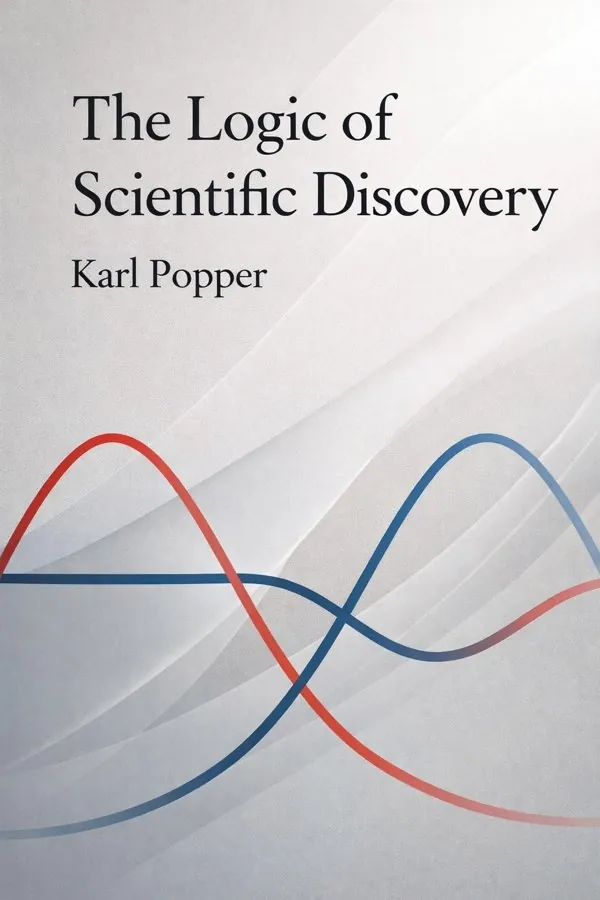
The Logic of Scientific Discovery: Summary & Key Insights
by Karl Popper
 10 min9 chaptersAudio available
Key Takeaways from The Logic of Scientific Discovery
One of Popper’s most important starting points is that science does not begin with pure, neutral observation.
A theory earns scientific status not because it can be confirmed, but because it can be contradicted.
Progress in science is less like stacking bricks and more like surviving criticism.
Surviving tests is impressive, but it is not the same as being verified forever.
Human knowledge grows not because we become infallible, but because we become better at finding and correcting mistakes.
What Is The Logic of Scientific Discovery About?
The Logic of Scientific Discovery by Karl Popper is a western_phil book spanning 5 pages. What makes science genuinely scientific? In The Logic of Scientific Discovery, Karl Popper offers one of the most influential answers in modern philosophy: science advances not by proving ideas true, but by exposing them to the risk of being proven false. First published in German in 1935 and later expanded in English, this landmark work challenged the dominant belief that scientific knowledge grows through verification and accumulation of positive evidence. Popper argued instead that no number of confirming observations can finally establish a universal theory, while a single genuine counterexample can force us to revise or abandon it. This insight reshaped the philosophy of science, introducing falsifiability as the criterion that separates science from pseudoscience. Popper shows that real scientific theories are bold, testable, and vulnerable to refutation. His argument matters far beyond laboratories: it offers a model of intellectual honesty, disciplined criticism, and continuous learning. As one of the twentieth century’s most important philosophers, Popper wrote with unusual rigor and ambition, giving readers not just a theory of science, but a method for thinking clearly in any field where truth matters.
This FizzRead summary covers all 9 key chapters of The Logic of Scientific Discovery in approximately 10 minutes, distilling the most important ideas, arguments, and takeaways from Karl Popper's work. Also available as an audio summary and Key Quotes Podcast.
The Logic of Scientific Discovery
What makes science genuinely scientific? In The Logic of Scientific Discovery, Karl Popper offers one of the most influential answers in modern philosophy: science advances not by proving ideas true, but by exposing them to the risk of being proven false. First published in German in 1935 and later expanded in English, this landmark work challenged the dominant belief that scientific knowledge grows through verification and accumulation of positive evidence. Popper argued instead that no number of confirming observations can finally establish a universal theory, while a single genuine counterexample can force us to revise or abandon it.
This insight reshaped the philosophy of science, introducing falsifiability as the criterion that separates science from pseudoscience. Popper shows that real scientific theories are bold, testable, and vulnerable to refutation. His argument matters far beyond laboratories: it offers a model of intellectual honesty, disciplined criticism, and continuous learning. As one of the twentieth century’s most important philosophers, Popper wrote with unusual rigor and ambition, giving readers not just a theory of science, but a method for thinking clearly in any field where truth matters.
Who Should Read The Logic of Scientific Discovery?
This book is perfect for anyone interested in western_phil and looking to gain actionable insights in a short read. Whether you're a student, professional, or lifelong learner, the key ideas from The Logic of Scientific Discovery by Karl Popper will help you think differently.
- ✓Readers who enjoy western_phil and want practical takeaways
- ✓Professionals looking to apply new ideas to their work and life
- ✓Anyone who wants the core insights of The Logic of Scientific Discovery in just 10 minutes
Want the full summary?
Get instant access to this book summary and 100K+ more with Fizz Moment.
Get Free SummaryAvailable on App Store • Free to download
Key Chapters
One of Popper’s most important starting points is that science does not begin with pure, neutral observation. It begins with problems, expectations, and theories. This may seem surprising, because we often imagine scientists first collecting facts and only later building explanations. Popper argues the reverse: what we notice, measure, and test is already shaped by questions we ask and assumptions we bring. Observation is never theory-free.
This matters because many philosophical confusions arise when we blur the line between individual empirical statements and broader theoretical systems. An observation such as “this metal rod expanded when heated” is very different from a theory like thermodynamics. The observation is limited, local, and tied to a specific event. The theory is a universal explanatory framework that reaches far beyond any single case. If we fail to distinguish between these levels, we begin to think science is just a pile of observations rather than a structured attempt to explain reality.
In practice, this insight changes how we evaluate knowledge claims. A doctor does not simply gather symptoms as isolated facts; she interprets them through theories of disease. A climate scientist does not merely record temperature readings; she examines them in relation to models of atmospheric systems. Even everyday decision-making works this way: when you suspect your car battery is dead, you interpret dim headlights and clicking sounds through a working hypothesis.
Popper wants us to see that theories are creative human constructions. They are not read straight from nature; they are proposed, then tested. This means that scientific progress depends not only on careful observation but also on imaginative conjecture. The crucial discipline lies in how these conjectures are criticized.
Actionable takeaway: whenever you encounter a claim presented as “just the facts,” ask what theory or assumption is organizing those facts behind the scenes.
A theory earns scientific status not because it can be confirmed, but because it can be contradicted. This is Popper’s famous criterion of demarcation, and it remains one of his most enduring contributions. Philosophers before him often tried to distinguish science from non-science through verification: if a claim could be supported by observation, it was considered meaningful or scientific. Popper saw a major flaw in this approach. Almost any flexible system can collect supporting examples if it is interpreted loosely enough.
Consider astrology. Its defenders can often find events that seem to fit a horoscope after the fact. Psychoanalytic interpretations can also explain almost any behavior once they are allowed enough interpretive freedom. These systems may appear persuasive because nothing seems to count against them. For Popper, that is precisely the problem. A theory that forbids nothing, predicts nothing risky, and cannot in principle be shown false is not scientific.
By contrast, Einstein’s theory of relativity impressed Popper because it made bold predictions that could have failed. If observations during an eclipse had not matched the theory’s expectations about light bending near the sun, relativity would have faced serious trouble. That vulnerability to refutation gave it scientific character.
Falsifiability does not mean a theory must already be false, nor does it mean scientists should reject every theory at the first difficulty. It means a theory must expose itself to possible failure through clear, testable claims. The more a theory rules out, the more informative it becomes.
This idea is useful well beyond science. In business, a strategy that cannot be evaluated by measurable outcomes becomes empty. In policy, a proposal that explains every result as success cannot be improved. Honest thinking requires conditions under which we admit we were wrong.
Actionable takeaway: define in advance what evidence would count against your belief; if no such evidence exists, you may not be dealing with a genuinely testable idea.
Progress in science is less like stacking bricks and more like surviving criticism. Popper rejects the comforting image that knowledge grows mainly by accumulating confirmations. Instead, he argues that scientists propose bold hypotheses and then subject them to severe tests. A theory survives not because it has been proven true, but because it has not yet been refuted under demanding conditions.
This is the logic of falsification. Universal statements such as “all swans are white” can never be conclusively verified, because future observations might reveal a black swan. But they can be falsified by a single genuine counterexample. That asymmetry gives science its critical edge. Theories remain conjectural, always open to challenge.
Popper’s point is not that science is pessimistic. It is that criticism is productive. By eliminating false theories, we get closer to better explanations. Even failed theories contribute to progress because they reveal where our understanding was weak. This makes error not a disgrace but a tool of discovery.
The practical implications are enormous. In pharmaceutical research, a drug hypothesis is subjected to trials precisely because researchers need opportunities to disconfirm claims about safety or effectiveness. In engineering, stress tests are valuable because they reveal failure points before structures collapse in the real world. In personal life, if you assume a certain study method works best, compare it against alternatives rather than simply noticing the times it seemed useful.
Popper also emphasizes that ad hoc modifications can weaken science. If every failed prediction is rescued by improvised excuses, the theory stops taking real risks. Better science makes itself vulnerable and learns from the result.
Actionable takeaway: treat every important belief as a hypothesis under test, and deliberately seek conditions that could reveal where it fails.
Surviving tests is impressive, but it is not the same as being verified forever. Popper introduces the idea of corroboration to describe theories that have withstood serious attempts at refutation. A corroborated theory has earned provisional confidence, not final certainty. This distinction protects science from dogmatism while still allowing practical trust in well-tested ideas.
Why not simply say that repeated success makes a theory probably true? Popper is wary of turning scientific acceptance into a comfortingly numerical idea. He argues that the logic of universal statements does not allow straightforward verification through repeated instances. A thousand successful tests do not logically guarantee that the next one will also succeed. What matters more is the severity and relevance of the tests a theory has survived.
For example, Newtonian mechanics was highly corroborated for centuries because it explained and predicted a vast range of phenomena. Scientists relied on it for real-world applications with extraordinary success. Yet later evidence showed limits to its scope, and relativity offered a deeper framework. Newton was not useless; he was highly successful within domains where his theory remained reliable. Corroboration captures this practical strength without pretending to absolute truth.
This idea is invaluable in everyday reasoning. A hiring process may corroborate that a candidate is reliable if references, interviews, and work samples all align, but none of this proves future perfection. A financial model may perform well across several market conditions without guaranteeing universal success. Good judgment combines confidence with revisability.
Popper’s lesson is intellectually mature: trust should be earned through testing, and even then it should remain conditional. Theories deserve acceptance when they perform better than competitors under criticism, not because they have crossed some final threshold of proof.
Actionable takeaway: rely on ideas that have survived strong testing, but hold them with confidence proportional to evidence, not with the illusion of certainty.
Human knowledge grows not because we become infallible, but because we become better at finding and correcting mistakes. This is one of the deepest themes in Popper’s philosophy. He replaces the dream of secure foundations with a dynamic process of conjecture and refutation. We propose explanations, criticize them, discard weaker ones, and develop stronger successors. Progress is real, but it is fallible.
This view has a liberating consequence: certainty is not required for learning. In fact, the demand for certainty can paralyze inquiry by making us defend beliefs too rigidly. Popper’s model instead encourages intellectual courage. We can advance by making risky guesses, provided we remain willing to expose them to criticism.
The history of science illustrates this repeatedly. Astronomy advanced not by preserving perfect systems, but by moving from Ptolemy to Copernicus, Kepler, Newton, and Einstein. Each stage involved error, but also improvement. Later theories explained more, predicted better, or accounted for anomalies that earlier frameworks could not. Progress did not require final truth; it required better problem-solving power.
This idea applies to organizations, education, and personal development. A company can improve faster by running experiments that reveal failed assumptions rather than by protecting executive pride. A student learns more deeply by attempting difficult problems and analyzing mistakes than by repeating only familiar exercises. A relationship improves when partners examine recurring misunderstandings instead of insisting they were already right.
Popper’s philosophy is therefore not only about science. It is about a culture of criticism where error is treated as informative rather than shameful. The goal is not to avoid being wrong at all costs, but to build systems that help us discover wrongness early and respond intelligently.
Actionable takeaway: create routines that turn mistakes into feedback, such as postmortems, test runs, or review sessions focused on what failed and why.
Much of traditional philosophy assumed that science rests on induction: we observe many cases, notice a pattern, and infer a universal law. Popper argues that this approach cannot logically justify scientific knowledge. No matter how many times something has happened, it does not follow with certainty that it must always happen. Repetition may encourage expectation, but it does not provide a logical guarantee.
This is the classic problem of induction, sharpened by Popper into a decisive critique. If we say “the sun has risen every day, so it will rise tomorrow,” we are relying on habit, background theory, and practical confidence, not strict logical proof. Scientific laws face the same problem. Countless observations of white swans do not prove that all swans are white. Universal claims outrun finite evidence.
Popper’s alternative is not skepticism for its own sake. He does not conclude that science is impossible. Instead, he shifts the emphasis from trying to justify laws by induction to testing them deductively. From a theory, we derive predictions. If those predictions fail, the theory is challenged. This gives science a rigorous logical structure without pretending that universal truths can be established by accumulation alone.
In practical settings, this insight helps guard against overconfidence. A manager might assume a process is reliable because it worked ten times in a row, but a proper stress test may reveal hidden fragility. An investor may mistake a streak of gains for proof of a winning strategy, overlooking changing conditions. Past success can inform action, but it should never be confused with certainty.
Popper’s critique trains us to separate expectation from justification. We often must act under uncertainty, but wise action acknowledges that future cases may break familiar patterns.
Actionable takeaway: whenever you generalize from repeated success, ask what test could reveal whether the pattern is robust or merely accidental.
Scientific objectivity does not depend on scientists being personally unbiased saints. It depends on methods and institutions that make criticism possible. Popper offers a powerful social understanding of objectivity: because individuals are fallible and often attached to their own ideas, science becomes reliable only when claims are publicly testable, arguments are open to challenge, and results can be independently checked.
This is an important correction to naive images of objectivity as pure detachment. Scientists are human. They have ambitions, loyalties, and blind spots. But science can still produce increasingly reliable knowledge because it organizes inquiry around shared standards of criticism. Peer review, replication, experimental transparency, and open debate all serve this function. They make it harder for error to survive unchallenged.
Think of how this works in practice. If one lab reports a breakthrough but others cannot reproduce it, confidence falls. If a study’s methods are vague or its data inaccessible, the claim is weakened. By contrast, findings that withstand independent scrutiny become more trustworthy. Popper’s point is institutional as much as logical: truth-seeking requires systems that expose claims to hostile testing, not environments that merely reward agreement.
This lesson extends to journalism, governance, and teamwork. A healthy organization is not one in which everyone aligns smoothly with leadership, but one in which assumptions can be challenged without punishment. Strong decisions emerge when dissent is structured, evidence is shared, and bad ideas can be rejected before they become expensive mistakes.
Popper’s philosophy is therefore deeply ethical. It favors openness over authority and criticism over complacency. Objectivity is not the absence of human limitation; it is the disciplined management of it.
Actionable takeaway: build review processes where your ideas must face independent criticism before they guide major decisions.
A strong theory does more than fit known facts; it makes bold, simple, and wide-reaching claims that could easily fail. Popper values simplicity, but not because simpler theories are aesthetically pleasing alone. He values them because genuinely simple theories tend to be more informative. They say more, rule out more possibilities, and therefore take greater risks.
Imagine two explanations for the same phenomenon. One states a clear rule that predicts specific outcomes. The other is padded with exceptions, vague clauses, and rescue devices that can accommodate almost anything. The second may seem safer because it is harder to disprove, but for Popper that is a weakness, not a strength. A theory that can explain every possible result often explains nothing sharply.
This is why ad hoc modifications are dangerous. Suppose a market analyst predicts a stock rise and, when it falls, adds a new condition to save the theory. If every failure can be absorbed this way, the original claim loses testability. In science, good theories compress reality into precise claims that face real danger from evidence. Their simplicity is linked to explanatory power.
Einstein’s relativity again serves as a model. It was mathematically elegant, conceptually unified, and exposed itself to striking tests. Its strength came from the combination of breadth and vulnerability. Many weaker systems remain alive only because they are endlessly adjusted after the fact.
This idea helps in daily reasoning as well. Clear goals, measurable assumptions, and concise explanations are usually more useful than sprawling narratives designed to excuse every outcome. Simplicity should not mean oversimplification, but disciplined commitment to claims that can genuinely be checked.
Actionable takeaway: prefer explanations that make clear, risky predictions over those that stay safe by remaining vague, flexible, or endlessly adjustable.
Not every meaningful idea is scientific, and Popper is careful about this point. His demarcation criterion separates science from non-science, but it does not imply that non-scientific ideas are worthless. Some metaphysical concepts, though not falsifiable themselves, may still guide research, shape imagination, and prepare the way for future scientific theories.
This is a subtle but important distinction. Popper opposes pseudoscience because it masquerades as testable knowledge while avoiding refutation. But he does not dismiss all non-testable thought. Questions about causality, realism, the uniformity of nature, or the basic intelligibility of the world may not be directly falsifiable, yet they can influence scientific practice deeply. They can function as background assumptions, heuristic principles, or philosophical commitments.
For example, the belief that nature is orderly and law-governed is not itself a scientific hypothesis in the ordinary sense. Yet without some version of that belief, systematic inquiry would lose motivation. Likewise, early atomism or speculative cosmological ideas sometimes began as philosophical visions before later becoming more testable. What matters is intellectual honesty about status. A metaphysical idea should not be presented as experimentally confirmed if it is not.
This helps avoid two mistakes: treating science as the only source of meaning, and treating every compelling worldview as scientific. In contemporary life, many debates go wrong because people confuse moral, existential, or metaphysical claims with empirical ones. Popper gives us a cleaner framework. We can respect different kinds of ideas while demanding testability only where scientific authority is being claimed.
Actionable takeaway: distinguish clearly between ideas that inspire inquiry and ideas that have already survived empirical testing, and do not confuse philosophical value with scientific validation.
All Chapters in The Logic of Scientific Discovery
About the Author
Karl Popper (1902–1994) was an Austrian-British philosopher whose work transformed the philosophy of science and political thought. Born in Vienna, he engaged early with mathematics, physics, psychology, and the intellectual currents of interwar Europe. He became internationally famous for arguing that falsifiability, not verification, is the hallmark of scientific theories. This idea reshaped debates about scientific method and the nature of knowledge. After leaving Austria, Popper worked in New Zealand and later at the London School of Economics, where he developed a broad philosophy centered on fallibilism, criticism, and open inquiry. He also became a major defender of liberal democracy in works such as The Open Society and Its Enemies. Today, Popper is remembered as one of the twentieth century’s most influential and wide-ranging philosophers.
Get This Summary in Your Preferred Format
Read or listen to the The Logic of Scientific Discovery summary by Karl Popper anytime, anywhere. FizzRead offers multiple formats so you can learn on your terms — all free.
Available formats: App · Audio · PDF · EPUB — All included free with FizzRead
Download The Logic of Scientific Discovery PDF and EPUB Summary
Key Quotes from The Logic of Scientific Discovery
“One of Popper’s most important starting points is that science does not begin with pure, neutral observation.”
“A theory earns scientific status not because it can be confirmed, but because it can be contradicted.”
“Progress in science is less like stacking bricks and more like surviving criticism.”
“Surviving tests is impressive, but it is not the same as being verified forever.”
“Human knowledge grows not because we become infallible, but because we become better at finding and correcting mistakes.”
Frequently Asked Questions about The Logic of Scientific Discovery
The Logic of Scientific Discovery by Karl Popper is a western_phil book that explores key ideas across 9 chapters. What makes science genuinely scientific? In The Logic of Scientific Discovery, Karl Popper offers one of the most influential answers in modern philosophy: science advances not by proving ideas true, but by exposing them to the risk of being proven false. First published in German in 1935 and later expanded in English, this landmark work challenged the dominant belief that scientific knowledge grows through verification and accumulation of positive evidence. Popper argued instead that no number of confirming observations can finally establish a universal theory, while a single genuine counterexample can force us to revise or abandon it. This insight reshaped the philosophy of science, introducing falsifiability as the criterion that separates science from pseudoscience. Popper shows that real scientific theories are bold, testable, and vulnerable to refutation. His argument matters far beyond laboratories: it offers a model of intellectual honesty, disciplined criticism, and continuous learning. As one of the twentieth century’s most important philosophers, Popper wrote with unusual rigor and ambition, giving readers not just a theory of science, but a method for thinking clearly in any field where truth matters.
More by Karl Popper

You Might Also Like
A Little History of Philosophy
Nigel Warburton
10 min
Areopagitica
John Milton
10 min
How To Think Like A Philosopher: Essential Principles For Clear Thinking
Peter Cave
10 min
Language, Truth and Logic
A. J. Ayer
10 min
The Age of Reason
Thomas Paine
10 min
The Essays
Michel De Montaigne
10 minBrowse by Category
Ready to read The Logic of Scientific Discovery?
Get the full summary and 100K+ more books with Fizz Moment.