
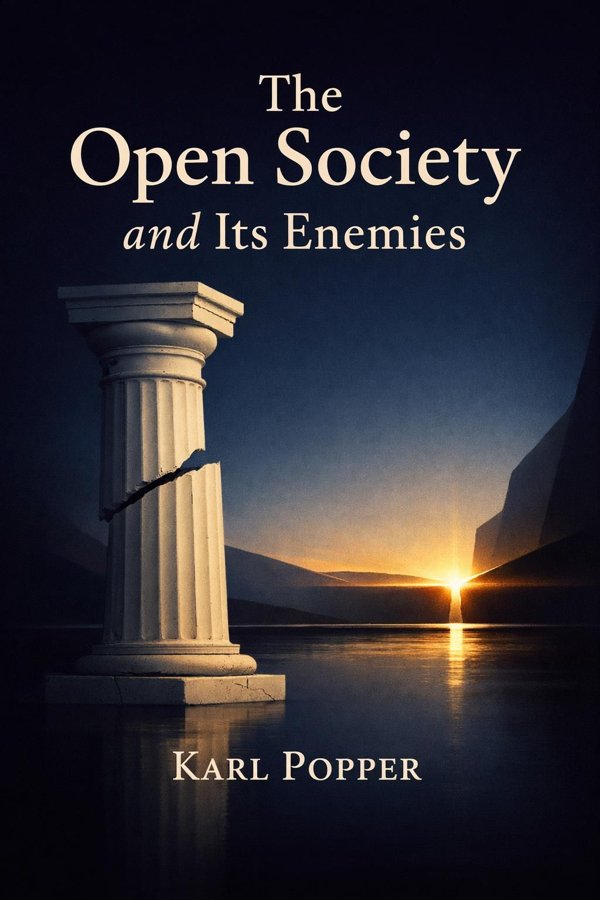
The Open Society and Its Enemies: The Spell of Plato; The High Tide of Prophecy: Hegel, Marx, and the Aftermath: Summary & Key Insights
by Karl Popper
 10 min9 chaptersAudio available
Key Takeaways from The Open Society and Its Enemies: The Spell of Plato; The High Tide of Prophecy: Hegel, Marx, and the Aftermath
A society becomes humane at the moment it allows its own rules to be questioned.
Brilliant ideas can become dangerous when they treat human beings as material for a design.
The most seductive political error is to confuse patterns in history with laws of fate.
A philosophy becomes dangerous when it teaches people to worship success as truth.
A theory can be morally urgent and still politically mistaken.
What Is The Open Society and Its Enemies: The Spell of Plato; The High Tide of Prophecy: Hegel, Marx, and the Aftermath About?
The Open Society and Its Enemies: The Spell of Plato; The High Tide of Prophecy: Hegel, Marx, and the Aftermath by Karl Popper is a western_phil book spanning 12 pages. Karl Popper’s The Open Society and Its Enemies is one of the twentieth century’s most forceful defenses of freedom, democracy, and intellectual humility. Written during the catastrophe of World War II, the book asks a haunting question: how do sophisticated philosophies end up justifying oppression? Popper traces the roots of modern totalitarian thinking to a tradition he calls historicism—the belief that history unfolds according to discoverable laws and that political leaders can shape society by obeying those laws. In two sweeping volumes, he turns a critical eye toward Plato, Hegel, and Marx, arguing that even brilliant thinkers can inspire closed, authoritarian systems when they subordinate individuals to abstract historical destinies. What makes this work endure is not only its critique of grand political theories, but its positive alternative. Popper defends the “open society,” a social order built on free criticism, institutional reform, personal responsibility, and the recognition that human knowledge is always fallible. As one of the most influential philosophers of science and politics, Popper brings unusual authority to this argument. His message remains urgent wherever ideology promises salvation at the cost of liberty.
This FizzRead summary covers all 9 key chapters of The Open Society and Its Enemies: The Spell of Plato; The High Tide of Prophecy: Hegel, Marx, and the Aftermath in approximately 10 minutes, distilling the most important ideas, arguments, and takeaways from Karl Popper's work. Also available as an audio summary and Key Quotes Podcast.
The Open Society and Its Enemies: The Spell of Plato; The High Tide of Prophecy: Hegel, Marx, and the Aftermath
Karl Popper’s The Open Society and Its Enemies is one of the twentieth century’s most forceful defenses of freedom, democracy, and intellectual humility. Written during the catastrophe of World War II, the book asks a haunting question: how do sophisticated philosophies end up justifying oppression? Popper traces the roots of modern totalitarian thinking to a tradition he calls historicism—the belief that history unfolds according to discoverable laws and that political leaders can shape society by obeying those laws. In two sweeping volumes, he turns a critical eye toward Plato, Hegel, and Marx, arguing that even brilliant thinkers can inspire closed, authoritarian systems when they subordinate individuals to abstract historical destinies.
What makes this work endure is not only its critique of grand political theories, but its positive alternative. Popper defends the “open society,” a social order built on free criticism, institutional reform, personal responsibility, and the recognition that human knowledge is always fallible. As one of the most influential philosophers of science and politics, Popper brings unusual authority to this argument. His message remains urgent wherever ideology promises salvation at the cost of liberty.
Who Should Read The Open Society and Its Enemies: The Spell of Plato; The High Tide of Prophecy: Hegel, Marx, and the Aftermath?
This book is perfect for anyone interested in western_phil and looking to gain actionable insights in a short read. Whether you're a student, professional, or lifelong learner, the key ideas from The Open Society and Its Enemies: The Spell of Plato; The High Tide of Prophecy: Hegel, Marx, and the Aftermath by Karl Popper will help you think differently.
- ✓Readers who enjoy western_phil and want practical takeaways
- ✓Professionals looking to apply new ideas to their work and life
- ✓Anyone who wants the core insights of The Open Society and Its Enemies: The Spell of Plato; The High Tide of Prophecy: Hegel, Marx, and the Aftermath in just 10 minutes
Want the full summary?
Get instant access to this book summary and 100K+ more with Fizz Moment.
Get Free SummaryAvailable on App Store • Free to download
Key Chapters
A society becomes humane at the moment it allows its own rules to be questioned. Popper begins from a vast historical contrast: early human communities were largely “closed societies,” bound together by custom, taboo, myth, and unquestioned authority. In such worlds, the individual did not stand apart from the group. Social roles were inherited, norms were sacred, and change was experienced as threat rather than opportunity. These societies could provide cohesion and meaning, but they also restricted personal autonomy and critical thought.
The “open society” emerges when people begin to separate nature from convention and ask whether inherited institutions are justifiable. This shift is revolutionary because it makes reform possible. Laws become human creations rather than divine commands. Leaders become accountable. Citizens gain the right to disagree without being cast as enemies of order. For Popper, Greek philosophy helped trigger this movement, but the transition has always been fragile. Many people still long for the psychological comfort of tribal certainty, especially in times of crisis.
You can see this tension today whenever public debate is framed as a betrayal of the nation, tradition, or identity. In workplaces, families, and politics alike, closed systems discourage criticism by treating loyalty as silence. Open systems do the opposite: they treat criticism as a tool for improvement. A school that invites students to question policies is more open than one that demands obedience. A government that permits opposition parties is more open than one that labels dissent treason.
Actionable takeaway: ask of any institution you belong to—can its rules be criticized without fear? If not, you may be facing the logic of a closed society.
Brilliant ideas can become dangerous when they treat human beings as material for a design. Popper’s reading of Plato is deliberately provocative: he argues that The Republic is not merely an abstract meditation on justice, but a political blueprint with deeply authoritarian features. Plato’s ideal state is hierarchical, ruled by philosopher-kings, structured by rigid class divisions, and dedicated above all to stability. Change is treated as decay, individuality is subordinated to social order, and education becomes a tool for shaping people into predetermined roles.
Popper does not deny Plato’s genius. His concern is that Plato’s political thought emerges from a nostalgic reaction to social breakdown in Athens. Faced with instability, Plato seeks salvation in a frozen social order governed by a wise elite. In this model, rulers claim superior knowledge of the good, while ordinary citizens are expected to obey. Even censorship and political myth can be justified if they preserve harmony.
This matters because many modern ideologies repeat the same temptation. Whenever a movement says society would function perfectly if only the right experts were empowered to override messy democratic disagreement, Plato’s shadow appears. The same pattern shows up in smaller settings too. A manager who believes only top leadership sees the whole truth may suppress feedback in the name of efficiency. A parent may confuse control with wisdom.
Popper’s critique is not that expertise is useless, but that no person or class should be entrusted with unchecked authority on the assumption that they possess final truth. A decent society must build in correction from below.
Actionable takeaway: whenever someone proposes a perfectly ordered system, ask what room it leaves for criticism, dissent, and the possibility that the rulers are mistaken.
The most seductive political error is to confuse patterns in history with laws of fate. Popper calls this error historicism: the belief that history unfolds according to discoverable, inevitable laws and that political wisdom lies in aligning oneself with the future’s predetermined direction. Historicists do not merely study the past. They claim to know where humanity must be heading and to derive political legitimacy from that supposed knowledge.
Popper thinks this is intellectually flawed and politically dangerous. It is flawed because human history depends heavily on the growth of knowledge, and future knowledge cannot be predicted in advance. Scientific discoveries, inventions, cultural shifts, and moral awakenings change the course of events in ways no historical law can fully foresee. It is dangerous because once leaders claim to know history’s destination, they can dismiss objections as backward, irrational, or temporary. Suffering in the present becomes acceptable because it supposedly serves an inevitable future.
Examples are easy to find. A regime may justify repression by claiming it is accelerating national destiny. A company may force painful restructuring by insisting “history demands innovation,” as if its strategy were not a choice but a necessity. Even in personal life, people sometimes adopt miniature historicism: “this is just how things are going, so resistance is pointless.”
Popper’s response is modest but powerful. The future is open because human action and human learning are open. We can identify trends, probabilities, and recurring dangers, but we cannot read history like a script. Politics should therefore be judged by institutions, consequences, and correctability—not by prophetic certainty.
Actionable takeaway: treat all claims about “the inevitable course of history” with skepticism, and ask what evidence, alternatives, and safeguards are being ignored.
A philosophy becomes dangerous when it teaches people to worship success as truth. Popper’s critique of Hegel is among the sharpest parts of the book. He sees Hegel as a master of historicist thinking who transformed obscure metaphysics into a justification for state power. In Popper’s account, Hegel presents history as a rational process unfolding through conflict, contradiction, and the self-realization of Spirit, culminating in the modern state. This lets existing authority appear not merely powerful, but philosophically necessary.
For Popper, the problem is not just style—though he accuses Hegel of needless obscurity—but substance. If the state is treated as the embodiment of historical reason, then criticism of the state becomes criticism of reason itself. Individual persons lose moral priority. Politics becomes sanctified. National power can be dressed up as destiny. Popper connects this to later authoritarian tendencies, especially forms of nationalism and collectivism that elevate the state over the citizen.
This pattern repeats whenever institutions portray themselves as beyond criticism because they embody some higher mission. Bureaucracies do it when they claim procedure itself is wisdom. Political parties do it when they identify themselves with the nation. Corporations do it when they equate shareholder strategy with historical progress. Once power is mystified, accountability weakens.
Popper’s insistence is simple: institutions are human creations, not sacred expressions of historical necessity. Their legitimacy depends on whether they can be criticized, reformed, and restrained. No dialectic, national myth, or grand metaphysical system should shield them from examination.
Actionable takeaway: whenever a leader or institution claims to represent history, reason, or destiny itself, bring the discussion back to concrete questions—who benefits, who is harmed, and how can this power be checked?
A theory can be morally urgent and still politically mistaken. Popper treats Marx more sympathetically than Plato or Hegel because Marx genuinely sought to understand exploitation, class domination, and the suffering produced by industrial capitalism. Popper acknowledges Marx’s penetrating analysis of how economic structures shape social life and how capitalism can generate instability, insecurity, and inequality. These insights gave workers and reformers a language for confronting real injustice.
But Popper argues that Marx’s larger system goes too far. Marx turns historical tendencies into historical necessities. Class struggle becomes the engine of history, capitalism becomes doomed by internal contradictions, and socialism appears as the inevitable next stage. This combines moral passion with predictive certainty, and that combination is dangerous. Once revolution is thought to be historically guaranteed, political judgment can become rigid. Failed predictions are explained away; harsh measures are excused as temporary steps toward emancipation.
Popper also rejects Marx’s confidence that abolishing class society would dissolve major political problems. Power does not disappear when property relations change. New elites, bureaucracies, and forms of coercion can emerge under revolutionary banners. History in the twentieth century made this painfully clear.
Still, Popper does not dismiss Marx altogether. He thinks Marx exposed genuine social problems that liberal societies ignore at their peril. The lesson is not to stop criticizing capitalism, but to criticize it without prophecy. We should address poverty, exploitation, and domination through reforms that can be tested and revised.
Actionable takeaway: separate a thinker’s diagnosis from their determinism—learn from Marx’s critique of injustice without accepting claims that history guarantees one final solution.
The dream of perfect society often becomes a license for political cruelty. One of Popper’s central warnings is against utopian social engineering: the attempt to redesign society according to a comprehensive blueprint aimed at achieving an ideal final state. Utopian projects sound inspiring because they promise harmony, justice, and the end of conflict. But Popper argues that they almost always require concentrated power, suppression of dissent, and large-scale coercion, since real people rarely fit abstract plans.
The logic is straightforward. If leaders are convinced that they know the ultimate destination of history or justice, opposition becomes an obstacle rather than a contribution. Delays become betrayal. Harsh methods become regrettable necessities. Since the goal is total transformation, failures are met not with modest revision but with escalating force. The more ambitious the plan, the greater the temptation to silence criticism.
This is not limited to revolutions. In organizations, leaders sometimes launch sweeping reforms meant to “transform culture” overnight, ignoring local knowledge and punishing skepticism. In cities, planners may impose top-down solutions that displace communities because the map looks cleaner than lived reality. In personal life, people can also pursue impossible total self-reinvention and then respond to setbacks with self-punishment instead of adjustment.
Popper’s alternative is piecemeal social engineering: address concrete problems one by one, evaluate results, preserve the ability to reverse mistakes, and prefer institutions that reduce suffering over schemes that promise perfection. This may sound less heroic, but it is more humane because it respects uncertainty and limits harm.
Actionable takeaway: when evaluating reforms, prefer reversible improvements that solve specific problems over sweeping plans that demand unquestioned faith in a final ideal.
Freedom survives not because people are good, but because institutions allow error to be exposed. Popper’s positive political vision centers on the open society, a society in which no authority is beyond criticism and no political arrangement is treated as final. Its essence is not consensus but corrigibility. People disagree, institutions make mistakes, and policies fail; what matters is whether the system lets us detect and correct those failures without violence.
That is why Popper redefines a core democratic question. Instead of asking, “Who should rule?” he asks, “How can we organize institutions so that bad rulers can be removed without bloodshed?” This shifts political thinking away from ideal leaders and toward constitutional safeguards: elections, separation of powers, a free press, independent courts, protections for minorities, and norms of public argument. The point of democracy is not to install perfect wisdom, but to limit damage and enable peaceful reform.
Open societies also require a cultural habit: tolerating criticism without collapsing into cynicism or fanaticism. In science, hypotheses are tested. In politics, policies should be too. A welfare program, policing strategy, school reform, or tax measure should be open to evidence-based revision. Citizens need not agree on ultimate values to share a commitment to criticism, debate, and institutional restraint.
In daily life, this principle is equally useful. Teams improve when members can challenge bad ideas without fear. Relationships deepen when disagreement is possible without domination. The open society begins in character as much as in law: intellectual humility, willingness to listen, and courage to revise.
Actionable takeaway: strengthen systems that make criticism safe—whether in civic life, work, or home—because freedom depends less on good intentions than on correctable institutions.
We grow wiser not by proving ourselves right, but by making it easier to discover when we are wrong. This is the spirit of Popper’s critical rationalism, the philosophical attitude that unifies his work in science and politics. Human knowledge is fallible. We learn through conjectures, tests, objections, and revisions. No theory, ideology, or leader has privileged access to final truth. What distinguishes rational inquiry is therefore not certainty, but openness to criticism.
In political life, this means abandoning the search for infallible foundations. A policy should not be defended because it follows sacred tradition, historical destiny, or ideological purity. It should be defended provisionally, by arguments and evidence, while remaining open to amendment. Critical rationalism is demanding because it asks us to hold commitments strongly enough to act, yet lightly enough to revise.
This mindset has practical advantages. In public policy, pilot programs and measurable outcomes are better than rhetorical certainty. In business, experiments often outperform rigid master plans. In education, students learn more when they are encouraged to challenge assumptions rather than memorize dogma. Even in personal decision-making, people improve when they ask, “What evidence would show me I’m mistaken?” rather than merely seeking confirmation.
Popper does not suggest that reason eliminates values. We still care about justice, freedom, and reducing suffering. But rational politics recognizes that good ends can be pursued badly, and that institutions must allow us to learn from unintended consequences. The enemy is not conviction; it is conviction armored against criticism.
Actionable takeaway: before defending a belief or policy, identify what evidence, argument, or outcome would lead you to revise it. If nothing could, you are protecting dogma, not practicing reason.
The most compassionate politics often looks less dramatic than revolution. Popper’s defense of piecemeal reform is sometimes misunderstood as timid or unimaginative, but he presents it as an ethically serious response to human fallibility. Because large social systems are complex, interventions produce unintended consequences. The bigger and more irreversible the intervention, the greater the risk of widespread harm. Politics should therefore focus first on reducing concrete suffering rather than imposing total visions of the good.
This approach starts with practical questions: What specific injustice are we trying to address? Which reform can we test? How will we know if it works? Can we reverse or modify it if it fails? By breaking change into manageable steps, societies retain the capacity to learn. Popper prefers the elimination of avoidable misery over the pursuit of abstract perfection because suffering is often easier to identify reliably than ideal happiness.
Examples abound. Rather than remaking an entire healthcare system overnight on ideological grounds, policymakers can expand access through targeted pilots, compare outcomes, and scale what works. Instead of abolishing all existing school structures in pursuit of a perfect model, educators can test curriculum changes district by district. In organizations, iterative improvement usually beats massive restructuring imposed from the top.
Piecemeal reform also has a moral benefit: it reduces the temptation to sacrifice present people for future dreams. Those most harmed by sweeping experiments are usually the powerless. Incrementalism, at its best, is not complacency. It is disciplined, evidence-sensitive courage.
Actionable takeaway: when confronting a major social or personal problem, define the smallest meaningful intervention, test it carefully, and improve step by step rather than betting everything on one grand transformation.
All Chapters in The Open Society and Its Enemies: The Spell of Plato; The High Tide of Prophecy: Hegel, Marx, and the Aftermath
About the Author
Karl Popper (1902–1994) was an Austrian-British philosopher whose work transformed both the philosophy of science and modern political thought. Born in Vienna, he reacted strongly against dogmatism, totalitarianism, and claims to historical inevitability. He became internationally known for his idea of falsifiability, arguing that scientific theories must be open to refutation rather than protected from criticism. This same commitment to fallibility shaped his political philosophy. In The Open Society and Its Enemies, Popper defended liberal democracy, institutional accountability, and gradual reform against authoritarian ideologies and utopian social planning. He taught in New Zealand and later at the London School of Economics, where his ideas influenced generations of scholars. Today he remains one of the most important philosophical advocates of free inquiry, critical debate, and the open society.
Get This Summary in Your Preferred Format
Read or listen to the The Open Society and Its Enemies: The Spell of Plato; The High Tide of Prophecy: Hegel, Marx, and the Aftermath summary by Karl Popper anytime, anywhere. FizzRead offers multiple formats so you can learn on your terms — all free.
Available formats: App · Audio · PDF · EPUB — All included free with FizzRead
Download The Open Society and Its Enemies: The Spell of Plato; The High Tide of Prophecy: Hegel, Marx, and the Aftermath PDF and EPUB Summary
Key Quotes from The Open Society and Its Enemies: The Spell of Plato; The High Tide of Prophecy: Hegel, Marx, and the Aftermath
“A society becomes humane at the moment it allows its own rules to be questioned.”
“Brilliant ideas can become dangerous when they treat human beings as material for a design.”
“The most seductive political error is to confuse patterns in history with laws of fate.”
“A philosophy becomes dangerous when it teaches people to worship success as truth.”
“A theory can be morally urgent and still politically mistaken.”
Frequently Asked Questions about The Open Society and Its Enemies: The Spell of Plato; The High Tide of Prophecy: Hegel, Marx, and the Aftermath
The Open Society and Its Enemies: The Spell of Plato; The High Tide of Prophecy: Hegel, Marx, and the Aftermath by Karl Popper is a western_phil book that explores key ideas across 9 chapters. Karl Popper’s The Open Society and Its Enemies is one of the twentieth century’s most forceful defenses of freedom, democracy, and intellectual humility. Written during the catastrophe of World War II, the book asks a haunting question: how do sophisticated philosophies end up justifying oppression? Popper traces the roots of modern totalitarian thinking to a tradition he calls historicism—the belief that history unfolds according to discoverable laws and that political leaders can shape society by obeying those laws. In two sweeping volumes, he turns a critical eye toward Plato, Hegel, and Marx, arguing that even brilliant thinkers can inspire closed, authoritarian systems when they subordinate individuals to abstract historical destinies. What makes this work endure is not only its critique of grand political theories, but its positive alternative. Popper defends the “open society,” a social order built on free criticism, institutional reform, personal responsibility, and the recognition that human knowledge is always fallible. As one of the most influential philosophers of science and politics, Popper brings unusual authority to this argument. His message remains urgent wherever ideology promises salvation at the cost of liberty.
More by Karl Popper
You Might Also Like
A Little History of Philosophy
Nigel Warburton
10 min
Areopagitica
John Milton
10 min
How To Think Like A Philosopher: Essential Principles For Clear Thinking
Peter Cave
10 min
Language, Truth and Logic
A. J. Ayer
10 min
The Age of Reason
Thomas Paine
10 min
The Essays
Michel De Montaigne
10 minBrowse by Category
Ready to read The Open Society and Its Enemies: The Spell of Plato; The High Tide of Prophecy: Hegel, Marx, and the Aftermath?
Get the full summary and 100K+ more books with Fizz Moment.