
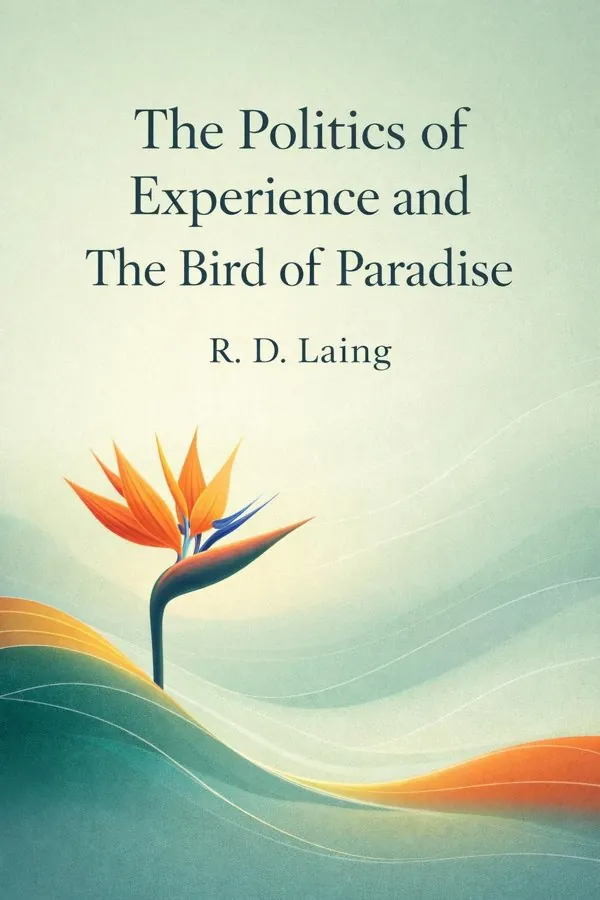
The Politics of Experience and The Bird of Paradise: Summary & Key Insights
by R. D. Laing
 10 min6 chaptersAudio available
What Is The Politics of Experience and The Bird of Paradise About?
The Politics of Experience and The Bird of Paradise by R. D. Laing is a mental_health book spanning 6 pages. Originally published in 1967, this influential work by Scottish psychiatrist R. D. Laing explores the nature of human experience, social alienation, and madness. Laing challenges conventional psychiatric practices and argues that what is often labeled as mental illness may be a meaningful response to an alienating world. The book combines philosophical reflection with psychological insight, offering a radical rethinking of mental health and human consciousness.
This FizzRead summary covers all 6 key chapters of The Politics of Experience and The Bird of Paradise in approximately 10 minutes, distilling the most important ideas, arguments, and takeaways from R. D. Laing's work. Also available as an audio summary and Key Quotes Podcast.
The Politics of Experience and The Bird of Paradise
Originally published in 1967, this influential work by Scottish psychiatrist R. D. Laing explores the nature of human experience, social alienation, and madness. Laing challenges conventional psychiatric practices and argues that what is often labeled as mental illness may be a meaningful response to an alienating world. The book combines philosophical reflection with psychological insight, offering a radical rethinking of mental health and human consciousness.
Who Should Read The Politics of Experience and The Bird of Paradise?
This book is perfect for anyone interested in mental_health and looking to gain actionable insights in a short read. Whether you're a student, professional, or lifelong learner, the key ideas from The Politics of Experience and The Bird of Paradise by R. D. Laing will help you think differently.
- ✓Readers who enjoy mental_health and want practical takeaways
- ✓Professionals looking to apply new ideas to their work and life
- ✓Anyone who wants the core insights of The Politics of Experience and The Bird of Paradise in just 10 minutes
Want the full summary?
Get instant access to this book summary and 100K+ more with Fizz Moment.
Get Free SummaryAvailable on App Store • Free to download
Key Chapters
Every human being knows what it feels like to be split within—to present a face to the world while whispering another truth inside. This is not simply a poetic metaphor; it is the central predicament of modern existence. In our desperate attempts to be acceptable, we construct what I have called a “false self,” a façade that conforms to social expectations while concealing our more vulnerable truth. Beneath it lies the “true self,” the living core of our being, which longs for understanding but fears betrayal.
In clinical practice, I noticed how profoundly this division could shape experience. Many patients described a sense of unreality, as though they were acting a role rather than living a life. This sense was not confined to the so-called psychotic. It is, I believe, a universal human condition intensified by a society that prizes compliance over authenticity. When the distance between the true and false selves becomes unbearable, the individual may break down—not because they are ill, but because the self can no longer sustain the lie.
In this light, what psychiatry calls schizophrenia can be seen as an existential crisis rather than a biological defect. The fragmented speech, the loss of coherence, the retreat into an inner world—all these may be attempts to preserve meaning when the outer world denies it. The therapeutic task, then, is not to suppress these expressions but to listen to them, to find their human sense. Healing begins not through control but through recognition. When we grant the divided self permission to speak, we rediscover what it means to be whole.
If you have ever looked at a sunset and felt nothing, you have already encountered the poverty I write about. The tragedy of modern man is not that he suffers, but that he has lost touch with his own experience. We no longer see what is before us; we see what we have been taught to see. From infancy, our perceptions are trained, categorized, disciplined. The world becomes filtered through social language, which dictates what is meaningful and what must be ignored.
Our senses could be gateways to wonder, yet they are colonized by habit. We inherit a socially constructed reality, so rigid that authentic experience feels like transgression. To feel too deeply is suspect; to question appearances is dangerous. And so the self becomes numb. Psychiatry, in its traditional form, participates in this alienation. It treats symptoms, not meanings. It restores adjustment, not awareness.
But to reclaim the politics of experience, one must reclaim perception itself. This requires unlearning much of what society has taught. It means allowing the ordinary to become luminous again—letting the familiar dissolve into mystery. Madness, at its best, can be a violent attempt to break free from this perceptual prison. It can be a form of spontaneous de-conditioning, a rebellion of the senses. If society cannot tolerate this freedom, it is because it threatens the very structure that keeps experience domesticated. Yet without such freedom, we remain asleep within the illusion of normality.
+ 4 more chapters — available in the FizzRead app
All Chapters in The Politics of Experience and The Bird of Paradise
About the Author
R. D. Laing (Ronald David Laing, 1927–1989) was a Scottish psychiatrist and writer known for his existential and humanistic approach to mental illness. His work questioned traditional psychiatric methods and emphasized understanding the subjective experiences of patients. Laing became a central figure in the anti-psychiatry movement of the 1960s and 1970s.
Get This Summary in Your Preferred Format
Read or listen to the The Politics of Experience and The Bird of Paradise summary by R. D. Laing anytime, anywhere. FizzRead offers multiple formats so you can learn on your terms — all free.
Available formats: App · Audio · PDF · EPUB — All included free with FizzRead
Download The Politics of Experience and The Bird of Paradise PDF and EPUB Summary
Key Quotes from The Politics of Experience and The Bird of Paradise
“Every human being knows what it feels like to be split within—to present a face to the world while whispering another truth inside.”
“If you have ever looked at a sunset and felt nothing, you have already encountered the poverty I write about.”
Frequently Asked Questions about The Politics of Experience and The Bird of Paradise
The Politics of Experience and The Bird of Paradise by R. D. Laing is a mental_health book that explores key ideas across 6 chapters. Originally published in 1967, this influential work by Scottish psychiatrist R. D. Laing explores the nature of human experience, social alienation, and madness. Laing challenges conventional psychiatric practices and argues that what is often labeled as mental illness may be a meaningful response to an alienating world. The book combines philosophical reflection with psychological insight, offering a radical rethinking of mental health and human consciousness.
More by R. D. Laing
You Might Also Like
Big Feelings: How to Be Okay When Things Are Not Okay
Liz Fosslien, Mollie West Duffy
10 min
Creative Arts Therapies Handbook: Art, Music and Dance Therapy Practices for Wellbeing
Susan I. Buchalter
10 min
Emotional First Aid: Healing Rejection, Guilt, Failure, and Other Everyday Hurts
Guy Winch
10 min
Lost Connections: Why You're Depressed and How to Find Hope
Johann Hari
10 min
No Time to Panic: How to Stop Worrying and Embrace Life
Matt Gutman
10 min
Overcoming Mobbing: A Recovery Guide for Workplace Aggression and Bullying
Maureen Duffy, Len Sperry
10 minBrowse by Category
Ready to read The Politics of Experience and The Bird of Paradise?
Get the full summary and 100K+ more books with Fizz Moment.