
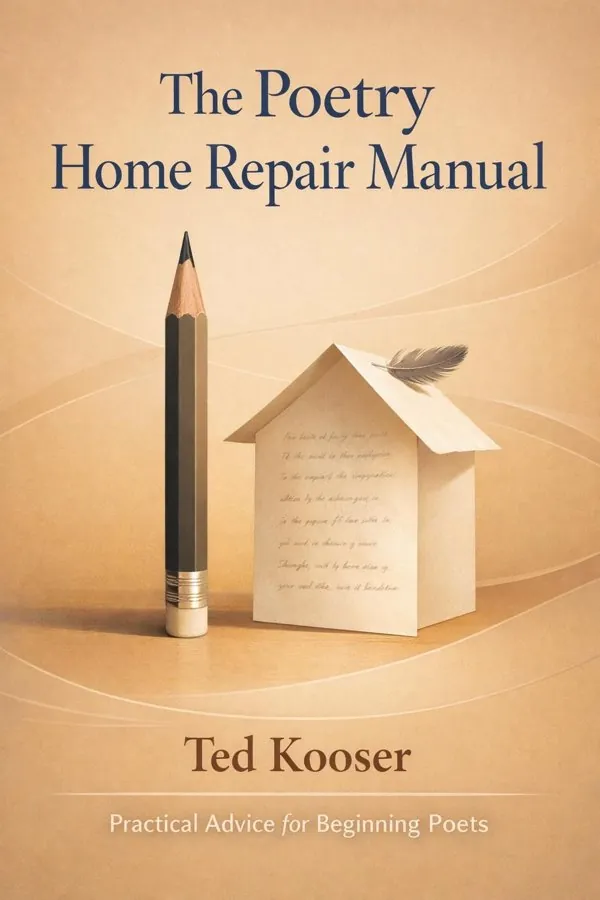
The Poetry Home Repair Manual: Practical Advice for Beginning Poets: Summary & Key Insights
by Ted Kooser
 10 min9 chaptersAudio available
Key Takeaways from The Poetry Home Repair Manual: Practical Advice for Beginning Poets
A poem fails the moment it stops caring whether anyone can enter it.
The everyday world is not a barrier to poetry; it is one of poetry’s richest sources.
A poetic voice is not a costume; it is a way of speaking truthfully on the page.
Emotion in poetry becomes stronger when it is shown through images rather than announced in general terms.
Form is not a cage for thought but a container that shapes it.
What Is The Poetry Home Repair Manual: Practical Advice for Beginning Poets About?
The Poetry Home Repair Manual: Practical Advice for Beginning Poets by Ted Kooser is a writing book spanning 10 pages. Poetry can seem intimidating, as if it belongs to specialists who know hidden rules and obscure references. In The Poetry Home Repair Manual, Ted Kooser dismantles that myth and replaces it with something far more encouraging: poetry as a humane, practical craft that anyone can begin to learn. Rather than treating poems like academic puzzles, Kooser approaches them as acts of attention, feeling, and communication. He shows beginning poets how to notice the world more carefully, shape experience into language, and revise with patience and purpose. What makes this book especially valuable is its tone. Kooser writes like a generous mentor, not a gatekeeper. His guidance is concrete, direct, and grounded in lived experience, offering advice on imagery, voice, sound, structure, revision, titles, and publication without turning poetry into a rigid formula. He urges writers to favor clarity over pretension and emotional honesty over cleverness. Kooser’s authority is considerable. A Pulitzer Prize-winning poet and former U.S. Poet Laureate, he brings decades of reading, writing, and teaching to the page. The result is a reassuring and deeply useful handbook for anyone trying to write poems that truly reach another person.
This FizzRead summary covers all 9 key chapters of The Poetry Home Repair Manual: Practical Advice for Beginning Poets in approximately 10 minutes, distilling the most important ideas, arguments, and takeaways from Ted Kooser's work. Also available as an audio summary and Key Quotes Podcast.
The Poetry Home Repair Manual: Practical Advice for Beginning Poets
Poetry can seem intimidating, as if it belongs to specialists who know hidden rules and obscure references. In The Poetry Home Repair Manual, Ted Kooser dismantles that myth and replaces it with something far more encouraging: poetry as a humane, practical craft that anyone can begin to learn. Rather than treating poems like academic puzzles, Kooser approaches them as acts of attention, feeling, and communication. He shows beginning poets how to notice the world more carefully, shape experience into language, and revise with patience and purpose.
What makes this book especially valuable is its tone. Kooser writes like a generous mentor, not a gatekeeper. His guidance is concrete, direct, and grounded in lived experience, offering advice on imagery, voice, sound, structure, revision, titles, and publication without turning poetry into a rigid formula. He urges writers to favor clarity over pretension and emotional honesty over cleverness.
Kooser’s authority is considerable. A Pulitzer Prize-winning poet and former U.S. Poet Laureate, he brings decades of reading, writing, and teaching to the page. The result is a reassuring and deeply useful handbook for anyone trying to write poems that truly reach another person.
Who Should Read The Poetry Home Repair Manual: Practical Advice for Beginning Poets?
This book is perfect for anyone interested in writing and looking to gain actionable insights in a short read. Whether you're a student, professional, or lifelong learner, the key ideas from The Poetry Home Repair Manual: Practical Advice for Beginning Poets by Ted Kooser will help you think differently.
- ✓Readers who enjoy writing and want practical takeaways
- ✓Professionals looking to apply new ideas to their work and life
- ✓Anyone who wants the core insights of The Poetry Home Repair Manual: Practical Advice for Beginning Poets in just 10 minutes
Want the full summary?
Get instant access to this book summary and 100K+ more with Fizz Moment.
Get Free SummaryAvailable on App Store • Free to download
Key Chapters
A poem fails the moment it stops caring whether anyone can enter it. One of Ted Kooser’s central arguments is that poetry should not be treated as a code designed to exclude ordinary readers. Too many beginners assume that difficulty automatically signals seriousness, so they reach for vague abstractions, private symbols, or complicated language in hopes of sounding literary. Kooser pushes in the opposite direction. He believes the best poems invite a reader in through clarity, precision, and emotional relevance.
This does not mean poetry must be simplistic. It means that a poem should offer a real experience rather than a fog of hints. A strong poem makes the reader see, hear, feel, or remember something. Instead of saying “I felt existential despair in the face of time,” a poet might describe a father folding his dead wife’s apron and placing it in a drawer. The feeling becomes embodied, and therefore more powerful.
Kooser’s practical lesson is that poetry is a form of human exchange. The poet notices something, shapes it, and offers it to another person. Even when a poem is mysterious, its mystery should feel alive and resonant, not merely obscure. Writers should ask: Am I communicating an experience, or hiding behind language? Am I helping the reader enter the poem, or pushing them away?
A useful application is to revise any draft by underlining its abstract nouns and replacing at least some of them with concrete images, actions, or sensory details. If the poem becomes more vivid and moving, you are heading in the right direction.
Actionable takeaway: Write each poem with a real reader in mind, and revise for invitation rather than intimidation.
The everyday world is not a barrier to poetry; it is one of poetry’s richest sources. Kooser encourages beginning poets to stop waiting for dramatic inspiration and start paying attention to the ordinary scenes, objects, and moments that surround them. A rusted mailbox, a grocery receipt, a dog sleeping in sunlight, the smell of wet leaves, or the silence after an argument can all become the seed of a poem. What matters is not the grandeur of the subject but the sharpness of the noticing.
This idea is liberating because it shifts poetry away from performance and toward observation. Many beginners think they need extraordinary experiences before they can write anything meaningful. Kooser argues that meaning is often revealed through close attention to common life. A chipped coffee cup can suggest routine, memory, class, comfort, or loneliness depending on how it is seen. Poetry begins when a writer notices what others overlook.
The practical skill here is disciplined observation. Keep a notebook and record specific details: colors, textures, overheard phrases, weather patterns, gestures, and small incidents. Instead of writing “the street was sad,” write “newspapers swirled around the bus stop bench where one mitten had been left behind.” The second version gives the reader something to experience.
Kooser also implies that writers should trust their own environments. You do not need to imitate another poet’s landscapes or concerns. Your kitchen, neighborhood, job, family rituals, and local weather are enough. In fact, they may be better than borrowed material because they carry your authentic seeing.
Actionable takeaway: Spend ten minutes each day describing one ordinary object or scene in precise sensory detail, and use those notes as poem starters.
A poetic voice is not a costume; it is a way of speaking truthfully on the page. Kooser advises beginners to resist imitation, grandiosity, and artificial eloquence. Many new poets write as though poetry requires them to become someone else: more solemn, more cryptic, more dramatic. But a poem gains power when the language feels earned and believable. Readers respond to authenticity long before they admire technique.
Voice emerges from choices in diction, rhythm, attitude, and perspective. It is shaped by what you notice, how you phrase it, and the emotional stance you take toward your material. A calm, observant voice can be as memorable as a flamboyant one. Kooser’s own example as a poet demonstrates that plain style, when sharpened by precision and sensitivity, can carry tremendous depth.
Practically, this means writing in words you would actually use, then refining them for compression and resonance. If your draft sounds like an imitation of what you think poets sound like, it probably needs to be stripped back. A line like “the cerulean firmament wept celestial grief” may impress no one if it is not natural to your sensibility. “Rain slid down the windshield while she kept driving” may carry more force because it feels lived.
Kooser also suggests that voice is built through repeated practice, not discovered in a flash. The more you write, the more your habits of perception and speech reveal themselves. Reading widely helps, but so does listening to your own cadences.
Actionable takeaway: Read your poem aloud and circle any phrase you would never naturally say; revise until the poem sounds like your most attentive self speaking.
Emotion in poetry becomes stronger when it is shown through images rather than announced in general terms. Kooser places great emphasis on imagery because readers cannot inhabit an abstraction, but they can inhabit a scene. If a poet writes “I was lonely,” the statement may be honest, but it remains flat unless it is given shape. If the poet writes, “I set two plates out before remembering,” loneliness becomes visible and immediate.
This is one of the most practical lessons in the book. Imagery gives the poem body. It anchors emotion in the senses and helps transform private feeling into shared experience. Strong details are usually specific, surprising, and selective. You do not need to describe everything. You need the right details, the ones that imply the emotional and thematic weight of the moment.
Kooser’s approach also teaches restraint. Rather than explaining the meaning after every image, let the image do some of the work. Trust the reader to infer sadness from the untouched pie cooling in a widow’s kitchen, or tension from a child aligning crayons by color while adults whisper in the next room. The image creates atmosphere without overstatement.
A practical exercise is to take an abstract word like grief, joy, fear, envy, or hope and list ten physical manifestations of it: gestures, objects, sounds, weather, posture, household details. Then build the poem from those particulars. This method helps poets escape vague emotional labeling and move into dramatized feeling.
Actionable takeaway: In revision, replace at least three abstract emotional statements with sensory images that allow the reader to feel the emotion for themselves.
Form is not a cage for thought but a container that shapes it. Kooser treats poetic form with practicality rather than dogmatism. He does not insist that beginners master every traditional structure before writing freely, nor does he dismiss formal techniques as outdated. Instead, he argues that line breaks, stanza shape, meter, and pattern should help the poem say what it needs to say in the most effective way possible.
This perspective helps new poets avoid two common mistakes. The first is treating free verse as an excuse for shapelessness. The second is forcing a poem into a rigid form that damages its natural movement. Every formal decision should have a reason. A short line can slow the reader down, create emphasis, or produce tension. A long line can mimic overflow, speech, or accumulation. Stanzas can separate time, thought, or emotional movement.
Kooser’s broader lesson is that poets should become aware of structure as a meaning-making tool. Ask what the poem wants. A meditative lyric might need gentle unfolding. A poem about panic might benefit from abrupt line breaks. A sonnet may sharpen an argument through compression, while a loose narrative poem may need more room to breathe.
One practical application is to print a draft and experiment with different lineations and stanza patterns. Read each version aloud. Notice how pacing, emphasis, and mood change. This makes form tangible rather than theoretical. The goal is not to make the poem look poetic, but to create a structure that reinforces its emotional and rhetorical design.
Actionable takeaway: Before finalizing a poem, test at least two different line and stanza arrangements to find the form that best supports its meaning.
First drafts often contain energy, but rarely excellence. Kooser presents revision as the real workshop of poetry, the place where raw impulse is shaped into art. Beginning poets frequently believe that inspiration should arrive nearly finished, and that heavy revision somehow weakens authenticity. Kooser rejects this romantic myth. A poem can begin in spontaneity, but it matures through re-seeing, cutting, tightening, and clarifying.
Revision involves more than correcting errors. It means asking what the poem is really about, where it comes alive, and where it drifts into explanation, cliché, or excess. Sometimes the strongest line in a draft points to a different poem than the one the writer thought they were making. Revision requires humility and curiosity: a willingness to let the poem teach you what it wants to become.
Kooser’s advice is practical. Remove unnecessary adjectives. Cut decorative language that calls attention to itself. Strengthen verbs. Replace generalizations with particulars. Check whether each line earns its place. If a title gives away too much, revise it. If the ending merely explains the poem, trust the image and stop sooner. Reading aloud is especially useful because awkward phrasing, false notes, and dead spots become easier to hear.
Another helpful strategy is distance. Put the poem away for several days, then return as if you were a reader encountering it for the first time. You will see weak openings, muddy images, or emotional overstatement more clearly.
Actionable takeaway: Treat revision as a separate creative stage, and make at least three focused passes on every poem: one for clarity, one for imagery, and one for sound.
A poem is not only read with the eyes; it is also heard by the inner ear. Kooser reminds beginners that sound is one of poetry’s oldest and most powerful tools. Even in free verse, the arrangement of sounds affects how a poem feels. Rhythm, repetition, consonance, assonance, alliteration, pauses, and sentence flow all contribute to the reader’s experience. Sound can soothe, jar, accelerate, or deepen emotion.
This does not mean every poem must rhyme or sing in obvious ways. In fact, overdone sound effects can feel mechanical. Kooser’s emphasis is subtler: language should be chosen not only for meaning but for music. Consider the difference between “the steel gate slammed shut” and “the metal door closed.” Both communicate an action, but the first has sonic force that supports the event. Harsh consonants can intensify tension; long vowels can create spaciousness or melancholy.
Reading aloud is the best test. A line that looks fine on the page may stumble in the mouth. Repeated weak syllables can flatten momentum. Unintended rhyme can distract. A well-made poem often contains patterns of sound the reader may not consciously analyze but still feels.
For beginners, one useful exercise is to revise a poem with your ear alone. Ignore content for a moment and listen for clunky transitions, monotony, accidental tongue-twisters, or places where sentence rhythm does not match the mood. You can also borrow techniques from music: refrain, variation, contrast, and tempo.
Actionable takeaway: Read every poem aloud at least twice before considering it finished, and revise any line that sounds awkward, flat, or tonally out of place.
The beginning of a poem is a threshold, and titles are part of that doorway. Kooser stresses that titles and opening lines matter because they establish the reader’s first orientation. A weak title can be generic, explanatory, or forgettable. A weak opening can delay the poem’s real energy. Strong beginnings invite curiosity, establish tone, and create momentum from the first moment.
A title can do several jobs. It can provide context, create tension, point toward irony, or frame the poem in a way that enriches the reading. “Morning” tells us little. “Morning, After the Auction” already opens imaginative space. Similarly, a title should not merely repeat the first line unless repetition adds a deliberate effect. It should contribute something.
The opening line should also avoid unnecessary clearing of the throat. Many early drafts begin too soon with exposition or too late with abstraction. Kooser encourages poets to enter close to the moment of heat. Instead of starting with “I remember a difficult summer in my childhood,” try beginning with “The corn curled white under the noon sun.” The second approach places the reader directly in a world.
A practical revision method is to write five alternate titles and three alternate opening lines for every poem. This forces you to think about framing and entry rather than settling for the first thing that occurred to you. Often the right title or opening reveals the poem’s true center.
Actionable takeaway: Revisit your title and first line last, and revise them until they create immediate interest, clarity, and tonal direction.
Many beginners quietly measure their progress by publication, but Kooser offers a healthier perspective: publication is a possible outcome, not the purpose of the art. Writing poems mainly to collect acceptances can distort judgment, encourage imitation, and make discouragement inevitable. The deeper task is to keep improving your powers of attention, craft, and sincerity. Publication may come, but it should not replace the inward standards of good work.
Kooser does not dismiss sharing poems. On the contrary, he values readers, workshops, and literary communities when they are honest and supportive. He also recognizes that submitting to magazines can teach perseverance and professionalism. Still, he suggests that poets should not confuse visibility with value. A rejected poem may still be promising. A published poem is not automatically your best.
This idea extends into what Kooser implies about the poet’s life. To write well, you must cultivate habits: reading deeply, observing closely, revising carefully, and staying patient over time. Poetry is not built on dramatic inspiration alone but on discipline and openness. You do not need a glamorous literary identity. You need steadiness.
A practical application is to balance outward goals with inward ones. Yes, send work out if you wish. But also set goals you control: write three mornings a week, memorize a favorite poem each month, keep an observation journal, revise one old draft every Friday. These habits create a durable writing life.
Actionable takeaway: Judge your growth primarily by the strength of your poems and the consistency of your practice, not by publication alone.
All Chapters in The Poetry Home Repair Manual: Practical Advice for Beginning Poets
About the Author
Ted Kooser is an American poet, essayist, and educator celebrated for his plainspoken style, emotional clarity, and vivid attention to everyday life. Born in Iowa and long associated with Nebraska, he has become one of the most widely admired voices in contemporary American poetry. Kooser served as the 13th Poet Laureate of the United States from 2004 to 2006, a role in which he championed accessible poetry for general readers. He received the Pulitzer Prize for Poetry for Delights & Shadows and has published numerous poetry collections, essays, and books on writing. A longtime teacher and mentor, Kooser is especially respected for helping readers and beginning writers see poetry as a living, approachable craft rooted in observation, sincerity, and precision.
Get This Summary in Your Preferred Format
Read or listen to the The Poetry Home Repair Manual: Practical Advice for Beginning Poets summary by Ted Kooser anytime, anywhere. FizzRead offers multiple formats so you can learn on your terms — all free.
Available formats: App · Audio · PDF · EPUB — All included free with FizzRead
Download The Poetry Home Repair Manual: Practical Advice for Beginning Poets PDF and EPUB Summary
Key Quotes from The Poetry Home Repair Manual: Practical Advice for Beginning Poets
“A poem fails the moment it stops caring whether anyone can enter it.”
“The everyday world is not a barrier to poetry; it is one of poetry’s richest sources.”
“A poetic voice is not a costume; it is a way of speaking truthfully on the page.”
“Emotion in poetry becomes stronger when it is shown through images rather than announced in general terms.”
“Form is not a cage for thought but a container that shapes it.”
Frequently Asked Questions about The Poetry Home Repair Manual: Practical Advice for Beginning Poets
The Poetry Home Repair Manual: Practical Advice for Beginning Poets by Ted Kooser is a writing book that explores key ideas across 9 chapters. Poetry can seem intimidating, as if it belongs to specialists who know hidden rules and obscure references. In The Poetry Home Repair Manual, Ted Kooser dismantles that myth and replaces it with something far more encouraging: poetry as a humane, practical craft that anyone can begin to learn. Rather than treating poems like academic puzzles, Kooser approaches them as acts of attention, feeling, and communication. He shows beginning poets how to notice the world more carefully, shape experience into language, and revise with patience and purpose. What makes this book especially valuable is its tone. Kooser writes like a generous mentor, not a gatekeeper. His guidance is concrete, direct, and grounded in lived experience, offering advice on imagery, voice, sound, structure, revision, titles, and publication without turning poetry into a rigid formula. He urges writers to favor clarity over pretension and emotional honesty over cleverness. Kooser’s authority is considerable. A Pulitzer Prize-winning poet and former U.S. Poet Laureate, he brings decades of reading, writing, and teaching to the page. The result is a reassuring and deeply useful handbook for anyone trying to write poems that truly reach another person.
You Might Also Like
The Art of Perspective
Christopher Castellani
10 min
Making a Point: The Persnickety Story of English Punctuation
David Crystal
10 min
The Elements Of Eloquence: How To Turn The Perfect English Phrase
Mark Forsyth
10 min
The Pocket Muse: Ideas and Inspirations for Writing
Monica Wood
10 min
A Little Book on Form: An Exploration into the Formal Imagination of Poetry
Robert Hass
10 min
Adventures In The Screen Trade: A Personal View Of Hollywood And Screenwriting
William Goldman
10 minBrowse by Category
Ready to read The Poetry Home Repair Manual: Practical Advice for Beginning Poets?
Get the full summary and 100K+ more books with Fizz Moment.