
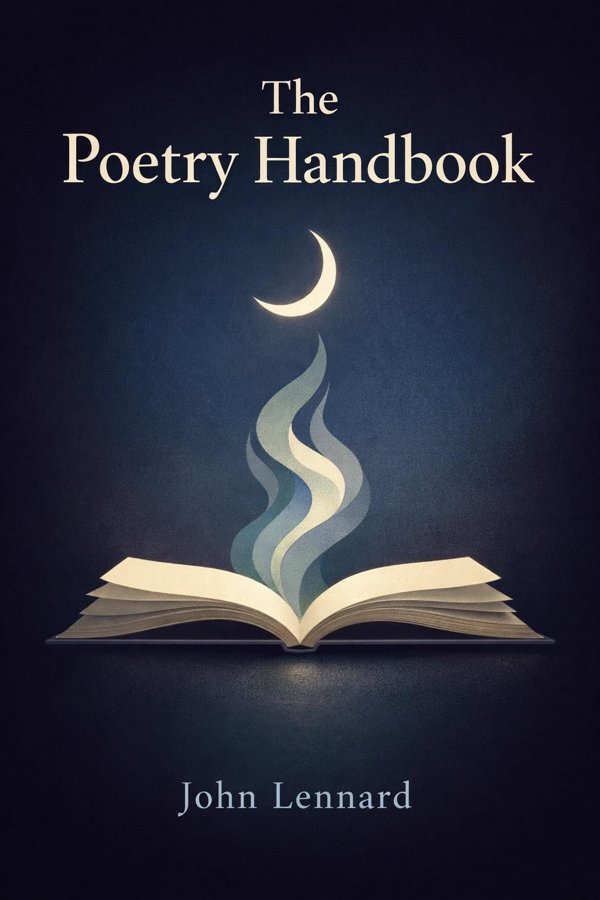
The Poetry Handbook: Summary & Key Insights
by John Lennard
 10 min10 chaptersAudio available
What Is The Poetry Handbook About?
The Poetry Handbook by John Lennard is a education book spanning 10 pages. The Poetry Handbook is a comprehensive guide to reading, understanding, and appreciating poetry. It introduces key poetic forms, techniques, and traditions, offering readers practical tools for analyzing verse from various periods and styles. Written in clear and accessible language, it serves both students and general readers seeking to deepen their engagement with poetry.
This FizzRead summary covers all 10 key chapters of The Poetry Handbook in approximately 10 minutes, distilling the most important ideas, arguments, and takeaways from John Lennard's work. Also available as an audio summary and Key Quotes Podcast.
The Poetry Handbook
The Poetry Handbook is a comprehensive guide to reading, understanding, and appreciating poetry. It introduces key poetic forms, techniques, and traditions, offering readers practical tools for analyzing verse from various periods and styles. Written in clear and accessible language, it serves both students and general readers seeking to deepen their engagement with poetry.
Who Should Read The Poetry Handbook?
This book is perfect for anyone interested in education and looking to gain actionable insights in a short read. Whether you're a student, professional, or lifelong learner, the key ideas from The Poetry Handbook by John Lennard will help you think differently.
- ✓Readers who enjoy education and want practical takeaways
- ✓Professionals looking to apply new ideas to their work and life
- ✓Anyone who wants the core insights of The Poetry Handbook in just 10 minutes
Want the full summary?
Get instant access to this book summary and 100K+ more with Fizz Moment.
Get Free SummaryAvailable on App Store • Free to download
Key Chapters
One must begin by asking, what is poetry? It is too easy to answer grandly that poetry is language at its most intense. In practice, however, poetry is language shaped by deliberate attention to rhythm, sound, and resonance. It condenses experience into patterns that both delight and provoke thought. Poetry differs from prose not merely by brevity or typography but by its heightened density of meaning — by the way each word carries weight beyond its syntax.
In this chapter, I discuss poetry’s relation to ordinary speech. We speak rhythmically every day; poetry amplifies this natural cadence into conscious art. The poet’s task is to create a linguistic event — something inseparable from its form. This means that every decision about meter, rhyme, pause, or line break becomes part of the poem’s total meaning. Poetry is both music and argument.
I emphasize that poetry always exists at the intersection of pattern and freedom. Meter offers predictability; imagination provides deviation. Great poets exploit the tension between these forces. When we read with awareness of that balance, we begin to understand the living pulse of verse: it moves neither mechanically nor chaotically, but harmoniously.
Through examples from English tradition, I show how definition evolves from Chaucer’s storytelling verse to the modernist fragment. A poem is not a puzzle designed to confuse but a composition designed to reward attention. Its purpose is to help language think more deeply than casual discourse allows.
Sound lies at the foundation of poetry’s power. When we speak of rhythm, we mean the ordering of stresses — the heartbeat of language. English, being a stress-timed language, allows poets to use meter as a framework. Whether it is the steady pentameter of Shakespeare or the supple variable lines of free verse, rhythm remains essential because it engages the ear before the intellect.
In this part of the handbook, I teach scansion not as a mechanical exercise but as a means of appreciation. To mark feet and accents is to feel the poem physically. The alternation of stressed and unstressed syllables mirrors emotional tension, creating expectation and release. For instance, when a poet introduces a variation — an inverted foot, a dropped syllable, or a caesura — we perceive it instinctively, even if we cannot name it. Such deviations are deliberate; they guide emphasis and tone.
I also explore how rhythm and meaning interplay. A slow, heavy line suggests gravity or sorrow; a quick, light one evokes motion or wit. Meter is not a cage but a musical score. To read poetry aloud is to re-enact that music. Understanding rhythm enables us to listen for the poet’s emotional intention hidden within form.
+ 8 more chapters — available in the FizzRead app
All Chapters in The Poetry Handbook
About the Author
John Lennard is a British literary scholar and critic known for his work on poetry and drama. He has taught at the University of Cambridge and the Open University, and authored several books on literary analysis and interpretation.
Get This Summary in Your Preferred Format
Read or listen to the The Poetry Handbook summary by John Lennard anytime, anywhere. FizzRead offers multiple formats so you can learn on your terms — all free.
Available formats: App · Audio · PDF · EPUB — All included free with FizzRead
Download The Poetry Handbook PDF and EPUB Summary
Key Quotes from The Poetry Handbook
“One must begin by asking, what is poetry?”
“Sound lies at the foundation of poetry’s power.”
Frequently Asked Questions about The Poetry Handbook
The Poetry Handbook by John Lennard is a education book that explores key ideas across 10 chapters. The Poetry Handbook is a comprehensive guide to reading, understanding, and appreciating poetry. It introduces key poetic forms, techniques, and traditions, offering readers practical tools for analyzing verse from various periods and styles. Written in clear and accessible language, it serves both students and general readers seeking to deepen their engagement with poetry.
You Might Also Like
Bedtime Biography: Florence Nightingale
Isabel Thomas
10 min
Introduction To Museum Studies
Howard H. Hoyt
10 min
A Mind for Numbers: How to Excel at Math and Science (Even If You Flunked Algebra)
Barbara Oakley
10 min
AI for Educators: Learning Strategies, Teacher Empowerment, and the Future of Education
Matt Miller
10 min
Animation For Beginners
Morr Meroz
10 min
Artificial Intelligence for Learning
Donald Clark
10 minBrowse by Category
Ready to read The Poetry Handbook?
Get the full summary and 100K+ more books with Fizz Moment.