
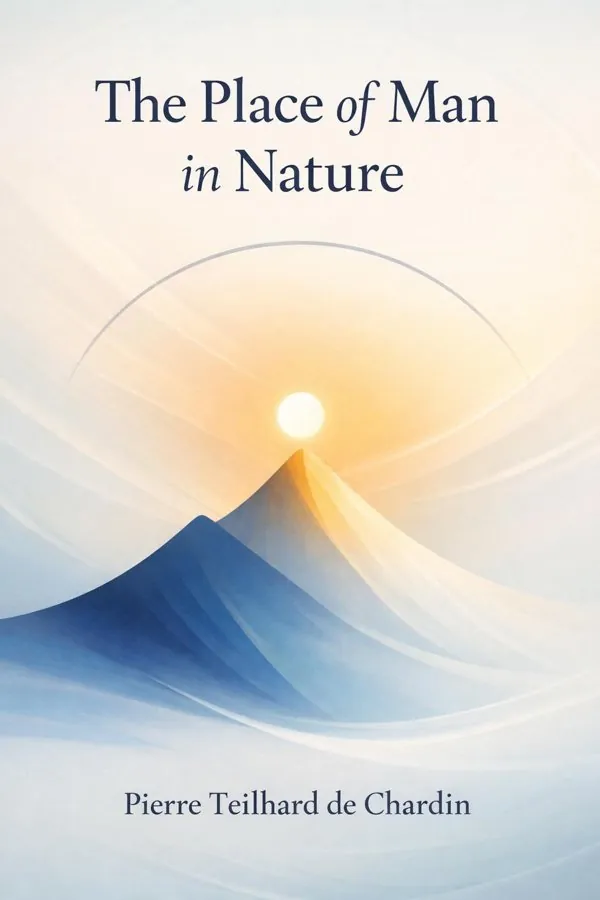
The Place of Man in Nature: Summary & Key Insights
 10 min9 chaptersAudio available
Key Takeaways from The Place of Man in Nature
Before we can understand humanity, we must first widen our lens beyond society, biology, and even Earth itself.
Life is not merely matter arranged differently; it is matter crossing a threshold into organized vitality.
Something radically new appears when evolution produces beings who know that they know.
Human beings are not simply another successful species; they represent a turning point in evolution.
One of Teilhard’s most daring claims is that matter and spirit are not enemies locked in opposition.
What Is The Place of Man in Nature About?
The Place of Man in Nature by Pierre Teilhard de Chardin is a civilization book spanning 9 pages. Pierre Teilhard de Chardin’s The Place of Man in Nature asks one of the oldest and most urgent questions in human thought: where do we belong in the vast unfolding of the universe? Drawing on his work as a paleontologist, philosopher, and Jesuit priest, Teilhard presents a sweeping vision in which matter, life, consciousness, and spirit are not separate realms but stages in a single evolutionary process. Humanity, in his view, is not an accident standing outside nature, but a decisive expression of nature becoming aware of itself. What makes this book enduringly powerful is its bold attempt to reconcile scientific discovery with spiritual meaning. Rather than seeing evolution as a threat to faith, Teilhard interprets it as the very method through which complexity, consciousness, and unity emerge. He introduces influential ideas such as the biosphere, the noosphere, and the Omega Point to show that human beings carry both biological and spiritual significance. For readers interested in civilization, philosophy, science, or religion, this book offers a grand framework for understanding why humanity matters and what direction our collective future may be taking.
This FizzRead summary covers all 9 key chapters of The Place of Man in Nature in approximately 10 minutes, distilling the most important ideas, arguments, and takeaways from Pierre Teilhard de Chardin's work. Also available as an audio summary and Key Quotes Podcast.
The Place of Man in Nature
Pierre Teilhard de Chardin’s The Place of Man in Nature asks one of the oldest and most urgent questions in human thought: where do we belong in the vast unfolding of the universe? Drawing on his work as a paleontologist, philosopher, and Jesuit priest, Teilhard presents a sweeping vision in which matter, life, consciousness, and spirit are not separate realms but stages in a single evolutionary process. Humanity, in his view, is not an accident standing outside nature, but a decisive expression of nature becoming aware of itself.
What makes this book enduringly powerful is its bold attempt to reconcile scientific discovery with spiritual meaning. Rather than seeing evolution as a threat to faith, Teilhard interprets it as the very method through which complexity, consciousness, and unity emerge. He introduces influential ideas such as the biosphere, the noosphere, and the Omega Point to show that human beings carry both biological and spiritual significance. For readers interested in civilization, philosophy, science, or religion, this book offers a grand framework for understanding why humanity matters and what direction our collective future may be taking.
Who Should Read The Place of Man in Nature?
This book is perfect for anyone interested in civilization and looking to gain actionable insights in a short read. Whether you're a student, professional, or lifelong learner, the key ideas from The Place of Man in Nature by Pierre Teilhard de Chardin will help you think differently.
- ✓Readers who enjoy civilization and want practical takeaways
- ✓Professionals looking to apply new ideas to their work and life
- ✓Anyone who wants the core insights of The Place of Man in Nature in just 10 minutes
Want the full summary?
Get instant access to this book summary and 100K+ more with Fizz Moment.
Get Free SummaryAvailable on App Store • Free to download
Key Chapters
Before we can understand humanity, we must first widen our lens beyond society, biology, and even Earth itself. Teilhard argues that the human story only becomes intelligible when placed within the immense history of the cosmos. The universe is not a static container filled with finished things. It is a drama of emergence, a process in which energy condenses into matter, matter organizes into structures, and structures gradually become capable of life and thought. In this perspective, humans are not dropped into an alien world; we are continuous with the long movement that produced stars, planets, cells, and consciousness.
This cosmic framing matters because it changes how we interpret ourselves. If we see the universe as inert and meaningless, then human consciousness appears accidental and fragile. If we see the universe as developmental, however, then consciousness becomes a significant outcome of a deep pattern. Teilhard does not deny material processes; he insists that they reveal increasing complexity over time. The emergence of mind is therefore not a break from nature but one of nature’s highest expressions.
A practical way to apply this insight is to reconsider modern feelings of isolation. Many people experience themselves as detached individuals in an impersonal universe. Teilhard invites us to see ourselves instead as participants in a vast continuum. Scientific education, ecological awareness, and even personal reflection can become richer when we ask not only “What am I?” but “What long process am I part of?”
Actionable takeaway: Regularly place personal concerns in a larger evolutionary context. Whether you are making career, ethical, or civic decisions, ask how your actions contribute to the ongoing human story rather than only to immediate self-interest.
Life is not merely matter arranged differently; it is matter crossing a threshold into organized vitality. Teilhard describes the biosphere as the thin, living envelope of Earth in which chemical elements become cells, organisms, ecosystems, and eventually reflective beings. This idea emphasizes that life is both fragile and astonishingly powerful. From apparently lifeless material conditions, the planet gives rise to self-repair, reproduction, adaptation, and growth. The biosphere marks the moment when Earth ceases to be only geological and becomes biological.
For Teilhard, this emergence is not random clutter but a movement toward greater complexity and interiority. Even the simplest life forms show a new level of organization compared with inert matter. As evolution advances, life does not merely multiply; it differentiates, experiments, and builds increasing complexity. The biosphere is therefore not just a scientific fact but a stage in a larger ascent. It prepares the conditions under which nervous systems, awareness, and eventually human reflection can arise.
This idea has clear contemporary relevance. Environmental crises often stem from treating life as disposable background. Teilhard’s biosphere concept reminds us that all higher human achievements depend on a delicate web of living processes. Public health, agriculture, climate stability, and civilization itself rest on the resilience of this living layer. In practical terms, it encourages responsible consumption, biodiversity protection, and a deeper respect for the interconnected systems that support us.
Actionable takeaway: Treat ecological responsibility as a civilizational duty. Make at least one recurring choice that supports the biosphere—reduce waste, protect habitats, support sustainable food systems, or advocate for science-based environmental policy.
Something radically new appears when evolution produces beings who know that they know. Teilhard calls this new layer the noosphere: the sphere of thought surrounding and transforming the Earth. Just as the biosphere names the domain of life, the noosphere names the domain of reflective consciousness, language, culture, science, memory, and shared ideas. Humanity does not simply inhabit nature physically; it overlays nature with symbols, institutions, technologies, and meanings.
The power of the noosphere lies in collective thought. Individual minds matter, but human significance expands when minds connect. Libraries, schools, legal systems, religions, scientific communities, and digital networks all belong to the noosphere. Through them, human beings accumulate knowledge across generations and coordinate at scales impossible for isolated organisms. Civilization itself is one of the clearest expressions of this evolutionary layer.
Teilhard’s insight feels especially prophetic today. The internet, global media, and AI-driven systems show how ideas now move almost instantly around the planet. But the noosphere is not automatically wise. It can spread truth or misinformation, solidarity or hatred, creativity or distraction. The question is not whether humanity is interconnected, but whether that interconnection leads toward higher consciousness or greater fragmentation.
Applied practically, this means treating information as an ethical environment. What we read, share, teach, and create shapes the noosphere. Educators build it. Journalists influence it. Entrepreneurs scale it. Citizens feed it every day through participation. A healthy civilization requires not just more communication, but better communication guided by truth and human flourishing.
Actionable takeaway: Audit your contribution to the noosphere. Choose one concrete habit—such as verifying sources, reading deeply, creating thoughtful work, or supporting institutions of knowledge—that improves the quality of collective thought.
Human beings are not simply another successful species; they represent a turning point in evolution. Teilhard sees humanity as the moment when the evolutionary process becomes conscious of itself. Animals adapt, sense, and respond, but human beings reflect, compare, remember historically, imagine futures, and ask ultimate questions. This capacity for reflection gives humanity a unique place in nature: we do not just live within evolution, we can understand it and influence its direction.
This does not mean humans are separate from other forms of life or licensed to dominate without restraint. Rather, our distinctiveness carries responsibility. If consciousness has emerged through us, then we are accountable for how it is used. Science, ethics, politics, art, and religion are all expressions of reflective power. We can destroy ecosystems, wage industrial wars, and manipulate populations, but we can also create justice, knowledge, solidarity, and beauty. Human uniqueness is therefore inseparable from moral seriousness.
In everyday life, this idea reframes personal development. Education is not just skill acquisition; it is the cultivation of a being capable of reflection and contribution. Parenting becomes more than care; it becomes the formation of consciousness. Leadership is not mere management; it is the guidance of reflective beings whose decisions shape the future.
Teilhard’s view also offers an antidote to cynicism. If humans are evolution becoming self-aware, then thought, responsibility, and hope are not decorative extras. They are central to what the universe has produced in us. That does not guarantee progress, but it does make our choices meaningful.
Actionable takeaway: Use reflective awareness deliberately. Set aside time each week to examine not only what you are doing, but what kind of consciousness your habits, work, and relationships are shaping.
One of Teilhard’s most daring claims is that matter and spirit are not enemies locked in opposition. Instead, they are dimensions of one evolving reality. As the universe becomes more complex externally, it also develops greater interiority internally. In simpler terms, increasing organization in matter is accompanied by increasing depth of consciousness. Spirit is not imported from outside the world as a foreign addition; it emerges through the world’s own development.
This idea helps resolve a long-standing tension between scientific and religious views. Material explanations describe processes, structures, and mechanisms. Spiritual interpretation asks about meaning, value, inwardness, and destiny. Teilhard argues that these are not mutually exclusive levels of understanding. To study neurons does not eliminate the reality of thought. To trace biological evolution does not erase human inwardness. Instead, science reveals the outer curve of development while spirituality interprets its inner significance.
Practically, this insight can heal fragmented ways of living. Many people separate work from meaning, body from soul, and facts from values. Teilhard encourages integration. A doctor can treat physical systems while respecting human dignity. A scientist can pursue evidence while remaining open to wonder. A person of faith can embrace evolutionary science without fear. The world need not be divided into sacred and secular compartments if reality itself is moving toward deeper unity.
This does not simplify every tension. Teilhard remains controversial precisely because he stretches categories. Yet his larger invitation is clear: do not reduce reality to only what can be measured, and do not dismiss material processes as spiritually irrelevant.
Actionable takeaway: Practice integrated thinking. In one area of life—health, work, learning, or service—ask how material action and deeper meaning can be pursued together rather than treated as separate concerns.
A central and controversial element of Teilhard’s thought is his insistence that evolution is not merely change, but change with a discernible tendency. He does not claim that progress is smooth or guaranteed in every local event. Extinction, regression, and catastrophe are real. Yet across immense spans of time, he sees a broad movement toward greater complexity, consciousness, and unity. Evolution, in this sense, has an arrow.
Why does this matter? Because without some directionality, human meaning becomes difficult to ground in the larger process of nature. If everything is sheer drift, then consciousness is just one temporary byproduct among others. Teilhard instead suggests that the rise of reflective life reveals something about the universe itself: it is capable of producing increasing depth and relation. Humanity is not the endpoint, but it is evidence that the process tends somewhere beyond mere repetition.
This idea has practical force even for readers who do not accept all of Teilhard’s metaphysics. In social life, progress often depends on perceiving long-range patterns beneath short-term chaos. Democratic reform, scientific advancement, and moral expansion rarely move in straight lines, but they can still display direction across generations. Recognizing directional development can nourish resilience. It encourages us to judge moments within longer arcs.
Still, Teilhard’s view is not passive optimism. Direction does not remove responsibility. If evolution tends toward higher consciousness, then human beings must cooperate with that tendency through ethical action, intellectual honesty, and social creativity. The future remains open in its concrete form even if the broad movement has orientation.
Actionable takeaway: When facing confusion or setback, ask what long-term pattern your choices support. Align your efforts with complexity, learning, cooperation, and moral growth rather than short-term impulsiveness.
If evolution has a direction, where does it lead? Teilhard’s answer is the Omega Point: a final state of maximum consciousness, unity, and personal fulfillment in which the many are gathered without being erased. Omega is not merely a future technological achievement or social order. It is the ultimate pole drawing the universe forward, the point at which the growth of consciousness reaches consummation in a transcendent unity. For Teilhard, this is where his scientific vision and Christian faith meet.
The importance of Omega lies less in predicting a timeline than in giving form to hope. Human history often looks chaotic, violent, and fragmented. Teilhard acknowledges this, but he insists that the deepest movement of reality is not toward dissolution. It is toward integration. Omega names the conviction that the universe is intelligible, purposeful, and oriented toward a fulfillment greater than anything yet visible.
Even readers who do not share Teilhard’s theology can engage the concept symbolically. Omega can be understood as the horizon of fuller human unity, truth, and consciousness. In practical life, such a horizon matters because people and civilizations act differently when they have a compelling image of the future. Without a higher aim, societies tend to drift into consumption, conflict, or despair.
Teilhard’s Omega also preserves personhood. Unity is not absorption into faceless sameness. The closer beings come to true center, the more fully personal they become. That is a striking alternative to both atomistic individualism and collectivist erasure.
Actionable takeaway: Clarify your highest horizon. Identify the ultimate values—truth, love, justice, unity, transcendence—that orient your life, and use them to guide daily choices rather than living only by immediate pressures.
Many modern readers assume they must choose between scientific honesty and spiritual conviction. Teilhard rejects that forced choice. He argues that science and faith address different but overlapping dimensions of reality. Science studies processes, development, and empirical relationships. Faith seeks the deeper meaning, destiny, and interior significance of existence. When rightly understood, they can enrich rather than cancel one another.
Teilhard’s own life gave him unusual authority on this question. As a trained paleontologist, he worked directly with fossils, geological time, and evolutionary evidence. As a Jesuit, he was equally committed to theological reflection. He therefore speaks not as an outsider to either domain, but as someone trying to hold both together without intellectual dishonesty. His synthesis remains debated, yet it continues to attract readers because it confronts one of modern civilization’s deepest fractures.
This idea has practical value far beyond religious debate. In education, it encourages students to resist false binaries between facts and meaning. In public discourse, it suggests that scientific literacy and moral seriousness belong together. In personal life, it helps people integrate wonder with evidence. One can accept evolution, neuroscience, and cosmology while still asking what kind of universe gives rise to truth, beauty, conscience, and love.
Teilhard does not offer a simplistic peace treaty. Real tensions remain between specific doctrines and scientific theories. But his enduring contribution is methodological and existential: do not solve complexity by amputating part of reality.
Actionable takeaway: When confronting a difficult question, seek both empirical clarity and existential depth. Ask not only “What do the facts show?” but also “What meaning, responsibility, or purpose follows from those facts?”
All Chapters in The Place of Man in Nature
About the Author
Pierre Teilhard de Chardin (1881–1955) was a French Jesuit priest, paleontologist, philosopher, and theologian whose work sought to unite evolutionary science with a spiritual understanding of the universe. Trained in both religious scholarship and natural science, he participated in important paleontological research and became deeply interested in human origins and the meaning of evolution. Teilhard argued that the cosmos develops through increasing complexity and consciousness, culminating in humanity and moving toward what he called the Omega Point. His ideas, including the biosphere and noosphere, influenced later discussions in theology, philosophy, systems thinking, and cultural theory. Though some of his writings faced resistance during his lifetime, he became one of the twentieth century’s most distinctive voices on the relationship between science, faith, and the future of humanity.
Get This Summary in Your Preferred Format
Read or listen to the The Place of Man in Nature summary by Pierre Teilhard de Chardin anytime, anywhere. FizzRead offers multiple formats so you can learn on your terms — all free.
Available formats: App · Audio · PDF · EPUB — All included free with FizzRead
Download The Place of Man in Nature PDF and EPUB Summary
Key Quotes from The Place of Man in Nature
“Before we can understand humanity, we must first widen our lens beyond society, biology, and even Earth itself.”
“Life is not merely matter arranged differently; it is matter crossing a threshold into organized vitality.”
“Something radically new appears when evolution produces beings who know that they know.”
“Human beings are not simply another successful species; they represent a turning point in evolution.”
“One of Teilhard’s most daring claims is that matter and spirit are not enemies locked in opposition.”
Frequently Asked Questions about The Place of Man in Nature
The Place of Man in Nature by Pierre Teilhard de Chardin is a civilization book that explores key ideas across 9 chapters. Pierre Teilhard de Chardin’s The Place of Man in Nature asks one of the oldest and most urgent questions in human thought: where do we belong in the vast unfolding of the universe? Drawing on his work as a paleontologist, philosopher, and Jesuit priest, Teilhard presents a sweeping vision in which matter, life, consciousness, and spirit are not separate realms but stages in a single evolutionary process. Humanity, in his view, is not an accident standing outside nature, but a decisive expression of nature becoming aware of itself. What makes this book enduringly powerful is its bold attempt to reconcile scientific discovery with spiritual meaning. Rather than seeing evolution as a threat to faith, Teilhard interprets it as the very method through which complexity, consciousness, and unity emerge. He introduces influential ideas such as the biosphere, the noosphere, and the Omega Point to show that human beings carry both biological and spiritual significance. For readers interested in civilization, philosophy, science, or religion, this book offers a grand framework for understanding why humanity matters and what direction our collective future may be taking.
More by Pierre Teilhard de Chardin
You Might Also Like
The Structure of Scientific Revolutions
Thomas S. Kuhn
10 min
Genius
Harold Bloom
10 min
A Cultural History of the Medieval Age
Various Editors
10 min
A History of God: The 4,000-Year Quest of Judaism, Christianity and Islam
Karen Armstrong
10 min
A History of the World in 10½ Chapters
Julian Barnes
10 min
A Short History of Progress
Ronald Wright
10 minBrowse by Category
Ready to read The Place of Man in Nature?
Get the full summary and 100K+ more books with Fizz Moment.