
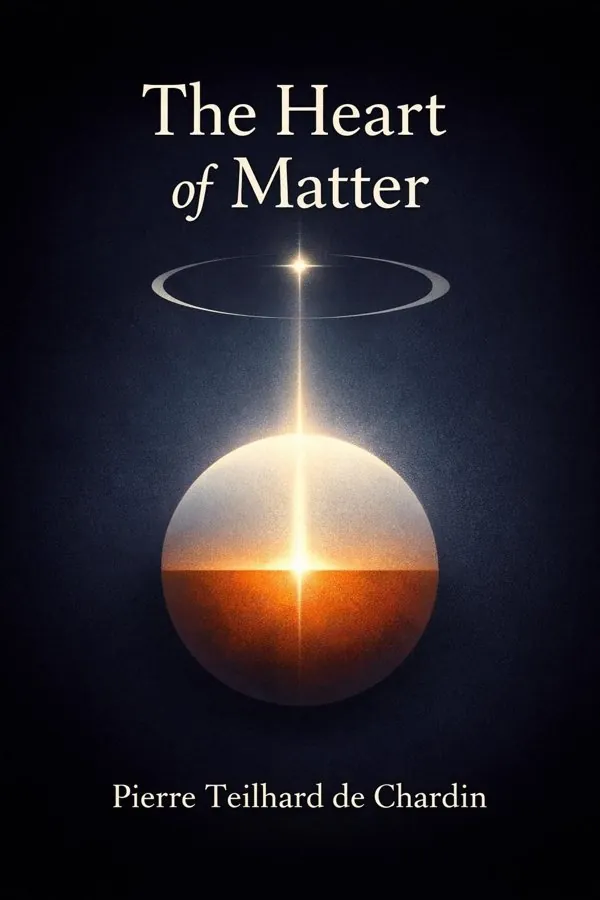
The Heart of Matter: Summary & Key Insights
 10 min9 chaptersAudio available
Key Takeaways from The Heart of Matter
Some people encounter the sacred in silence, ritual, or revelation; Teilhard first sensed it in stones.
The modern habit is to think of matter as inert, mechanical, and spiritually empty.
Evolution is often described as random variation filtered by survival, but Teilhard asks a different question: what overall pattern does evolution reveal?
Animals can perceive and respond, but human beings can know that they know.
Human beings do not evolve only through bodies and genes; we also evolve through ideas, symbols, and relationships.
What Is The Heart of Matter About?
The Heart of Matter by Pierre Teilhard de Chardin is a western_phil book spanning 5 pages. The Heart of Matter is Pierre Teilhard de Chardin’s deeply personal attempt to answer one of the oldest and most urgent questions in human thought: how can matter, life, consciousness, and God belong to one coherent story? Written near the end of his life and published posthumously, the book blends memoir, philosophy, theology, and scientific reflection into a single spiritual vision. Teilhard retraces his path from a childhood fascination with rocks, fossils, and the physical world to a mature conviction that matter is not dead substance but the very medium through which spirit unfolds. For him, evolution is not merely a biological process; it is the drama of creation itself, moving toward greater complexity, interiority, and union. What makes this work enduring is its bold refusal to separate science from faith or the material from the divine. Teilhard writes not as an abstract theorist but as a Jesuit priest and paleontologist whose life was shaped by both prayer and empirical inquiry. The result is a daring and influential meditation on the universe, humanity’s place within it, and the possibility that all creation is converging toward a sacred fulfillment.
This FizzRead summary covers all 9 key chapters of The Heart of Matter in approximately 10 minutes, distilling the most important ideas, arguments, and takeaways from Pierre Teilhard de Chardin's work. Also available as an audio summary and Key Quotes Podcast.
The Heart of Matter
The Heart of Matter is Pierre Teilhard de Chardin’s deeply personal attempt to answer one of the oldest and most urgent questions in human thought: how can matter, life, consciousness, and God belong to one coherent story? Written near the end of his life and published posthumously, the book blends memoir, philosophy, theology, and scientific reflection into a single spiritual vision. Teilhard retraces his path from a childhood fascination with rocks, fossils, and the physical world to a mature conviction that matter is not dead substance but the very medium through which spirit unfolds. For him, evolution is not merely a biological process; it is the drama of creation itself, moving toward greater complexity, interiority, and union. What makes this work enduring is its bold refusal to separate science from faith or the material from the divine. Teilhard writes not as an abstract theorist but as a Jesuit priest and paleontologist whose life was shaped by both prayer and empirical inquiry. The result is a daring and influential meditation on the universe, humanity’s place within it, and the possibility that all creation is converging toward a sacred fulfillment.
Who Should Read The Heart of Matter?
This book is perfect for anyone interested in western_phil and looking to gain actionable insights in a short read. Whether you're a student, professional, or lifelong learner, the key ideas from The Heart of Matter by Pierre Teilhard de Chardin will help you think differently.
- ✓Readers who enjoy western_phil and want practical takeaways
- ✓Professionals looking to apply new ideas to their work and life
- ✓Anyone who wants the core insights of The Heart of Matter in just 10 minutes
Want the full summary?
Get instant access to this book summary and 100K+ more with Fizz Moment.
Get Free SummaryAvailable on App Store • Free to download
Key Chapters
Some people encounter the sacred in silence, ritual, or revelation; Teilhard first sensed it in stones. One of the most compelling threads in The Heart of Matter is his recollection of childhood wonder before the earth itself. As a boy in the volcanic landscapes of France, he was drawn to rocks, minerals, and fossils with an intensity that was almost devotional. What fascinated him was not only their solidity, but their endurance. Matter seemed to possess a kind of hidden permanence, a depth that pointed beyond appearances.
This early attraction became the seed of his lifelong project. Instead of seeing the physical world as something inferior to spirit, Teilhard gradually came to believe that matter was the starting point of spiritual discovery. The earth was not a distraction from God; it was a path toward God. His scientific training later reinforced this instinct. The fossil record, geological strata, and evolutionary history all revealed a universe in motion, developing through time rather than appearing as a static finished product.
This insight matters because many people still live with an inner split: science belongs to facts, faith belongs to meaning. Teilhard rejects that divide. He invites us to recover reverence for the material world, whether through nature study, scientific work, art, or ordinary attention to embodied life. To care for the earth, the body, and history is not spiritually secondary; it is part of awakening.
A practical way to apply this idea is to treat physical reality with deeper contemplative respect. Go for a walk, study a natural object, or reflect on your own body not as mere machinery but as part of a larger unfolding story. Actionable takeaway: begin a daily habit of noticing one concrete thing in the material world that awakens wonder, and let that wonder become a doorway to reflection.
Evolution is often described as random variation filtered by survival, but Teilhard asks a different question: what overall pattern does evolution reveal? Looking across the history of the cosmos, he sees a striking trend. Matter organizes into more complex forms; complexity gives rise to life; life develops nervous systems; and eventually consciousness begins to reflect upon itself. For Teilhard, this broad movement suggests that evolution has an inner direction, not in the simplistic sense of a straight line, but as a deep tendency toward greater complexity and interiority.
This is one of the book’s central philosophical contributions. Teilhard does not deny struggle, waste, extinction, or contingency. He knows history is full of rupture. Yet beneath those disruptions he sees an ascent: atoms become molecules, molecules become cells, cells become organisms, and organisms eventually become beings capable of truth, freedom, and love. Human self-awareness marks a turning point because the universe, through us, becomes conscious of itself.
This idea can reshape the way we understand our own growth. Personal development is not separate from cosmic history. Learning, moral effort, creativity, and self-transcendence are continuations of evolution at the level of consciousness. Education, scientific inquiry, and social progress therefore matter not merely for utility, but because they deepen the reflective life of the world.
A practical application is to view frustration and complexity in life differently. Growth often feels messy because evolution itself is messy. A team learning to cooperate, a society expanding rights, or an individual becoming more self-aware all pass through conflict before reaching integration.
Actionable takeaway: identify one area of your life where confusion may actually be part of a larger maturation process, and commit to one disciplined step that supports growth rather than retreat.
Animals can perceive and respond, but human beings can know that they know. For Teilhard, this reflective consciousness is not a trivial upgrade; it is a decisive threshold in the history of the universe. In humanity, evolution becomes capable of self-examination, foresight, moral responsibility, and collective planning. We do not simply live within the world; we ask what the world means and what it is becoming.
Teilhard sees this reflective power as both privilege and burden. Once consciousness turns back upon itself, human beings can no longer live by instinct alone. We become responsible for directing energies that were previously unconscious. Technology, culture, science, ethics, and religion all emerge from this new stage. The human species therefore occupies a pivotal role: we are not the end of evolution, but the phase in which evolution becomes intentional.
This helps explain why Teilhard places such emphasis on human collaboration. Reflection is not only individual. As societies grow more interconnected through language, institutions, and communication, thought itself becomes planetary. Today this seems even more relevant in the age of global networks, shared crises, and collective intelligence. The question is not whether humanity is connected, but whether that connection will deepen consciousness or multiply confusion.
In everyday terms, this idea invites us to use our awareness responsibly. Reflection without action becomes sterile; action without reflection becomes dangerous. Whether we are consuming media, making ethical decisions, or contributing to public life, we help shape the quality of consciousness that surrounds us.
Actionable takeaway: practice one act of deliberate reflection each day, such as journaling or pausing before a major decision, so that your choices arise from awareness rather than impulse.
Human beings do not evolve only through bodies and genes; we also evolve through ideas, symbols, and relationships. Teilhard gives this sphere of shared thought a memorable name: the noosphere. Just as the geosphere refers to the earth’s physical layers and the biosphere to the realm of life, the noosphere is the layer of reflective consciousness generated by humanity’s collective mental and cultural activity.
In The Heart of Matter, this idea helps bridge biology and history. Once thought emerges, evolution accelerates in new ways. Language, memory, science, law, religion, and technology allow human experience to accumulate and circulate across generations. The result is an ever-thickening web of awareness. Teilhard believed this process was not accidental. Increasing interdependence is one of the signs that the universe is moving toward greater unity.
This concept feels remarkably contemporary. The internet, global media, international research communities, and transnational moral movements all illustrate how human minds now function in a shared informational environment. But Teilhard also warns, implicitly, that connection alone is not enough. Networks can spread wisdom or noise, solidarity or fragmentation. The noosphere must be humanized and spiritualized if it is to serve genuine growth.
Practically, this means our intellectual and digital habits matter. Every conversation, publication, class, post, and act of listening contributes to the mental atmosphere we inhabit together. We are not isolated thinkers; we are co-creators of the world’s field of meaning.
Actionable takeaway: improve the noosphere in one concrete way this week by sharing something truthful, constructive, and unifying instead of adding more distraction or hostility to the collective conversation.
Teilhard’s most famous and controversial idea is that evolution culminates not in abstract perfection, but in a personal center he calls the Omega Point. In Christian terms, this center is the cosmic Christ. The universe is not merely expanding outward through complexity; it is also converging inward toward unity. For Teilhard, Christ is not only the redeemer of souls in a private religious sense, but the divine pole toward which all creation is being drawn.
This idea, often called Christogenesis, is essential to understanding The Heart of Matter. Teilhard refuses to choose between evolutionary process and theological meaning. Instead, he interprets Christ as the one in whom the fragmented energies of the universe find coherence and fulfillment. Evolution alone could describe increasing complexity, but it could not guarantee final unity. Omega names the future possibility that all consciousness, without losing individuality, becomes integrated in love.
Even readers who do not share Teilhard’s theology can appreciate the structure of the idea. Human life seems to require some orienting horizon: truth, justice, flourishing, God, or universal reconciliation. Teilhard gives that horizon a deeply relational form. The endpoint of development is not domination, escape, or dissolution, but communion.
In practice, this changes the meaning of hope. Hope is not optimism that things will automatically improve. It is trust that our acts of truthfulness, creativity, and love participate in a larger movement toward unification. For religious readers, this can deepen the meaning of prayer and service. For secular readers, it can clarify the value of working toward integrative ideals.
Actionable takeaway: define the highest unifying ideal that orients your life, and use it as a criterion for one important decision you face this week.
Force is usually imagined in physical terms: gravity, pressure, competition, energy. Teilhard adds another kind of force to the story of the cosmos: love. In his vision, love is not mere sentiment or private affection. It is the power that unites without erasing difference. Because evolution advances through increasing complexity and connection, love becomes the only energy capable of bringing persons into deeper union while preserving their uniqueness.
This is why love occupies such a central place in The Heart of Matter. If consciousness is destined for greater integration, then coercion cannot be the final principle. Fear can control, but it cannot create communion. Love alone binds centers of awareness together from within. For Teilhard, this makes love not a decorative moral ideal but a structural necessity of the universe’s future.
Seen this way, acts of solidarity, friendship, forgiveness, and sacrifice have cosmic significance. They are not simply admirable behaviors within a random world; they anticipate the form of the world’s fulfillment. Even in practical settings like families, workplaces, classrooms, and civic life, genuine progress depends on some capacity to cooperate across difference.
The application is concrete. Love in Teilhard’s sense means choosing forms of relationship that increase life, trust, and shared purpose. A leader who respects the dignity of others, a scientist who collaborates openly, or a citizen who refuses dehumanization is contributing to unification rather than fragmentation.
Actionable takeaway: strengthen one relationship through a deliberate act of attentive presence, reconciliation, or encouragement, and treat it as meaningful work in the larger task of human unity.
Any spiritual philosophy that celebrates progress must eventually face suffering. Teilhard does not ignore the harshness of existence: death, failure, war, limitation, and loss all mark the human condition. The question he asks is whether pain can be given meaning without being denied. In The Heart of Matter, his answer is that suffering, while never good in itself, can be integrated into the movement of spiritual growth when consciously accepted and offered.
This idea has roots in Christian spirituality, but Teilhard reframes it through evolution. Since the world is unfinished, friction and incompletion are built into the process. Every advance involves tension, labor, and often sacrifice. Human beings therefore encounter not only the joy of participation in creation, but also its cost. The spiritual task is not passive resignation. It is to unite one’s suffering with a larger purpose, transforming isolation into offering.
This perspective can be helpful in ordinary life. Illness, grief, professional disappointment, or seasons of uncertainty often feel meaningless because they interrupt our plans. Teilhard suggests that even what limits us can deepen us if it becomes a site of fidelity, compassion, and inward expansion. This does not erase injustice or excuse avoidable pain. It means that when suffering cannot be removed, it can still be transfigured.
Practically, this may involve asking a different question in hardship: not only “Why is this happening?” but also “How can this become a place of growth, service, or solidarity?” Such a shift can restore agency without denying sorrow.
Actionable takeaway: when facing a difficulty you cannot control, name one way you can convert it into patience, empathy, prayer, or purposeful endurance.
One of Teilhard’s greatest achievements is not a single doctrine but a method of vision. He refuses the easy opposition between science and faith. Science, in his view, reveals the structure, age, and dynamic unfolding of the universe with unmatched rigor. Faith discloses the depth, direction, and ultimate meaning of that unfolding. Neither is complete on its own. Science without meaning risks reductionism; faith without reality risks fantasy.
The Heart of Matter embodies this synthesis because it emerges from a life lived in both worlds. Teilhard was a trained paleontologist committed to evidence, yet also a Jesuit priest formed by Christian theology and spiritual discipline. Instead of compartmentalizing these identities, he tried to think from within both at once. The result is not always easy, but it remains intellectually fertile because it addresses the whole human person.
This integration is especially relevant today. Many readers feel pressured to choose between empirical honesty and spiritual depth. Teilhard offers a third path: rigorous inquiry joined to reverence. We can accept evolutionary science, cosmic history, and human development while still asking metaphysical and moral questions that science alone cannot settle.
In practical terms, this encourages intellectual humility. A doctor, engineer, teacher, or believer need not pretend their discipline explains everything. Richer understanding often comes from crossing boundaries respectfully. The best conversations about reality happen when evidence and wisdom are allowed to illuminate one another.
Actionable takeaway: examine one belief or assumption you hold, and ask how it might look if you considered both scientific understanding and existential or spiritual meaning together rather than in isolation.
All Chapters in The Heart of Matter
About the Author
Pierre Teilhard de Chardin (1881–1955) was a French Jesuit priest, paleontologist, theologian, and philosopher whose work sought to unite modern science with Christian faith. Trained in geology and deeply engaged in the study of evolution, he participated in important paleontological research and became widely known for his sweeping vision of the cosmos as a developing spiritual process. Teilhard argued that evolution leads toward increasing complexity, consciousness, and ultimately union in what he called the Omega Point. Because some of his theological ideas were considered controversial, many of his major writings were published only after his death. Today he remains one of the most original and debated thinkers of the twentieth century, influencing discussions in religion, philosophy, ecology, and science-and-faith studies.
Get This Summary in Your Preferred Format
Read or listen to the The Heart of Matter summary by Pierre Teilhard de Chardin anytime, anywhere. FizzRead offers multiple formats so you can learn on your terms — all free.
Available formats: App · Audio · PDF · EPUB — All included free with FizzRead
Download The Heart of Matter PDF and EPUB Summary
Key Quotes from The Heart of Matter
“Some people encounter the sacred in silence, ritual, or revelation; Teilhard first sensed it in stones.”
“The modern habit is to think of matter as inert, mechanical, and spiritually empty.”
“Evolution is often described as random variation filtered by survival, but Teilhard asks a different question: what overall pattern does evolution reveal?”
“Animals can perceive and respond, but human beings can know that they know.”
“Human beings do not evolve only through bodies and genes; we also evolve through ideas, symbols, and relationships.”
Frequently Asked Questions about The Heart of Matter
The Heart of Matter by Pierre Teilhard de Chardin is a western_phil book that explores key ideas across 9 chapters. The Heart of Matter is Pierre Teilhard de Chardin’s deeply personal attempt to answer one of the oldest and most urgent questions in human thought: how can matter, life, consciousness, and God belong to one coherent story? Written near the end of his life and published posthumously, the book blends memoir, philosophy, theology, and scientific reflection into a single spiritual vision. Teilhard retraces his path from a childhood fascination with rocks, fossils, and the physical world to a mature conviction that matter is not dead substance but the very medium through which spirit unfolds. For him, evolution is not merely a biological process; it is the drama of creation itself, moving toward greater complexity, interiority, and union. What makes this work enduring is its bold refusal to separate science from faith or the material from the divine. Teilhard writes not as an abstract theorist but as a Jesuit priest and paleontologist whose life was shaped by both prayer and empirical inquiry. The result is a daring and influential meditation on the universe, humanity’s place within it, and the possibility that all creation is converging toward a sacred fulfillment.
More by Pierre Teilhard de Chardin
You Might Also Like
A Little History of Philosophy
Nigel Warburton
10 min
Areopagitica
John Milton
10 min
How To Think Like A Philosopher: Essential Principles For Clear Thinking
Peter Cave
10 min
Language, Truth and Logic
A. J. Ayer
10 min
The Age of Reason
Thomas Paine
10 min
The Essays
Michel De Montaigne
10 minBrowse by Category
Ready to read The Heart of Matter?
Get the full summary and 100K+ more books with Fizz Moment.