
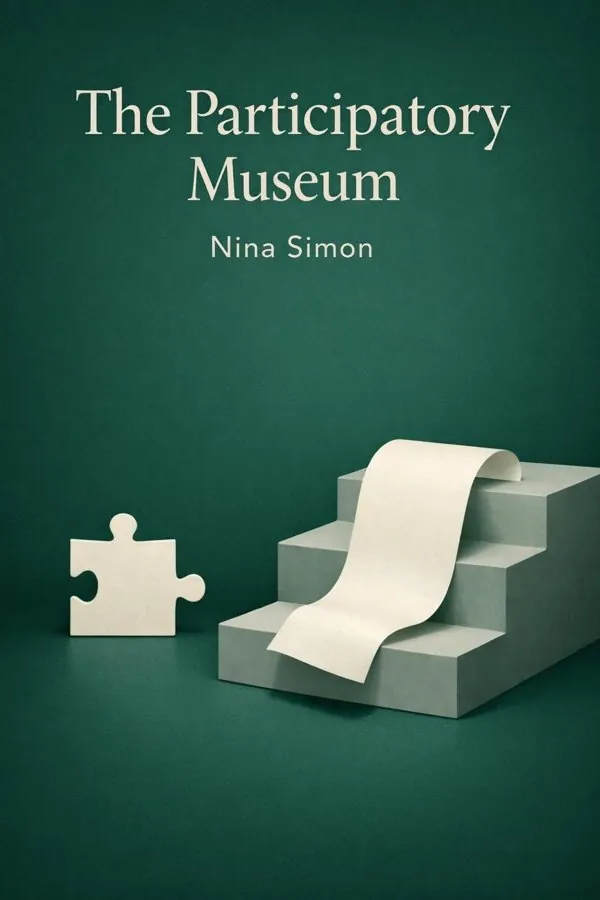
The Participatory Museum: Summary & Key Insights
by Nina Simon
 10 min9 chaptersAudio available
Key Takeaways from The Participatory Museum
A museum that only speaks is easy to admire, but harder to love.
Not all participation is equally demanding, meaningful, or appropriate.
People do not participate simply because they are invited.
The biggest obstacle to participation is not lack of interest but lack of confidence.
An exhibition becomes more powerful when visitors can leave a trace of themselves inside it.
What Is The Participatory Museum About?
The Participatory Museum by Nina Simon is a education book spanning 11 pages. What if museums stopped treating visitors as passive recipients of knowledge and started inviting them to help create it? In The Participatory Museum, Nina Simon argues that cultural institutions become more relevant, inclusive, and memorable when they shift from one-way presentation to active collaboration. Rather than asking people to simply observe exhibits, Simon shows how museums can invite audiences to contribute stories, interpretations, ideas, and even program design. The result is not a loss of expertise, but a richer and more human form of institutional authority. This book matters because it addresses a challenge faced by nearly every educational and cultural organization: how to remain meaningful in a world where people expect interaction, voice, and connection. Simon offers practical frameworks for designing participation at different levels, from simple contribution activities to co-created projects. She also tackles the difficult questions: what motivates visitors, what barriers keep them from joining in, and how can institutions sustain trust over time? As a museum leader, designer, and one of the most influential thinkers in audience engagement, Nina Simon brings both credibility and hands-on experience. Her book is a foundational guide for anyone who wants to make institutions more open, responsive, and community-centered.
This FizzRead summary covers all 9 key chapters of The Participatory Museum in approximately 10 minutes, distilling the most important ideas, arguments, and takeaways from Nina Simon's work. Also available as an audio summary and Key Quotes Podcast.
The Participatory Museum
What if museums stopped treating visitors as passive recipients of knowledge and started inviting them to help create it? In The Participatory Museum, Nina Simon argues that cultural institutions become more relevant, inclusive, and memorable when they shift from one-way presentation to active collaboration. Rather than asking people to simply observe exhibits, Simon shows how museums can invite audiences to contribute stories, interpretations, ideas, and even program design. The result is not a loss of expertise, but a richer and more human form of institutional authority.
This book matters because it addresses a challenge faced by nearly every educational and cultural organization: how to remain meaningful in a world where people expect interaction, voice, and connection. Simon offers practical frameworks for designing participation at different levels, from simple contribution activities to co-created projects. She also tackles the difficult questions: what motivates visitors, what barriers keep them from joining in, and how can institutions sustain trust over time?
As a museum leader, designer, and one of the most influential thinkers in audience engagement, Nina Simon brings both credibility and hands-on experience. Her book is a foundational guide for anyone who wants to make institutions more open, responsive, and community-centered.
Who Should Read The Participatory Museum?
This book is perfect for anyone interested in education and looking to gain actionable insights in a short read. Whether you're a student, professional, or lifelong learner, the key ideas from The Participatory Museum by Nina Simon will help you think differently.
- ✓Readers who enjoy education and want practical takeaways
- ✓Professionals looking to apply new ideas to their work and life
- ✓Anyone who wants the core insights of The Participatory Museum in just 10 minutes
Want the full summary?
Get instant access to this book summary and 100K+ more with Fizz Moment.
Get Free SummaryAvailable on App Store • Free to download
Key Chapters
A museum that only speaks is easy to admire, but harder to love. Nina Simon begins with a simple but powerful observation: people no longer want to be treated as passive audiences. In everyday life, they rate products, post photos, share opinions, remix media, and participate in communities. Yet many museums still rely on an older model in which curators present official knowledge and visitors quietly absorb it. Simon argues that this gap makes museums feel less relevant, especially to people who do not already see themselves reflected in institutional culture.
Participation matters because it turns museums into places of exchange rather than transmission. Instead of seeing visitors as empty vessels waiting to be filled with information, Simon sees them as knowledgeable, creative, and socially motivated. When people are invited to contribute, whether through stories, responses, objects, questions, or collaborative projects, they build a stronger personal connection to the institution. They are more likely to return, bring others, and feel a sense of ownership.
This does not mean abandoning scholarship or curatorial expertise. Simon is careful to distinguish participation from chaos. The goal is not to replace institutional knowledge but to create frameworks where public voices can enrich the experience. A history museum might invite visitors to record family migration stories alongside an immigration exhibit. An art museum might ask guests to vote on themes for community tours. These experiences make the museum feel alive, contemporary, and socially meaningful.
Actionable takeaway: audit your current visitor experience and identify one place where people are only consuming content. Then redesign that moment so visitors can meaningfully respond, contribute, or shape what happens next.
Not all participation is equally demanding, meaningful, or appropriate. One of Simon’s most useful contributions is her framework of four participatory models: contributory, collaborative, co-creative, and hosted. This structure helps institutions move beyond vague enthusiasm for engagement and make intentional design choices.
In contributory projects, visitors provide small pieces of input within a structure controlled by the institution. Examples include writing comments on a wall, submitting photos, or answering prompts in an exhibit. Collaborative projects involve the public as active partners in developing content, though staff still lead the process. Co-creative projects go further by inviting community members and museum staff to work together from the start to define goals and outcomes. Hosted projects give outside groups access to museum space and resources so they can create their own experiences.
Each level has different strengths. Contributory formats are accessible, scalable, and easy to test. Co-creative and hosted formats can be more transformative, but they also require trust, time, and flexibility. Simon’s key insight is that institutions should not assume deeper participation is always better. A quick-response station may be perfect for a busy family exhibit, while a neighborhood advisory process may be necessary for a community history project.
For example, a science museum might use contributory participation by asking visitors to share observations about climate change. A local history museum might co-create an exhibition with longtime residents and youth organizers. The right model depends on the purpose, audience, and capacity of the institution.
Actionable takeaway: before launching a project, decide which participation level fits your goals, and clearly define who controls decisions, who contributes, and what success would look like.
People do not participate simply because they are invited. They participate when the invitation is clear, the activity feels worthwhile, and the environment supports success. Simon emphasizes that effective participatory experiences require thoughtful design. Badly designed participation can feel awkward, superficial, or manipulative. Good design makes engagement intuitive, purposeful, and rewarding.
A central principle is scaffolding. Visitors need structure: clear prompts, manageable tasks, visible examples, and feedback that shows their contribution matters. An empty comment board that says “Share your thoughts” may generate little interest. But a prompt like “What object from your childhood tells your family’s story?” paired with example responses and a place to pin photos creates a stronger pathway into participation. People are more likely to contribute when they understand what is being asked and can imagine themselves succeeding.
Simon also highlights the importance of social design. Participation is often contagious. When visitors see others engaging, they feel more comfortable doing the same. This means location, visibility, staff facilitation, and exhibit flow all matter. Participation should not be hidden away like an afterthought. It should be integrated into the visitor journey and supported by a tone that feels welcoming rather than evaluative.
Design must also respect visitors’ time and energy. Not every activity should require deep commitment. Some moments should be quick and playful; others can offer richer involvement for those who want more. A well-designed participatory system offers multiple entry points.
Actionable takeaway: test participatory activities with real users before launch. If people seem confused, rushed, or hesitant, simplify the prompt, provide examples, and make the value of participating more visible.
The biggest obstacle to participation is not lack of interest but lack of confidence. Simon shows that many visitors want to engage, yet hesitate because they are unsure whether their contribution is welcome, useful, or safe. Institutions often overestimate how ready people are to jump in. To design for participation, museums must understand both what motivates people and what holds them back.
People participate for many reasons: curiosity, self-expression, social connection, recognition, learning, and the chance to make something meaningful. Some enjoy sharing expertise. Others want to see their experiences reflected in a public setting. Still others participate because a friend, staff member, or facilitator makes the invitation feel personal. These motivations vary across audiences, so a one-size-fits-all approach rarely works.
Barriers are equally varied. Visitors may fear doing the activity incorrectly, looking foolish, exposing personal information, or being ignored. Language, cultural norms, disability access, and unfamiliar institutional codes can all make participation feel risky. Simon argues that museums must actively lower these barriers by designing welcoming invitations, using plain language, offering multiple ways to engage, and validating all contributions.
Consider an exhibit asking visitors to respond to a question about identity. Some may want to write a detailed reflection, while others prefer to place a colored token, record audio, or respond anonymously. Flexible formats acknowledge different comfort levels. Staff presence matters too. A warm facilitator can transform a hesitant audience into an active one.
Actionable takeaway: map the likely motivations and barriers for your target audience before designing a participatory project, and build in at least three features that reduce fear and increase confidence.
An exhibition becomes more powerful when visitors can leave a trace of themselves inside it. Simon argues that participation in exhibition design is not just about adding interactive stations. It is about rethinking the role of exhibitions from static presentations to evolving platforms for dialogue, contribution, and shared meaning-making.
Participatory exhibitions can take many forms. Visitors may add personal stories, vote on interpretive questions, contribute objects, annotate labels, or shape the organization of content. In some cases, communities are involved much earlier by helping choose themes, identify overlooked narratives, or challenge the assumptions built into curatorial practice. This shift is especially important for topics tied to identity, place, memory, and social history, where lived experience can deepen or complicate official accounts.
For example, an exhibition about work could invite visitors to contribute photographs of their tools or uniforms, creating a living archive of local labor. A natural history museum might ask families to share observations about neighborhood biodiversity, connecting personal experience to scientific themes. These contributions do more than decorate the exhibit; they expand its authority by showing that knowledge exists in many forms.
Simon also warns that participation should not become clutter. Contributions need curation, context, and purpose. If everything is included without care, the exhibition can become noisy or confusing. The institution still plays a vital role in framing, selecting, and connecting public input to broader ideas.
Actionable takeaway: when planning your next exhibition, identify one point where visitor knowledge could genuinely deepen the content, then design a clear method for collecting, displaying, and contextualizing those contributions.
Interpretation is often where museum authority is felt most strongly. Labels, audio guides, timelines, and wall texts traditionally tell visitors what objects mean and why they matter. Simon argues that interpretation becomes more engaging when it opens space for dialogue rather than delivering a single final answer. This does not weaken scholarship; it acknowledges that meaning is often layered, contested, and enriched by diverse perspectives.
Participatory interpretation can include visitor responses beside labels, questions that provoke reflection, community-written texts, or digital tools that allow people to compare viewpoints. An art museum might present curatorial interpretation next to comments from artists, local residents, and schoolchildren. A history museum might include conflicting memories of the same event to reveal how public memory works. The goal is not relativism, but transparency about the fact that interpretation is created by people within specific contexts.
This approach can be especially effective with difficult or sensitive material. Rather than pretending to offer a neutral, complete account, museums can frame exhibits as spaces for thoughtful public engagement. Visitors are often more invested when they feel their own thinking is part of the experience. Even a simple prompt such as “What do you notice that others might miss?” can shift a person from passive reading to active interpretation.
The challenge is balance. Too many competing voices without structure can confuse visitors. Simon suggests that institutions should frame participation carefully, showing how public interpretation complements expert knowledge rather than replacing it.
Actionable takeaway: review your interpretive materials and revise at least one section so it asks visitors to think, compare, or contribute instead of only receiving a fixed explanation.
You cannot build a participatory museum with a nonparticipatory culture behind the scenes. Simon makes clear that real public engagement is not just a program tactic; it often requires organizational change. Institutions that want to invite community voice must examine how decisions are made internally, who holds power, and whether staff are prepared to share authority in meaningful ways.
This can be uncomfortable. Museums are often structured around expertise, risk management, and control. Participation introduces uncertainty. Public contributions may be messy, unexpected, or critical. Staff may worry about quality, consistency, or mission drift. Simon does not dismiss these concerns, but she argues that they must be managed through strategy rather than used as excuses for inaction.
Institutional change may involve training staff in facilitation, creating cross-department collaboration, revising evaluation metrics, or developing policies for community partnerships. It also means aligning participation with mission. If participation is seen as a side project owned by education staff alone, it will remain peripheral. But if leadership recognizes community engagement as central to relevance and impact, participation can shape exhibitions, collections, programming, and governance.
For example, a museum that wants to serve new local audiences might create advisory groups, involve community members in planning, and reward staff for relationship-building rather than only production output. Over time, these shifts move participation from occasional experiment to institutional habit.
Actionable takeaway: identify one internal practice, such as decision-making, staffing, or success metrics, that currently discourages participation, and propose a concrete change that would make shared authority more possible.
Participation is not successful just because people show up or leave comments. Simon insists that museums must evaluate participatory work thoughtfully and sustain it responsibly. The real question is not only how many people engaged, but what kind of value was created for visitors, communities, staff, and the institution.
Evaluation should consider both quantitative and qualitative evidence. Numbers matter: participation rates, return visits, time spent, diversity of contributors, and repeat involvement can reveal patterns. But stories matter too. Did participants feel heard? Did the project attract new audiences? Did staff gain new insight? Did community relationships deepen? Some of the most important outcomes, such as trust, belonging, or changed perception, are not captured by attendance alone.
Sustainability is equally important. A participatory initiative that launches with excitement but disappears without follow-up can damage trust. If visitors contribute stories, ideas, or objects, they need to see what happens next. Institutions should communicate outcomes, acknowledge contributors, and create feedback loops. Even small gestures, such as posting updates or thanking participants publicly, signal that participation is real rather than extractive.
Simon also encourages ongoing learning. Not every project will succeed, and that is normal. Museums should treat participatory work as iterative practice: test, observe, revise, and improve. A weak first attempt can become a strong long-term model if the institution is willing to learn from discomfort and failure.
Actionable takeaway: for every participatory project, define success in advance, gather both data and participant feedback, and plan a visible follow-up so contributors know their involvement had impact.
All Chapters in The Participatory Museum
About the Author
Nina Simon is an influential museum professional, author, and designer whose work has helped redefine how cultural institutions engage with the public. She is best known for advancing the idea that museums should be participatory, community-centered spaces where visitors do more than observe. Simon served as Executive Director of the Santa Cruz Museum of Art & History, where she led efforts to make the institution more inclusive, locally rooted, and socially active. She later founded OF/BY/FOR ALL, a global initiative that supports organizations seeking to become more representative of and responsive to their communities. Through her writing, speaking, and leadership, Simon has become one of the most respected voices in museum innovation, participatory design, and audience engagement.
Get This Summary in Your Preferred Format
Read or listen to the The Participatory Museum summary by Nina Simon anytime, anywhere. FizzRead offers multiple formats so you can learn on your terms — all free.
Available formats: App · Audio · PDF · EPUB — All included free with FizzRead
Download The Participatory Museum PDF and EPUB Summary
Key Quotes from The Participatory Museum
“A museum that only speaks is easy to admire, but harder to love.”
“Not all participation is equally demanding, meaningful, or appropriate.”
“People do not participate simply because they are invited.”
“The biggest obstacle to participation is not lack of interest but lack of confidence.”
“An exhibition becomes more powerful when visitors can leave a trace of themselves inside it.”
Frequently Asked Questions about The Participatory Museum
The Participatory Museum by Nina Simon is a education book that explores key ideas across 9 chapters. What if museums stopped treating visitors as passive recipients of knowledge and started inviting them to help create it? In The Participatory Museum, Nina Simon argues that cultural institutions become more relevant, inclusive, and memorable when they shift from one-way presentation to active collaboration. Rather than asking people to simply observe exhibits, Simon shows how museums can invite audiences to contribute stories, interpretations, ideas, and even program design. The result is not a loss of expertise, but a richer and more human form of institutional authority. This book matters because it addresses a challenge faced by nearly every educational and cultural organization: how to remain meaningful in a world where people expect interaction, voice, and connection. Simon offers practical frameworks for designing participation at different levels, from simple contribution activities to co-created projects. She also tackles the difficult questions: what motivates visitors, what barriers keep them from joining in, and how can institutions sustain trust over time? As a museum leader, designer, and one of the most influential thinkers in audience engagement, Nina Simon brings both credibility and hands-on experience. Her book is a foundational guide for anyone who wants to make institutions more open, responsive, and community-centered.
You Might Also Like

Bedtime Biography: Florence Nightingale
Isabel Thomas
10 min
Introduction To Museum Studies
Howard H. Hoyt
10 min
A Mind for Numbers: How to Excel at Math and Science (Even If You Flunked Algebra)
Barbara Oakley
10 min
AI for Educators: Learning Strategies, Teacher Empowerment, and the Future of Education
Matt Miller
10 min
Animation For Beginners
Morr Meroz
10 min
Artificial Intelligence for Learning
Donald Clark
10 minBrowse by Category
Ready to read The Participatory Museum?
Get the full summary and 100K+ more books with Fizz Moment.