
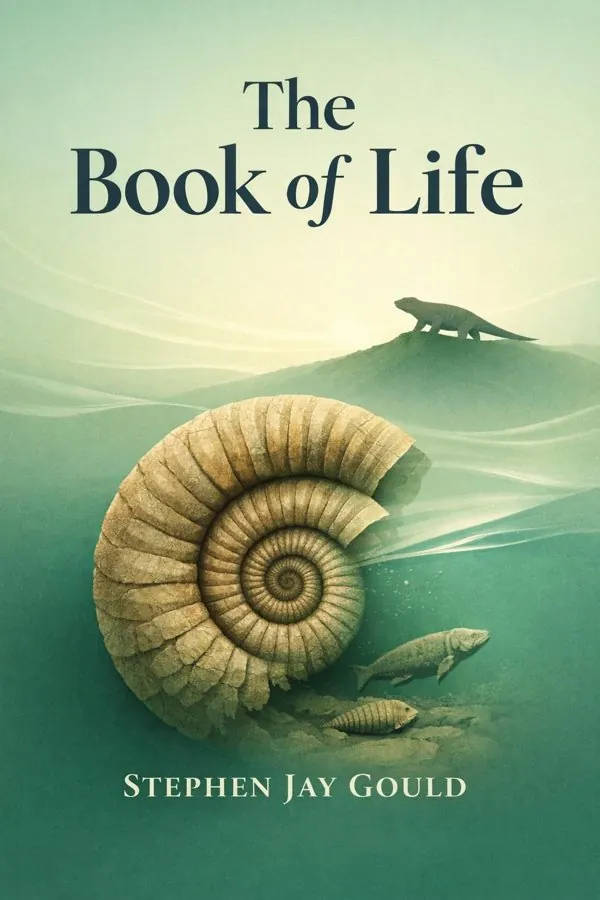
The Book of Life: An Illustrated History of the Evolution of Life on Earth: Summary & Key Insights
 10 min11 chaptersAudio available
What Is The Book of Life: An Illustrated History of the Evolution of Life on Earth About?
The Book of Life: An Illustrated History of the Evolution of Life on Earth by Stephen Jay Gould is a life_science book spanning 11 pages. A richly illustrated account of the history of life on Earth, edited by Stephen Jay Gould, presenting the story of evolution from the earliest microorganisms to the rise of humankind. The book combines scientific insight with vivid artwork to depict key moments in the development of life, extinction events, and evolutionary transitions.
This FizzRead summary covers all 11 key chapters of The Book of Life: An Illustrated History of the Evolution of Life on Earth in approximately 10 minutes, distilling the most important ideas, arguments, and takeaways from Stephen Jay Gould's work. Also available as an audio summary and Key Quotes Podcast.
The Book of Life: An Illustrated History of the Evolution of Life on Earth
A richly illustrated account of the history of life on Earth, edited by Stephen Jay Gould, presenting the story of evolution from the earliest microorganisms to the rise of humankind. The book combines scientific insight with vivid artwork to depict key moments in the development of life, extinction events, and evolutionary transitions.
Who Should Read The Book of Life: An Illustrated History of the Evolution of Life on Earth?
This book is perfect for anyone interested in life_science and looking to gain actionable insights in a short read. Whether you're a student, professional, or lifelong learner, the key ideas from The Book of Life: An Illustrated History of the Evolution of Life on Earth by Stephen Jay Gould will help you think differently.
- ✓Readers who enjoy life_science and want practical takeaways
- ✓Professionals looking to apply new ideas to their work and life
- ✓Anyone who wants the core insights of The Book of Life: An Illustrated History of the Evolution of Life on Earth in just 10 minutes
Want the full summary?
Get instant access to this book summary and 100K+ more with Fizz Moment.
Get Free SummaryAvailable on App Store • Free to download
Key Chapters
Picture early Earth—a chaotic sphere of molten rock, suffused with volcanic gas and lightning strikes under a dim sun. From that turbulence, life emerged. Our story begins not with simplicity but with complexity waiting to happen: the right mixture of chemical elements, water, and energy forming the precursors of biological molecules. In this section, I explore the moment when geochemistry turned into biochemistry. The young planet’s atmosphere contained methane, ammonia, and hydrogen, producing amino acids and nucleotides in its oceans. Through self-organizing reactions, the first replicating structures—simple RNA-like molecules—appeared, setting the foundation for Darwinian evolution.
From the author’s vantage, this step was the most profound. Life didn’t arise because the Earth was designed for it; rather, life found a way to exploit the planet’s physics. Once replication began, natural selection could act, guiding molecular complexity toward more stable and efficient systems. The origin of life, though obscured in detail, teaches us a central truth: evolution begins wherever variation and inheritance coexist. In reading this chapter, you sense the Earth’s first pulse of self-perpetuation—the birth of history itself.
The next great event belongs to microbes—cyanobacteria, the architects of oxygenic photosynthesis. When they began using sunlight to split water molecules, releasing oxygen as a byproduct, they transformed the planet’s atmosphere forever. This was the first ecological revolution—unseen yet monumental. I describe how, over millions of years, oxygen built up in the oceans, rusting iron formations, and eventually filled the air, setting the stage for aerobic life.
From my perspective, photosynthesis embodies the power of cumulative innovation. Evolution never plans ahead; it tinkers, repurposes, and modifies. Cyanobacteria didn’t intend to pave the way for animal life—they simply pursued survival. But in doing so, they changed everything. The oxygen crisis wiped out anaerobic organisms, forcing adaptation or extinction. Yet that same crisis enabled the rise of cells with mitochondria, capable of using oxygen to generate more energy. Thus, evolution advanced not through harmony but through upheaval.
+ 9 more chapters — available in the FizzRead app
All Chapters in The Book of Life: An Illustrated History of the Evolution of Life on Earth
About the Author
Stephen Jay Gould (1941–2002) was an American paleontologist, evolutionary biologist, and historian of science. He was one of the most influential popular science writers of the 20th century, known for his essays in Natural History magazine and his contributions to evolutionary theory, including the concept of punctuated equilibrium.
Get This Summary in Your Preferred Format
Read or listen to the The Book of Life: An Illustrated History of the Evolution of Life on Earth summary by Stephen Jay Gould anytime, anywhere. FizzRead offers multiple formats so you can learn on your terms — all free.
Available formats: App · Audio · PDF · EPUB — All included free with FizzRead
Download The Book of Life: An Illustrated History of the Evolution of Life on Earth PDF and EPUB Summary
Key Quotes from The Book of Life: An Illustrated History of the Evolution of Life on Earth
“Picture early Earth—a chaotic sphere of molten rock, suffused with volcanic gas and lightning strikes under a dim sun.”
“The next great event belongs to microbes—cyanobacteria, the architects of oxygenic photosynthesis.”
Frequently Asked Questions about The Book of Life: An Illustrated History of the Evolution of Life on Earth
The Book of Life: An Illustrated History of the Evolution of Life on Earth by Stephen Jay Gould is a life_science book that explores key ideas across 11 chapters. A richly illustrated account of the history of life on Earth, edited by Stephen Jay Gould, presenting the story of evolution from the earliest microorganisms to the rise of humankind. The book combines scientific insight with vivid artwork to depict key moments in the development of life, extinction events, and evolutionary transitions.
More by Stephen Jay Gould
The Desert Evolution
Stephen Jay Gould
10 min
Ever Since Darwin: Reflections in Natural History
Stephen Jay Gould
10 min
The Panda’s Thumb: More Reflections in Natural History
Stephen Jay Gould
10 min
Full House: The Spread of Excellence from Plato to Darwin
Stephen Jay Gould
10 minYou Might Also Like
The Selfish Gene
Richard Dawkins
10 min
Awakenings
Oliver Sacks
10 min
Parasite Rex: Inside the Bizarre World of Nature's Most Dangerous Creatures
Carl Zimmer
10 min
The Atlas of Life on Earth
Various
10 min
The Book of Humans: The Story of How We Became Us
Adam Rutherford
10 min
The Horse
Wendy Williams
10 minBrowse by Category
Ready to read The Book of Life: An Illustrated History of the Evolution of Life on Earth?
Get the full summary and 100K+ more books with Fizz Moment.