
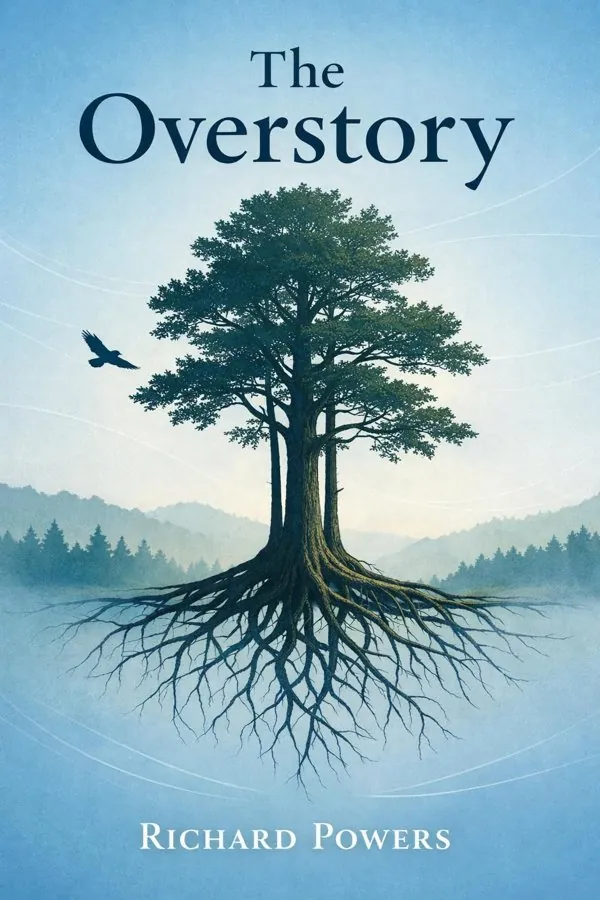
The Overstory: Summary & Key Insights
 10 min3 chaptersAudio available
What Is The Overstory About?
The Overstory by Richard Powers is a environment book spanning 3 pages. A sweeping, interwoven novel that explores the lives of nine individuals whose experiences with trees and forests shape their understanding of the world and humanity’s relationship with nature. Through interconnected narratives, the book examines ecological awareness, activism, and the profound interconnectedness of all living things.
This FizzRead summary covers all 3 key chapters of The Overstory in approximately 10 minutes, distilling the most important ideas, arguments, and takeaways from Richard Powers's work. Also available as an audio summary and Key Quotes Podcast.
The Overstory
A sweeping, interwoven novel that explores the lives of nine individuals whose experiences with trees and forests shape their understanding of the world and humanity’s relationship with nature. Through interconnected narratives, the book examines ecological awareness, activism, and the profound interconnectedness of all living things.
Who Should Read The Overstory?
This book is perfect for anyone interested in environment and looking to gain actionable insights in a short read. Whether you're a student, professional, or lifelong learner, the key ideas from The Overstory by Richard Powers will help you think differently.
- ✓Readers who enjoy environment and want practical takeaways
- ✓Professionals looking to apply new ideas to their work and life
- ✓Anyone who wants the core insights of The Overstory in just 10 minutes
Want the full summary?
Get instant access to this book summary and 100K+ more with Fizz Moment.
Get Free SummaryAvailable on App Store • Free to download
Key Chapters
The opening section, 'Roots,' plants the novel’s living architecture. I structured it as a forest of beginnings—each character a seed buried in the soil of their own heritage. The first to sprout is Nicholas Hoel, who inherits from his ancestors a family chronicle recorded through the slow photography of a chestnut tree. This tree becomes more than material—it is a witness to history, a biological clock measuring human generations. Through the Hoel family we see how the American landscape itself has memory, and that memory can be captured if only we care to look long enough.
Mimi Ma’s lineage comes from a very different angle: her father, an immigrant engineer, planted a mulberry tree in his suburban yard, a living reminder of China and of continuity amid displacement. When he dies, suicide born from alienation and cultural fracture, Mimi’s spiritual path begins beneath that same tree. It is both refuge and oracle, teaching her that even grief is part of a regenerative ecosystem.
Adam Appich enters the forest through psychology. His research into group behavior and moral reasoning begins as an academic pursuit, a way to understand why humans cooperate—or fail to—in the face of collective dilemmas. Yet, slowly, his study of human networks dovetails with ecological thinking. When he recognizes that trees form communities with their own intricate economies of exchange and defense, his life turns from detached observation to embodied participation in environmental activism.
Then there is Ray Brinkman, a lawyer of logic and precedent, and his spouse Dorothy Cazaly, a woman who feels the pull of intuitive connection. Their marriage charts the human side of ecological ethics—the quiet domestic battleground where one partner wants to leave the world as it is, and the other feels compelled to intervene. Through their aging and reflections, I wanted readers to see that moral awakening does not always erupt in protest; sometimes it germinates slowly, in the fertile loam of everyday conscience.
Douglas Pavlicek, meanwhile, carries scars from the Vietnam War and a strange kind of survivor’s devotion to restoration. After his plane is shot down and he’s saved by the impact of a banyan, he spends years planting trees for reforestation programs, only to realize he’s been aiding monoculture—industrial ecology masquerading as salvation. His disillusionment clears the soil for a deeper understanding of nature’s balance, one that resists human management.
In Neelay Mehta, I imagined the bridge between biology and technology. Paralyzed as a child after falling from a tree, he spends his life building computer systems that simulate organic networks. Yet his greatest creation—a digital world inspired by the structure of trees—transforms from an entertainment platform into a kind of virtual mirror, reflecting our real world’s interdependence. When he finally grasps that digital life and biological life are mirrors of the same systemic intelligence, he too becomes an advocate for the forests’ survival.
Patricia Westerford stands as the novel’s intellectual core. Modeled loosely on real ecological pioneers, she discovers that trees communicate through underground fungal networks, sharing nutrients, warning of danger, and acting in cohesive, communal ways. When she publishes her findings, academia brands her a fraud. Banished from research, she retreats into isolation, only to be vindicated years later when science catches up. Patricia’s journey represents the larger arc of the novel—the slow recognition that intelligence and cooperation are not uniquely human traits.
Finally, Olivia Vandergriff collapses the distance between revelation and action. A near-death experience electrifies her with a sense of purpose; she begins hearing what she interprets as the voice of living trees. Whether one reads her visions as mystical truth or desperate metaphor, her passion ignites the group that will form the heart of the book’s activism. It is Olivia who gathers Adam, Mimi, and Douglas into a fragile yet powerful coalition determined to defend the forests from destruction. In their stories converging, human lives braid together like roots beneath the earth, unseen but inseparable.
Once the roots have been established, the narrative trunk rises—solid, conflicted, fed by the convergences and collisions of belief. Olivia’s group becomes a symbol of hope and futility intertwined. Their acts of resistance—chaining themselves to trees, occupying logging sites, enduring arrest—echo the immense patience of the forests they fight for. Yet the world around them moves with industrial urgency, and their defiance, viewed by the law as extremism, eventually fractures under pressure. One dies, another is jailed, another withdraws into silence. The forest records all this quietly, continuing its cycle beyond the limits of protest.
What I wanted to show here is that human time and arboreal time rarely align. Activism operates within the lifespan of outrage; forests stretch over centuries. The tragedy that envelops these characters is not failure—it is a misalignment of scale. Their actions matter, but in an ecosystemic sense, not a personal one. When Olivia and her companions struggle, they do so inside a world whose processes dwarf them. Nature does not require their salvation; rather, it invites their participation.
Ray and Dorothy’s later story continues exploring that moral tension. As Ray’s health declines, Dorothy rediscovers awe in the ordinary acts of care—watering plants, watching sunlight shift across leaves. To her, this small domestic noticing becomes a way of rejoining the great conversation of life. I used their quiet evenings as a counterpoint to the drama of activists in crisis. Progress need not mean conquest; responsibility may manifest as simple attentiveness.
Meanwhile, Neelay’s digital universe evolves beyond its creator’s control. What began as a fantasy gaming empire transforms into an algorithmic simulation of global biodiversity, revealing patterns that mirror those in Patricia’s scientific work. The boundary between technology and nature blurs, showing that even in silicon forests, the logic of interconnection persists. Civilization itself, I wanted to suggest, is a kind of canopy system—branching, feeding, competing, adapting.
Patricia, now older and vindicated, becomes a guide more in silence than in speech. Through her, readers are asked to consider the humility required to see beyond individual agency. She realizes that her discoveries, once deemed heretical, are only fragments of a vast communication system that has always been there. The tragedies of Olivia, Douglas, and Adam are not anomalies; they are part of a wider narrative cycle, one that includes death and return, decay and new growth. Her ultimate insight is simple: survival depends on recognition of symbiosis.
+ 1 more chapters — available in the FizzRead app
All Chapters in The Overstory
About the Author
Richard Powers is an American novelist known for his works that blend science, technology, and human emotion. His novels often explore the intersection of biology, artificial intelligence, and environmental consciousness. Powers won the Pulitzer Prize for Fiction for The Overstory in 2019.
Get This Summary in Your Preferred Format
Read or listen to the The Overstory summary by Richard Powers anytime, anywhere. FizzRead offers multiple formats so you can learn on your terms — all free.
Available formats: App · Audio · PDF · EPUB — All included free with FizzRead
Download The Overstory PDF and EPUB Summary
Key Quotes from The Overstory
“The opening section, 'Roots,' plants the novel’s living architecture.”
“Once the roots have been established, the narrative trunk rises—solid, conflicted, fed by the convergences and collisions of belief.”
Frequently Asked Questions about The Overstory
The Overstory by Richard Powers is a environment book that explores key ideas across 3 chapters. A sweeping, interwoven novel that explores the lives of nine individuals whose experiences with trees and forests shape their understanding of the world and humanity’s relationship with nature. Through interconnected narratives, the book examines ecological awareness, activism, and the profound interconnectedness of all living things.
More by Richard Powers
You Might Also Like
A Life on Our Planet: My Witness Statement and a Vision for the Future
David Attenborough
10 min
A Sky Full Of Birds
Matt Merritt
10 min
Carbon Zero: Imagining Cities That Can Save the Planet
Alex Steffen
10 min
Eaarth: Making a Life on a Tough New Planet
Bill McKibben
10 min
The Social Contract and Environmental Governance
Various Editors
10 min
The Wild Places
Robert Macfarlane
10 minBrowse by Category
Ready to read The Overstory?
Get the full summary and 100K+ more books with Fizz Moment.