
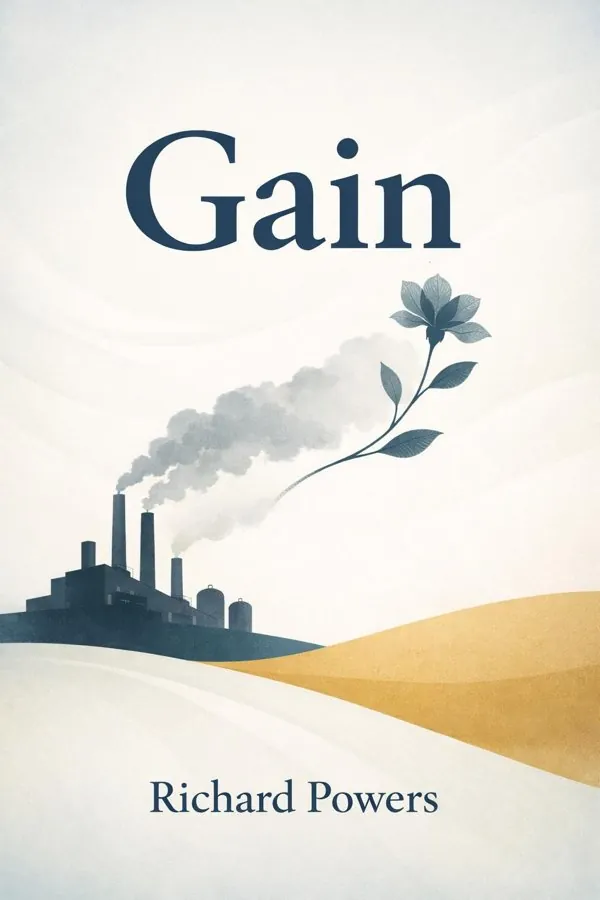
Gain: Summary & Key Insights
 10 min4 chaptersAudio available
What Is Gain About?
Gain by Richard Powers is a bestsellers book spanning 4 pages. Gain is a novel that intertwines the rise of a chemical conglomerate, Clare International, with the personal story of Laura Bodey, a woman whose life is affected by the company’s environmental impact. The narrative explores the evolution of American capitalism, industrial progress, and the human cost of corporate success.
This FizzRead summary covers all 4 key chapters of Gain in approximately 10 minutes, distilling the most important ideas, arguments, and takeaways from Richard Powers's work. Also available as an audio summary and Key Quotes Podcast.
Gain
Gain is a novel that intertwines the rise of a chemical conglomerate, Clare International, with the personal story of Laura Bodey, a woman whose life is affected by the company’s environmental impact. The narrative explores the evolution of American capitalism, industrial progress, and the human cost of corporate success.
Who Should Read Gain?
This book is perfect for anyone interested in bestsellers and looking to gain actionable insights in a short read. Whether you're a student, professional, or lifelong learner, the key ideas from Gain by Richard Powers will help you think differently.
- ✓Readers who enjoy bestsellers and want practical takeaways
- ✓Professionals looking to apply new ideas to their work and life
- ✓Anyone who wants the core insights of Gain in just 10 minutes
Want the full summary?
Get instant access to this book summary and 100K+ more with Fizz Moment.
Get Free SummaryAvailable on App Store • Free to download
Key Chapters
The story of Clare begins in the early nineteenth century, when Samuel Clare founds his modest soap-making venture. This part of the book reads like an industrial ballad—filled with scents of animal fat and lye, with an optimism that belongs to a new nation discovering its mechanical heart. The tone is almost reverent: in an America still half wilderness and half invention, the simple act of refining soap carries with it a sense of moral improvement. Cleanliness, light, and modernity converge.
Through Samuel Clare’s successors, each generation perfects the business in response to the era’s technologies. Powers mirrors the rhythm of historical progress itself—steam engines, railroads, electrification, the birth of chemistry as a systematic science—and Clare follows each turn, expanding from household soap to industrial chemicals and international markets. There is fascination, pride, and self-assurance in every stage. The novel’s corporate sections are written in a documentary style, almost as if Clare International itself were a living organism evolving toward grandeur.
But as Clare’s scale increases, its human face begins to fade. The family concern is replaced by shareholders, scientific managers, and marketing departments. The product line spreads outward, becoming unrecognizable from its origin, while the idea of ‘gain’ becomes more abstract—no longer physical cleanliness but financial and technological mastery. Powers structures these passages to evoke both admiration and dread. We watch history unfold, but also notice the changing moral tenor: industry no longer serves its workers or its customers; it serves its own momentum.
In writing these sections, I wanted readers to feel both the magnificence and the menace of this transformation. Industrial capitalism is not evil in any one character—it’s systemic, seductive, and inevitable in its logic. Clare International stands as a mirror to America itself: inspired, inventive, and ultimately indifferent to the costs it cannot easily measure.
Laura Bodey enters the narrative centuries later, her life seemingly detached from Clare’s grand history. She lives in Lacewood, a middle-American town built around a Clare plant, a place that feels safe, prosperous, and predictably modern. Laura is divorced but independent, raising two children, working in real estate, and sustaining a type of quiet resilience that belongs to millions of contemporary lives. Her story begins as an intimate counterpoint to Clare’s public grandeur.
Through Laura’s eyes, we see how Clare’s success manifests in ordinary life: in well-mown lawns, in fluorescent detergents, in the convenient packaging of modern goods. Yet the comfort coexists with subtle unease—the scent of chemicals in the air, the strange news of illnesses and environmental issues whispered among neighbors, the difficulty of assigning blame when all appears prosperous.
Laura’s awakening does not come from ideology but from experience. When she begins to notice changes in her own health, the realization forms not through accusation but through slow comprehension. The pain exists before its meaning. In her world, corporate generosity and sponsorship are woven into every civic fabric—Little League teams, scholarships, community events. Clare is a benefactor as much as a manufacturer. The contradiction becomes painfully intimate when Laura, after a diagnosis of cancer, starts connecting her illness to the unseen presence of Clare’s waste and emissions.
Her struggle is written without melodrama. She continues to love her children fiercely, to navigate the medical labyrinth, to sustain normalcy even as her body betrays her. In Laura’s quiet endurance, I wanted readers to feel the moral inertia of our times: we suspect something larger is wrong, yet we hesitate to face it because it sustains our very way of life. Laura’s courage lies in that contradiction—she refuses bitterness, but she cannot unsee what connects her fate to the industrial world around her.
Laura’s chapters humanize the abstraction of progress. They remind us that behind every innovation stands a living landscape, a neighborhood, a body exposed to consequence. She is not meant to symbolize victimhood alone; she embodies the human complexity of living with both gratitude and cost.
+ 2 more chapters — available in the FizzRead app
All Chapters in Gain
About the Author
Richard Powers (born June 18, 1957) is an American novelist known for his works that blend science, technology, and human experience. He won the Pulitzer Prize for Fiction for The Overstory and has been recognized for his deep, interdisciplinary storytelling.
Get This Summary in Your Preferred Format
Read or listen to the Gain summary by Richard Powers anytime, anywhere. FizzRead offers multiple formats so you can learn on your terms — all free.
Available formats: App · Audio · PDF · EPUB — All included free with FizzRead
Download Gain PDF and EPUB Summary
Key Quotes from Gain
“The story of Clare begins in the early nineteenth century, when Samuel Clare founds his modest soap-making venture.”
“Laura Bodey enters the narrative centuries later, her life seemingly detached from Clare’s grand history.”
Frequently Asked Questions about Gain
Gain by Richard Powers is a bestsellers book that explores key ideas across 4 chapters. Gain is a novel that intertwines the rise of a chemical conglomerate, Clare International, with the personal story of Laura Bodey, a woman whose life is affected by the company’s environmental impact. The narrative explores the evolution of American capitalism, industrial progress, and the human cost of corporate success.
More by Richard Powers


You Might Also Like

The Godfather
Mario Puzo
10 min
The Handmaid's Tale
Margaret Atwood
10 min
The Hunger Games
Suzanne Collins
10 min
The Nightingale
Kristin Hannah
10 min
The Seven Husbands of Evelyn Hugo
Taylor Jenkins Reid
10 min
Backwater Justice
Fern Michaels
10 minBrowse by Category
Ready to read Gain?
Get the full summary and 100K+ more books with Fizz Moment.