
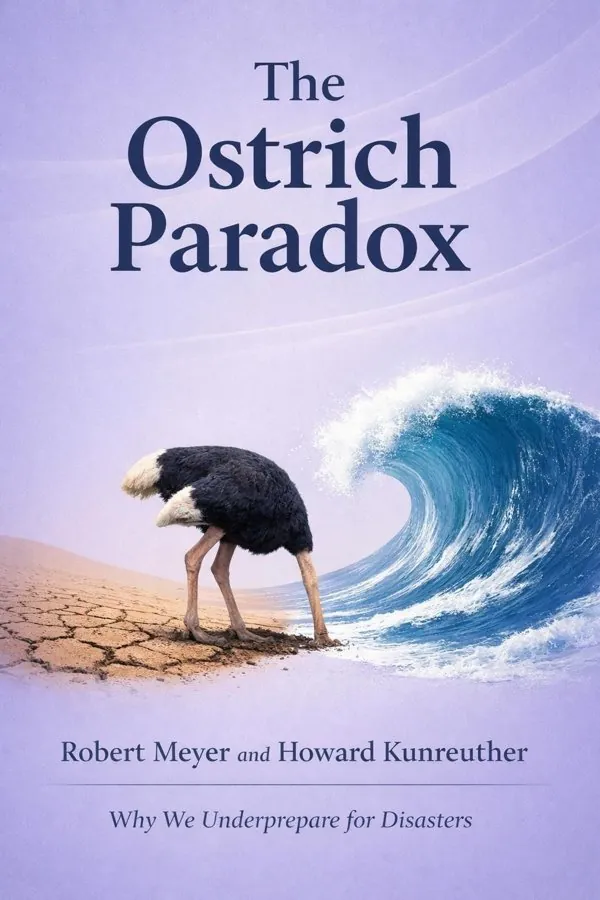
The Ostrich Paradox: Why We Underprepare for Disasters: Summary & Key Insights
by Robert Meyer, Howard Kunreuther
 10 min11 chaptersAudio available
What Is The Ostrich Paradox: Why We Underprepare for Disasters About?
The Ostrich Paradox: Why We Underprepare for Disasters by Robert Meyer and Howard Kunreuther is a cognition book spanning 11 pages. In The Ostrich Paradox, Wharton professors Robert Meyer and Howard Kunreuther explore why individuals, communities, and governments consistently fail to prepare adequately for disasters. Drawing on behavioral economics and risk management research, they identify six cognitive biases that lead to underestimation of risks and propose strategies to overcome these tendencies, aiming to improve resilience and decision-making in the face of natural and man-made catastrophes.
This FizzRead summary covers all 11 key chapters of The Ostrich Paradox: Why We Underprepare for Disasters in approximately 10 minutes, distilling the most important ideas, arguments, and takeaways from Robert Meyer and Howard Kunreuther's work. Also available as an audio summary and Key Quotes Podcast.
The Ostrich Paradox: Why We Underprepare for Disasters
In The Ostrich Paradox, Wharton professors Robert Meyer and Howard Kunreuther explore why individuals, communities, and governments consistently fail to prepare adequately for disasters. Drawing on behavioral economics and risk management research, they identify six cognitive biases that lead to underestimation of risks and propose strategies to overcome these tendencies, aiming to improve resilience and decision-making in the face of natural and man-made catastrophes.
Who Should Read The Ostrich Paradox: Why We Underprepare for Disasters?
This book is perfect for anyone interested in cognition and looking to gain actionable insights in a short read. Whether you're a student, professional, or lifelong learner, the key ideas from The Ostrich Paradox: Why We Underprepare for Disasters by Robert Meyer and Howard Kunreuther will help you think differently.
- ✓Readers who enjoy cognition and want practical takeaways
- ✓Professionals looking to apply new ideas to their work and life
- ✓Anyone who wants the core insights of The Ostrich Paradox: Why We Underprepare for Disasters in just 10 minutes
Want the full summary?
Get instant access to this book summary and 100K+ more with Fizz Moment.
Get Free SummaryAvailable on App Store • Free to download
Key Chapters
Across decades of fieldwork, we found a paradox that replays after every major disaster. When a hurricane devastates a coastline or an earthquake levels a city, we vow never to repeat the oversight. We pass new regulations, launch public awareness campaigns, and pour resources into rebuilding. Yet, within a few years, vigilance fades. People return to risky zones, funding priorities shift, and the cycle resets. Our team explored this pattern not only in natural disasters but also in financial crises and technological failures. Whether the event is physical or economic, human behavior follows a remarkably consistent script: we learn intensely right after the shock, then swiftly forget.
This pattern isn’t simply institutional neglect. It’s cognitive. The brain prioritizes immediate concerns over abstract probabilities. After a crisis, emotional salience—fear, urgency—drives attention. Once that fades, the mind returns to daily routines. The result is what we term disaster myopia: the narrowing of focus to short-term benefits and the discounting of long-term risk.
Society thus oscillates between panic and complacency. Our research highlights this dynamic through vivid case studies—communities on the Gulf Coast rebuilding after Hurricane Katrina, New York’s infrastructure after Superstorm Sandy, and even investment markets after major downturns. The outward problems differ, but the inner psychology is the same. This realization prompted us to look beyond engineering or policy failure and to focus squarely on cognition—on how normal, well-intentioned people make predictably poor decisions under uncertainty.
Understanding underpreparation requires recognizing its systemic roots. Governments often mirror the psychology of their citizens: politicians gain little credit for preventing crises that never happen, but they are punished harshly for disasters that do. Corporations face similar pressures to show short-term profit rather than long-term resilience. The consequence is a shared structural myopia that leaves entire societies vulnerable to foreseeable harm. The solution begins with acknowledging that risk preparation is not intuitive—it must be deliberately taught, reinforced, and institutionalized.
Our work identifies six biases that consistently shape human reactions to risk: myopia, amnesia, optimism, inertia, simplification, and herding. Each of these operates subtly within individual cognition yet has enormous collective consequences when multiplied across a society.
Myopia distorts time perception, leading people to favor present comfort over future security. Amnesia describes the inevitable fading of emotional memory; after a few years without incident, the urgency to stay prepared dissolves. Optimism leads us to believe that disaster won’t personally strike us—psychologists call this the 'self-serving bias.' Inertia traps us in the status quo, even when logic calls for change. Simplification reflects the mind’s tendency to reduce complex probabilities into simpler, often distorted narratives. And herding reminds us that we look to others, not objective data, to decide how seriously to take a risk.
Together, these biases form the mental scaffolding of underpreparation. Importantly, they are not flaws in character or intelligence—they are universal cognitive shortcuts that evolved for survival in short-term, immediate environments. The challenge is that the modern world confronts us with long-term, low-frequency, high-impact threats—storms, pandemics, cyberattacks—that our ancient brains are poorly equipped to handle intuitively.
Recognizing these biases is the first act of empowerment. When we understand the wiring of our decision-making systems, we can begin to design tools, incentives, and institutional practices that counteract their influence. This is the bridge between behavioral science and public policy, and it’s where much of our work at Wharton has focused.
+ 9 more chapters — available in the FizzRead app
All Chapters in The Ostrich Paradox: Why We Underprepare for Disasters
About the Authors
Robert Meyer is a professor of marketing and co-director of the Wharton Risk Management and Decision Processes Center. Howard Kunreuther is a professor of decision sciences and business and public policy, and also co-director of the same center. Both are recognized experts in behavioral decision theory and risk management.
Get This Summary in Your Preferred Format
Read or listen to the The Ostrich Paradox: Why We Underprepare for Disasters summary by Robert Meyer and Howard Kunreuther anytime, anywhere. FizzRead offers multiple formats so you can learn on your terms — all free.
Available formats: App · Audio · PDF · EPUB — All included free with FizzRead
Download The Ostrich Paradox: Why We Underprepare for Disasters PDF and EPUB Summary
Key Quotes from The Ostrich Paradox: Why We Underprepare for Disasters
“Across decades of fieldwork, we found a paradox that replays after every major disaster.”
“Our work identifies six biases that consistently shape human reactions to risk: myopia, amnesia, optimism, inertia, simplification, and herding.”
Frequently Asked Questions about The Ostrich Paradox: Why We Underprepare for Disasters
The Ostrich Paradox: Why We Underprepare for Disasters by Robert Meyer and Howard Kunreuther is a cognition book that explores key ideas across 11 chapters. In The Ostrich Paradox, Wharton professors Robert Meyer and Howard Kunreuther explore why individuals, communities, and governments consistently fail to prepare adequately for disasters. Drawing on behavioral economics and risk management research, they identify six cognitive biases that lead to underestimation of risks and propose strategies to overcome these tendencies, aiming to improve resilience and decision-making in the face of natural and man-made catastrophes.
You Might Also Like
A Field Guide to Lies: Critical Thinking in the Information Age
Daniel J. Levitin
10 min
A Theory of Cognitive Dissonance
Leon Festinger
10 min
Black-And-White Thinking: The Burden of a Binary Brain in a Complex World
Kevin Dutton
10 min
Born Liars: Why We Can’t Live Without Deceit
Ian Leslie
10 min
Collective Illusions: Conformity, Complicity, and the Science of Why We Make Bad Decisions
Todd Rose
10 min
Concrete Mathematics: A Foundation for Computer Science
Ronald L. Graham, Donald E. Knuth, Oren Patashnik
10 minBrowse by Category
Ready to read The Ostrich Paradox: Why We Underprepare for Disasters?
Get the full summary and 100K+ more books with Fizz Moment.