
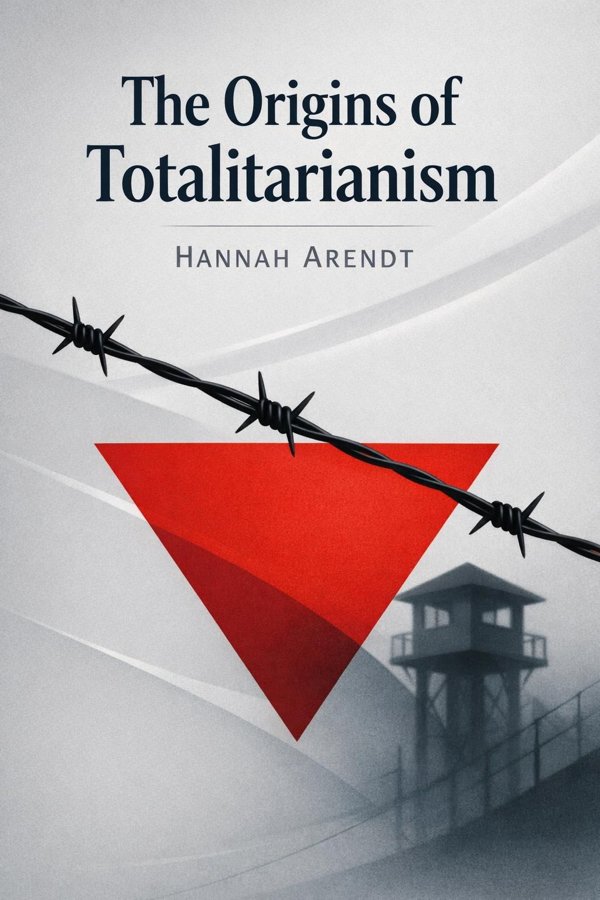
The Origins of Totalitarianism: Summary & Key Insights
 10 min3 chaptersAudio available
What Is The Origins of Totalitarianism About?
The Origins of Totalitarianism by Hannah Arendt is a politics book spanning 3 pages. Originally published in 1951, Hannah Arendt’s *The Origins of Totalitarianism* is a seminal work of political philosophy that examines the rise of totalitarian movements in the twentieth century. Arendt analyzes the historical and social conditions that led to the emergence of Nazism and Stalinism, exploring themes such as antisemitism, imperialism, and the nature of total domination. The book is divided into three parts—Antisemitism, Imperialism, and Totalitarianism—and remains a foundational text for understanding the mechanisms and psychology of oppressive political systems.
This FizzRead summary covers all 3 key chapters of The Origins of Totalitarianism in approximately 10 minutes, distilling the most important ideas, arguments, and takeaways from Hannah Arendt's work. Also available as an audio summary and Key Quotes Podcast.
The Origins of Totalitarianism
Originally published in 1951, Hannah Arendt’s *The Origins of Totalitarianism* is a seminal work of political philosophy that examines the rise of totalitarian movements in the twentieth century. Arendt analyzes the historical and social conditions that led to the emergence of Nazism and Stalinism, exploring themes such as antisemitism, imperialism, and the nature of total domination. The book is divided into three parts—Antisemitism, Imperialism, and Totalitarianism—and remains a foundational text for understanding the mechanisms and psychology of oppressive political systems.
Who Should Read The Origins of Totalitarianism?
This book is perfect for anyone interested in politics and looking to gain actionable insights in a short read. Whether you're a student, professional, or lifelong learner, the key ideas from The Origins of Totalitarianism by Hannah Arendt will help you think differently.
- ✓Readers who enjoy politics and want practical takeaways
- ✓Professionals looking to apply new ideas to their work and life
- ✓Anyone who wants the core insights of The Origins of Totalitarianism in just 10 minutes
Want the full summary?
Get instant access to this book summary and 100K+ more with Fizz Moment.
Get Free SummaryAvailable on App Store • Free to download
Key Chapters
Our story begins in nineteenth-century Europe, where antisemitism underwent a transformation that would shape the political storms of the century to come. It was no longer merely a matter of theological prejudice or individual hatred. A new, politically charged antisemitism arose as part of a broader social disintegration. The Jews, long established as a semi-autonomous community within Christian Europe, found their position simultaneously emancipated and endangered. With the decline of religious authority and the rise of the modern nation-state, Jews were granted citizenship, but this new equality proved unstable. In their ascent to prominence in finance and administration, Jews became the visible symbols of modernization itself—a modernization that left many disoriented and displaced.
Modern antisemitism differed from earlier hostility because it drew its power from political and social grievances, not theological disputes. As traditional elites lost their sense of security amid the expansion of capitalism and industrialization, they projected their anxieties onto a convenient scapegoat. Jews became personifications of 'rootless cosmopolitanism', accused simultaneously of controlling both capital and subversion. Political parties seized upon this sentiment and transformed it into mass movements.
The erosion of the nation-state system further intensified this process. The precarious position of minorities within multinational empires and later within the disintegrating European order after the First World War created a class of stateless people deprived of legal protections. The Jews, historically accustomed to living without full political rights, now shared the fate of millions who found themselves without any rights at all. In this vacuum, antisemitic movements gained their monstrous credibility. They claimed to restore authentic national unity through exclusion and hatred, forging community from resentment rather than shared purpose.
The Dreyfus Affair in France marked a turning point. In those years, antisemitism ceased to be merely a prejudice of individuals and became a mobilizing ideology. Here the conflict over the fate of one Jewish officer revealed a deeper crisis of the Republic itself. The Affair exposed how fragile the modern concept of justice had become, and how easily it could be sacrificed to the passions of the crowd. In hindsight, the affair prefigured the age of mass politics and propaganda, where truth and falsehood would be subordinated to political convenience.
When antisemitism entered the political sphere, it provided totalitarian movements with an ideal prototype: a politics based on imaginary enemies, sustained by myths rather than by facts. In the hatred of Jews, the masses first learned the intoxicating unity of belonging to a movement that did not demand reason but faith.
Imperialism, the second root of totalitarianism, was born from Europe’s expansion into lands beyond its borders—a movement that seemed at first purely economic and strategic, but quickly developed far-reaching consequences for political thought. When European powers divided Africa and Asia among themselves in the late nineteenth century, they exported not only their armies but their ideas about human hierarchy and governance. Imperial bureaucracy created vast systems of rule that operated without the consent or participation of the ruled. This transformation eroded the traditional limits of political responsibility at home.
In the colonies, the notion of equality before the law was suspended; conquest justified rule, and racial difference rationalized domination. The result was the birth of race-thinking—a view that sought to anchor political superiority in biological fate. Here, in the administrative experiments and ruthless efficiency of colonial rule, totalitarianism found its first laboratories. The people administered abroad were treated as raw material, objects of categorization and control. Bureaucracy became autonomous, accountable not to any political body but to the impersonal demands of expansion. It was in this moral vacuum that the idea of governing without law, for the sake of an abstract mission, took root.
The expansionist drive that underpinned imperialism also destabilized Europe itself. Economic competition and national rivalries eroded the balance of the old nation-states. The political order no longer served the citizens but the machinery of accumulation and conquest. Within Europe, masses of people detached from traditional social structures—workers uprooted by industrialization, peasants dislocated by urbanization—emerged as politically unanchored. They formed what I call 'the masses': individuals no longer bound by class or civic solidarity, easily swayed by ideology.
Imperialism dissolved the distinction between the domestic and the foreign, between rule and exploitation. It accustomed societies to the idea that certain populations might justifiably be treated as superfluous. When this logic returned to Europe, it was not surprising that entire peoples could later be designated unfit to live. Race-thinking, once applied to colonized territories, now turned inward, giving totalitarian ideologies their pseudo-scientific veneer and their boundless ambition.
In the decline of the nation-state, with its guarantee of citizenship and lawful rights, humanity discovered how fragile legal personhood truly is. Without the political space of the nation, human rights became abstract ideals—declared universal but, in practice, unenforceable. The stateless—refugees, deportees, displaced persons—were the first victims of this contradiction. Their fate, treated as a problem of administration rather than justice, foreshadowed the entire totalitarian project: the replacement of political responsibility by bureaucratic procedure, the reduction of human beings to cases.
+ 1 more chapters — available in the FizzRead app
All Chapters in The Origins of Totalitarianism
About the Author
Hannah Arendt (1906–1975) was a German-born political theorist and philosopher known for her works on power, authority, and totalitarianism. After fleeing Nazi Germany, she settled in the United States, where she taught at several universities and wrote influential books including *The Human Condition* and *Eichmann in Jerusalem*. Her thought continues to shape modern political theory and philosophy.
Get This Summary in Your Preferred Format
Read or listen to the The Origins of Totalitarianism summary by Hannah Arendt anytime, anywhere. FizzRead offers multiple formats so you can learn on your terms — all free.
Available formats: App · Audio · PDF · EPUB — All included free with FizzRead
Download The Origins of Totalitarianism PDF and EPUB Summary
Key Quotes from The Origins of Totalitarianism
“Our story begins in nineteenth-century Europe, where antisemitism underwent a transformation that would shape the political storms of the century to come.”
“When European powers divided Africa and Asia among themselves in the late nineteenth century, they exported not only their armies but their ideas about human hierarchy and governance.”
Frequently Asked Questions about The Origins of Totalitarianism
The Origins of Totalitarianism by Hannah Arendt is a politics book that explores key ideas across 3 chapters. Originally published in 1951, Hannah Arendt’s *The Origins of Totalitarianism* is a seminal work of political philosophy that examines the rise of totalitarian movements in the twentieth century. Arendt analyzes the historical and social conditions that led to the emergence of Nazism and Stalinism, exploring themes such as antisemitism, imperialism, and the nature of total domination. The book is divided into three parts—Antisemitism, Imperialism, and Totalitarianism—and remains a foundational text for understanding the mechanisms and psychology of oppressive political systems.
More by Hannah Arendt


You Might Also Like

Antifa: The Anti-Fascist Handbook
Mark Bray
10 min
Attack from Within: How Disinformation Is Sabotaging America
Barbara McQuade
10 min
Coercion, Capital, and European States, AD 990–1992
Charles Tilly
10 min
Digital Democracy: Concepts, Methodologies, Tools, and Applications
Various Authors
10 min
Fascism
Stanley G. Payne
10 min
Fire And Fury: Inside The Trump White House
Michael Wolff
10 minBrowse by Category
Ready to read The Origins of Totalitarianism?
Get the full summary and 100K+ more books with Fizz Moment.