
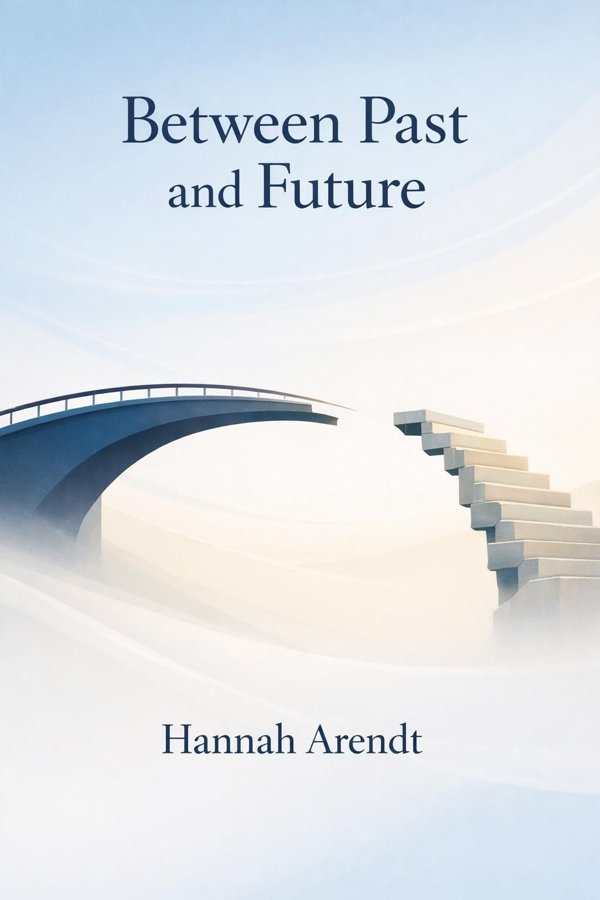
Between Past and Future: Eight Exercises in Political Thought: Summary & Key Insights
 10 min8 chaptersAudio available
What Is Between Past and Future: Eight Exercises in Political Thought About?
Between Past and Future: Eight Exercises in Political Thought by Hannah Arendt is a politics book spanning 8 pages. Between Past and Future is a collection of essays by political theorist Hannah Arendt, first published in 1961. The book explores the crisis of modernity and the loss of traditional values, examining how humanity can think and act politically in a world where the past no longer provides guidance for the future. Arendt discusses key concepts such as freedom, authority, education, and the role of thought in political life, offering profound reflections on the conditions of human existence in the modern age.
This FizzRead summary covers all 8 key chapters of Between Past and Future: Eight Exercises in Political Thought in approximately 10 minutes, distilling the most important ideas, arguments, and takeaways from Hannah Arendt's work. Also available as an audio summary and Key Quotes Podcast.
Between Past and Future: Eight Exercises in Political Thought
Between Past and Future is a collection of essays by political theorist Hannah Arendt, first published in 1961. The book explores the crisis of modernity and the loss of traditional values, examining how humanity can think and act politically in a world where the past no longer provides guidance for the future. Arendt discusses key concepts such as freedom, authority, education, and the role of thought in political life, offering profound reflections on the conditions of human existence in the modern age.
Who Should Read Between Past and Future: Eight Exercises in Political Thought?
This book is perfect for anyone interested in politics and looking to gain actionable insights in a short read. Whether you're a student, professional, or lifelong learner, the key ideas from Between Past and Future: Eight Exercises in Political Thought by Hannah Arendt will help you think differently.
- ✓Readers who enjoy politics and want practical takeaways
- ✓Professionals looking to apply new ideas to their work and life
- ✓Anyone who wants the core insights of Between Past and Future: Eight Exercises in Political Thought in just 10 minutes
Want the full summary?
Get instant access to this book summary and 100K+ more with Fizz Moment.
Get Free SummaryAvailable on App Store • Free to download
Key Chapters
The opening exercise confronts the collapse of the Western tradition, that long chain linking Plato to the modern age. For centuries, this tradition offered us a way of ordering thought and action; it told us what was permanent and what was transient, what was authoritative and what was subordinate. Yet, in the modern age, this chain has broken. The authority that once came from the past—the belief that older truths are truer truths—has lost its force. The result is not simply a loss of moral compass, but a deeper crisis: we no longer live within a world that can tell us who we are.
The modern revolt against tradition, which began with the great thinkers of the Enlightenment, was at once liberating and disorienting. On one hand, it freed humanity from the tyranny of inherited dogma; on the other, it left individuals naked before the burden of judgment. Without the protective layer of tradition, we must now ask every political and moral question anew. I argue that the real challenge of modernity is not to lament this loss but to learn to think without the scaffolding of inherited meanings. The danger emerges when we confuse liberation from tradition with license or nihilism. To live without tradition requires a different courage: the courage to judge the world freshly, to create meaning in the present even as the past becomes increasingly opaque.
This loss also rearranges the relationship between history and action. In earlier times, authority structured both memory and expectation: the past transmitted models to imitate, the future promised fulfillment. With the chain broken, history becomes a sequence of events without binding meaning. The task for modern political thought, then, is to rediscover a mode of thinking that does not depend on inherited legitimacy yet is not crushed by arbitrariness. Our age demands a recovery of the world’s in-between spaces, where individuals can still act, speak, and build common meaning despite the ruins of metaphysical systems.
In the second essay, I investigate how human beings have come to think historically and what it has meant to lose the cyclical order that once governed our understanding of time. Ancient civilizations understood history through repetition: the rise and fall of cities, the eternal return of seasons, the remembrance of ancestors. Modernity replaced this cyclical rhythm with a linear sense of progress. We have, in effect, transformed history from an eternal cycle into a forward-moving stream. This shift carries tremendous political implications. Once we begin to think of time as a line, we become obsessed with progress, destiny, and development—concepts that blur the distinction between action and process.
Yet, the faith in historical progress hides a particular danger. It tempts us to interpret our deeds as necessary results of impersonal forces rather than as free acts. When the movement of history is seen as inevitable, responsibility dissolves. I propose instead that we must recover the meaning of natality—the capacity of each birth, each beginning, to introduce something genuinely new into the world. History, properly understood, is not a process that sweeps us along but a realm of beginnings created through human action. Every deed introduces novelty. To think historically, then, is not to submit to necessity but to grasp the fragility and the promise of the new.
This understanding allows us to reclaim the dignity of the present. The present is not simply a passage between what has been and what will be; it is the site of appearance, where action becomes visible and the meaning of history is disclosed. When we lose sight of this, we substitute living judgment for dead inevitability. The challenge for political thought is to reassert human freedom against the myth of historical necessity.
+ 6 more chapters — available in the FizzRead app
All Chapters in Between Past and Future: Eight Exercises in Political Thought
About the Author
Hannah Arendt (1906–1975) was a German-born political theorist and philosopher known for her works on totalitarianism, authority, and the nature of power. After fleeing Nazi Germany, she settled in the United States, where she taught at several universities and wrote influential books including The Origins of Totalitarianism, The Human Condition, and Eichmann in Jerusalem.
Get This Summary in Your Preferred Format
Read or listen to the Between Past and Future: Eight Exercises in Political Thought summary by Hannah Arendt anytime, anywhere. FizzRead offers multiple formats so you can learn on your terms — all free.
Available formats: App · Audio · PDF · EPUB — All included free with FizzRead
Download Between Past and Future: Eight Exercises in Political Thought PDF and EPUB Summary
Key Quotes from Between Past and Future: Eight Exercises in Political Thought
“The opening exercise confronts the collapse of the Western tradition, that long chain linking Plato to the modern age.”
“In the second essay, I investigate how human beings have come to think historically and what it has meant to lose the cyclical order that once governed our understanding of time.”
Frequently Asked Questions about Between Past and Future: Eight Exercises in Political Thought
Between Past and Future: Eight Exercises in Political Thought by Hannah Arendt is a politics book that explores key ideas across 8 chapters. Between Past and Future is a collection of essays by political theorist Hannah Arendt, first published in 1961. The book explores the crisis of modernity and the loss of traditional values, examining how humanity can think and act politically in a world where the past no longer provides guidance for the future. Arendt discusses key concepts such as freedom, authority, education, and the role of thought in political life, offering profound reflections on the conditions of human existence in the modern age.
More by Hannah Arendt
You Might Also Like
Antifa: The Anti-Fascist Handbook
Mark Bray
10 min
Attack from Within: How Disinformation Is Sabotaging America
Barbara McQuade
10 min
Coercion, Capital, and European States, AD 990–1992
Charles Tilly
10 min
Digital Democracy: Concepts, Methodologies, Tools, and Applications
Various Authors
10 min
Fascism
Stanley G. Payne
10 min
Fire And Fury: Inside The Trump White House
Michael Wolff
10 minBrowse by Category
Ready to read Between Past and Future: Eight Exercises in Political Thought?
Get the full summary and 100K+ more books with Fizz Moment.