
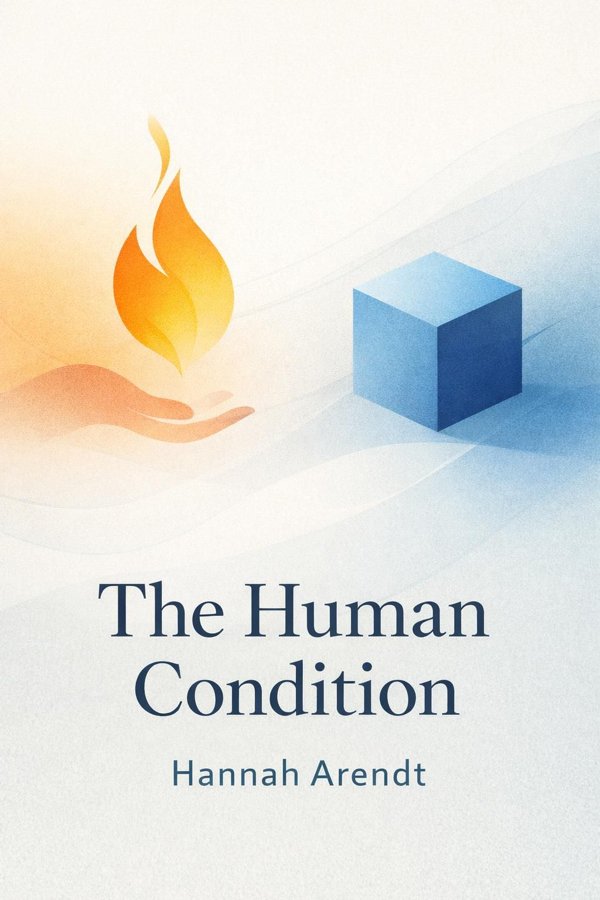
The Human Condition: Summary & Key Insights
 10 min11 chaptersAudio available
What Is The Human Condition About?
The Human Condition by Hannah Arendt is a western_phil book spanning 11 pages. In this seminal work, Hannah Arendt explores the fundamental activities of human life—labor, work, and action—and their relationship to the human condition. She examines how modernity, technology, and political structures have transformed the way humans engage with the world and each other, offering a profound reflection on freedom, public life, and the nature of human existence.
This FizzRead summary covers all 11 key chapters of The Human Condition in approximately 10 minutes, distilling the most important ideas, arguments, and takeaways from Hannah Arendt's work. Also available as an audio summary and Key Quotes Podcast.
The Human Condition
In this seminal work, Hannah Arendt explores the fundamental activities of human life—labor, work, and action—and their relationship to the human condition. She examines how modernity, technology, and political structures have transformed the way humans engage with the world and each other, offering a profound reflection on freedom, public life, and the nature of human existence.
Who Should Read The Human Condition?
This book is perfect for anyone interested in western_phil and looking to gain actionable insights in a short read. Whether you're a student, professional, or lifelong learner, the key ideas from The Human Condition by Hannah Arendt will help you think differently.
- ✓Readers who enjoy western_phil and want practical takeaways
- ✓Professionals looking to apply new ideas to their work and life
- ✓Anyone who wants the core insights of The Human Condition in just 10 minutes
Want the full summary?
Get instant access to this book summary and 100K+ more with Fizz Moment.
Get Free SummaryAvailable on App Store • Free to download
Key Chapters
Before speaking of activities, I must clarify what I mean by the human condition. Human existence is not defined by any single essence or purpose; rather, it is framed by certain conditions under which life unfolds. Life itself, worldliness, mortality, plurality—these are not gifts or goals but the environment of every human activity.
The condition of life touches upon our biological existence, the necessity to maintain and renew our vitality through labor. Worldliness refers to the human capacity to build a stable, lasting environment—a world of things amid the flux of nature. Mortality, paradoxically, makes our brief passage significant; through it, we seek continuity in what we create and enact. Plurality, finally, is the fundamental condition of political life—men, not Man, inhabit the earth. Each human being is unique, yet capable of beginning something new in the shared realm of action.
To grasp the human condition is to acknowledge that life is relational. We are neither gods detached from the world nor animals subsumed in nature. The world that stands between us both connects and separates. Action and speech reveal who we are; they weave the web of human affairs. Thus, human dignity arises not from what we are, but from what we do together.
Labor is the activity by which life sustains itself. It is as ancient as the species itself and as ceaseless as the metabolic process it serves. The laboring human, whom I call the *animal laborans*, is bound to necessity. His effort produces nothing permanent, only the means to live another day. Food, shelter, cleaning—all are within the cycle of labor: consuming what was produced, producing what will be consumed.
In classical times, labor stood at the lowest level of the *vita activa*. The ancients considered it degrading not because it was shameful, but because it left no trace in the world; it was work for the body, not the city. Slaves were deemed fit for labor, citizens for action. Labor’s endlessness mirrored nature’s own circular rhythm—birth, growth, decay, renewal. Yet modern society, by elevating labor, has reversed this ancient hierarchy. Productivity, not permanence, has become the highest value.
The industrial and technological revolutions intensified this transformation. Machines, designed to alleviate toil, have instead made labor central to human identity. We define ourselves by what we do for a living, not by the worlds we build or the deeds we perform. The promise of automation is paradoxical: it threatens to free us from labor while depriving us of the very experience that structured our daily existence. In the victory of the *animal laborans*, the specific dignity of human action is at risk of being forgotten.
+ 9 more chapters — available in the FizzRead app
All Chapters in The Human Condition
About the Author
Hannah Arendt (1906–1975) was a German-born political theorist and philosopher known for her works on totalitarianism, authority, and the nature of power. After fleeing Nazi Germany, she settled in the United States, where she wrote influential books such as 'The Origins of Totalitarianism' and 'Eichmann in Jerusalem'.
Get This Summary in Your Preferred Format
Read or listen to the The Human Condition summary by Hannah Arendt anytime, anywhere. FizzRead offers multiple formats so you can learn on your terms — all free.
Available formats: App · Audio · PDF · EPUB — All included free with FizzRead
Download The Human Condition PDF and EPUB Summary
Key Quotes from The Human Condition
“Before speaking of activities, I must clarify what I mean by the human condition.”
“Labor is the activity by which life sustains itself.”
Frequently Asked Questions about The Human Condition
The Human Condition by Hannah Arendt is a western_phil book that explores key ideas across 11 chapters. In this seminal work, Hannah Arendt explores the fundamental activities of human life—labor, work, and action—and their relationship to the human condition. She examines how modernity, technology, and political structures have transformed the way humans engage with the world and each other, offering a profound reflection on freedom, public life, and the nature of human existence.
More by Hannah Arendt

You Might Also Like
A Little History of Philosophy
Nigel Warburton
10 min
Areopagitica
John Milton
10 min
How To Think Like A Philosopher: Essential Principles For Clear Thinking
Peter Cave
10 min
Language, Truth and Logic
A. J. Ayer
10 min
The Age of Reason
Thomas Paine
10 min
The Essays
Michel De Montaigne
10 minBrowse by Category
Ready to read The Human Condition?
Get the full summary and 100K+ more books with Fizz Moment.