
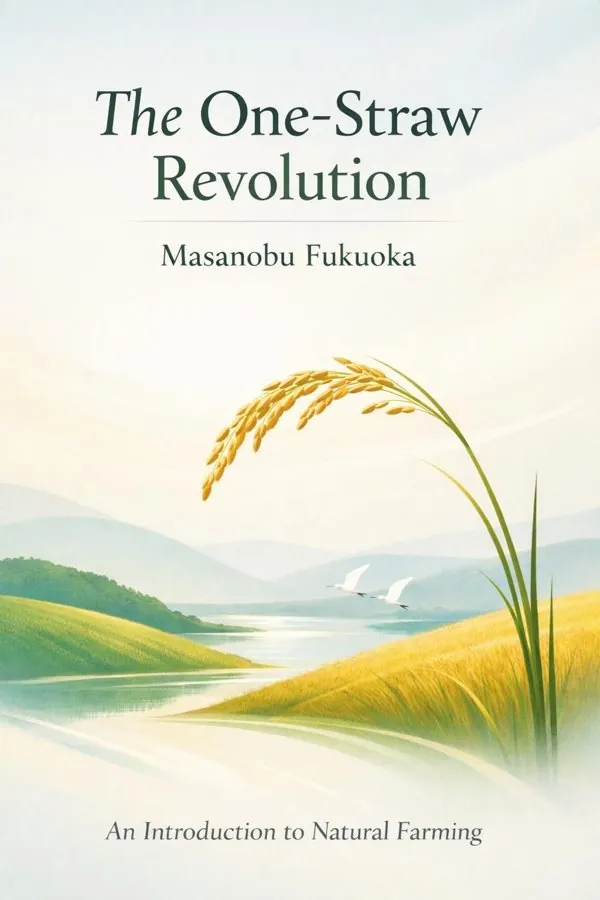
The One-Straw Revolution: An Introduction to Natural Farming: Summary & Key Insights
 10 min9 chaptersAudio available
Key Takeaways from The One-Straw Revolution: An Introduction to Natural Farming
The most radical insight in Fukuoka’s book is that many of the problems farmers struggle to solve are created by farming methods themselves.
Chemical fertilizers can create quick growth, but they bypass the slow, living processes that build resilient soil.
One of Fukuoka’s deepest insights is that nature is not chaotic; it is ordered in ways modern agriculture often fails to understand.
Modern agriculture often treats transplantation, nursery management, and intensive soil preparation as signs of sophistication.
Fukuoka understood that fertility is not something poured onto land from the outside; it emerges from the life within the soil.
What Is The One-Straw Revolution: An Introduction to Natural Farming About?
The One-Straw Revolution: An Introduction to Natural Farming by Masanobu Fukuoka is a environment book spanning 6 pages. What if the most productive way to farm were not to control nature more aggressively, but to interfere with it less? In The One-Straw Revolution, Masanobu Fukuoka challenges the foundations of modern agriculture and offers a radically different vision: farming that cooperates with natural processes instead of trying to dominate them. Drawing on decades of experience cultivating rice, barley, and citrus on his farm in rural Japan, Fukuoka argues that plowing, chemical fertilizers, pesticides, and heavy machinery are not signs of progress, but symptoms of a misunderstanding of how nature works. Part practical guide, part philosophical manifesto, the book shows how simple methods such as direct sowing, mulching with straw, ground cover, and careful observation can produce abundant harvests while restoring soil health and ecological balance. But Fukuoka’s message reaches far beyond farming. He invites readers to question the modern obsession with efficiency, expertise, and endless intervention. His authority comes not only from scientific training as a former agricultural researcher, but from a lifetime spent testing his ideas in the field. The result is a timeless environmental classic that speaks to farmers, gardeners, and anyone searching for a wiser relationship with the natural world.
This FizzRead summary covers all 9 key chapters of The One-Straw Revolution: An Introduction to Natural Farming in approximately 10 minutes, distilling the most important ideas, arguments, and takeaways from Masanobu Fukuoka's work. Also available as an audio summary and Key Quotes Podcast.
The One-Straw Revolution: An Introduction to Natural Farming
What if the most productive way to farm were not to control nature more aggressively, but to interfere with it less? In The One-Straw Revolution, Masanobu Fukuoka challenges the foundations of modern agriculture and offers a radically different vision: farming that cooperates with natural processes instead of trying to dominate them. Drawing on decades of experience cultivating rice, barley, and citrus on his farm in rural Japan, Fukuoka argues that plowing, chemical fertilizers, pesticides, and heavy machinery are not signs of progress, but symptoms of a misunderstanding of how nature works.
Part practical guide, part philosophical manifesto, the book shows how simple methods such as direct sowing, mulching with straw, ground cover, and careful observation can produce abundant harvests while restoring soil health and ecological balance. But Fukuoka’s message reaches far beyond farming. He invites readers to question the modern obsession with efficiency, expertise, and endless intervention. His authority comes not only from scientific training as a former agricultural researcher, but from a lifetime spent testing his ideas in the field. The result is a timeless environmental classic that speaks to farmers, gardeners, and anyone searching for a wiser relationship with the natural world.
Who Should Read The One-Straw Revolution: An Introduction to Natural Farming?
This book is perfect for anyone interested in environment and looking to gain actionable insights in a short read. Whether you're a student, professional, or lifelong learner, the key ideas from The One-Straw Revolution: An Introduction to Natural Farming by Masanobu Fukuoka will help you think differently.
- ✓Readers who enjoy environment and want practical takeaways
- ✓Professionals looking to apply new ideas to their work and life
- ✓Anyone who wants the core insights of The One-Straw Revolution: An Introduction to Natural Farming in just 10 minutes
Want the full summary?
Get instant access to this book summary and 100K+ more with Fizz Moment.
Get Free SummaryAvailable on App Store • Free to download
Key Chapters
The most radical insight in Fukuoka’s book is that many of the problems farmers struggle to solve are created by farming methods themselves. When he speaks of “do-nothing” farming, he does not mean neglect, laziness, or abandonment. He means refusing unnecessary work and learning to distinguish what nature already does well from what humans compulsively try to manage. In his view, modern agriculture adds layer after layer of intervention—plowing, fertilizing, spraying, pruning, weeding—without first asking whether these actions are truly needed.
Fukuoka developed natural farming by repeatedly asking four questions: What if I do not plow? What if I do not use chemical fertilizer? What if I do not rely on pesticides? What if I reduce or eliminate weeding? Instead of assuming these practices were essential, he experimented with letting natural cycles maintain soil structure, fertility, and balance. He discovered that healthy soil organisms can aerate earth better than machines, that crop residues can return nutrients, and that biodiversity can keep many pests in check.
This idea has practical relevance far beyond agriculture. In gardening, it may mean observing before digging, mulching instead of constantly cultivating, or allowing beneficial insects to do work that chemicals would disrupt. In life more broadly, it suggests that efficiency often comes from subtraction, not addition.
The actionable takeaway is simple: before adding a new tool, treatment, or technique, first ask what problem your previous intervention may have created—and whether nature can solve it more elegantly than you can.
Fukuoka’s critique of modern agriculture begins with a disturbing paradox: the more humanity tries to improve nature through force, the more dependent and unstable agriculture becomes. Chemical fertilizers can create quick growth, but they bypass the slow, living processes that build resilient soil. Pesticides may suppress one insect temporarily, yet they often kill predators, pollinators, and microorganisms as well, setting off a chain of new imbalances. Mechanized tilling makes fields look orderly, but it disrupts soil structure, increases erosion, and weakens the underground communities that sustain fertility.
Fukuoka argues that industrial farming is based on a mindset of fragmentation. Scientists isolate nutrients, pests, diseases, and yields into separate problems, then prescribe separate solutions. But a farm is not a machine assembled from replaceable parts. It is a living ecosystem in which plants, insects, fungi, water, animals, and climate interact constantly. Attempts to dominate one piece of the system usually damage another.
We can see this today in monocultures that require constant inputs to survive, soils exhausted by synthetic dependence, and food systems vulnerable to drought, pests, and market shocks. Fukuoka does not deny the short-term productivity of industrial methods; he questions their long-term cost. If farming must continually fight declining soil life, chemical resistance, and ecological collapse, then its productivity is built on hidden losses.
The practical lesson is to evaluate agriculture not just by immediate yield, but by durability, soil health, biodiversity, and independence from costly inputs. The actionable takeaway: whenever a farming solution promises control, ask what new dependency it creates.
One of Fukuoka’s deepest insights is that nature is not chaotic; it is ordered in ways modern agriculture often fails to understand. Natural farming works by aligning cultivation with the rhythms already present in the landscape rather than imposing artificial schedules and rigid control. Fukuoka’s fields were not abandoned wilderness, but carefully observed ecosystems where rice followed winter grain, straw returned to the land, white clover covered the soil, and ducks, insects, and microorganisms all played roles in maintaining balance.
Instead of plowing before each planting, he relied on the natural looseness of biologically active soil. Instead of applying synthetic fertilizer, he returned crop residues and let decomposition feed the next cycle. Instead of leaving land bare between crops, he used living ground cover to prevent erosion, conserve moisture, and suppress weeds. His methods depended on timing: sowing seed just before seasonal conditions favored germination, spreading straw after harvest, and allowing one crop to establish as another finished.
This approach reminds us that successful cultivation is less about commanding nature and more about reading it accurately. Gardeners can apply the same principle by observing sunlight, seasonal moisture, insect patterns, and local plant behavior before making decisions. Even small-scale food growers can reduce inputs by designing around climate and ecology rather than fighting them.
The actionable takeaway is to spend more time observing recurring seasonal patterns in your land or garden. Let planting, mulching, and harvesting fit those cycles, instead of forcing nature to obey an abstract plan.
Modern agriculture often treats transplantation, nursery management, and intensive soil preparation as signs of sophistication. Fukuoka turned that assumption upside down by showing that direct sowing can be both simpler and more natural. Rather than raising seedlings in special conditions and then moving them into disturbed soil, he scattered seed directly into the field at the right time and let plants establish themselves where they would mature. This reduced labor, minimized root shock, and allowed crops to adapt from the beginning to their real environment.
His use of seed balls became one of the best-known elements of natural farming. Seeds were mixed with clay and sometimes compost, rolled into small pellets, and scattered over fields or degraded land. The clay protected seeds from birds, insects, and premature germination until rain and conditions were suitable. Seed balls offered a low-cost, elegant way to sow without plowing or carefully burying each seed. They also made re-vegetation possible in places where conventional cultivation would be difficult.
The power of this method lies in its humility. Rather than engineering every stage of a plant’s life, Fukuoka created favorable conditions and trusted natural selection to do part of the work. For gardeners, this may mean trying more direct seeding, reducing transplant dependence, or experimenting with simple seed pellets for hard-to-establish species.
The actionable takeaway is to identify one crop you currently overmanage and test a simpler direct-sowing approach. Compare labor, plant vigor, and soil disturbance before assuming complexity is superior.
Fukuoka understood that fertility is not something poured onto land from the outside; it emerges from the life within the soil. One of his most practical contributions is his insistence that crop residues, ground cover, and biological activity can replace much of what modern farming seeks through purchased inputs. After harvesting rice or barley, he spread the straw back across the field. What many farmers saw as waste, he treated as nourishment and protection. Straw moderated soil temperature, conserved moisture, reduced erosion, fed decomposers, and gradually returned nutrients to the earth.
He also used white clover and other low-growing plants as living mulch. Ground cover prevented bare soil, helped suppress weeds, and supported a healthier underground ecosystem. This combination of surface mulch and living cover created a self-reinforcing cycle: better soil structure led to more microbial life, which improved fertility and water retention, which supported healthier crops. In Fukuoka’s system, fertility was not manufactured; it was regenerated.
The implications are important for both farms and home gardens. Bare soil is often a sign of ecological stress. Constant digging, removal of plant residues, and dependence on soluble fertilizers may produce quick results, but they weaken the deeper foundations of productivity. Returning organic matter and protecting soil can reduce labor over time while improving resilience.
The actionable takeaway is practical and immediate: stop treating organic residues as trash. Use straw, leaves, or chopped plant matter as mulch, and keep soil covered as much of the year as possible to rebuild fertility from the ground up.
A central mistake of modern farming, according to Fukuoka, is the belief that insects and plant diseases are enemies to be eradicated. In natural systems, pests rarely appear as isolated problems. They are usually signs that a larger balance has been disturbed. When monocultures spread over large areas, when soils are weakened by chemical dependence, when beneficial predators are eliminated, and when plants are pushed into unnatural growth through fertilizer, outbreaks become more likely. The pest is not the root cause; it is the visible symptom of a damaged ecosystem.
Fukuoka’s fields did not eliminate insects. They hosted many forms of life. But by preserving biodiversity and avoiding poisons, he allowed ecological relationships to regulate one another. Predatory insects, frogs, spiders, birds, and soil organisms all contributed to a more stable environment. Healthy plants growing in living soil also tend to be less vulnerable than crops stressed by artificial conditions.
This perspective shifts the farmer’s role from warrior to diagnostician. If aphids appear, the question is not only how to kill them, but why the system favored them. If disease spreads rapidly, one should examine soil health, air circulation, moisture patterns, and genetic uniformity. Even in small gardens, planting diversity, avoiding overfertilization, and inviting beneficial insects can reduce recurrent pest problems.
The actionable takeaway is to treat every pest outbreak as ecological feedback. Before reaching for a spray, look for the underlying imbalance in soil, plant health, biodiversity, or farm design—and address that first.
Fukuoka’s philosophy of non-action is often misunderstood as passive withdrawal, but in reality it demands extraordinary attentiveness. To intervene less, one must perceive more. A farmer who avoids plowing must understand how roots, worms, moisture, and organic matter maintain structure. A grower who avoids pesticides must notice insect relationships, plant health, and seasonal fluctuations. Non-action is not ignorance; it is disciplined restraint grounded in close observation of natural processes.
This idea reflects a larger philosophical argument running through the book. Fukuoka believed modern people are too quick to assume that knowledge means control. We analyze, classify, and manipulate, then mistake that activity for wisdom. But nature’s wholeness often exceeds our categories. The more aggressively we act on partial understanding, the more likely we are to produce unintended consequences. By stepping back, we create space to see what is already functioning.
There is a practical lesson here for anyone managing land. Instead of solving every issue immediately, spend time noticing patterns: which weeds appear where, how water moves after rain, where beneficial insects gather, which patches retain moisture, and how crops respond to different levels of disturbance. Observation can reveal that many “problems” are transitional stages or self-correcting dynamics.
The actionable takeaway is to build a habit of deliberate observation before intervention. When facing a problem in the field or garden, wait, watch, and record what is happening for a few days or weeks. Let understanding guide action, and let inaction remain a valid choice.
Although The One-Straw Revolution is full of practical farming methods, Fukuoka insists that the deepest crisis is not agricultural but human. We have become alienated from nature because we imagine ourselves separate from it. The drive to improve, dominate, and perfect the world comes from a false confidence in human intellect and a diminished trust in the self-organizing wisdom of life. For Fukuoka, environmental destruction is therefore not merely a technical failure. It is a spiritual and philosophical one.
He argues that modern civilization confuses complexity with progress. More technology, more productivity, more specialization, and more control are assumed to be signs of advancement. Yet these same forces can produce ecological ruin, social fragmentation, and inner emptiness. The “one-straw revolution” is revolutionary because it begins with a humble object and a humble act: returning straw to the field, participating in natural cycles, and recognizing that small, simple actions can restore wholeness.
This message reaches readers who may never farm. It applies to how we consume food, define success, and relate to the living world. A simpler life is not necessarily a poorer life. In many cases, it is richer, saner, and more connected. Fukuoka calls for a transformation in consciousness as much as in cultivation.
The actionable takeaway is to choose one area of life where you can replace domination with cooperation—whether in food growing, consumption, or daily habits—and practice simplicity as a form of ecological responsibility.
Fukuoka challenges one of the strongest assumptions in modern economics: that output alone determines success. A field may produce high yields for a few years, but if it depends on purchased chemicals, erodes topsoil, pollutes water, and destroys biodiversity, is it truly productive? His answer is no. Real productivity must include the long-term health of the land, the quality of food, the independence of the farmer, and the resilience of the surrounding ecosystem.
This broader definition matters because industrial systems often hide their costs. Cheap food may depend on fossil fuels, degraded rivers, collapsing insect populations, and debt-driven farming. By contrast, a natural farm may appear less efficient by narrow accounting standards, yet it can be far more efficient when measured in total energy use, ecological integrity, and sustainability across generations. Fukuoka showed that low-input farming can still produce meaningful harvests while building, rather than mining, fertility.
This concept also invites consumers to rethink food choices. Supporting local, ecologically sound growers may seem more expensive at the checkout, but it often reflects the true cost of food production more honestly than artificially cheap industrial goods. On a personal level, gardeners can adopt this principle by valuing soil improvement, biodiversity, and reduced inputs alongside harvest size.
The actionable takeaway is to redefine success in any growing system. Track not just yield, but soil quality, input dependence, water retention, biodiversity, and labor intensity. What grows the most is not always what sustains the most.
All Chapters in The One-Straw Revolution: An Introduction to Natural Farming
About the Author
Masanobu Fukuoka (1913–2008) was a Japanese farmer, microbiologist, and philosopher whose work transformed global thinking about agriculture and ecology. Born in Ehime Prefecture on the island of Shikoku, he trained as a scientist and worked as a plant pathology researcher for Japan’s Ministry of Agriculture. In his mid-twenties, a profound personal realization led him to question modern scientific assumptions and return to his family’s farm. There he spent decades developing “natural farming,” a system that rejects plowing, synthetic fertilizers, pesticides, and excessive intervention. Through his farming practice and writing, especially The One-Straw Revolution, Fukuoka became a major influence on sustainable agriculture, permaculture, and environmental philosophy. His legacy endures as both a practical model for ecological cultivation and a profound critique of humanity’s attempt to dominate nature.
Get This Summary in Your Preferred Format
Read or listen to the The One-Straw Revolution: An Introduction to Natural Farming summary by Masanobu Fukuoka anytime, anywhere. FizzRead offers multiple formats so you can learn on your terms — all free.
Available formats: App · Audio · PDF · EPUB — All included free with FizzRead
Download The One-Straw Revolution: An Introduction to Natural Farming PDF and EPUB Summary
Key Quotes from The One-Straw Revolution: An Introduction to Natural Farming
“The most radical insight in Fukuoka’s book is that many of the problems farmers struggle to solve are created by farming methods themselves.”
“Fukuoka’s critique of modern agriculture begins with a disturbing paradox: the more humanity tries to improve nature through force, the more dependent and unstable agriculture becomes.”
“One of Fukuoka’s deepest insights is that nature is not chaotic; it is ordered in ways modern agriculture often fails to understand.”
“Modern agriculture often treats transplantation, nursery management, and intensive soil preparation as signs of sophistication.”
“Fukuoka understood that fertility is not something poured onto land from the outside; it emerges from the life within the soil.”
Frequently Asked Questions about The One-Straw Revolution: An Introduction to Natural Farming
The One-Straw Revolution: An Introduction to Natural Farming by Masanobu Fukuoka is a environment book that explores key ideas across 9 chapters. What if the most productive way to farm were not to control nature more aggressively, but to interfere with it less? In The One-Straw Revolution, Masanobu Fukuoka challenges the foundations of modern agriculture and offers a radically different vision: farming that cooperates with natural processes instead of trying to dominate them. Drawing on decades of experience cultivating rice, barley, and citrus on his farm in rural Japan, Fukuoka argues that plowing, chemical fertilizers, pesticides, and heavy machinery are not signs of progress, but symptoms of a misunderstanding of how nature works. Part practical guide, part philosophical manifesto, the book shows how simple methods such as direct sowing, mulching with straw, ground cover, and careful observation can produce abundant harvests while restoring soil health and ecological balance. But Fukuoka’s message reaches far beyond farming. He invites readers to question the modern obsession with efficiency, expertise, and endless intervention. His authority comes not only from scientific training as a former agricultural researcher, but from a lifetime spent testing his ideas in the field. The result is a timeless environmental classic that speaks to farmers, gardeners, and anyone searching for a wiser relationship with the natural world.
You Might Also Like

A Life on Our Planet: My Witness Statement and a Vision for the Future
David Attenborough
10 min
A Sky Full Of Birds
Matt Merritt
10 min
Carbon Zero: Imagining Cities That Can Save the Planet
Alex Steffen
10 min
Eaarth: Making a Life on a Tough New Planet
Bill McKibben
10 min
The Social Contract and Environmental Governance
Various Editors
10 min
The Wild Places
Robert Macfarlane
10 minBrowse by Category
Ready to read The One-Straw Revolution: An Introduction to Natural Farming?
Get the full summary and 100K+ more books with Fizz Moment.