
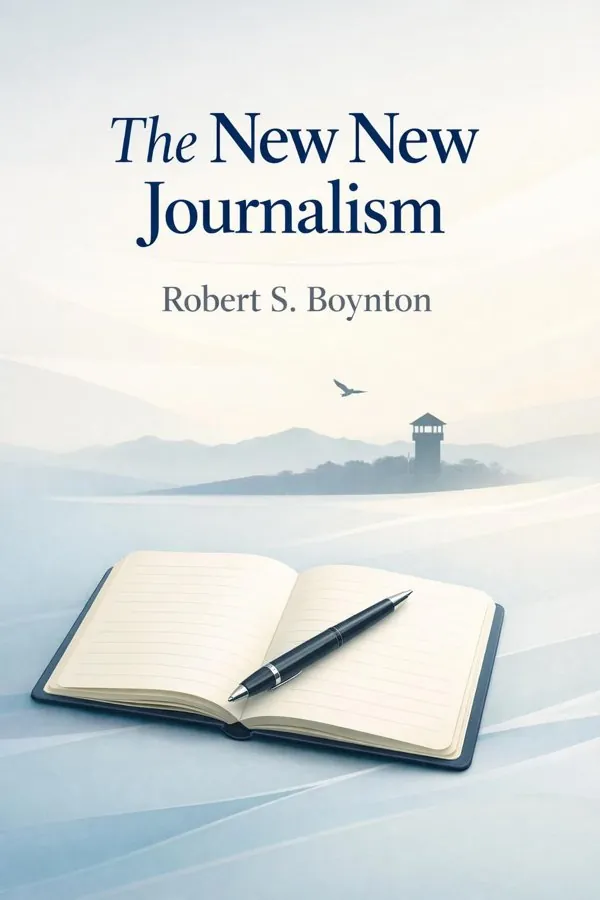
The New New Journalism: Conversations with America's Best Nonfiction Writers on Their Craft: Summary & Key Insights
 10 min11 chaptersAudio available
What Is The New New Journalism: Conversations with America's Best Nonfiction Writers on Their Craft About?
The New New Journalism: Conversations with America's Best Nonfiction Writers on Their Craft by Robert S. Boynton is a writing book spanning 11 pages. This book presents in-depth interviews with leading American nonfiction writers who have shaped contemporary literary journalism. Boynton explores their creative processes, narrative techniques, and the evolution of long-form reporting in the post–New Journalism era. The conversations reveal how these writers blend rigorous reporting with literary style to produce compelling works of narrative nonfiction.
This FizzRead summary covers all 11 key chapters of The New New Journalism: Conversations with America's Best Nonfiction Writers on Their Craft in approximately 10 minutes, distilling the most important ideas, arguments, and takeaways from Robert S. Boynton's work. Also available as an audio summary and Key Quotes Podcast.
The New New Journalism: Conversations with America's Best Nonfiction Writers on Their Craft
This book presents in-depth interviews with leading American nonfiction writers who have shaped contemporary literary journalism. Boynton explores their creative processes, narrative techniques, and the evolution of long-form reporting in the post–New Journalism era. The conversations reveal how these writers blend rigorous reporting with literary style to produce compelling works of narrative nonfiction.
Who Should Read The New New Journalism: Conversations with America's Best Nonfiction Writers on Their Craft?
This book is perfect for anyone interested in writing and looking to gain actionable insights in a short read. Whether you're a student, professional, or lifelong learner, the key ideas from The New New Journalism: Conversations with America's Best Nonfiction Writers on Their Craft by Robert S. Boynton will help you think differently.
- ✓Readers who enjoy writing and want practical takeaways
- ✓Professionals looking to apply new ideas to their work and life
- ✓Anyone who wants the core insights of The New New Journalism: Conversations with America's Best Nonfiction Writers on Their Craft in just 10 minutes
Want the full summary?
Get instant access to this book summary and 100K+ more with Fizz Moment.
Get Free SummaryAvailable on App Store • Free to download
Key Chapters
To appreciate the identity of the New New Journalism, one must first revisit its forerunner. The New Journalism of the 1960s broke from convention by blending factual reporting with literary techniques. It celebrated the subjective eye of the reporter, the sensory detail of fiction, and an obsession with character and scene. Writers like Wolfe, Capote, and Talese turned reportage into literature.
Yet by the 1980s, that movement had spent much of its energy. What arose in its wake was quieter but in many ways more radical. The writers of the New New Journalism—figures such as Susan Orlean, Jon Krakauer, Adrian Nicole LeBlanc, and Lawrence Weschler—abandoned the flamboyant authorial presence of earlier years. They embraced long-form immersion and ethical restraint, rooting their narratives in careful observation rather than dramatic self-display. Their stories were built on intimacy rather than spectacle. This evolution mirrored broader cultural changes: a distrust of grand narratives, a renewed interest in everyday life, and the recognition that truth often hides in nuance rather than in the extraordinary event.
Thus, the New New Journalism represents not a break from the past but a maturation. It is reportage with both the humility of ethnography and the elegance of literature, journalism that seeks to understand rather than to impress.
In shaping this book, I decided to let the practitioners speak for themselves. Each chapter takes the form of an extended interview, designed to reveal not only how a writer constructs a story but why they choose to tell it. My role was to provoke reflection—to ask about ethics, about the limits of empathy, about the invisible negotiations that take place between writer and subject.
The structure mirrors the communal nature of the craft. Literary journalists rarely work in isolation; they build upon one another’s experiments. The conversational form allows patterns to emerge organically. Certain themes—trust, time, observation, structure—reappear across dialogues. The reader comes to see how each writer uses reporting as a kind of moral inquiry. Instead of prescribing rules, I wanted to illuminate habits of mind: patience, attentiveness, the ability to dwell in ambiguity.
This method reflects a conviction that knowledge of craft is best transmitted through stories rather than instructions. When Gay Talese discusses spending weeks with his subjects before taking notes, or when Ted Conover describes working undercover at Sing Sing, we glimpse not doctrine but lived practice. Through such portraits, technical details acquire emotional dimension.
+ 9 more chapters — available in the FizzRead app
All Chapters in The New New Journalism: Conversations with America's Best Nonfiction Writers on Their Craft
About the Author
Robert S. Boynton is an American journalist, author, and director of the Literary Reportage program at New York University. His work focuses on narrative nonfiction and the craft of long-form journalism. He has written for publications such as The New Yorker, The Atlantic, and The New York Times Magazine.
Get This Summary in Your Preferred Format
Read or listen to the The New New Journalism: Conversations with America's Best Nonfiction Writers on Their Craft summary by Robert S. Boynton anytime, anywhere. FizzRead offers multiple formats so you can learn on your terms — all free.
Available formats: App · Audio · PDF · EPUB — All included free with FizzRead
Download The New New Journalism: Conversations with America's Best Nonfiction Writers on Their Craft PDF and EPUB Summary
Key Quotes from The New New Journalism: Conversations with America's Best Nonfiction Writers on Their Craft
“To appreciate the identity of the New New Journalism, one must first revisit its forerunner.”
“In shaping this book, I decided to let the practitioners speak for themselves.”
Frequently Asked Questions about The New New Journalism: Conversations with America's Best Nonfiction Writers on Their Craft
The New New Journalism: Conversations with America's Best Nonfiction Writers on Their Craft by Robert S. Boynton is a writing book that explores key ideas across 11 chapters. This book presents in-depth interviews with leading American nonfiction writers who have shaped contemporary literary journalism. Boynton explores their creative processes, narrative techniques, and the evolution of long-form reporting in the post–New Journalism era. The conversations reveal how these writers blend rigorous reporting with literary style to produce compelling works of narrative nonfiction.
You Might Also Like
The Art of Perspective
Christopher Castellani
10 min
Making a Point: The Persnickety Story of English Punctuation
David Crystal
10 min
The Elements Of Eloquence: How To Turn The Perfect English Phrase
Mark Forsyth
10 min
The Pocket Muse: Ideas and Inspirations for Writing
Monica Wood
10 min
A Little Book on Form: An Exploration into the Formal Imagination of Poetry
Robert Hass
10 min
Adventures In The Screen Trade: A Personal View Of Hollywood And Screenwriting
William Goldman
10 minBrowse by Category
Ready to read The New New Journalism: Conversations with America's Best Nonfiction Writers on Their Craft?
Get the full summary and 100K+ more books with Fizz Moment.