
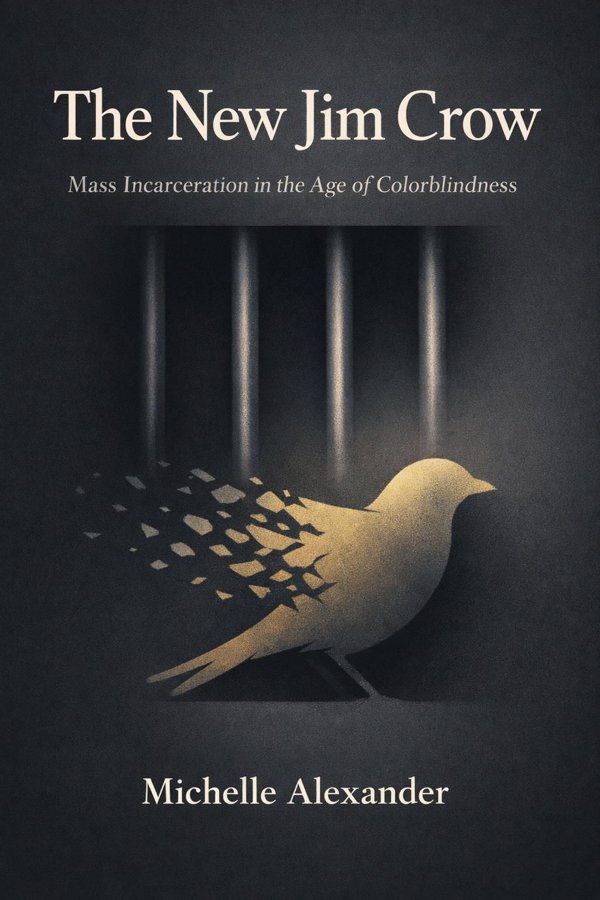
The New Jim Crow: Mass Incarceration in the Age of Colorblindness: Summary & Key Insights
 10 min9 chaptersAudio available
Key Takeaways from The New Jim Crow: Mass Incarceration in the Age of Colorblindness
A society does not need openly racist laws to preserve racial hierarchy; it only needs a new language and a new mechanism.
Mass incarceration did not arise because crime suddenly demanded it; it grew because policy makers chose to build it.
Freedom feels very different when entire communities are treated as suspect.
A legal system can reject overt racism while still protecting racial inequality.
The sentence does not end when the prison gate opens.
What Is The New Jim Crow: Mass Incarceration in the Age of Colorblindness About?
The New Jim Crow: Mass Incarceration in the Age of Colorblindness by Michelle Alexander is a sociology book spanning 6 pages. What if the end of legal segregation did not end racial caste in America, but merely changed its form? In The New Jim Crow, legal scholar and civil rights advocate Michelle Alexander argues that mass incarceration has become a powerful system of social control that functions much like earlier racial hierarchies. Her central claim is not simply that the criminal justice system is biased, but that it has helped create a new racial order—one that labels millions of people, especially Black men, as criminals and then excludes them from full citizenship. Alexander traces how the War on Drugs, aggressive policing, prosecutorial discretion, and harsh sentencing combined to produce a vast prison system with devastating effects on Black communities. She also shows how a supposedly “colorblind” political culture masks these outcomes, allowing severe racial disparities to persist without openly racist laws. The book matters because it reframes mass incarceration from a narrow crime issue into a moral, political, and civil rights crisis. Drawing on her experience as a lawyer, advocate, and scholar, Alexander offers a forceful, deeply researched critique that has reshaped public debate about race, punishment, and democracy in the United States.
This FizzRead summary covers all 9 key chapters of The New Jim Crow: Mass Incarceration in the Age of Colorblindness in approximately 10 minutes, distilling the most important ideas, arguments, and takeaways from Michelle Alexander's work. Also available as an audio summary and Key Quotes Podcast.
The New Jim Crow: Mass Incarceration in the Age of Colorblindness
What if the end of legal segregation did not end racial caste in America, but merely changed its form? In The New Jim Crow, legal scholar and civil rights advocate Michelle Alexander argues that mass incarceration has become a powerful system of social control that functions much like earlier racial hierarchies. Her central claim is not simply that the criminal justice system is biased, but that it has helped create a new racial order—one that labels millions of people, especially Black men, as criminals and then excludes them from full citizenship.
Alexander traces how the War on Drugs, aggressive policing, prosecutorial discretion, and harsh sentencing combined to produce a vast prison system with devastating effects on Black communities. She also shows how a supposedly “colorblind” political culture masks these outcomes, allowing severe racial disparities to persist without openly racist laws.
The book matters because it reframes mass incarceration from a narrow crime issue into a moral, political, and civil rights crisis. Drawing on her experience as a lawyer, advocate, and scholar, Alexander offers a forceful, deeply researched critique that has reshaped public debate about race, punishment, and democracy in the United States.
Who Should Read The New Jim Crow: Mass Incarceration in the Age of Colorblindness?
This book is perfect for anyone interested in sociology and looking to gain actionable insights in a short read. Whether you're a student, professional, or lifelong learner, the key ideas from The New Jim Crow: Mass Incarceration in the Age of Colorblindness by Michelle Alexander will help you think differently.
- ✓Readers who enjoy sociology and want practical takeaways
- ✓Professionals looking to apply new ideas to their work and life
- ✓Anyone who wants the core insights of The New Jim Crow: Mass Incarceration in the Age of Colorblindness in just 10 minutes
Want the full summary?
Get instant access to this book summary and 100K+ more with Fizz Moment.
Get Free SummaryAvailable on App Store • Free to download
Key Chapters
A society does not need openly racist laws to preserve racial hierarchy; it only needs a new language and a new mechanism. That is the provocative starting point of Michelle Alexander’s argument. She contends that every major racial caste system in American history emerged after moments of racial progress. Slavery was followed by Jim Crow. Jim Crow, once formally dismantled, was followed by mass incarceration. Each system differed in style and legal structure, but all served a similar function: keeping Black Americans in a subordinate social position.
Alexander emphasizes that racial control today rarely announces itself as racial control. Instead, it is justified through the language of crime, public safety, and personal responsibility. This shift matters because it allows the broader public to deny the racial nature of the system even while accepting its consequences. If someone is seen not as a citizen but as a criminal, discrimination against them can appear normal, deserved, or even necessary.
A practical example is the way criminal records operate after release. A person may legally be denied work, housing, education benefits, and even voting rights. Though these restrictions are framed as consequences for lawbreaking, they often function as a durable badge of second-class status that falls disproportionately on Black communities.
The concept can be applied beyond the courtroom. When evaluating any policy, ask not only whether it appears race-neutral on paper, but whether it produces patterned racial exclusion in practice. The key takeaway is this: to challenge inequality effectively, look beyond explicit prejudice and examine the institutions that quietly reproduce hierarchy under neutral-sounding rules.
Mass incarceration did not arise because crime suddenly demanded it; it grew because policy makers chose to build it. Alexander argues that the War on Drugs was the engine that dramatically expanded the American criminal justice system, even though drug crime was declining in some periods and drug use was not confined to any one racial group. The political decision to declare war created the conditions for aggressive enforcement, more arrests, harsher sentencing, and the expansion of prisons and jails.
One of Alexander’s sharpest insights is that a war mentality changes what government institutions believe they are allowed to do. Police departments receive incentives, funding, and military-style equipment. Prosecutors gain leverage. Legislators benefit politically from “tough on crime” rhetoric. Once this machinery is in place, it develops its own momentum. Entire bureaucracies, careers, and budgets begin to depend on continued enforcement.
Consider how this plays out at street level. In many urban neighborhoods, police devote extraordinary resources to low-level drug enforcement, stopping, searching, and arresting large numbers of residents. Yet studies repeatedly show that drug use and drug sales occur across racial and class lines. The difference lies in where the state chooses to concentrate surveillance.
The broader lesson is that punitive systems often expand through political choices dressed up as common sense. If we want a fairer society, we must question the assumptions behind those choices. The actionable takeaway: when you hear public officials link punishment with safety, ask for evidence about effectiveness, racial impact, and who benefits institutionally from the policy.
Freedom feels very different when entire communities are treated as suspect. In Alexander’s account, the New Jim Crow begins not in prison cells but on the street, where policing practices in Black and brown neighborhoods often resemble occupation more than protection. The War on Drugs gave law enforcement broad authority to stop, search, interrogate, and arrest people with minimal accountability, especially in poor communities of color.
This chapter’s logic is simple but powerful: if police flood a neighborhood, make discretionary stops, and treat minor signs as probable cause, they will inevitably generate more arrests there. The result is then cited as proof that crime is concentrated in that community, which justifies even more surveillance. This self-reinforcing cycle creates the appearance of criminality while deepening mistrust between residents and the state.
Examples include stop-and-frisk tactics, pretextual traffic stops, consent searches, and raids based on weak intelligence. Even when these actions do not lead to conviction, they impose costs: humiliation, fear, lost time, court fees, family stress, and a normalized sense that one’s rights are conditional. Children grow up watching adults searched or handcuffed, learning early that the law does not meet everyone equally.
In practical terms, Alexander helps readers see policing as a front-end sorting system, not merely a response to crime. To apply this insight, examine local policing data: where are stops concentrated, who is searched, and what is the hit rate? The takeaway is clear: meaningful reform must begin before incarceration, by challenging the everyday practices that transform neighborhood presence into permanent social vulnerability.
A legal system can reject overt racism while still protecting racial inequality. That is the central tension Alexander explores in her discussion of courts and the “color of justice.” Modern equal protection doctrine often requires proof of intentional racial discrimination, a standard so demanding that systemic bias can thrive without legal remedy. If no official openly admits racial motive, courts are often reluctant to intervene, even when outcomes are starkly unequal.
This doctrine matters because criminal justice systems rarely operate through explicit racial language anymore. Instead, they rely on discretion at every stage: police decide whom to stop, prosecutors decide what charges to file, judges determine sentences, and legislators craft rules that appear neutral. Each decision may seem individualized, but together they generate massive racial disparities that the law struggles to recognize.
A useful example is selective enforcement. If Black drivers are stopped and searched far more often than white drivers, but officers cite vague factors like “suspicious behavior,” challenging the pattern becomes difficult. Similarly, mandatory minimums and plea bargaining can pressure defendants into accepting severe consequences without a full trial, while insulating the broader system from public scrutiny.
Alexander’s deeper point is that formal neutrality is not the same as justice. A rule can be race-neutral in wording while racially unequal in effect. For readers, this offers a practical test: do not ask only whether a policy uses racist language; ask whether it distributes burdens and opportunities fairly. The actionable takeaway: support legal and policy reforms that measure outcomes, limit unchecked discretion, and treat structural inequality as a public problem rather than an individual accident.
The sentence does not end when the prison gate opens. One of the book’s most devastating insights is that the formal punishment of incarceration is only the beginning of a much longer chain of exclusion. Alexander describes this network of barriers as the “cruel hand” of the system: legal and social penalties that follow people long after release and make genuine reintegration extraordinarily difficult.
A criminal record can block access to employment, public housing, student aid, occupational licenses, and social services. In many states, it can also mean losing the right to vote, serve on juries, or participate fully in civic life. These penalties do not merely punish past conduct; they shape the future by making stability harder to achieve. Without a job or housing, people face greater vulnerability, family strain, and social isolation.
Imagine two people applying for the same apartment or job. One checks the box indicating a felony conviction. Even if the offense was nonviolent and years old, that mark often functions as a near-automatic disqualification. The stigma becomes self-reinforcing: society demands rehabilitation while denying the conditions that make rehabilitation possible.
This idea has immediate relevance for employers, educators, landlords, and policy makers. Reentry is not just a personal challenge; it is structured by institutional choices. “Ban the box” initiatives, expungement reform, restoration of voting rights, and fair chance hiring are practical responses to the problem.
The takeaway is simple but urgent: if we care about public safety and justice, we must stop treating formerly incarcerated people as permanently disposable. Real accountability must include real pathways back into society.
Few labels in public life are as powerful as “criminal.” Alexander argues that once this label is attached, it authorizes forms of exclusion that would be unacceptable if applied openly on the basis of race. This is why mass incarceration functions, in her view, as a new caste system. The criminal label transforms human beings into people against whom discrimination seems reasonable, lawful, and morally deserved.
The comparison to Jim Crow is not literal sameness. Alexander does not claim that contemporary America replicates segregation in identical form. Rather, she argues that both systems create a category of people relegated to inferior status. Under Jim Crow, the badge was race. Under mass incarceration, the badge is criminality—but because policing and prosecution are racially skewed, the burden falls disproportionately on Black communities.
This framework helps explain why the social consequences of incarceration are so enduring. A person with a record may be legally excluded from jury service, denied access to jobs, and viewed as dangerous or unreliable in everyday life. Families suffer too: children lose parents, households lose income, and neighborhoods absorb the destabilizing effects of constant removal and return.
In practical conversation, this idea invites a change in language. Ask how often public debate reduces people to their worst act rather than recognizing their full humanity. Support institutions that use person-first language and create second chances rather than permanent stigma.
The actionable takeaway: challenge the reflex to equate conviction with permanent moral worthlessness. A just society should hold people accountable without converting them into lifelong outsiders.
One of the most unsettling features of modern inequality is that it can flourish without anyone saying the quiet part out loud. Alexander argues that colorblind political culture allows racialized systems to operate while shielding them from criticism. By avoiding explicit racial language and framing policy around crime, order, and personal choice, leaders can mobilize fear and resentment without appearing racist.
This political strategy has deep consequences. If the public believes the system targets behavior rather than people, then unequal outcomes can be interpreted as evidence of group failure rather than institutional design. The conversation shifts from structural questions—why policing is concentrated, how sentencing works, who profits from prison expansion—to moral judgments about communities deemed criminal.
A familiar example is political messaging that invokes “law and order” during moments of social unrest. Such language may seem neutral, but historically it has often coded racial anxieties into acceptable public speech. It reassures some voters while legitimizing policies that intensify surveillance and punishment in communities already facing disadvantage.
Alexander’s insight is useful far beyond criminal justice. In education, housing, and employment, race-neutral language can still mask unequal treatment. The task is not to reject neutrality itself, but to refuse the illusion that neutrality in language guarantees fairness in results.
A practical response is to become more attentive to framing. When politicians or media outlets discuss crime, ask what racial imagery is implied, what data are omitted, and which policy solutions are treated as thinkable. The takeaway: colorblind rhetoric is not proof of racial progress if it prevents honest discussion of racialized harm.
Systems of injustice survive not only through force, but through fragmentation. Alexander argues that mass incarceration has been sustained in part because it isolates the people most affected and divides potential allies. Poor communities of color are heavily targeted, but broader society often sees those caught in the system as criminals first and citizens second. That framing makes empathy scarce and coalition-building difficult.
There is also a painful internal dimension to this divide. Within marginalized communities, stigma attached to incarceration can produce silence, shame, and distancing. People may defend “respectable” members of the community while abandoning those with records, unintentionally reinforcing the caste logic Alexander criticizes. This mirrors a broader pattern in social movements: when the most vulnerable are treated as politically inconvenient, durable change becomes much harder.
Examples abound. A reform campaign may gain support for nonviolent first-time offenders but ignore people convicted of more serious charges. Advocacy groups may rally around narrow legal reforms while avoiding the deeper question of why punishment and exclusion are so central in the first place. Partial victories matter, but Alexander warns that they can leave the core structure intact.
Her alternative is moral and strategic solidarity. If mass incarceration is a caste system, then the movement against it must defend the humanity of all those trapped within it, not only the easiest cases. That means listening to formerly incarcerated people, supporting community-led organizations, and resisting narratives that sort the deserving from the disposable.
The actionable takeaway: broaden your circle of concern. Lasting reform requires coalitions rooted in shared dignity, not selective sympathy.
Reform that tweaks procedure without confronting underlying values will never be enough. In the final movement of the book, Alexander calls for something larger than technical criminal justice reform: a broad social movement willing to face the intertwined realities of race, poverty, punishment, and political power. Her message is both sobering and hopeful. Sobering, because the system is deeply entrenched. Hopeful, because history shows that caste systems can be challenged when people name them clearly and organize collectively.
Alexander does not offer a simplistic policy checklist, but she points toward a new moral consensus. Society must move beyond the belief that safety is best achieved through stigmatization, cages, and perpetual exclusion. Instead, it should invest in education, treatment, employment, housing, public health, and democratic inclusion. Such investments address the conditions that make communities vulnerable while restoring the humanity of those harmed by the system.
A practical application is to think in layers. Local action might include supporting diversion programs, civilian oversight, reentry services, and sentencing reform. State-level action may involve ending felony disenfranchisement, reducing mandatory minimums, and expanding record clearing. Nationally, citizens can challenge fear-based politics and support leaders who treat racial justice and public safety as connected rather than opposed.
Most importantly, Alexander insists that honest public language matters. If people continue to describe the crisis only as a problem of individual bad choices, structural change will remain out of reach. The takeaway: meaningful transformation begins by naming the system, listening to those most affected, and linking policy reform to a deeper commitment to human dignity and democratic equality.
All Chapters in The New Jim Crow: Mass Incarceration in the Age of Colorblindness
About the Author
Michelle Alexander is an American civil rights lawyer, legal scholar, writer, and advocate whose work focuses on racial justice, democracy, and the criminal legal system. She has taught at Ohio State University Moritz College of Law and has worked with major civil rights organizations, including the ACLU, where she focused on issues such as racial profiling and voting rights. Alexander is best known for The New Jim Crow, a landmark book that helped transform public understanding of mass incarceration by framing it as a modern system of racial caste. Her writing combines legal analysis, historical perspective, and moral urgency, making complex structural issues accessible to broad audiences. Through her scholarship and advocacy, she has become one of the most influential voices in debates about prison reform, policing, and racial inequality in the United States.
Get This Summary in Your Preferred Format
Read or listen to the The New Jim Crow: Mass Incarceration in the Age of Colorblindness summary by Michelle Alexander anytime, anywhere. FizzRead offers multiple formats so you can learn on your terms — all free.
Available formats: App · Audio · PDF · EPUB — All included free with FizzRead
Download The New Jim Crow: Mass Incarceration in the Age of Colorblindness PDF and EPUB Summary
Key Quotes from The New Jim Crow: Mass Incarceration in the Age of Colorblindness
“A society does not need openly racist laws to preserve racial hierarchy; it only needs a new language and a new mechanism.”
“Mass incarceration did not arise because crime suddenly demanded it; it grew because policy makers chose to build it.”
“Freedom feels very different when entire communities are treated as suspect.”
“A legal system can reject overt racism while still protecting racial inequality.”
“The sentence does not end when the prison gate opens.”
Frequently Asked Questions about The New Jim Crow: Mass Incarceration in the Age of Colorblindness
The New Jim Crow: Mass Incarceration in the Age of Colorblindness by Michelle Alexander is a sociology book that explores key ideas across 9 chapters. What if the end of legal segregation did not end racial caste in America, but merely changed its form? In The New Jim Crow, legal scholar and civil rights advocate Michelle Alexander argues that mass incarceration has become a powerful system of social control that functions much like earlier racial hierarchies. Her central claim is not simply that the criminal justice system is biased, but that it has helped create a new racial order—one that labels millions of people, especially Black men, as criminals and then excludes them from full citizenship. Alexander traces how the War on Drugs, aggressive policing, prosecutorial discretion, and harsh sentencing combined to produce a vast prison system with devastating effects on Black communities. She also shows how a supposedly “colorblind” political culture masks these outcomes, allowing severe racial disparities to persist without openly racist laws. The book matters because it reframes mass incarceration from a narrow crime issue into a moral, political, and civil rights crisis. Drawing on her experience as a lawyer, advocate, and scholar, Alexander offers a forceful, deeply researched critique that has reshaped public debate about race, punishment, and democracy in the United States.
More by Michelle Alexander
You Might Also Like

Between the World and Me
Ta-Nehisi Coates
10 min
Half the Sky
Nicholas D. Kristof, Sheryl WuDunn
10 min
Men Explain Things To Me
Rebecca Solnit
10 min
Rational Ritual
Michael Suk-Young Chwe
10 min
The New Jim Crow
Michelle Alexander
10 min
Beyond Culture
Edward T. Hall
10 minBrowse by Category
Ready to read The New Jim Crow: Mass Incarceration in the Age of Colorblindness?
Get the full summary and 100K+ more books with Fizz Moment.