
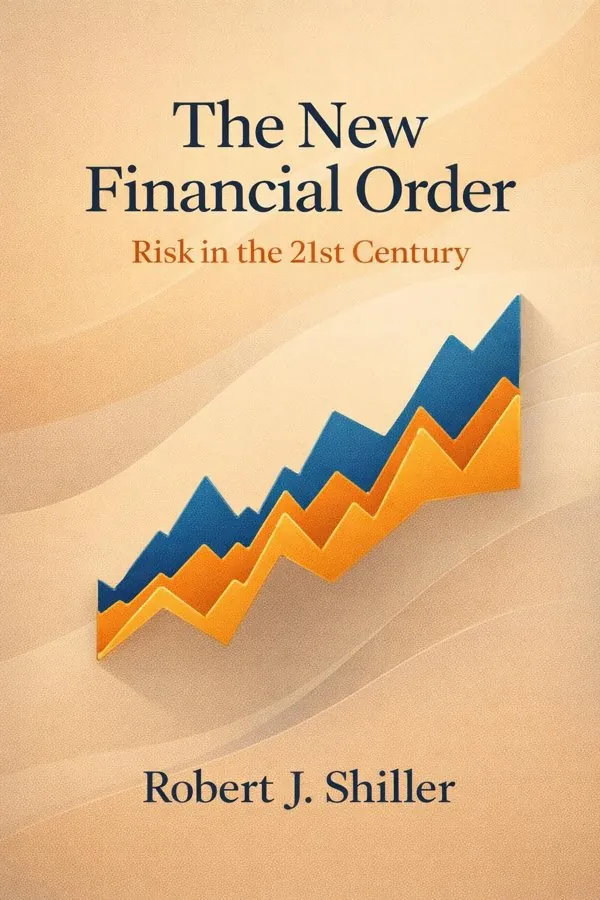
The New Financial Order: Risk in the 21st Century: Summary & Key Insights
 10 min11 chaptersAudio available
What Is The New Financial Order: Risk in the 21st Century About?
The New Financial Order: Risk in the 21st Century by Robert J. Shiller is a finance book spanning 11 pages. In this influential work, Nobel laureate Robert J. Shiller proposes a bold vision for reshaping the financial system to better manage the risks of modern life. He argues that advances in information technology and financial theory can democratize finance, allowing individuals and societies to insure against major economic risks such as job loss, income inequality, and market volatility. Shiller outlines practical mechanisms for creating new markets and instruments that could stabilize economies and promote social welfare in the 21st century.
This FizzRead summary covers all 11 key chapters of The New Financial Order: Risk in the 21st Century in approximately 10 minutes, distilling the most important ideas, arguments, and takeaways from Robert J. Shiller's work. Also available as an audio summary and Key Quotes Podcast.
The New Financial Order: Risk in the 21st Century
In this influential work, Nobel laureate Robert J. Shiller proposes a bold vision for reshaping the financial system to better manage the risks of modern life. He argues that advances in information technology and financial theory can democratize finance, allowing individuals and societies to insure against major economic risks such as job loss, income inequality, and market volatility. Shiller outlines practical mechanisms for creating new markets and instruments that could stabilize economies and promote social welfare in the 21st century.
Who Should Read The New Financial Order: Risk in the 21st Century?
This book is perfect for anyone interested in finance and looking to gain actionable insights in a short read. Whether you're a student, professional, or lifelong learner, the key ideas from The New Financial Order: Risk in the 21st Century by Robert J. Shiller will help you think differently.
- ✓Readers who enjoy finance and want practical takeaways
- ✓Professionals looking to apply new ideas to their work and life
- ✓Anyone who wants the core insights of The New Financial Order: Risk in the 21st Century in just 10 minutes
Want the full summary?
Get instant access to this book summary and 100K+ more with Fizz Moment.
Get Free SummaryAvailable on App Store • Free to download
Key Chapters
To understand what the financial order of the twenty-first century might look like, we must first appreciate where our current institutions come from. Finance has always been, at its heart, a technology for managing uncertainty. Its earliest functions—insurance against fire, maritime ventures, or crop failure—emerged in a world that feared randomness but lacked the informational infrastructure to measure it. As historians of risk such as Peter Bernstein have noted, the modern conception of probability and risk assessment only crystallized during the Renaissance, when thinkers first began to see the future as something that could be quantified.
The great financial innovations of the nineteenth and twentieth centuries—credit markets, stock exchanges, central banking—were all responses to risk. They allowed capital to flow from savers to entrepreneurs, and wealth to be redistributed across time and space. However, these systems were largely designed for businesses and governments, not for individuals. While corporations could issue bonds or sell shares to manage uncertainty, households had little recourse beyond traditional insurance and savings.
By the late twentieth century, as global markets expanded and information became more granular, it became clear that these old frameworks were inadequate. The risks people face today—technological displacement, global recessions, lifelong healthcare costs—cannot be addressed with 19th century instruments. This historical perspective shows that financial evolution follows human need, and that our next phase must extend protection to the risks of modern existence.
The engine driving the next revolution in finance is information technology. Every day, data is generated that captures the movements of people, prices, and performance across the globe. Until recently, such data were incomprehensible in volume and complexity. But now, the tools of computing—machine learning, online databases, real-time analytics—allow us to model risk at an unprecedented level.
I envision a system in which continually updated economic information underpins a new generation of financial instruments. Take, for example, the idea of micro-data on job markets. If we can aggregate and process this information accurately, we can create securities that reflect regional or occupational income patterns. Advances in IT make it possible not just to observe these metrics, but to trade upon them collectively, thereby transforming uncertainty into marketable, hedgeable risk.
This transformation requires a cultural leap: finance must no longer be seen solely as the domain of traders and institutions. It must become a public good, grounded in transparency and accessibility. By building open, well-regulated databases and communication infrastructures, we can democratize the capacity to share economic risk. The new financial order depends on our ability to turn information—once chaotic and private—into structured opportunities for protection and growth.
+ 9 more chapters — available in the FizzRead app
All Chapters in The New Financial Order: Risk in the 21st Century
About the Author
Robert J. Shiller is an American economist, professor at Yale University, and recipient of the 2013 Nobel Prize in Economic Sciences. He is known for his pioneering work on behavioral finance, asset pricing, and market volatility, and is the author of several influential books including 'Irrational Exuberance' and 'Animal Spirits'.
Get This Summary in Your Preferred Format
Read or listen to the The New Financial Order: Risk in the 21st Century summary by Robert J. Shiller anytime, anywhere. FizzRead offers multiple formats so you can learn on your terms — all free.
Available formats: App · Audio · PDF · EPUB — All included free with FizzRead
Download The New Financial Order: Risk in the 21st Century PDF and EPUB Summary
Key Quotes from The New Financial Order: Risk in the 21st Century
“To understand what the financial order of the twenty-first century might look like, we must first appreciate where our current institutions come from.”
“The engine driving the next revolution in finance is information technology.”
Frequently Asked Questions about The New Financial Order: Risk in the 21st Century
The New Financial Order: Risk in the 21st Century by Robert J. Shiller is a finance book that explores key ideas across 11 chapters. In this influential work, Nobel laureate Robert J. Shiller proposes a bold vision for reshaping the financial system to better manage the risks of modern life. He argues that advances in information technology and financial theory can democratize finance, allowing individuals and societies to insure against major economic risks such as job loss, income inequality, and market volatility. Shiller outlines practical mechanisms for creating new markets and instruments that could stabilize economies and promote social welfare in the 21st century.
More by Robert J. Shiller
You Might Also Like



Browse by Category
Ready to read The New Financial Order: Risk in the 21st Century?
Get the full summary and 100K+ more books with Fizz Moment.