
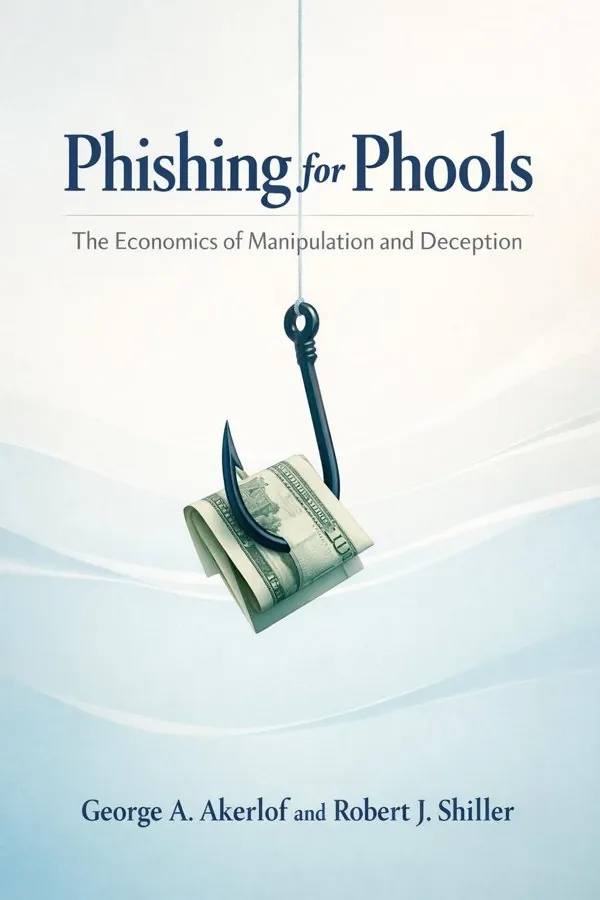
Phishing for Phools: The Economics of Manipulation and Deception: Summary & Key Insights
by George A. Akerlof, Robert J. Shiller
 10 min10 chaptersAudio available
What Is Phishing for Phools: The Economics of Manipulation and Deception About?
Phishing for Phools: The Economics of Manipulation and Deception by George A. Akerlof and Robert J. Shiller is a economics book spanning 10 pages. In this influential work, Nobel laureates George A. Akerlof and Robert J. Shiller explore how markets, while often efficient, can also exploit human psychological weaknesses. They argue that free markets not only allow but encourage 'phishing'—the manipulation of consumers and investors for profit. Through examples from finance, health, and politics, the authors reveal how deception and exploitation are intrinsic to modern capitalism, urging readers to recognize and mitigate these manipulative forces.
This FizzRead summary covers all 10 key chapters of Phishing for Phools: The Economics of Manipulation and Deception in approximately 10 minutes, distilling the most important ideas, arguments, and takeaways from George A. Akerlof and Robert J. Shiller's work. Also available as an audio summary and Key Quotes Podcast.
Phishing for Phools: The Economics of Manipulation and Deception
In this influential work, Nobel laureates George A. Akerlof and Robert J. Shiller explore how markets, while often efficient, can also exploit human psychological weaknesses. They argue that free markets not only allow but encourage 'phishing'—the manipulation of consumers and investors for profit. Through examples from finance, health, and politics, the authors reveal how deception and exploitation are intrinsic to modern capitalism, urging readers to recognize and mitigate these manipulative forces.
Who Should Read Phishing for Phools: The Economics of Manipulation and Deception?
This book is perfect for anyone interested in economics and looking to gain actionable insights in a short read. Whether you're a student, professional, or lifelong learner, the key ideas from Phishing for Phools: The Economics of Manipulation and Deception by George A. Akerlof and Robert J. Shiller will help you think differently.
- ✓Readers who enjoy economics and want practical takeaways
- ✓Professionals looking to apply new ideas to their work and life
- ✓Anyone who wants the core insights of Phishing for Phools: The Economics of Manipulation and Deception in just 10 minutes
Want the full summary?
Get instant access to this book summary and 100K+ more with Fizz Moment.
Get Free SummaryAvailable on App Store • Free to download
Key Chapters
We begin with a simple yet unsettling idea: in every market there are ‘phools.’ The term isn’t meant to insult, but to describe people — essentially all of us at various times — who are led astray by manipulation. As we define it, a ‘phool’ is someone deceived or seduced into actions that serve another’s profit rather than their own genuine interest. In competitive markets, sellers aren’t rewarded for protecting you; they’re rewarded for selling to you. And if trickery helps accomplish that, the system allows, even encourages, it.
The origin of this insight lies in information asymmetry. In our earlier work on the ‘market for lemons,’ we demonstrated that markets falter when one party knows more than the other. Here, we go further. We show that asymmetry doesn’t only distort prices — it distorts minds. Emotion replaces calculation; persuasion replaces reasoning. You buy insurance not because it’s optimal but because fear has been sold to you. You choose a diet product not because it works but because an image has nudged your impulse.
In this sense, a phool is not weak; a phool is human. Our bounded rationality, our susceptibility to storytelling, and our desire for social belonging make us targets. We all live with a psychological economy that runs parallel to the financial one — and wherever there’s profit in exploiting that recursive loop, there will be actors eager to do so.
Recognizing this concept is the first step toward maturity in economic thinking. Traditional models portray people as ‘homo economicus,’ rational calculators maximizing utility. But the real marketplace teems with ‘homo emoticus,’ whose preferences shift under pressure and persuasion. Phishing for phools is the natural outcome of that dynamic. It’s not about evil; it’s about equilibrium.
For decades, economists built elegant frameworks assuming that individuals act rationally: they know what they want, they gather information efficiently, and they make choices consistent with maximizing their welfare. Yet, time and again, real-world evidence has shattered this tidy picture. In our collaboration, we bring behavioral economics and psychology to bear on this contradiction. Humans, we observe, are guided as much by stories and biases as by facts and logic.
Consider the optimism bias — our tendency to believe that things will turn out better for us than for others. It fuels investment bubbles; it underpins risky health choices; it drives the consumerism that sustains GDP growth. Or think of loss aversion, the mental asymmetry that makes people fear losses more than they value equivalent gains. Marketers and financial agents understand this well; they design offers that soothe that fear while taking advantage of it. They ‘phish’ for that psychological gap.
Markets thrive on these tendencies because competition rewards anyone who learns to exploit them. A novice investor, moved by excitement and greed, finances speculative assets that professionals themselves secretly doubt. A patient, overwhelmed by medical jargon, trusts a salesman more than a physician. At every level, decisions are shaped not by pure information but by emotion filtered through manipulation.
We argue that economics must evolve to respect this reality. To study prices without studying stories is to miss half of the picture. To design regulation without acknowledging persuasion is to leave large apertures for corruption. Our purpose is not to replace economics with psychology but to integrate them. Rational choice still operates, but within a universe of imperfect knowledge and manipulable desires. Recognizing that interplay is crucial if we wish to construct markets that deliver real welfare rather than mere profit.
+ 8 more chapters — available in the FizzRead app
All Chapters in Phishing for Phools: The Economics of Manipulation and Deception
About the Authors
George A. Akerlof is an American economist and Nobel laureate known for his work on information asymmetry, particularly 'The Market for Lemons.' Robert J. Shiller is an American economist, Nobel laureate, and professor at Yale University, recognized for his research on asset prices, behavioral economics, and market volatility.
Get This Summary in Your Preferred Format
Read or listen to the Phishing for Phools: The Economics of Manipulation and Deception summary by George A. Akerlof and Robert J. Shiller anytime, anywhere. FizzRead offers multiple formats so you can learn on your terms — all free.
Available formats: App · Audio · PDF · EPUB — All included free with FizzRead
Download Phishing for Phools: The Economics of Manipulation and Deception PDF and EPUB Summary
Key Quotes from Phishing for Phools: The Economics of Manipulation and Deception
“We begin with a simple yet unsettling idea: in every market there are ‘phools.”
“Yet, time and again, real-world evidence has shattered this tidy picture.”
Frequently Asked Questions about Phishing for Phools: The Economics of Manipulation and Deception
Phishing for Phools: The Economics of Manipulation and Deception by George A. Akerlof and Robert J. Shiller is a economics book that explores key ideas across 10 chapters. In this influential work, Nobel laureates George A. Akerlof and Robert J. Shiller explore how markets, while often efficient, can also exploit human psychological weaknesses. They argue that free markets not only allow but encourage 'phishing'—the manipulation of consumers and investors for profit. Through examples from finance, health, and politics, the authors reveal how deception and exploitation are intrinsic to modern capitalism, urging readers to recognize and mitigate these manipulative forces.
You Might Also Like

Business Adventures
John Brooks
10 min
Nudge
Richard H. Thaler, Cass R. Sunstein
10 min
The Hitchhiker"s Guide to the Galaxy
Douglas Adams
10 minThe Muqaddimah
Ibn Khaldun
10 minThe Outsiders
William N. Thorndike
10 min
A Little History of Economics
Niall Kishtainy
10 minBrowse by Category
Ready to read Phishing for Phools: The Economics of Manipulation and Deception?
Get the full summary and 100K+ more books with Fizz Moment.