
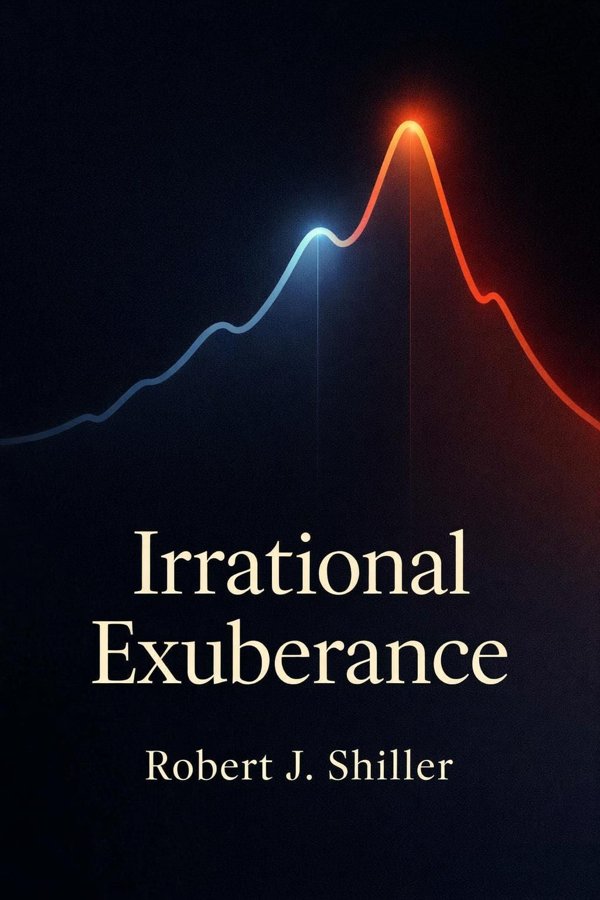
Irrational Exuberance: Summary & Key Insights
 10 min12 chaptersAudio available
What Is Irrational Exuberance About?
Irrational Exuberance by Robert J. Shiller is a economics book spanning 12 pages. Irrational Exuberance is an influential work by economist Robert J. Shiller that examines the psychological and structural factors behind speculative bubbles in financial markets. First published in 2000, the book analyzes the stock market boom of the late 1990s and later editions expanded to include the housing bubble and the 2008 financial crisis. Shiller combines behavioral economics, historical data, and market analysis to explain how investor psychology and social dynamics can drive asset prices far beyond their fundamental values.
This FizzRead summary covers all 12 key chapters of Irrational Exuberance in approximately 10 minutes, distilling the most important ideas, arguments, and takeaways from Robert J. Shiller's work. Also available as an audio summary and Key Quotes Podcast.
Irrational Exuberance
Irrational Exuberance is an influential work by economist Robert J. Shiller that examines the psychological and structural factors behind speculative bubbles in financial markets. First published in 2000, the book analyzes the stock market boom of the late 1990s and later editions expanded to include the housing bubble and the 2008 financial crisis. Shiller combines behavioral economics, historical data, and market analysis to explain how investor psychology and social dynamics can drive asset prices far beyond their fundamental values.
Who Should Read Irrational Exuberance?
This book is perfect for anyone interested in economics and looking to gain actionable insights in a short read. Whether you're a student, professional, or lifelong learner, the key ideas from Irrational Exuberance by Robert J. Shiller will help you think differently.
- ✓Readers who enjoy economics and want practical takeaways
- ✓Professionals looking to apply new ideas to their work and life
- ✓Anyone who wants the core insights of Irrational Exuberance in just 10 minutes
Want the full summary?
Get instant access to this book summary and 100K+ more with Fizz Moment.
Get Free SummaryAvailable on App Store • Free to download
Key Chapters
Understanding the present requires confronting history. Speculative bubbles are not new phenomena—they have appeared repeatedly over centuries. The very name 'irrational exuberance' could have described the Dutch tulip mania of the 1630s, the South Sea Bubble of the 1720s, or the stock market crash of 1929. I begin here because the patterns of exuberance are deeply human and thus recurrent.
The 1929 crash stands as one of the clearest early examples. As stock prices soared, confidence fed upon itself. Newspapers, analysts, and even household conversations echoed the same refrain: times had changed, and prosperity had become permanent. Yet when optimism outstrips fundamentals, the reckoning inevitably follows. The aftermath of that crash reshaped the global economy for a generation and remains the archetype of speculative failure. When comparing the years leading up to 1929 with the 1990s boom, the parallels are striking: rapid technological change, new fortunes made overnight, a belief that the world had entered a new economic era. Each era, believing itself special, forgets it is merely repeating a pattern of collective overconfidence.
By studying these past episodes, we see that the psychology of speculation is persistent. Bubbles thrive in moments when historical memory fades, when people rationalize high prices with narratives of innovation or destiny. My purpose in revisiting history is not nostalgia but clarity: every future bubble carries within it the same human impulses that drove those before. Once you recognize these recurring stories, you start to see beyond the surface of euphoria and fear.
In markets, the anchor of reality lies in fundamentals—earnings, dividends, productivity, and economic growth. Through careful long-term analysis, I show how, by the late 1990s, stock prices had detached dramatically from these anchors. My data series, stretching back over a century, revealed that price-to-earnings ratios were at historic extremes. If an investor were to rely on the evidence of the century rather than the excitement of the moment, it was clear that the boom could not last indefinitely.
This section of the book challenges the comforting illusion that markets always reflect intrinsic value. In fact, markets can remain excessively priced for extended periods, sustained by collective optimism. When investors see prices continually rising, they tune out fundamental measures, convincing themselves that this time, structural or technological changes justify higher valuations. Such reasoning was common during the dot-com era, when profits mattered less than stories of limitless innovation.
By contrasting empirical valuation measures—like the cyclically adjusted price-to-earnings (CAPE) ratio—with historical norms, I tried to provide readers with a perspective grounded in evidence rather than emotion. Markets can deviate from fundamentals for years, but fundamentals remain the compass that eventually reasserts direction. Recognizing this dissonance is not about predicting an exact timing of collapse—it is about understanding that deviations driven by psychology, not productivity, are inherently unstable.
+ 10 more chapters — available in the FizzRead app
All Chapters in Irrational Exuberance
About the Author
Robert J. Shiller is an American economist, academic, and Nobel laureate in Economic Sciences. He is a professor of economics at Yale University and a fellow at the Yale School of Management’s International Center for Finance. Shiller is known for his pioneering work in behavioral finance and for developing the Case-Shiller Home Price Index. His research has profoundly influenced understanding of market volatility and speculative behavior.
Get This Summary in Your Preferred Format
Read or listen to the Irrational Exuberance summary by Robert J. Shiller anytime, anywhere. FizzRead offers multiple formats so you can learn on your terms — all free.
Available formats: App · Audio · PDF · EPUB — All included free with FizzRead
Download Irrational Exuberance PDF and EPUB Summary
Key Quotes from Irrational Exuberance
“Understanding the present requires confronting history.”
“In markets, the anchor of reality lies in fundamentals—earnings, dividends, productivity, and economic growth.”
Frequently Asked Questions about Irrational Exuberance
Irrational Exuberance by Robert J. Shiller is a economics book that explores key ideas across 12 chapters. Irrational Exuberance is an influential work by economist Robert J. Shiller that examines the psychological and structural factors behind speculative bubbles in financial markets. First published in 2000, the book analyzes the stock market boom of the late 1990s and later editions expanded to include the housing bubble and the 2008 financial crisis. Shiller combines behavioral economics, historical data, and market analysis to explain how investor psychology and social dynamics can drive asset prices far beyond their fundamental values.
More by Robert J. Shiller
The New Financial Order: Risk in the 21st Century
Robert J. Shiller
10 min
Phishing for Phools: The Economics of Manipulation and Deception
George A. Akerlof and Robert J. Shiller
10 min
Narrative Economics: How Stories Go Viral and Drive Major Economic Events
Robert J. Shiller
10 minYou Might Also Like

Business Adventures
John Brooks
10 min
Nudge
Richard H. Thaler, Cass R. Sunstein
10 min
The Hitchhiker"s Guide to the Galaxy
Douglas Adams
10 minThe Muqaddimah
Ibn Khaldun
10 minThe Outsiders
William N. Thorndike
10 min
A Little History of Economics
Niall Kishtainy
10 minBrowse by Category
Ready to read Irrational Exuberance?
Get the full summary and 100K+ more books with Fizz Moment.