
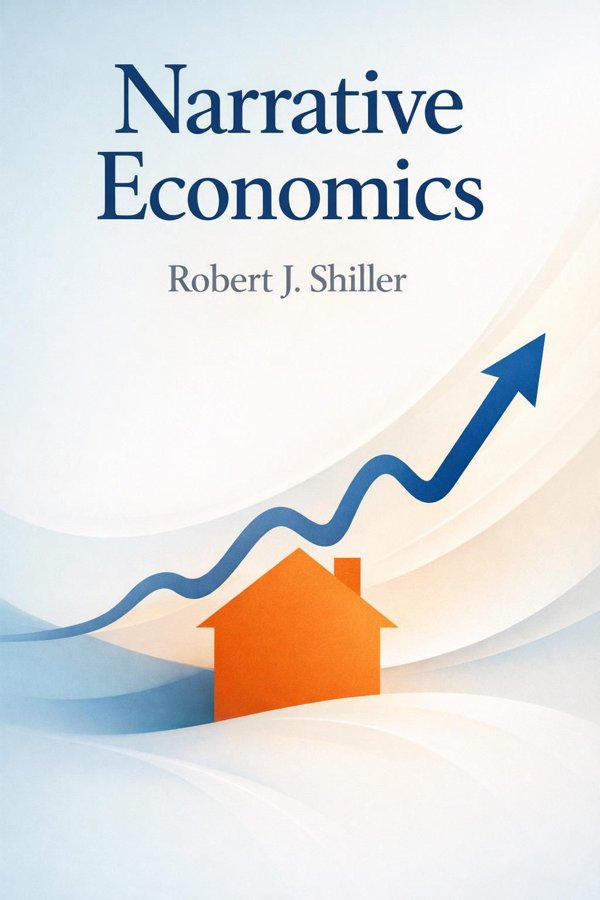
Narrative Economics: How Stories Go Viral and Drive Major Economic Events: Summary & Key Insights
 10 min11 chaptersAudio available
What Is Narrative Economics: How Stories Go Viral and Drive Major Economic Events About?
Narrative Economics: How Stories Go Viral and Drive Major Economic Events by Robert J. Shiller is a economics book spanning 11 pages. In 'Narrative Economics', Nobel laureate Robert J. Shiller explores how popular stories and contagious narratives influence economic behavior and shape major financial events. He argues that economic fluctuations are often driven not just by data or policy but by the spread of compelling narratives—such as those about housing booms, stock market bubbles, or technological revolutions—that capture public imagination and affect decision-making on a mass scale.
This FizzRead summary covers all 11 key chapters of Narrative Economics: How Stories Go Viral and Drive Major Economic Events in approximately 10 minutes, distilling the most important ideas, arguments, and takeaways from Robert J. Shiller's work. Also available as an audio summary and Key Quotes Podcast.
Narrative Economics: How Stories Go Viral and Drive Major Economic Events
In 'Narrative Economics', Nobel laureate Robert J. Shiller explores how popular stories and contagious narratives influence economic behavior and shape major financial events. He argues that economic fluctuations are often driven not just by data or policy but by the spread of compelling narratives—such as those about housing booms, stock market bubbles, or technological revolutions—that capture public imagination and affect decision-making on a mass scale.
Who Should Read Narrative Economics: How Stories Go Viral and Drive Major Economic Events?
This book is perfect for anyone interested in economics and looking to gain actionable insights in a short read. Whether you're a student, professional, or lifelong learner, the key ideas from Narrative Economics: How Stories Go Viral and Drive Major Economic Events by Robert J. Shiller will help you think differently.
- ✓Readers who enjoy economics and want practical takeaways
- ✓Professionals looking to apply new ideas to their work and life
- ✓Anyone who wants the core insights of Narrative Economics: How Stories Go Viral and Drive Major Economic Events in just 10 minutes
Want the full summary?
Get instant access to this book summary and 100K+ more with Fizz Moment.
Get Free SummaryAvailable on App Store • Free to download
Key Chapters
When economists attempt to explain the great swings of history—the Great Depression, the stagflation of the 1970s, or the technology-driven booms of recent decades—they often rely on data: GDP contractions, price indices, or employment charts. But I want you to look deeper, into the cultural and emotional stories that people believed during those times. During the Great Depression, for instance, the prevailing narrative was one of moral reckoning—the idea that people had been too reckless, too indulgent, and were now paying a deserved price. That narrative justified extreme thrift and discouraged spending precisely when the economy needed stimulus. Similarly, narratives about war, heroism, technology, and prosperity contributed to post-war booms, because they fueled collective optimism.
Throughout history, you can trace how certain stories become dominant at pivotal economic moments. The 'new era' narrative of the 1920s celebrated perpetual progress and infinite market growth—it was contagious optimism. But once it cracked, the counternarratives of fear and guilt swept the population faster than policy could respond. These stories were not irrational noise; they were informational and motivational structures that coordinated collective action. My historical analysis reveals how shifts in narrative frequency coincide with economic turning points. Newspapers, speeches, and popular media act as vectors that transmit those ideas with remarkable speed, producing cascades of behavior that can magnify recessions or inflate bubbles.
You might wonder: how can stories spread like epidemics? The answer lies in human psychology and communication networks. Narratives propagate through social interactions, media, and now, digital platforms that vastly accelerate contagion. The mechanism parallels epidemiology—certain stories have “high contagion rates,” meaning they’re memorable, emotionally charged, and easy to retell. When a narrative evokes fear, hope, or moral judgment, it becomes intrinsically viral.
Think of how rumors during a financial panic spread almost instantaneously today through Twitter or news alerts. The diffusion of narratives can be modeled similarly to disease spread, where people become 'infected' by an idea and pass it along. But as stories circulate, they mutate. A banking crisis narrative might evolve from 'liquidity shortage' into 'the system is corrupt,' changing emotional tone and public response. This mutation is key: it explains why old economic ideas—like the fear of inflation or distrust of institutions—can resurface decades later in altered form.
Understanding narrative spread means seeing economic discourse as part of a living ecosystem of human communication. The stories we share determine whether people trust financial institutions, feel secure enough to invest, or panic enough to withdraw their savings. By analyzing those transmission channels, we can forecast how an economic idea might evolve, amplify, or fade. In the modern world, where media reproduce and mutate ideas almost instantly, economists must learn to study stories as epidemiologists study diseases.
+ 9 more chapters — available in the FizzRead app
All Chapters in Narrative Economics: How Stories Go Viral and Drive Major Economic Events
About the Author
Robert J. Shiller is an American economist, professor at Yale University, and recipient of the 2013 Nobel Prize in Economic Sciences. He is known for his work on behavioral economics, financial markets, and the development of the Case-Shiller Home Price Index. His influential books include 'Irrational Exuberance' and 'Finance and the Good Society'.
Get This Summary in Your Preferred Format
Read or listen to the Narrative Economics: How Stories Go Viral and Drive Major Economic Events summary by Robert J. Shiller anytime, anywhere. FizzRead offers multiple formats so you can learn on your terms — all free.
Available formats: App · Audio · PDF · EPUB — All included free with FizzRead
Download Narrative Economics: How Stories Go Viral and Drive Major Economic Events PDF and EPUB Summary
Key Quotes from Narrative Economics: How Stories Go Viral and Drive Major Economic Events
“But I want you to look deeper, into the cultural and emotional stories that people believed during those times.”
“You might wonder: how can stories spread like epidemics?”
Frequently Asked Questions about Narrative Economics: How Stories Go Viral and Drive Major Economic Events
Narrative Economics: How Stories Go Viral and Drive Major Economic Events by Robert J. Shiller is a economics book that explores key ideas across 11 chapters. In 'Narrative Economics', Nobel laureate Robert J. Shiller explores how popular stories and contagious narratives influence economic behavior and shape major financial events. He argues that economic fluctuations are often driven not just by data or policy but by the spread of compelling narratives—such as those about housing booms, stock market bubbles, or technological revolutions—that capture public imagination and affect decision-making on a mass scale.
More by Robert J. Shiller

You Might Also Like

Business Adventures
John Brooks
10 min
Nudge
Richard H. Thaler, Cass R. Sunstein
10 min
The Hitchhiker"s Guide to the Galaxy
Douglas Adams
10 minThe Muqaddimah
Ibn Khaldun
10 minThe Outsiders
William N. Thorndike
10 min
A Little History of Economics
Niall Kishtainy
10 minBrowse by Category
Ready to read Narrative Economics: How Stories Go Viral and Drive Major Economic Events?
Get the full summary and 100K+ more books with Fizz Moment.