
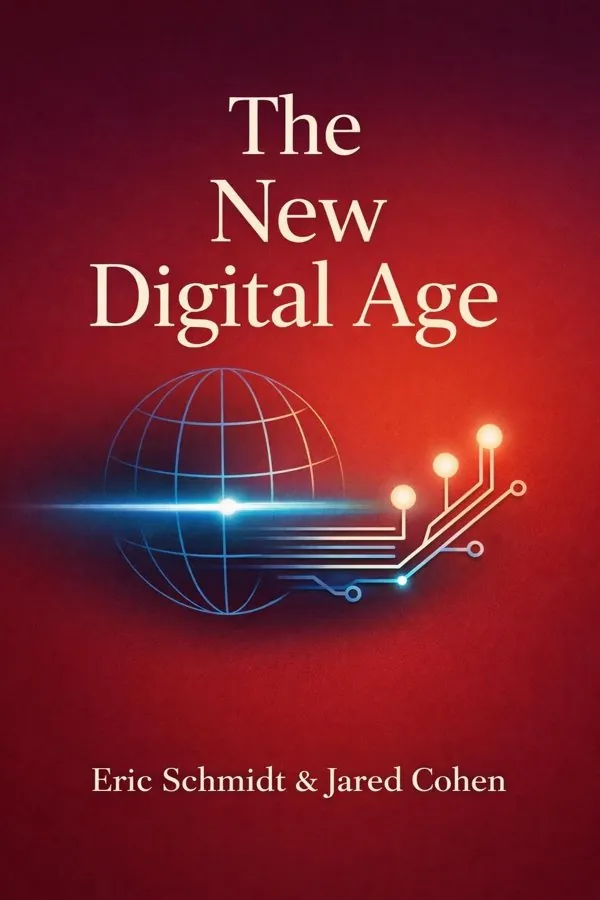
The New Digital Age: Reshaping the Future of People, Nations and Business: Summary & Key Insights
 10 min10 chaptersAudio available
Key Takeaways from The New Digital Age: Reshaping the Future of People, Nations and Business
The most powerful technology shift is not any single device, platform, or app, but the fact that billions of people are now connected at once.
In a hyperconnected world, the old idea of sovereignty becomes harder to enforce.
Political unrest no longer spreads only through underground meetings, printed pamphlets, or television broadcasts.
Technology does not make humanity automatically wiser; it also makes conflict more networked, decentralized, and hard to contain.
One of the defining dilemmas of the new digital age is that the same data that makes life more efficient also makes people more visible.
What Is The New Digital Age: Reshaping the Future of People, Nations and Business About?
The New Digital Age: Reshaping the Future of People, Nations and Business by Eric Schmidt & Jared Cohen is a future_trends book spanning 10 pages. What happens when nearly every person, institution, and government becomes connected to a shared digital infrastructure? In The New Digital Age, Eric Schmidt and Jared Cohen argue that this question will define the twenty-first century. Far more than a book about gadgets or social media, it is a broad exploration of how connectivity is reshaping politics, business, security, identity, and human relationships. The authors examine a world in which smartphones, cloud computing, social platforms, and data networks do not simply support modern life—they reorganize it. The book matters because it treats technology as a force that changes power itself. Digital tools can empower dissidents, entrepreneurs, students, and citizens, but they can also strengthen surveillance, cyberwarfare, extremism, and corporate influence. Schmidt and Cohen write with unusual authority: Schmidt led Google during one of the most transformative periods in internet history, while Cohen worked at the intersection of technology, diplomacy, and global conflict. Together, they offer a view that is both optimistic and cautionary. Their central message is clear: the future will belong to those who understand that technology is not separate from society, but the environment in which society now evolves.
This FizzRead summary covers all 10 key chapters of The New Digital Age: Reshaping the Future of People, Nations and Business in approximately 10 minutes, distilling the most important ideas, arguments, and takeaways from Eric Schmidt & Jared Cohen's work. Also available as an audio summary and Key Quotes Podcast.
The New Digital Age: Reshaping the Future of People, Nations and Business
What happens when nearly every person, institution, and government becomes connected to a shared digital infrastructure? In The New Digital Age, Eric Schmidt and Jared Cohen argue that this question will define the twenty-first century. Far more than a book about gadgets or social media, it is a broad exploration of how connectivity is reshaping politics, business, security, identity, and human relationships. The authors examine a world in which smartphones, cloud computing, social platforms, and data networks do not simply support modern life—they reorganize it.
The book matters because it treats technology as a force that changes power itself. Digital tools can empower dissidents, entrepreneurs, students, and citizens, but they can also strengthen surveillance, cyberwarfare, extremism, and corporate influence. Schmidt and Cohen write with unusual authority: Schmidt led Google during one of the most transformative periods in internet history, while Cohen worked at the intersection of technology, diplomacy, and global conflict. Together, they offer a view that is both optimistic and cautionary. Their central message is clear: the future will belong to those who understand that technology is not separate from society, but the environment in which society now evolves.
Who Should Read The New Digital Age: Reshaping the Future of People, Nations and Business?
This book is perfect for anyone interested in future_trends and looking to gain actionable insights in a short read. Whether you're a student, professional, or lifelong learner, the key ideas from The New Digital Age: Reshaping the Future of People, Nations and Business by Eric Schmidt & Jared Cohen will help you think differently.
- ✓Readers who enjoy future_trends and want practical takeaways
- ✓Professionals looking to apply new ideas to their work and life
- ✓Anyone who wants the core insights of The New Digital Age: Reshaping the Future of People, Nations and Business in just 10 minutes
Want the full summary?
Get instant access to this book summary and 100K+ more with Fizz Moment.
Get Free SummaryAvailable on App Store • Free to download
Key Chapters
The most powerful technology shift is not any single device, platform, or app, but the fact that billions of people are now connected at once. Schmidt and Cohen present connectivity as a civilizational force: once people can communicate instantly, access vast stores of information, and participate in digital networks, the way societies function begins to change from the ground up. Geography matters less, gatekeepers lose some control, and individuals gain new forms of leverage.
This matters because connection creates both opportunity and disruption. A farmer with a smartphone can check crop prices without relying on middlemen. A student in a remote village can access lectures from top universities. A small business can reach customers globally without opening physical stores. At the same time, rumors spread faster, public pressure intensifies, and institutions that once controlled information struggle to keep pace. Connectivity amplifies voices, but it also amplifies noise, outrage, and manipulation.
The authors emphasize that digital access is not just a technical convenience; it alters expectations. Citizens expect transparency, consumers expect instant service, and employees expect flexible, networked work. Governments and organizations that still operate like isolated hierarchies increasingly appear outdated in a world built on real-time communication.
A practical example is disaster response. Connected communities can use social media, mapping tools, and mobile payments to coordinate aid faster than traditional bureaucracies. But they also require trusted verification systems to avoid confusion. The lesson is simple: the networked world rewards speed, openness, and adaptability.
Actionable takeaway: Treat connectivity as strategic infrastructure, not a side benefit. Whether you are leading a team, building a business, or serving a community, design systems that assume constant connection, rapid feedback, and empowered individuals.
In a hyperconnected world, the old idea of sovereignty becomes harder to enforce. Governments still control territory, laws, and institutions, but they no longer control information flows in the same way. Schmidt and Cohen argue that digital networks undermine the ability of states to isolate their populations, manage narratives, and monopolize communication. Even authoritarian regimes face pressure when citizens can document abuses, access outside perspectives, and organize through distributed channels.
Yet the book does not suggest that governments become irrelevant. Instead, states evolve. Some respond by becoming more open and digitally competent, using technology to deliver services, improve transparency, and engage citizens. Others double down on control through censorship, surveillance, and digital repression. In both cases, governance becomes inseparable from technological capability.
The practical implication is that digital policy is now national policy. Questions about internet infrastructure, data localization, encryption, online identity, and platform regulation are no longer niche technical matters. They shape elections, economic competitiveness, and social trust. A government that fails to build digital capacity risks losing both legitimacy and effectiveness.
The authors also show that smaller and weaker states can gain influence if they use digital tools well. A country that builds smart public services, digital education, and strong cybersecurity can outperform larger rivals that remain bureaucratic and slow. Estonia is often cited as an example of how digital government can become a strategic asset.
Actionable takeaway: If you work in policy, public institutions, or regulated industries, stop treating technology as support infrastructure. Build digital literacy into leadership and recognize that future political power will depend partly on how well institutions manage information, networks, and citizen trust.
Political unrest no longer spreads only through underground meetings, printed pamphlets, or television broadcasts. In the digital age, revolutions and rebellions can gain momentum through mobile phones, social media, messaging apps, and shared visual evidence. Schmidt and Cohen argue that digital tools lower the coordination costs of dissent. People who once felt isolated can discover one another, witness common grievances, and mobilize quickly.
This does not mean technology causes revolutions by itself. The underlying drivers remain political corruption, economic frustration, repression, and social injustice. But digital networks change the tempo and visibility of collective action. A single video can expose abuse. A hashtag can unify a movement. A livestream can turn a local protest into a global event. Technology helps movements tell their own story before authorities can define it for them.
At the same time, the authors stress that digital activism has limits. Toppling a regime is not the same as building a stable government. Networks are excellent at mobilization, but less effective at creating durable institutions, negotiating complex compromises, or governing after victory. Online energy can dissipate once the immediate target is removed.
A practical example can be seen in protest movements that rapidly gather attention but struggle to turn momentum into policy change because leadership remains fragmented. The digital sphere is powerful for coordination, but not sufficient for institution-building.
Actionable takeaway: If you are involved in advocacy or civic organizing, use digital tools for visibility and mobilization, but pair them with strategy, leadership development, and long-term institution building. Lasting change requires both networks and structure.
Technology does not make humanity automatically wiser; it also makes conflict more networked, decentralized, and hard to contain. Schmidt and Cohen explain that terrorist groups, insurgents, criminal networks, and hostile states all benefit from the same digital tools that empower entrepreneurs and citizens. Cheap communication, encrypted messaging, online propaganda, and remote coordination reduce barriers to organizing harmful activity across borders.
One major shift is that influence itself becomes a battlefield. Extremist groups no longer rely only on physical training camps or traditional recruitment pipelines. They can radicalize, recruit, fundraise, and instruct followers online. Cyberattacks allow adversaries to damage infrastructure, steal information, or create fear without conventional military confrontation. In this environment, conflict often occurs below the threshold of formal war.
For businesses and governments, this means security can no longer be delegated solely to military or intelligence agencies. Banks, hospitals, utilities, logistics systems, and media organizations all become potential targets. A cyber incident can interrupt supply chains, expose sensitive data, or undermine public confidence at massive scale. Resilience matters as much as prevention.
The authors urge readers to understand that digital security is partly a social issue. Human error, weak passwords, poor training, and disinformation are often easier attack vectors than sophisticated code. A school district, startup, or local government may be vulnerable not because attackers are brilliant, but because defenses are neglected.
Actionable takeaway: Build security into everyday operations. Use strong authentication, train people to recognize manipulation, create backup systems, and rehearse incident response. In the digital age, preparedness is no longer optional; it is a core responsibility of any organization.
One of the defining dilemmas of the new digital age is that the same data that makes life more efficient also makes people more visible. Schmidt and Cohen explore how digital systems generate detailed records of movement, communication, preferences, and behavior. These records help companies personalize services and help governments improve administration, but they also create unprecedented opportunities for surveillance, misuse, and control.
The book argues that privacy is not disappearing, but being renegotiated. Individuals trade information for convenience every day, often without understanding the full consequences. Navigation apps know where we go. Platforms infer what we believe. Devices record what we buy, watch, and search. In democratic societies, this raises questions about consent, accountability, and the acceptable limits of state access. In authoritarian systems, it can become a mechanism of repression.
The tension is especially clear in the debate over security. Governments want data access to prevent crime, terrorism, and cyber threats. Citizens want protection from both criminals and intrusive institutions. Companies sit in the middle, expected to safeguard user data while complying with law. There is no simple formula that resolves all of these interests at once.
Practically, this means digital literacy must include privacy literacy. People need to understand settings, permissions, encryption, data-sharing practices, and the long tail of digital footprints. Organizations need governance frameworks that limit unnecessary collection and define clear responsibilities.
Actionable takeaway: Be intentional about your data exposure. Review privacy settings, minimize unnecessary sharing, choose trustworthy services, and support policies that require transparency and accountability from both governments and companies.
The digital revolution does not simply create new companies; it changes how value is created across entire economies. Schmidt and Cohen show that digital networks lower transaction costs, expand market access, and allow small actors to operate at scales once reserved for large institutions. Entrepreneurs can launch products globally, freelancers can work across borders, and data can become a major productive asset.
This transformation affects every sector. Retail becomes e-commerce and logistics. Media becomes distribution plus algorithms. Finance becomes mobile payments, digital identity, and real-time transactions. Manufacturing integrates sensors, software, and predictive analytics. Even agriculture becomes more data-driven through weather forecasting, satellite imaging, and supply chain visibility. The digital economy is not a separate silo; it overlays traditional industries and changes their economics.
The authors also note that disruption is uneven. Highly connected firms can become more efficient and profitable, while workers in slower-moving sectors may face displacement. Winner-take-most dynamics can emerge when platforms benefit from network effects and large data advantages. As a result, digital transformation can create growth and inequality at the same time.
A practical example is the rise of small online businesses that can reach niche global markets through marketplaces and social platforms. But their success often depends on algorithms, platform policies, payment access, and digital advertising costs outside their control. Opportunity expands, but dependence on digital infrastructure also increases.
Actionable takeaway: Invest in digital capability before disruption forces the issue. Learn how data, platforms, automation, and online distribution affect your field, and develop skills that complement technology rather than compete with routine tasks it can replace.
In the new digital age, large technology companies do more than sell products. They influence speech, commerce, access to information, identity verification, and even public order. Schmidt and Cohen highlight how corporations increasingly operate at a scale where their decisions affect societies much like public institutions do. A platform policy can shape political debate. A change in search ranking can alter visibility. A cloud outage can disrupt entire economies.
This growing power creates a new expectation: companies must think beyond shareholder returns and product growth. They need to consider human rights, content moderation, cybersecurity, political neutrality, and their relationships with governments. A company operating globally may face demands from democratic states, authoritarian regimes, activists, advertisers, and users at the same time. There are no easy answers, but neutrality is often impossible.
The authors imply that firms in the digital economy are now geopolitical actors, whether they want to be or not. Decisions about market access, censorship compliance, data storage, and encryption can carry diplomatic consequences. This is especially true for companies that provide communication infrastructure, cloud services, AI systems, and social platforms.
For leaders, the practical lesson is that ethics cannot be outsourced to public relations. Governance structures, escalation processes, transparency reporting, and clear principles matter. Companies that ignore their social impact may gain short-term freedom but face long-term distrust, regulation, and reputational damage.
Actionable takeaway: If you build or manage digital products, define your responsibilities early. Establish principles for privacy, safety, transparency, and government engagement before crises force reactive decisions. Scale without governance is a risk multiplier.
Diplomacy once moved mainly through embassies, formal meetings, and carefully managed state channels. In the digital age, Schmidt and Cohen argue, international relations unfold in a much broader arena that includes public platforms, digital communities, cyber operations, and private companies. Diplomats still negotiate treaties, but they now operate in a world where narratives spread instantly, citizens witness events in real time, and governments can influence foreign populations directly through digital media.
This changes both the tools and the pace of diplomacy. Crisis communication is faster, but so is escalation. A leaked document, viral post, or cyber incident can alter diplomatic dynamics overnight. Public opinion, once slower and more localized, can now shape international pressure in real time. Governments must therefore become better at digital communication, strategic transparency, and online credibility.
The book also points out that non-state actors have more room to influence global affairs. Activists, diaspora communities, researchers, journalists, and technology firms can shape agendas once controlled primarily by states. International influence no longer depends only on military strength or economic size; it also depends on digital reach, persuasive communication, and resilience against misinformation.
A practical example is the way humanitarian campaigns can mobilize cross-border support through online storytelling and data visualization, pushing governments to respond faster than they otherwise would. But the same channels can be exploited for propaganda and manipulation.
Actionable takeaway: Whether you work in public affairs, international business, or civic advocacy, develop digital communication skills with the same seriousness once reserved for formal negotiation. In a connected world, reputation, clarity, and speed have become instruments of influence.
The digital age solves one historical problem while creating another. For most of human history, information was scarce and difficult to access. Today, it is abundant, immediate, and often overwhelming. Schmidt and Cohen argue that the critical challenge is no longer simply obtaining information, but filtering, interpreting, and trusting it. Access alone does not guarantee understanding.
This matters because a world flooded with content rewards attention-grabbing material, not always accurate material. Search engines, social feeds, recommendation systems, and viral incentives shape what people see and believe. High-quality knowledge competes with rumors, selective editing, coordinated manipulation, and emotionally charged falsehoods. As a result, judgment becomes one of the most valuable skills in modern life.
The authors suggest that education must evolve accordingly. Students and citizens need not only facts, but frameworks for evaluating sources, identifying bias, cross-checking claims, and understanding how digital systems prioritize content. Leaders need the same capabilities. Poor decisions increasingly come not from lack of information, but from drowning in low-quality information or trusting what is most visible rather than most credible.
A practical application is in workplaces where teams use dashboards, analytics tools, and constant streams of updates. More data can improve decisions only if people know what matters, what is missing, and what may be misleading. Otherwise, information overload creates paralysis or false confidence.
Actionable takeaway: Build habits of digital discernment. Verify before sharing, compare multiple sources, ask who benefits from a claim, and distinguish between visibility and truth. In the information economy, critical thinking is a competitive and civic advantage.
The promise of digital technology is universal access, but access alone does not produce equal outcomes. Schmidt and Cohen warn that the new digital age may reduce some barriers while deepening others. A connected device can open doors to education, finance, healthcare, and entrepreneurship, yet the benefits are distributed unevenly depending on infrastructure, literacy, language, governance, and local opportunity.
This means the digital divide is more complex than simply who has internet access. There are divides in bandwidth, device quality, digital skills, institutional support, and the ability to convert information into income or influence. Two people may both be online, but one uses the internet to build a business while the other is trapped in low-quality content, predatory systems, or unstable access.
Emerging technologies such as AI, robotics, and advanced analytics may intensify this pattern. Countries and companies with strong education systems, capital, and research capacity can compound their advantages. Communities without these assets may become consumers of technology without becoming producers of value. The risk is not only inequality between nations, but also within them.
Still, the authors remain cautiously optimistic. With smart policy and thoughtful design, technology can extend opportunity dramatically. Digital payments can bring the unbanked into formal economies. Online learning can expand educational reach. Telemedicine can improve care in remote regions. But these gains require investment and inclusion, not technological determinism.
Actionable takeaway: Support digital inclusion beyond access alone. Prioritize skills, local capacity, affordable infrastructure, and trusted institutions. The future will be shaped not just by who gets connected, but by who can turn connectivity into capability.
All Chapters in The New Digital Age: Reshaping the Future of People, Nations and Business
About the Authors
Eric Schmidt is a leading technology executive best known for serving as CEO and later Executive Chairman of Google, where he helped scale the company into one of the world’s most influential digital platforms. His career has focused on innovation, internet infrastructure, and the strategic impact of technology on business and society. Jared Cohen is a policy expert, entrepreneur, and author who worked as an adviser at the U.S. State Department before founding Google Ideas, later known as Jigsaw, where he focused on the intersection of technology, security, and geopolitical risk. Together, Schmidt and Cohen combine deep expertise in Silicon Valley and international affairs. Their collaboration brings a rare perspective to the future of connectivity, showing how digital tools are transforming not only markets, but governments, conflict, diplomacy, and everyday life.
Get This Summary in Your Preferred Format
Read or listen to the The New Digital Age: Reshaping the Future of People, Nations and Business summary by Eric Schmidt & Jared Cohen anytime, anywhere. FizzRead offers multiple formats so you can learn on your terms — all free.
Available formats: App · Audio · PDF · EPUB — All included free with FizzRead
Download The New Digital Age: Reshaping the Future of People, Nations and Business PDF and EPUB Summary
Key Quotes from The New Digital Age: Reshaping the Future of People, Nations and Business
“The most powerful technology shift is not any single device, platform, or app, but the fact that billions of people are now connected at once.”
“In a hyperconnected world, the old idea of sovereignty becomes harder to enforce.”
“Political unrest no longer spreads only through underground meetings, printed pamphlets, or television broadcasts.”
“Technology does not make humanity automatically wiser; it also makes conflict more networked, decentralized, and hard to contain.”
“One of the defining dilemmas of the new digital age is that the same data that makes life more efficient also makes people more visible.”
Frequently Asked Questions about The New Digital Age: Reshaping the Future of People, Nations and Business
The New Digital Age: Reshaping the Future of People, Nations and Business by Eric Schmidt & Jared Cohen is a future_trends book that explores key ideas across 10 chapters. What happens when nearly every person, institution, and government becomes connected to a shared digital infrastructure? In The New Digital Age, Eric Schmidt and Jared Cohen argue that this question will define the twenty-first century. Far more than a book about gadgets or social media, it is a broad exploration of how connectivity is reshaping politics, business, security, identity, and human relationships. The authors examine a world in which smartphones, cloud computing, social platforms, and data networks do not simply support modern life—they reorganize it. The book matters because it treats technology as a force that changes power itself. Digital tools can empower dissidents, entrepreneurs, students, and citizens, but they can also strengthen surveillance, cyberwarfare, extremism, and corporate influence. Schmidt and Cohen write with unusual authority: Schmidt led Google during one of the most transformative periods in internet history, while Cohen worked at the intersection of technology, diplomacy, and global conflict. Together, they offer a view that is both optimistic and cautionary. Their central message is clear: the future will belong to those who understand that technology is not separate from society, but the environment in which society now evolves.
You Might Also Like
Futureproof: 9 Rules for Humans in the Age of Automation
Kevin Roose
10 min
The Third Wave
Alvin Toffler
10 min
2030: How Today's Biggest Trends Will Collide and Reshape the Future of Everything
Mauro F. Guillén
10 min
A Very Human Future: Enriching Humanity in a Digitized World
Rohit Talwar, Steve Wells, Alexandra Whittington
10 min
AI 2041: Ten Visions for Our Future
Kai-Fu Lee, Chen Qiufan
10 min
Abundance: The Future Is Better Than You Think
Peter H. Diamandis, Steven Kotler
10 minBrowse by Category
Ready to read The New Digital Age: Reshaping the Future of People, Nations and Business?
Get the full summary and 100K+ more books with Fizz Moment.