
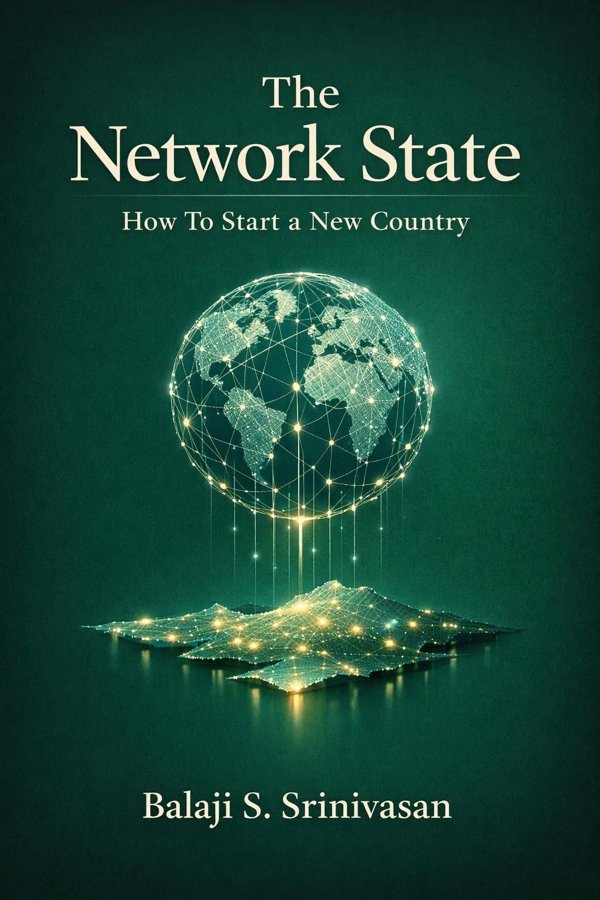
The Network State: How To Start a New Country: Summary & Key Insights
 10 min5 chaptersAudio available
What Is The Network State: How To Start a New Country About?
The Network State: How To Start a New Country by Balaji S. Srinivasan is a future_trends book spanning 5 pages. The Network State es una obra que explora cómo las comunidades digitales pueden evolucionar hasta convertirse en entidades soberanas. Srinivasan propone el concepto de 'estado en red', una nación construida desde internet, basada en valores compartidos, criptomonedas y acción colectiva. El libro describe cómo estas comunidades pueden organizarse, financiar territorio y establecer reconocimiento diplomático, redefiniendo la idea de nación en la era digital.
This FizzRead summary covers all 5 key chapters of The Network State: How To Start a New Country in approximately 10 minutes, distilling the most important ideas, arguments, and takeaways from Balaji S. Srinivasan's work. Also available as an audio summary and Key Quotes Podcast.
The Network State: How To Start a New Country
The Network State es una obra que explora cómo las comunidades digitales pueden evolucionar hasta convertirse en entidades soberanas. Srinivasan propone el concepto de 'estado en red', una nación construida desde internet, basada en valores compartidos, criptomonedas y acción colectiva. El libro describe cómo estas comunidades pueden organizarse, financiar territorio y establecer reconocimiento diplomático, redefiniendo la idea de nación en la era digital.
Who Should Read The Network State: How To Start a New Country?
This book is perfect for anyone interested in future_trends and looking to gain actionable insights in a short read. Whether you're a student, professional, or lifelong learner, the key ideas from The Network State: How To Start a New Country by Balaji S. Srinivasan will help you think differently.
- ✓Readers who enjoy future_trends and want practical takeaways
- ✓Professionals looking to apply new ideas to their work and life
- ✓Anyone who wants the core insights of The Network State: How To Start a New Country in just 10 minutes
Want the full summary?
Get instant access to this book summary and 100K+ more with Fizz Moment.
Get Free SummaryAvailable on App Store • Free to download
Key Chapters
To understand where we are going, we need to understand where we started. The structure of power has always mirrored the structure of communication. In the agrarian era, coercion and hierarchy dominated because the means of communication were limited. People organized around land. Then came the nation-state, enabled by print media, which united populations through shared languages and narratives. The world we live in today, however, is networked, not territorial. We talk more with people online across borders than we do with our physical neighbors. The old social contract is breaking down because our institutions were built for a pre-internet era.
In this context, I define the network state as a social, economic, and eventually political unit that starts online and becomes credible enough to earn offline sovereignty. It is not utopia. It has measurable population, wealth, and physical land, even if these are distributed globally. The key idea is that legitimacy no longer needs to flow from historical conquest or borders drawn by colonial powers — it can emerge from consensus among free individuals, digitally coordinated. The network replaces the notion of soil as the anchor of sovereignty.
Traditionalists might find this disorienting, but consider that many of our most valuable communities — open-source software, global crypto networks, digital fandoms, remote work collectives — already operate independently of nation-states. These are, in essence, the cultural prototypes for network states. They are global publics forming around ideas instead of geography. The challenge is transforming these distributed groups from loose associations into organized, sovereign entities capable of negotiating with legacy powers.
+ 3 more chapters — available in the FizzRead app
All Chapters in The Network State: How To Start a New Country
About the Author
Balaji S. Srinivasan es un emprendedor, inversor y pensador tecnológico estadounidense de origen indio. Fue cofundador de Counsyl, Earn.com y CTO de Coinbase. Es conocido por sus ideas sobre descentralización, criptomonedas y el futuro de la gobernanza digital.
Get This Summary in Your Preferred Format
Read or listen to the The Network State: How To Start a New Country summary by Balaji S. Srinivasan anytime, anywhere. FizzRead offers multiple formats so you can learn on your terms — all free.
Available formats: App · Audio · PDF · EPUB — All included free with FizzRead
Download The Network State: How To Start a New Country PDF and EPUB Summary
Key Quotes from The Network State: How To Start a New Country
“To understand where we are going, we need to understand where we started.”
“Every successful network state begins with a moral innovation — a belief powerful enough to forge trust among strangers.”
Frequently Asked Questions about The Network State: How To Start a New Country
The Network State: How To Start a New Country by Balaji S. Srinivasan is a future_trends book that explores key ideas across 5 chapters. The Network State es una obra que explora cómo las comunidades digitales pueden evolucionar hasta convertirse en entidades soberanas. Srinivasan propone el concepto de 'estado en red', una nación construida desde internet, basada en valores compartidos, criptomonedas y acción colectiva. El libro describe cómo estas comunidades pueden organizarse, financiar territorio y establecer reconocimiento diplomático, redefiniendo la idea de nación en la era digital.
You Might Also Like

Futureproof: 9 Rules for Humans in the Age of Automation
Kevin Roose
10 min
The Third Wave
Alvin Toffler
10 min
2030: How Today's Biggest Trends Will Collide and Reshape the Future of Everything
Mauro F. Guillén
10 min
A Very Human Future: Enriching Humanity in a Digitized World
Rohit Talwar, Steve Wells, Alexandra Whittington
10 min
AI 2041: Ten Visions for Our Future
Kai-Fu Lee, Chen Qiufan
10 min
Abundance: The Future Is Better Than You Think
Peter H. Diamandis, Steven Kotler
10 minBrowse by Category
Ready to read The Network State: How To Start a New Country?
Get the full summary and 100K+ more books with Fizz Moment.