
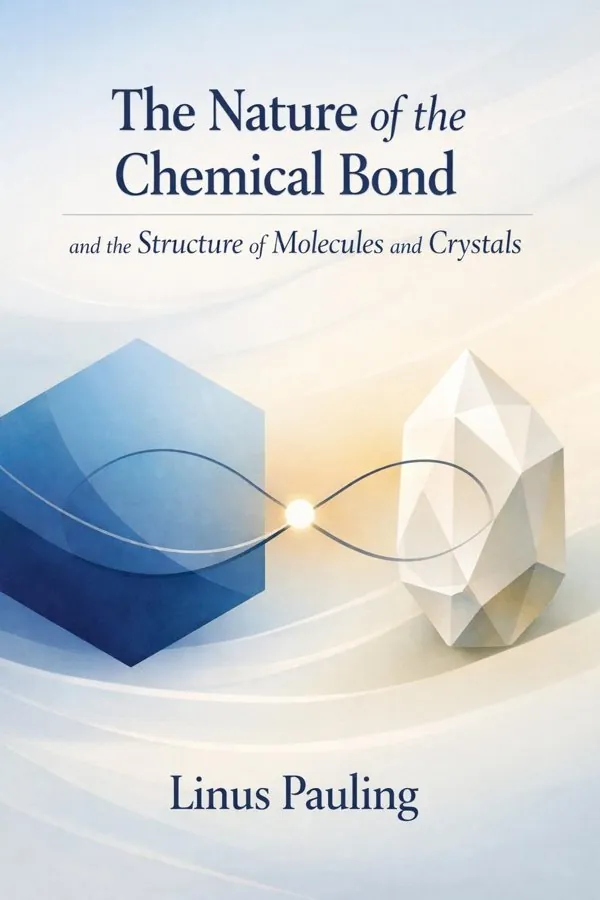
The Nature of the Chemical Bond and the Structure of Molecules and Crystals: An Introduction to Modern Structural Chemistry: Summary & Key Insights
 10 min8 chaptersAudio available
What Is The Nature of the Chemical Bond and the Structure of Molecules and Crystals: An Introduction to Modern Structural Chemistry About?
The Nature of the Chemical Bond and the Structure of Molecules and Crystals: An Introduction to Modern Structural Chemistry by Linus Pauling is a life_science book spanning 8 pages. This seminal work by Linus Pauling presents a comprehensive treatment of chemical bonding and molecular structure, introducing the valence bond theory and the concept of resonance. It laid the foundation for modern structural chemistry and profoundly influenced the understanding of molecular interactions and crystal structures.
This FizzRead summary covers all 8 key chapters of The Nature of the Chemical Bond and the Structure of Molecules and Crystals: An Introduction to Modern Structural Chemistry in approximately 10 minutes, distilling the most important ideas, arguments, and takeaways from Linus Pauling's work. Also available as an audio summary and Key Quotes Podcast.
The Nature of the Chemical Bond and the Structure of Molecules and Crystals: An Introduction to Modern Structural Chemistry
This seminal work by Linus Pauling presents a comprehensive treatment of chemical bonding and molecular structure, introducing the valence bond theory and the concept of resonance. It laid the foundation for modern structural chemistry and profoundly influenced the understanding of molecular interactions and crystal structures.
Who Should Read The Nature of the Chemical Bond and the Structure of Molecules and Crystals: An Introduction to Modern Structural Chemistry?
This book is perfect for anyone interested in life_science and looking to gain actionable insights in a short read. Whether you're a student, professional, or lifelong learner, the key ideas from The Nature of the Chemical Bond and the Structure of Molecules and Crystals: An Introduction to Modern Structural Chemistry by Linus Pauling will help you think differently.
- ✓Readers who enjoy life_science and want practical takeaways
- ✓Professionals looking to apply new ideas to their work and life
- ✓Anyone who wants the core insights of The Nature of the Chemical Bond and the Structure of Molecules and Crystals: An Introduction to Modern Structural Chemistry in just 10 minutes
Want the full summary?
Get instant access to this book summary and 100K+ more with Fizz Moment.
Get Free SummaryAvailable on App Store • Free to download
Key Chapters
The quest to understand bonding began long before the quantum era. Dalton’s atomic theory introduced the atom as the ultimate building block of matter, but for decades chemistry advanced without a clear picture of how atoms joined. It was with the rise of the electron, thanks to Thomson, and later Rutherford’s model of the nucleus, that the path opened for a structural chemistry grounded in physical law. My own fascination lay in bridging the atomic model and observable chemical behavior.
When quantum mechanics emerged through the work of Schrödinger, Heisenberg, and others, it became evident that the mystery of bonding could at last be addressed with rigor. The wave function of the electron—once an abstract notion—was revealed as the blueprint of chemical affinity. Using Heitler and London’s pioneering analysis of the hydrogen molecule, I saw that chemical bonds could be described as quantum-mechanical interactions between shared electron pairs. That insight launched what I termed the valence bond approach, the first truly predictive model of molecular structure.
In developing this viewpoint, I emphasized a blend of theory and experiment. X-ray diffraction, with its ability to reveal interatomic distances, was particularly illuminating: it transformed structural chemistry from inference into measurement. By comparing predicted bond lengths and angles with observed data, we could validate or refine our theoretical framework. Thus, modern structural chemistry emerged not from speculation but from a fertile marriage of mathematics and crystallography.
At the foundation of this entire framework lies the valence bond theory. The idea is simple in form but profound in implication: a chemical bond forms when two atomic orbitals overlap and share an electron pair of opposite spin. What seems subtle is the energy stabilization that arises from this sharing—it is a purely quantum consequence of electron exchange symmetry.
The hydrogen molecule provides the simplest demonstration. Two hydrogen atoms approach; their wavefunctions overlap; and the electrons, indistinguishable and correlated, prefer to dwell in the space between the nuclei. This configuration minimizes energy and gives rise to what we perceive macroscopically as the covalent bond. Extending this reasoning to multi-electron systems required introducing hybridization—sp, sp², sp³—concepts that explain how atoms like carbon can form bonds arranged tetrahedrally or planar structures consistent with observed geometries.
Hybridization reconciles quantum constraints with chemical intuition. It reveals, for example, why methane forms a perfect tetrahedron, why ethene is planar, and why benzene defies ordinary single and double-bond classification. Each new molecule became a test case demonstrating how nature blends the discrete and the continuous. Through the valence bond view, one learns to see every molecule as a pattern of orbital overlap, each bond a testament to the economy of quantum stability.
+ 6 more chapters — available in the FizzRead app
All Chapters in The Nature of the Chemical Bond and the Structure of Molecules and Crystals: An Introduction to Modern Structural Chemistry
About the Author
Linus Pauling (1901–1994) was an American chemist, biochemist, and peace activist. He is one of the few individuals to have received two unshared Nobel Prizes—one in Chemistry (1954) for his research into the nature of the chemical bond, and one for Peace (1962) for his activism against nuclear weapons testing.
Get This Summary in Your Preferred Format
Read or listen to the The Nature of the Chemical Bond and the Structure of Molecules and Crystals: An Introduction to Modern Structural Chemistry summary by Linus Pauling anytime, anywhere. FizzRead offers multiple formats so you can learn on your terms — all free.
Available formats: App · Audio · PDF · EPUB — All included free with FizzRead
Download The Nature of the Chemical Bond and the Structure of Molecules and Crystals: An Introduction to Modern Structural Chemistry PDF and EPUB Summary
Key Quotes from The Nature of the Chemical Bond and the Structure of Molecules and Crystals: An Introduction to Modern Structural Chemistry
“The quest to understand bonding began long before the quantum era.”
“At the foundation of this entire framework lies the valence bond theory.”
Frequently Asked Questions about The Nature of the Chemical Bond and the Structure of Molecules and Crystals: An Introduction to Modern Structural Chemistry
The Nature of the Chemical Bond and the Structure of Molecules and Crystals: An Introduction to Modern Structural Chemistry by Linus Pauling is a life_science book that explores key ideas across 8 chapters. This seminal work by Linus Pauling presents a comprehensive treatment of chemical bonding and molecular structure, introducing the valence bond theory and the concept of resonance. It laid the foundation for modern structural chemistry and profoundly influenced the understanding of molecular interactions and crystal structures.
More by Linus Pauling
You Might Also Like
The Selfish Gene
Richard Dawkins
10 min
Awakenings
Oliver Sacks
10 min
Parasite Rex: Inside the Bizarre World of Nature's Most Dangerous Creatures
Carl Zimmer
10 min
The Atlas of Life on Earth
Various
10 min
The Book of Humans: The Story of How We Became Us
Adam Rutherford
10 min
The Horse
Wendy Williams
10 minBrowse by Category
Ready to read The Nature of the Chemical Bond and the Structure of Molecules and Crystals: An Introduction to Modern Structural Chemistry?
Get the full summary and 100K+ more books with Fizz Moment.