
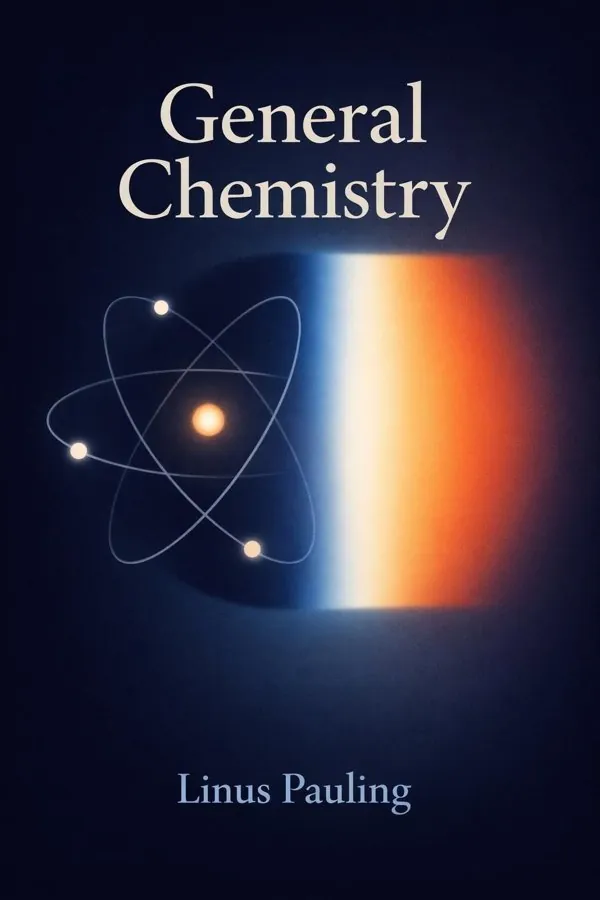
General Chemistry: Summary & Key Insights
 10 min9 chaptersAudio available
Key Takeaways from General Chemistry
Chemistry becomes exciting the moment you realize it is not just about substances in jars, but about the hidden rules governing everything material.
All of chemistry becomes understandable once matter is seen as built from tiny, countable units.
The periodic table is not a chart to memorize first and understand later; it is a map of atomic structure.
A substance’s character depends less on which atoms it contains than on how those atoms are joined.
Knowing that atoms are connected is only the beginning; chemistry becomes far more powerful when you see that three-dimensional shape governs function.
What Is General Chemistry About?
General Chemistry by Linus Pauling is a life_science book spanning 14 pages. General Chemistry by Linus Pauling is far more than an introductory science textbook. It is a masterful explanation of how matter is built, how substances interact, and why the physical world behaves with such remarkable order. Pauling guides readers from the foundations of atomic theory to chemical bonding, molecular structure, equilibrium, thermodynamics, acids and bases, electrochemistry, and reaction rates. What makes the book enduring is not just the range of topics it covers, but the way it connects them into a coherent vision of chemistry as a unified science. This book matters because chemistry sits at the intersection of physics, biology, medicine, engineering, and materials science. To understand chemistry is to understand the principles shaping everything from the air we breathe to the medicines we take and the technologies we use. Pauling was uniquely qualified to write this work. One of the greatest chemists of the twentieth century, he transformed our understanding of the chemical bond and molecular structure, earning the Nobel Prize in Chemistry. In General Chemistry, his authority, clarity, and intellectual curiosity turn a foundational subject into a deeply illuminating study of nature.
This FizzRead summary covers all 9 key chapters of General Chemistry in approximately 10 minutes, distilling the most important ideas, arguments, and takeaways from Linus Pauling's work. Also available as an audio summary and Key Quotes Podcast.
General Chemistry
General Chemistry by Linus Pauling is far more than an introductory science textbook. It is a masterful explanation of how matter is built, how substances interact, and why the physical world behaves with such remarkable order. Pauling guides readers from the foundations of atomic theory to chemical bonding, molecular structure, equilibrium, thermodynamics, acids and bases, electrochemistry, and reaction rates. What makes the book enduring is not just the range of topics it covers, but the way it connects them into a coherent vision of chemistry as a unified science.
This book matters because chemistry sits at the intersection of physics, biology, medicine, engineering, and materials science. To understand chemistry is to understand the principles shaping everything from the air we breathe to the medicines we take and the technologies we use. Pauling was uniquely qualified to write this work. One of the greatest chemists of the twentieth century, he transformed our understanding of the chemical bond and molecular structure, earning the Nobel Prize in Chemistry. In General Chemistry, his authority, clarity, and intellectual curiosity turn a foundational subject into a deeply illuminating study of nature.
Who Should Read General Chemistry?
This book is perfect for anyone interested in life_science and looking to gain actionable insights in a short read. Whether you're a student, professional, or lifelong learner, the key ideas from General Chemistry by Linus Pauling will help you think differently.
- ✓Readers who enjoy life_science and want practical takeaways
- ✓Professionals looking to apply new ideas to their work and life
- ✓Anyone who wants the core insights of General Chemistry in just 10 minutes
Want the full summary?
Get instant access to this book summary and 100K+ more with Fizz Moment.
Get Free SummaryAvailable on App Store • Free to download
Key Chapters
Chemistry becomes exciting the moment you realize it is not just about substances in jars, but about the hidden rules governing everything material. Pauling presents chemistry as the central science because it links physics, which explains fundamental forces and particles, with biology, which explains living systems built from molecules. This broad position gives chemistry a unique power: it shows how microscopic structure produces macroscopic behavior.
The scope of chemistry is therefore immense. It includes the composition of matter, the transformations substances undergo, the energy changes that accompany reactions, and the structures that determine properties. Chemistry asks why iron rusts, why salt dissolves in water, why proteins fold into useful shapes, and why some reactions proceed instantly while others take years. Pauling emphasizes that the chemist does not merely memorize facts but looks for patterns, regularities, and explanatory principles.
This approach also defines the method of chemistry. Observation, measurement, experiment, and theory must reinforce one another. A chemist measures masses, temperatures, pressures, and concentrations, but also imagines atoms, electrons, and bonds that cannot be seen directly. Science advances when these models predict reality accurately.
In practical terms, this perspective helps in everyday reasoning. Cooking, cleaning, battery use, medicine, corrosion, and environmental pollution all involve chemical principles. Even a simple choice such as storing food properly depends on knowing how temperature and oxygen affect reaction rates.
Actionable takeaway: stop treating chemistry as isolated information. Whenever you encounter a material change in daily life, ask what particles are involved, what energy is changing, and what molecular interactions explain the result.
All of chemistry becomes understandable once matter is seen as built from tiny, countable units. Pauling traces the birth of atomic theory to the need for a model that explains why substances combine in fixed proportions and why chemical reactions follow precise numerical laws. Dalton’s atomic hypothesis provided that framework: elements consist of atoms, atoms of a given element are alike in essential properties, and compounds form when atoms combine in definite ratios.
This idea transformed chemistry from a descriptive craft into a quantitative science. Laws such as conservation of mass and definite proportions suddenly made sense. Water is always composed of hydrogen and oxygen in a fixed ratio because it is made of molecules with a fixed composition. Carbon dioxide and carbon monoxide differ because the numbers of oxygen atoms combined with carbon differ. Atomic theory turns mass relationships into evidence of structure.
Pauling shows that atomic theory is valuable not because atoms were initially visible, but because the theory explained and predicted experimental results. That is a key scientific lesson. The best theories organize observations and allow new discoveries. Later work on electrons, nuclei, and isotopes refined Dalton’s model, but did not weaken the core insight that matter is particulate.
Atomic thinking has practical effects everywhere. Chemical formulas on food labels, balanced equations in industrial manufacture, dosage calculations in medicine, and fuel combustion analysis all rely on the idea that substances are made of discrete particles combining in measurable ways.
Actionable takeaway: when learning any chemical process, translate it into particles and ratios. Ask not just what substances are present, but how many atoms or molecules of each are involved.
The periodic table is not a chart to memorize first and understand later; it is a map of atomic structure. Pauling explains that the properties of elements arise from the arrangement of electrons around the nucleus. Atomic number determines the identity of an element, while electron configuration determines how it behaves chemically. Similar patterns in outer electrons produce repeating families of elements with related properties.
This insight gives the periodic system its predictive power. Alkali metals are highly reactive because they possess a single outer electron that is easily lost. Noble gases are stable because their outer shells are filled. Halogens readily gain an electron, which explains their tendency to form salts. Across a period, atomic size, ionization energy, and electronegativity shift in regular ways because nuclear charge and electron arrangement change systematically.
Pauling’s treatment makes the table feel alive. It is not a classification imposed from outside but an expression of nature’s order. Once readers understand electron shells and periodic trends, they can predict which elements form ions, which participate in covalent bonds, which become metals or nonmetals, and which compounds are likely to be stable.
Applications are extensive. Materials science depends on selecting elements with desired conductivity or strength. Pharmacology depends on periodic trends in bonding and reactivity. Environmental chemistry depends on understanding why some elements persist, dissolve, oxidize, or accumulate in organisms.
Actionable takeaway: instead of memorizing element behavior individually, use the periodic table as a reasoning tool. Before studying a reaction, locate each element and predict its likely size, charge tendency, and bonding behavior from its position.
A substance’s character depends less on which atoms it contains than on how those atoms are joined. Pauling’s greatest scientific legacy lies in explaining chemical bonding, and General Chemistry brings that insight to the center of the subject. Chemical bonds arise because arrangements of electrons can lower the energy of a system, creating stable associations among atoms. Ionic, covalent, and metallic bonding are not arbitrary labels but distinct ways matter achieves stability.
Ionic bonding results from electron transfer, producing oppositely charged ions that attract one another strongly, as in sodium chloride. Covalent bonding involves shared electron pairs, as in water, methane, and oxygen gas. Metallic bonding allows electrons to move more freely through a lattice of positive atomic cores, explaining conductivity and malleability in metals. Pauling’s deeper contribution is to show that bonding often has mixed character rather than fitting perfectly into one category. Electronegativity helps explain how strongly atoms pull on shared electrons and why some bonds are more polar than others.
Bonding theory explains countless properties. Why is diamond hard while graphite is soft, though both are pure carbon? Their bonding and structure differ. Why does salt dissolve in water? Polar water molecules stabilize ions. Why do some plastics flex while ceramics shatter? Their atomic connections differ profoundly.
This concept is useful beyond the classroom. Understanding bonds clarifies why detergents work, why metals corrode, why drugs interact with receptors, and why materials behave differently under heat or stress.
Actionable takeaway: whenever you study a substance, identify its dominant bonding type first. That single question often predicts melting point, solubility, conductivity, hardness, and reactivity.
Knowing that atoms are connected is only the beginning; chemistry becomes far more powerful when you see that three-dimensional shape governs function. Pauling emphasizes that molecules are not flat symbols on paper. They possess definite geometries determined by bond angles, electron pair repulsions, and orbital arrangements. Molecular structure is therefore a major key to understanding physical properties and chemical activity.
Shape influences polarity, boiling point, reactivity, and biological function. Water’s bent geometry makes it polar, helping explain its unusual solvent power and high boiling point relative to its size. Carbon dioxide, by contrast, is linear and nonpolar overall despite containing polar bonds. Methane’s tetrahedral geometry supports its stability, while more complex organic molecules display shapes that determine whether they fit into enzymes, receptors, or crystal lattices.
Pauling’s perspective is especially important for modern science because biology is molecular architecture in action. The functions of proteins, nucleic acids, and many pharmaceuticals depend on precise shapes and bond orientations. A small structural change can alter a molecule’s odor, toxicity, medicinal effect, or reaction pathway. Even in inorganic chemistry, lattice arrangement affects hardness, color, magnetism, and conductivity.
Practical applications are easy to see. Flavor molecules bind to receptors because of shape complementarity. Synthetic materials are engineered for flexibility or strength through molecular arrangement. Drug design depends on matching the geometry of a therapeutic molecule to a biological target.
Actionable takeaway: do not stop at a molecular formula. Draw or visualize the three-dimensional structure and ask how shape influences polarity, intermolecular attraction, and the molecule’s ability to interact with other substances.
Matter may look chaotic in everyday life, but its transformations follow clear quantitative rules. Pauling links the states of matter and the mathematics of chemical reactions to show that chemistry is both conceptual and measurable. Solids, liquids, and gases differ because particles move and interact differently. In solids, particles are constrained in ordered or semi-ordered arrangements; in liquids, they remain close but mobile; in gases, they move freely and occupy available volume. Temperature and pressure alter these states by changing particle motion and intermolecular forces.
These ideas flow naturally into stoichiometry, the quantitative study of chemical reactions. Balanced equations represent conservation of atoms and mass. If hydrogen reacts with oxygen to produce water, the equation tells us not only what changes but how much of each substance is involved. Stoichiometry allows chemists to calculate yields, predict limiting reactants, and minimize waste.
This is where chemistry becomes immediately practical. Industrial manufacturing depends on precise reactant ratios. In environmental analysis, stoichiometry helps determine pollutant production and neutralization. In medicine, dosage formulation and metabolic calculations depend on careful quantitative relationships. Even baking illustrates the principle: an incorrect proportion of ingredients changes the final product because the underlying chemistry is altered.
Pauling shows that chemical equations are compressed stories of matter in motion. They reveal what particles rearrange, what phases are involved, and what quantitative constraints govern the process.
Actionable takeaway: when faced with any chemical change, write the balanced equation and connect it to particle behavior in the relevant state of matter. This habit turns vague understanding into accurate prediction.
One of chemistry’s deepest lessons is that not all reactions run to completion; many settle into dynamic balance. Pauling explains equilibrium through the law of mass action, showing that opposing processes can proceed simultaneously until their rates become equal. At equilibrium, substances continue to interconvert, yet macroscopic concentrations remain constant. This idea replaces the simplistic notion that reactions merely start and finish.
Equilibrium helps explain dissociation, solubility, gas reactions, and biochemical regulation. Change the concentration, pressure, or temperature, and the equilibrium shifts in response. This makes chemistry adaptable and controllable. Industries exploit equilibrium in ammonia synthesis and acid production. Living systems use equilibrium principles in oxygen transport, buffering, and metabolism.
Acid-base chemistry is one of the most familiar applications of equilibrium. Acids donate protons, bases accept them, and pH measures the resulting balance in solution. Strong acids and bases ionize extensively; weak ones establish partial equilibria. Buffers resist dramatic pH change because they contain conjugate acid-base pairs that absorb disturbances. Pauling treats this not as a narrow topic but as a central language for understanding reactivity in water.
The applications are everywhere. Blood pH must remain tightly regulated. Soil acidity influences crop growth. Cleaning agents, antacids, food preservation, water treatment, and laboratory analysis all depend on acid-base control. Even the taste of citrus or the sting of vinegar reflects proton chemistry.
Actionable takeaway: when a reaction seems incomplete or reversible, think in terms of equilibrium rather than failure. In solutions especially, ask what factors shift the balance and how pH or concentration can be used to control the outcome.
Chemistry is not only about what changes, but about why changes are favorable and how energy and electrons move during those changes. Pauling integrates thermodynamics with electrochemistry and oxidation-reduction to show that chemical processes obey energetic logic. Thermodynamics asks whether a process can occur, how much energy it absorbs or releases, and how heat, work, entropy, and free energy shape direction.
Exothermic reactions release heat, while endothermic reactions absorb it, but heat alone does not decide spontaneity. Entropy, the tendency toward energy dispersal and increased multiplicity, also matters. A reaction proceeds spontaneously when the total energetic conditions favor it. This helps explain why some reactions that absorb heat still occur, and why some strongly exothermic reactions need activation to begin.
Electrochemistry adds another layer by focusing on electron transfer. Oxidation involves loss of electrons, reduction involves gain, and redox reactions underpin batteries, corrosion, metabolism, metal extraction, and combustion. A galvanic cell converts chemical energy into electrical energy because redox processes are separated and directed through an external circuit. Pauling presents these ideas as natural consequences of atomic and energetic principles.
The practical relevance is enormous. Batteries power devices because redox reactions are harnessed predictably. Rust prevention depends on controlling oxidation. Cellular respiration is a sequence of electron-transfer steps extracting usable energy from food. Industrial electrolysis produces important chemicals and metals.
Actionable takeaway: when analyzing any reaction, ask two questions: where is the energy going, and where are the electrons going? These questions often reveal whether the process is feasible, useful, and controllable.
A reaction may be possible in principle and still proceed too slowly to matter. Pauling’s discussion of kinetics completes the chemical picture by distinguishing thermodynamic possibility from reaction rate. Kinetics studies how fast reactions occur and what factors influence their speed, including concentration, temperature, catalysts, and molecular structure. This is essential because real-world chemistry depends not just on equilibrium positions but on the pathways taken to reach them.
Activation energy explains why some favorable reactions need an initial push. Catalysts accelerate reactions by providing lower-energy pathways without being consumed. Enzymes are the biological masters of this principle, allowing life to occur at moderate temperatures and pressures. Increasing temperature typically speeds reactions because more molecules possess enough energy to react. Higher concentration increases encounter frequency. Surface area matters when solids react.
Pauling ties kinetics to larger applications in materials and life. The stability of pharmaceuticals, the shelf life of food, the hardening of cement, the curing of polymers, the efficiency of engines, and the progression of metabolic reactions all depend on reaction rates. Chemistry becomes truly unified here: atomic structure influences bonding, bonding influences energetics, energetics and mechanism influence rate, and rate determines practical usefulness.
The book’s broader message emerges clearly in these applications. Chemistry is not a disconnected list of subfields. It is a single explanatory framework for understanding substances, transformations, energy, and life itself. From crystals to cells, the same principles recur with different complexity.
Actionable takeaway: whenever you learn a chemical reaction, do not ask only what products form. Also ask how quickly the reaction happens, what controls the speed, and how catalysts or conditions could make the process safer, cheaper, or more effective.
All Chapters in General Chemistry
About the Author
Linus Pauling (1901–1994) was an American chemist, biochemist, educator, and peace activist whose work reshaped modern science. He is best known for pioneering research on the nature of the chemical bond, using quantum principles to explain molecular structure and reactivity. His ideas transformed how chemists understand bonding, electronegativity, and the geometry of molecules. Pauling received the 1954 Nobel Prize in Chemistry for this work. Beyond chemistry, he made influential contributions to biology, including studies of protein structure and molecular disease. He was also a leading public advocate against nuclear weapons testing, an effort that earned him the 1962 Nobel Peace Prize. Remarkably, he remains one of the few individuals to receive two unshared Nobel Prizes. His writing combines scientific rigor with exceptional clarity.
Get This Summary in Your Preferred Format
Read or listen to the General Chemistry summary by Linus Pauling anytime, anywhere. FizzRead offers multiple formats so you can learn on your terms — all free.
Available formats: App · Audio · PDF · EPUB — All included free with FizzRead
Download General Chemistry PDF and EPUB Summary
Key Quotes from General Chemistry
“Chemistry becomes exciting the moment you realize it is not just about substances in jars, but about the hidden rules governing everything material.”
“All of chemistry becomes understandable once matter is seen as built from tiny, countable units.”
“The periodic table is not a chart to memorize first and understand later; it is a map of atomic structure.”
“A substance’s character depends less on which atoms it contains than on how those atoms are joined.”
“Knowing that atoms are connected is only the beginning; chemistry becomes far more powerful when you see that three-dimensional shape governs function.”
Frequently Asked Questions about General Chemistry
General Chemistry by Linus Pauling is a life_science book that explores key ideas across 9 chapters. General Chemistry by Linus Pauling is far more than an introductory science textbook. It is a masterful explanation of how matter is built, how substances interact, and why the physical world behaves with such remarkable order. Pauling guides readers from the foundations of atomic theory to chemical bonding, molecular structure, equilibrium, thermodynamics, acids and bases, electrochemistry, and reaction rates. What makes the book enduring is not just the range of topics it covers, but the way it connects them into a coherent vision of chemistry as a unified science. This book matters because chemistry sits at the intersection of physics, biology, medicine, engineering, and materials science. To understand chemistry is to understand the principles shaping everything from the air we breathe to the medicines we take and the technologies we use. Pauling was uniquely qualified to write this work. One of the greatest chemists of the twentieth century, he transformed our understanding of the chemical bond and molecular structure, earning the Nobel Prize in Chemistry. In General Chemistry, his authority, clarity, and intellectual curiosity turn a foundational subject into a deeply illuminating study of nature.
More by Linus Pauling
You Might Also Like
The Selfish Gene
Richard Dawkins
10 min
Awakenings
Oliver Sacks
10 min
Parasite Rex: Inside the Bizarre World of Nature's Most Dangerous Creatures
Carl Zimmer
10 min
The Atlas of Life on Earth
Various
10 min
The Book of Humans: The Story of How We Became Us
Adam Rutherford
10 min
The Horse
Wendy Williams
10 minBrowse by Category
Ready to read General Chemistry?
Get the full summary and 100K+ more books with Fizz Moment.