
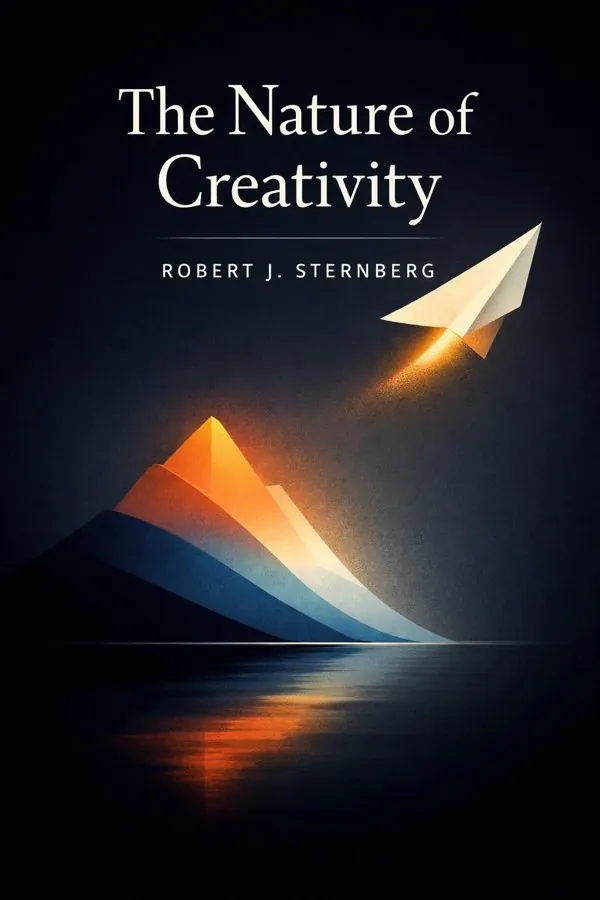
The Nature of Creativity: Summary & Key Insights
 10 min8 chaptersAudio available
Key Takeaways from The Nature of Creativity
Creativity becomes easier to understand the moment we stop treating it as magic.
A creative breakthrough often looks sudden, but beneath the surface it is constructed from ordinary mental processes used in extraordinary ways.
Talent alone rarely produces creativity; the willingness to take risks, persist through uncertainty, and care deeply about the work matters just as much.
No idea becomes creative in isolation; it must be recognized, interpreted, and valued by a community.
It is tempting to search for a single “creative brain,” but the book resists simplistic biological explanations.
What Is The Nature of Creativity About?
The Nature of Creativity by Robert J. Sternberg is a cognition book spanning 6 pages. Creativity is often treated as a mysterious gift possessed by a brilliant few, but The Nature of Creativity argues that it is far more complex, accessible, and scientifically understandable than myth suggests. Edited by psychologist Robert J. Sternberg, this scholarly volume brings together major thinkers in psychology and related fields to examine how creative thought arises, how it develops, how it can be measured, and how social environments help or hinder it. Rather than reducing creativity to inspiration alone, the book explores it as a dynamic interaction among cognition, personality, motivation, culture, biology, and education. What makes this collection especially valuable is its breadth. It does not offer a single neat formula; instead, it shows why creativity resists oversimplification. Readers encounter competing theories, empirical evidence, and practical implications for schools, workplaces, and everyday problem solving. Sternberg is a particularly credible guide for this subject: he is one of the most influential psychologists of his generation, known for pioneering work on intelligence, thinking, and human potential. For anyone who wants a deeper understanding of how original ideas emerge and how creative capacities can be cultivated, this book remains an important and intellectually rich resource.
This FizzRead summary covers all 8 key chapters of The Nature of Creativity in approximately 10 minutes, distilling the most important ideas, arguments, and takeaways from Robert J. Sternberg's work. Also available as an audio summary and Key Quotes Podcast.
The Nature of Creativity
Creativity is often treated as a mysterious gift possessed by a brilliant few, but The Nature of Creativity argues that it is far more complex, accessible, and scientifically understandable than myth suggests. Edited by psychologist Robert J. Sternberg, this scholarly volume brings together major thinkers in psychology and related fields to examine how creative thought arises, how it develops, how it can be measured, and how social environments help or hinder it. Rather than reducing creativity to inspiration alone, the book explores it as a dynamic interaction among cognition, personality, motivation, culture, biology, and education.
What makes this collection especially valuable is its breadth. It does not offer a single neat formula; instead, it shows why creativity resists oversimplification. Readers encounter competing theories, empirical evidence, and practical implications for schools, workplaces, and everyday problem solving. Sternberg is a particularly credible guide for this subject: he is one of the most influential psychologists of his generation, known for pioneering work on intelligence, thinking, and human potential. For anyone who wants a deeper understanding of how original ideas emerge and how creative capacities can be cultivated, this book remains an important and intellectually rich resource.
Who Should Read The Nature of Creativity?
This book is perfect for anyone interested in cognition and looking to gain actionable insights in a short read. Whether you're a student, professional, or lifelong learner, the key ideas from The Nature of Creativity by Robert J. Sternberg will help you think differently.
- ✓Readers who enjoy cognition and want practical takeaways
- ✓Professionals looking to apply new ideas to their work and life
- ✓Anyone who wants the core insights of The Nature of Creativity in just 10 minutes
Want the full summary?
Get instant access to this book summary and 100K+ more with Fizz Moment.
Get Free SummaryAvailable on App Store • Free to download
Key Chapters
Creativity becomes easier to understand the moment we stop treating it as magic. One of the book’s most important contributions is its historical framing: creativity was not always studied as a legitimate psychological topic. For a long time, it was romanticized as genius, divine inspiration, or an unexplainable trait belonging to artists and inventors. Early psychology focused more comfortably on memory, perception, and intelligence, leaving creativity at the margins. Over time, however, researchers began to ask whether originality could be observed, compared, and even nurtured.
This shift from mythology to measurement changed everything. Once scholars began defining creativity as the production of ideas or products that are both novel and appropriate, the field gained clarity. Novelty alone is not enough; random or bizarre ideas are not necessarily creative. Likewise, usefulness without originality may be competent but not inventive. Creativity sits at the intersection of surprise and value. This framework allowed researchers to develop tests, study problem solving, compare domains, and explore why some environments generate more innovation than others.
The historical perspective also reveals that definitions matter. How we define creativity influences what we measure, who we identify as creative, and which institutions we reward. A classroom that values only correct answers may overlook creativity entirely, while one that rewards thoughtful risk-taking may uncover it in unexpected students.
A practical example is workplace innovation. A manager who assumes creativity is a rare gift may wait passively for stars to emerge. A manager who understands creativity as a measurable, developable capacity can redesign meetings, incentives, and evaluation systems to invite original solutions.
Actionable takeaway: Replace vague admiration for “creative genius” with a clear question in your own life or work: what would count as both novel and useful here?
A creative breakthrough often looks sudden, but beneath the surface it is constructed from ordinary mental processes used in extraordinary ways. The book emphasizes that creativity is deeply cognitive: it grows out of how people encode information, retrieve memories, form associations, reframe problems, and evaluate possibilities. In other words, creative thought is not separate from thinking; it is a distinctive pattern of thinking.
Problem solving is central here. Creative individuals often excel not because they know more facts, but because they can represent problems differently. They see hidden assumptions, question obvious categories, and combine ideas that are usually kept apart. Memory also plays a surprising role. Creativity is not the absence of knowledge but a flexible relationship to knowledge. The more richly information is stored and connected, the more material the mind has to recombine into something new.
The book also explores divergent and convergent thinking. Divergent thinking generates multiple possibilities, while convergent thinking selects, refines, and tests the strongest option. Genuine creativity requires both. A designer brainstorming twenty logo concepts is using divergence; choosing one that fits the brand and works in practice requires convergence. Without divergence, thinking becomes rigid. Without convergence, ideas remain scattered and unusable.
These insights have practical implications. Teachers can ask students not just for answers, but for alternative explanations. Leaders can improve innovation by encouraging reframing: instead of asking “How do we sell more?” they might ask “What problem are customers really trying to solve?” Even personal creativity improves when people deliberately seek analogies across fields.
Actionable takeaway: When facing a difficult problem, write down three different ways to define it before trying to solve it; better problem framing often unlocks better ideas.
Talent alone rarely produces creativity; the willingness to take risks, persist through uncertainty, and care deeply about the work matters just as much. One of the book’s recurring themes is that creativity cannot be explained by cognition alone. Personality traits and motivational forces strongly influence whether original ideas are pursued, developed, and shared.
Creative people often show openness to experience, tolerance for ambiguity, independence of judgment, and a readiness to challenge convention. These qualities matter because originality usually involves social friction. A new idea may initially seem odd, impractical, or threatening. Someone who needs constant approval may abandon it too early. By contrast, someone with psychological resilience can sit with incompleteness, revise repeatedly, and withstand skepticism.
Motivation is equally crucial. The research highlighted in the volume points to the power of intrinsic motivation: people tend to be more creative when they are driven by curiosity, interest, mastery, or personal meaning rather than by external rewards alone. This does not mean rewards are always harmful, but when incentives become controlling, they can narrow attention and reduce exploratory thinking. A child who writes stories for enjoyment may be highly imaginative; if every story becomes graded only for correctness, the playfulness that fuels creativity may weaken.
Development also matters. Creative capacities do not emerge in a vacuum; they are shaped through experience, practice, confidence, and opportunity. Families, mentors, and schools can either protect imaginative exploration or suppress it with excessive conformity.
In practical settings, this means organizations should not only hire skilled people; they should create climates where unconventional suggestions are safe to express. Individuals, meanwhile, can examine whether they are pursuing work for genuine engagement or merely for approval.
Actionable takeaway: Identify one project you care about intrinsically and give it protected time each week, free from judgment and performance pressure.
It is tempting to search for a single “creative brain,” but the book resists simplistic biological explanations. Biological factors do matter: temperament, energy level, neural functioning, and even certain cognitive styles may influence creative potential. Yet the volume argues that biology is one strand in a much larger web. Creativity is not hardwired destiny; it emerges through interactions among brain, mind, experience, and environment.
Researchers have long been interested in whether creative individuals show distinctive patterns in attention, association, or mental flexibility. Some may be more sensitive to stimuli, more comfortable with complexity, or better able to connect distant ideas. Biological predispositions might make originality easier in some respects. At the same time, predisposition is not accomplishment. A person may have strong imaginative capacity and still produce little if deprived of education, tools, support, or discipline.
This nuanced view is important because biological arguments can easily become deterministic. If creativity is seen as purely inherited, people may underestimate the power of training and context. Conversely, if biology is ignored entirely, we miss the reality that individuals differ in temperament and cognitive style. A balanced position recognizes variation without turning it into fate.
A practical example is education. Some students may naturally enjoy novelty and open-ended tasks, while others prefer structure. Effective teaching does not assume one ideal cognitive profile; it offers multiple pathways into creative work. Similarly, organizations benefit when they recognize that creativity can appear as rapid ideation in one person and patient, pattern-based innovation in another.
Actionable takeaway: Treat natural strengths as starting points, not limits—notice your own creative style, then build routines and environments that help it translate into finished work.
What we choose to measure shapes what we choose to develop. The book devotes important attention to the challenges of assessing creativity and the practical question of whether it can be taught. The answer is not simple, but it is hopeful: creativity is difficult to measure perfectly, yet it can absolutely be encouraged through thoughtful methods.
Traditional assessments often favor speed, correctness, and agreement with predetermined answers. Creativity, however, involves originality, flexibility, elaboration, and context-sensitive usefulness. Researchers have therefore developed a variety of tools, including divergent thinking tasks, product evaluations, ratings by experts, and observations of problem-solving behavior. Each method captures something real, but none captures the whole phenomenon. A person may perform well on idea-generation tasks yet struggle to turn concepts into meaningful products. Another may seem average in testing yet create outstanding work over time in a specific domain.
This is why teaching creativity must go beyond slogans like “think outside the box.” Effective instruction gives people opportunities to ask questions, generate alternatives, experiment, receive feedback, revise, and reflect on process. In schools, that might mean project-based learning, open-ended prompts, interdisciplinary assignments, and tolerance for productive mistakes. In organizations, it could involve innovation labs, postmortems, design thinking workshops, or incentives for experimentation.
The key insight is that creativity improves when environments support both exploration and refinement. Students and professionals need techniques, domain knowledge, and freedom to try unusual approaches without being punished too early for imperfection.
Actionable takeaway: In any learning or work setting, add one recurring practice that rewards original approaches—not just correct outcomes—such as asking for three possible solutions instead of one.
Many people imagine creativity as spontaneous expression, but the book repeatedly suggests a deeper truth: originality becomes valuable only when shaped by discipline. Creative achievement depends on a tension between freedom and structure. Too much control suffocates exploration; too little control leaves ideas underdeveloped.
This balance appears in every domain. A novelist may begin with wild possibilities, but eventually must choose a point of view, revise scenes, and cut weaker passages. A scientist may start with speculative hypotheses, then submit them to rigorous methods and evidence. An entrepreneur may generate bold concepts, but must still test market demand, build systems, and execute consistently. The creative process is therefore not a single flash of insight but a cycle of generation, evaluation, refinement, and implementation.
The book’s multi-perspective approach helps readers see why some people have many ideas yet few achievements. They may be strong in ideation but weak in persistence, criticism, or execution. Others may be highly disciplined but too constrained by habit to imagine alternatives. The most effective creators learn to alternate modes: they suspend judgment during exploration, then reintroduce standards during revision.
This insight is highly practical. Teams can structure innovation sessions in phases, separating brainstorming from evaluation so that premature criticism does not kill possibility. Individuals can do the same by drafting freely, then editing later. Parents and teachers can encourage creative children not only to imagine, but also to finish, improve, and present their work.
Actionable takeaway: Divide your next creative project into two explicit stages—an idea stage with no self-censorship and a revision stage with clear criteria for improvement.
The biggest mistake in studying creativity is trying to explain it with only one lens. A central achievement of The Nature of Creativity is its insistence on integration. No single theory—whether cognitive, personality-based, social, biological, or educational—can fully account for how creative ideas emerge and endure. Creativity is best understood as a system of interacting influences.
This integrative approach matters because reductionism creates blind spots. If we focus only on intelligence, we miss the role of courage and motivation. If we focus only on personality, we miss the importance of knowledge and skill. If we focus only on the individual, we neglect the gatekeepers and cultural conditions that decide whether originality is recognized. If we focus only on environment, we overlook individual differences in thought and temperament. The book’s collected essays show that creativity is neither solely “in the person” nor solely “in the world,” but in the relationship between them.
An integrative model is also more useful in practice. Suppose a company wants more innovation. It should not simply hire “creative types.” It must also examine whether employees have time to think, whether failure is punished, whether departments share knowledge, whether leaders reward experimentation, and whether projects are aligned with meaningful goals. Similarly, a teacher who wants more creative students must combine content knowledge, open tasks, feedback, emotional support, and opportunities for independent thinking.
This broader perspective also encourages intellectual humility. Because creativity is multifaceted, no one intervention will solve everything. Progress comes from designing systems that support multiple dimensions at once.
Actionable takeaway: When creativity feels blocked, diagnose the problem across four levels—skills, motivation, environment, and evaluation—instead of blaming only yourself or only the situation.
All Chapters in The Nature of Creativity
About the Author
Robert J. Sternberg is an American psychologist, scholar, and academic leader best known for his influential work on intelligence, creativity, thinking, and wisdom. Across a distinguished career, he has taught at major universities, published extensively, and developed theories that challenged narrow views of human ability. His research has explored how people solve problems, adapt to changing environments, and generate original ideas, making him one of the most important voices in cognitive and educational psychology. Sternberg has also held major leadership roles, including serving as president of the American Psychological Association. As editor of The Nature of Creativity, he draws on decades of scholarship to present creativity not as a simple trait, but as a rich, multidimensional capacity shaped by mind, personality, and culture.
Get This Summary in Your Preferred Format
Read or listen to the The Nature of Creativity summary by Robert J. Sternberg anytime, anywhere. FizzRead offers multiple formats so you can learn on your terms — all free.
Available formats: App · Audio · PDF · EPUB — All included free with FizzRead
Download The Nature of Creativity PDF and EPUB Summary
Key Quotes from The Nature of Creativity
“Creativity becomes easier to understand the moment we stop treating it as magic.”
“A creative breakthrough often looks sudden, but beneath the surface it is constructed from ordinary mental processes used in extraordinary ways.”
“Talent alone rarely produces creativity; the willingness to take risks, persist through uncertainty, and care deeply about the work matters just as much.”
“No idea becomes creative in isolation; it must be recognized, interpreted, and valued by a community.”
“It is tempting to search for a single “creative brain,” but the book resists simplistic biological explanations.”
Frequently Asked Questions about The Nature of Creativity
The Nature of Creativity by Robert J. Sternberg is a cognition book that explores key ideas across 8 chapters. Creativity is often treated as a mysterious gift possessed by a brilliant few, but The Nature of Creativity argues that it is far more complex, accessible, and scientifically understandable than myth suggests. Edited by psychologist Robert J. Sternberg, this scholarly volume brings together major thinkers in psychology and related fields to examine how creative thought arises, how it develops, how it can be measured, and how social environments help or hinder it. Rather than reducing creativity to inspiration alone, the book explores it as a dynamic interaction among cognition, personality, motivation, culture, biology, and education. What makes this collection especially valuable is its breadth. It does not offer a single neat formula; instead, it shows why creativity resists oversimplification. Readers encounter competing theories, empirical evidence, and practical implications for schools, workplaces, and everyday problem solving. Sternberg is a particularly credible guide for this subject: he is one of the most influential psychologists of his generation, known for pioneering work on intelligence, thinking, and human potential. For anyone who wants a deeper understanding of how original ideas emerge and how creative capacities can be cultivated, this book remains an important and intellectually rich resource.
More by Robert J. Sternberg
You Might Also Like
A Field Guide to Lies: Critical Thinking in the Information Age
Daniel J. Levitin
10 min
A Theory of Cognitive Dissonance
Leon Festinger
10 min
Black-And-White Thinking: The Burden of a Binary Brain in a Complex World
Kevin Dutton
10 min
Born Liars: Why We Can’t Live Without Deceit
Ian Leslie
10 min
Collective Illusions: Conformity, Complicity, and the Science of Why We Make Bad Decisions
Todd Rose
10 min
Concrete Mathematics: A Foundation for Computer Science
Ronald L. Graham, Donald E. Knuth, Oren Patashnik
10 minBrowse by Category
Ready to read The Nature of Creativity?
Get the full summary and 100K+ more books with Fizz Moment.