
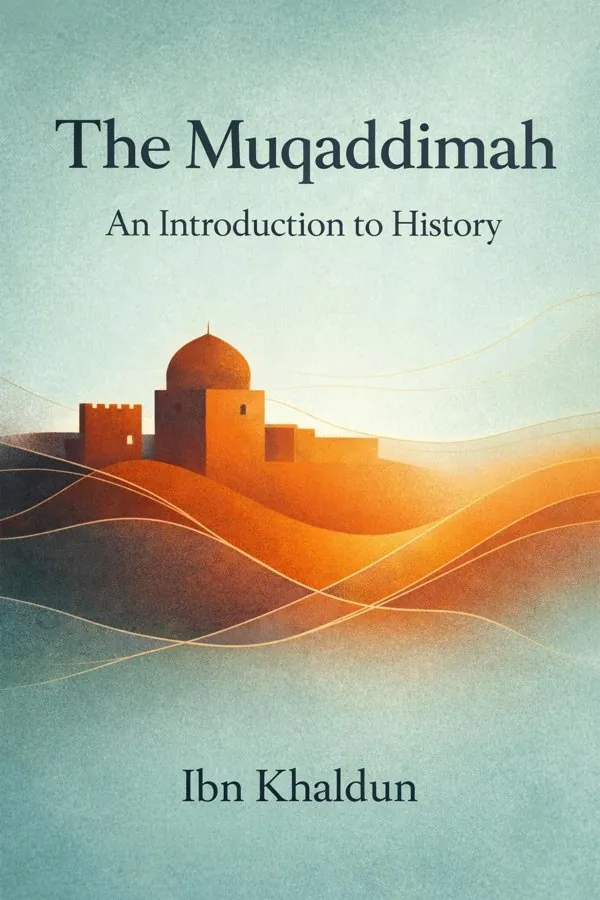
The Muqaddimah: An Introduction to History: Summary & Key Insights
by Ibn Khaldun
 10 min10 chaptersAudio available
Key Takeaways from The Muqaddimah: An Introduction to History
Civilization begins not with luxury, but with need.
The strongest societies are not always the richest; they are often the most united.
Power often comes from the edges, not the center.
The seeds of collapse are often planted at the moment of success.
A state cannot remain strong if it misunderstands how wealth is created.
What Is The Muqaddimah: An Introduction to History About?
The Muqaddimah: An Introduction to History by Ibn Khaldun is a civilization book spanning 10 pages. What if history were not just a record of kings, battles, and dates, but a science of how human societies actually work? In The Muqaddimah: An Introduction to History, Ibn Khaldun answers that question with astonishing originality. Written in 1377, this masterwork goes far beyond traditional chronicle-writing to explain why civilizations rise, flourish, weaken, and collapse. It explores the forces that shape collective life: social cohesion, political power, economics, geography, education, religion, and culture. Long before sociology, economics, and political science emerged as formal disciplines, Ibn Khaldun was already analyzing the patterns that govern them. What makes this book enduringly important is not only its breadth, but its method. Ibn Khaldun insists that historical claims must be tested against reason, social realities, and observable patterns. He does not merely describe events; he searches for causes. As a statesman, judge, diplomat, and scholar who witnessed political upheaval across North Africa and the Islamic world, he wrote with rare practical authority. The Muqaddimah remains one of the most profound works ever written on civilization because it teaches us how to think about power, society, and history itself.
This FizzRead summary covers all 10 key chapters of The Muqaddimah: An Introduction to History in approximately 10 minutes, distilling the most important ideas, arguments, and takeaways from Ibn Khaldun's work. Also available as an audio summary and Key Quotes Podcast.
The Muqaddimah: An Introduction to History
What if history were not just a record of kings, battles, and dates, but a science of how human societies actually work? In The Muqaddimah: An Introduction to History, Ibn Khaldun answers that question with astonishing originality. Written in 1377, this masterwork goes far beyond traditional chronicle-writing to explain why civilizations rise, flourish, weaken, and collapse. It explores the forces that shape collective life: social cohesion, political power, economics, geography, education, religion, and culture. Long before sociology, economics, and political science emerged as formal disciplines, Ibn Khaldun was already analyzing the patterns that govern them.
What makes this book enduringly important is not only its breadth, but its method. Ibn Khaldun insists that historical claims must be tested against reason, social realities, and observable patterns. He does not merely describe events; he searches for causes. As a statesman, judge, diplomat, and scholar who witnessed political upheaval across North Africa and the Islamic world, he wrote with rare practical authority. The Muqaddimah remains one of the most profound works ever written on civilization because it teaches us how to think about power, society, and history itself.
Who Should Read The Muqaddimah: An Introduction to History?
This book is perfect for anyone interested in civilization and looking to gain actionable insights in a short read. Whether you're a student, professional, or lifelong learner, the key ideas from The Muqaddimah: An Introduction to History by Ibn Khaldun will help you think differently.
- ✓Readers who enjoy civilization and want practical takeaways
- ✓Professionals looking to apply new ideas to their work and life
- ✓Anyone who wants the core insights of The Muqaddimah: An Introduction to History in just 10 minutes
Want the full summary?
Get instant access to this book summary and 100K+ more with Fizz Moment.
Get Free SummaryAvailable on App Store • Free to download
Key Chapters
Civilization begins not with luxury, but with need. Ibn Khaldun starts from a simple but powerful observation: a single human being cannot secure food, safety, and livelihood alone. People must cooperate, divide labor, and organize themselves into communities if they are to survive. In this sense, society is not an optional cultural achievement; it is a condition of human existence.
From this starting point, Ibn Khaldun builds a theory of civilization. Once people gather together, they create forms of order—families, tribes, towns, markets, and governments. Cooperation allows specialization: one person farms, another crafts tools, another administers justice, and another defends the group. This division of labor increases productivity and supports increasingly complex forms of life. What begins as necessity gradually produces culture, politics, and learning.
The insight still matters today. Modern economies depend on vast networks of interdependence that most people barely notice. A loaf of bread requires farmers, millers, truck drivers, shopkeepers, and regulators. A smartphone requires miners, engineers, coders, factory workers, and shipping systems spanning continents. Ibn Khaldun helps us see that civilization rests on cooperation long before it rests on ideology.
He also reminds us that social breakdown is not abstract. When trust, security, or productive cooperation fails, civilization weakens from the ground up. Failed states, economic collapse, and social fragmentation all show what happens when the basic conditions of collective life deteriorate.
Actionable takeaway: When analyzing any society, start with the fundamentals—how people cooperate to meet basic needs, maintain security, and sustain shared institutions.
The strongest societies are not always the richest; they are often the most united. Ibn Khaldun’s most famous concept is asabiyyah, usually translated as group solidarity or social cohesion. It is the bond that ties people together through kinship, shared hardship, loyalty, or common purpose. For Ibn Khaldun, this force is the engine behind political power and the foundation of successful states.
Asabiyyah is especially strong among tribal or frontier groups living under demanding conditions. Because survival requires mutual dependence, individuals learn discipline, courage, and loyalty. These groups can outperform wealthier but softer urban populations because they act with collective resolve. A dynasty often begins when a tightly bonded group conquers or consolidates power over a more fragmented society.
This idea extends far beyond tribal politics. Startups often defeat larger firms because founders and early employees share a mission and sacrifice together. Social movements gain momentum when participants feel deep moral and emotional solidarity. Military units, sports teams, and even families thrive when members trust one another and prioritize the group over personal vanity.
But asabiyyah is not blind tribalism in Ibn Khaldun’s thought. It is a practical explanation of how groups mobilize power. Religion can strengthen it by giving a wider moral purpose to solidarity. Leadership can focus it. Shared danger can intensify it. Yet luxury, complacency, and internal rivalry can dissolve it.
Modern institutions often underestimate this principle. Strategies fail when organizations have resources but no cohesion. Vision statements do little if people do not feel belonging or shared sacrifice.
Actionable takeaway: If you want a group to endure—whether a team, company, movement, or community—build trust, shared purpose, and mutual obligation before pursuing expansion.
Power often comes from the edges, not the center. Ibn Khaldun observed that ruling dynasties rarely emerge from comfortable urban elites. Instead, they are often founded by tougher, more cohesive groups from deserts, frontiers, or peripheral regions—people accustomed to hardship and bound by strong asabiyyah. These groups possess the discipline and unity needed to challenge established but decaying powers.
The rise of a dynasty follows a recognizable pattern. First, a group develops strong solidarity through shared struggle. Then it gains followers, often under a charismatic leader. If religion joins the movement, its moral force can multiply political energy by unifying people beyond blood ties. Once the group defeats rivals and captures the state, it replaces unstable or exhausted rulers with fresh vigor.
This pattern appears repeatedly across history. Nomadic confederations, revolutionary movements, and insurgent political parties often triumph not because they have the most wealth, but because they have more internal cohesion than the old regime. Even in business, disruptive newcomers can overthrow dominant incumbents when they are hungry, agile, and mission-driven while established firms are bureaucratic and self-protective.
Ibn Khaldun’s point is not that hardship is inherently noble, but that adversity produces capacities comfort rarely does. The center becomes vulnerable when it mistakes wealth for strength. Institutions can look powerful from the outside while being hollow within.
This insight is useful in leadership and strategy. The next transformative force in a field may not come from the biggest player but from a highly committed outsider group with stronger internal bonds and a clearer purpose.
Actionable takeaway: Watch the margins. In politics, organizations, and markets, the groups most likely to rise are often those with the strongest discipline, hunger, and unity—not the most established prestige.
The seeds of collapse are often planted at the moment of success. One of Ibn Khaldun’s greatest insights is that dynasties follow a cycle: rise, consolidation, expansion, comfort, decadence, and decline. The very achievements that create political order eventually weaken the qualities that made that order possible.
In the beginning, rulers are close to the rough virtues of their founding group—courage, austerity, solidarity, and personal leadership. As power stabilizes, institutions grow stronger, revenues increase, and luxury expands. Later generations inherit authority rather than earn it. They become accustomed to comfort, rely on mercenaries or bureaucrats instead of loyal companions, and lose touch with the discipline that built the state. The ruling class grows self-indulgent, taxation rises, and public spirit fades. Eventually a more cohesive outsider group replaces them.
This cycle is not fatalism; it is social analysis. Ibn Khaldun is describing how human habits change under conditions of power and prosperity. Families can experience similar patterns: one generation struggles, the next builds, the third consumes. Companies often begin entrepreneurial, become corporate, and end defensive and slow. Political movements that start with moral passion may harden into self-serving establishments.
The enduring value of this theory lies in its warning. Success can erode the very virtues that produced it. Institutions decline not only because of enemies, but because comfort undermines character and incentives.
Leaders today can use this framework to diagnose stagnation. Are systems still driven by purpose, competence, and sacrifice, or by entitlement, image, and routine? Renewal begins with asking that question honestly.
Actionable takeaway: Build mechanisms that preserve discipline during success—limit excess, reward competence, and reconnect institutions to the hardship-tested values that made them strong.
A state cannot remain strong if it misunderstands how wealth is created. Ibn Khaldun treats economic life not as a side issue, but as a core foundation of civilization. Labor produces value. Division of labor increases output. Markets flourish when people feel secure. Taxation supports government, but excessive taxation discourages production and eventually reduces revenue. In these observations, he anticipates major themes of modern economics.
He argues that prosperity depends on productive activity, not simply on rulers extracting resources. When taxes are moderate, people are motivated to work, trade, invest, and expand their enterprises. As states become extravagant and their expenses rise, rulers often increase taxes and arbitrary exactions. This may generate short-term income, but it weakens commerce and shrinks the overall economy. A predatory state destroys the source of its own wealth.
This analysis remains strikingly relevant. Governments today still wrestle with the balance between revenue needs and economic incentives. Businesses also face a similar principle internally: if management creates too much friction, bureaucracy, or punishment, initiative declines. Even nonprofit institutions can become extractive when administrators consume resources that should support the mission.
Ibn Khaldun also links economics to social morale. Prosperity is not only material; it supports education, urban life, and cultural refinement. But if wealth becomes disconnected from production and is sustained by rent-seeking, corruption follows.
His lesson is ultimately about sustainability. Productive societies reward work, maintain trust, and avoid suffocating those who create value. Healthy governance protects economic life rather than feeding parasitically on it.
Actionable takeaway: In any institution, ask whether rules and incentives encourage productive effort—or whether extraction, overcontrol, and excess costs are slowly destroying the source of prosperity.
Urban life is civilization at its height—and often at its most fragile. Ibn Khaldun sees cities as the place where surplus wealth, specialized labor, architecture, scholarship, and the arts can flourish. When a society becomes stable and prosperous, it builds towns and great capitals. Urbanization allows refinement: better institutions, more advanced crafts, richer culture, and broader intellectual exchange.
Yet the city also reveals a paradox. The very comfort and sophistication it enables can weaken social resilience. Urban populations depend on systems they did not personally build and may become detached from the hard disciplines of survival. Luxury increases wants, status competition intensifies, and people grow used to ease. As a result, the tough collective virtues associated with frontier life can fade.
This is not anti-city romanticism. Ibn Khaldun admires the achievements of urban civilization. But he insists that refinement comes at a cost if a society confuses polish with strength. A beautifully organized capital may be politically exhausted beneath the surface. A highly cultured elite may lose practical courage, moral seriousness, or solidarity with the broader population.
We can apply this insight today to global metropolises, corporate headquarters, elite institutions, and even digital cultures. Complexity and comfort increase possibilities, but they also create dependency, insulation, and fragility. A society that values appearance, consumption, and prestige more than shared purpose may be materially advanced yet socially brittle.
The challenge, then, is balance: preserving the benefits of urban sophistication without losing civic discipline and public-mindedness.
Actionable takeaway: Enjoy the fruits of complexity, but regularly ask what core habits—resilience, responsibility, solidarity, and realism—must be preserved so comfort does not become weakness.
Learning fails when teaching ignores how the mind actually grows. Ibn Khaldun offers a surprisingly modern critique of education, arguing that students should not be overloaded with abstractions before they grasp basic principles. Knowledge develops gradually, through stages, repetition, and increasing depth. Effective teaching begins with simple outlines, then returns to the subject with fuller explanation, and only later introduces complexity and disagreement.
He criticizes harsh instruction and excessive memorization when they crush curiosity and understanding. Students who are intimidated or forced into mechanical learning may retain words but not insight. Education should train judgment, not merely store information. This reflects his broader commitment to causality and understanding: to know something is to perceive its structure and reasons, not just recite inherited statements.
This idea applies strongly today. In schools, workplaces, and self-directed learning, people often try to master advanced material too quickly. Beginners consume dense theory without foundations, employees are handed tools without context, and leaders mistake information transfer for actual learning. The result is superficial competence.
Ibn Khaldun’s staged approach can improve modern teaching. A manager onboarding new employees should first explain the big picture, then procedures, then exceptions. A student learning history should first understand broad eras and causes before diving into debates over sources. A parent teaching a child should prioritize developmental readiness over performance pressure.
At a deeper level, he treats education as civilizational work. The transmission of knowledge sustains culture, institutions, and public life. Poor education weakens the future even in a wealthy society.
Actionable takeaway: Learn and teach in layers—start with essentials, repeat with greater depth, and aim for understanding over intimidation, speed, or empty memorization.
Political power becomes far stronger when people believe they serve a higher purpose. Ibn Khaldun argues that religion can deepen and widen asabiyyah by uniting individuals beyond tribal loyalties and personal interest. A group bound only by blood or expedience may achieve local power, but a group animated by religious mission can inspire broader obedience, sacrifice, and legitimacy.
Religion matters in his framework not merely as doctrine, but as a social force. It disciplines desires, directs ambition toward a transcendent end, and reduces internal rivalry by subordinating personal ego to shared moral law. This makes collective action more stable and more expansive. A religiously inspired movement can weld together otherwise competing groups under a common identity and purpose.
At the same time, Ibn Khaldun is not saying religion automatically guarantees justice or success. Its power depends on how sincerely it shapes conduct and how effectively it channels solidarity. When rulers use religion merely as decoration while pursuing corruption and luxury, legitimacy erodes. The moral force that once strengthened the state becomes hollow rhetoric.
This analysis remains relevant beyond formal religion. Ideologies, national missions, constitutional ideals, and deeply held ethical visions can serve similar functions by providing meaning and moral cohesion. Organizations often perform better when members believe their work contributes to something larger than personal advancement.
The practical lesson is that durable political order requires more than coercion or administration. People must feel that power is justified within a larger moral framework. Without that, unity tends to fracture under pressure.
Actionable takeaway: Strengthen institutions by linking shared effort to genuine moral purpose; people endure hardship more willingly when they believe they are serving something higher than themselves.
Human choices matter, but they never operate in a vacuum. Ibn Khaldun pays close attention to geography, climate, and environment as forces that shape the habits, livelihoods, and political possibilities of peoples. Different terrains produce different economic patterns, forms of mobility, diets, social organizations, and temperaments. Desert life fosters endurance and solidarity; fertile regions support dense settlement and wealth; strategic locations encourage trade and cultural exchange.
His environmental thinking is not simplistic determinism. He does not claim geography mechanically dictates destiny. Rather, he argues that physical conditions create pressures and opportunities that influence how societies develop. A people living under scarcity must cultivate different virtues than one living amid abundance. A mountain region, a caravan route, and a coastal port each encourage distinct forms of power and culture.
This remains highly relevant in modern analysis. Geography still affects infrastructure, migration, trade, war, resource politics, urban planning, and climate vulnerability. Island nations think differently about defense than land empires. Water scarcity shapes conflict and cooperation. Regions tied to trade corridors often become culturally hybrid and economically dynamic.
At the personal level, the idea encourages realism. Good strategy accounts for conditions rather than pretending all environments are equal. Leaders, planners, and institutions fail when they import models without adapting to local realities.
Ibn Khaldun’s broader lesson is that civilization is always embodied in place. To understand a society, one must ask not only what people believe, but where and how they live.
Actionable takeaway: Before judging a society, organization, or plan, examine the environment shaping it—resources, constraints, geography, and material conditions often explain more than ideology alone.
A false story repeated with confidence is still false. Perhaps Ibn Khaldun’s most revolutionary claim is methodological: history must be examined critically, not accepted blindly from earlier authorities. Chroniclers often transmit exaggerations, myths, partisan distortions, and numerical absurdities because they fail to ask whether reported events are socially and materially plausible. For Ibn Khaldun, reason is a necessary filter for historical truth.
He proposes that historians evaluate reports by comparing them with known patterns of human society. Could a ruler really have maintained an army of that size given the economy of the time? Could a city support the population attributed to it? Does a claim fit what we know about political motives, geography, institutions, and human behavior? This insistence on plausibility makes The Muqaddimah a foundational text in historical methodology.
The relevance today is enormous. In the age of viral misinformation, manipulated images, ideological media, and selective storytelling, Ibn Khaldun’s method is more urgent than ever. We still need to ask: Who benefits from this account? Is it materially possible? Does it fit broader evidence? Are we mistaking spectacle for explanation?
His approach also applies in business, politics, and daily life. Leaders should not make decisions based on flattering reports. Citizens should not accept narratives that merely confirm their biases. Researchers should test claims against reality rather than prestige.
By turning history into a discipline of inquiry rather than inheritance, Ibn Khaldun transformed the study of the past into a tool for understanding the present.
Actionable takeaway: Treat every striking claim—historical, political, or personal—as a report to be tested against evidence, context, and what is realistically possible in human affairs.
All Chapters in The Muqaddimah: An Introduction to History
About the Author
Ibn Khaldun (1332–1406) was an Arab historian, philosopher, diplomat, jurist, and political thinker born in Tunis. He lived amid the shifting power struggles of North Africa and al-Andalus, serving rulers in administrative and judicial roles while also enduring exile, imprisonment, and court intrigue. These experiences gave him an unusually practical understanding of politics, statecraft, and social change. He is best known for The Muqaddimah, the celebrated introduction to his universal history, in which he developed original theories of social cohesion, dynastic cycles, economics, education, and historical criticism. Often described as a precursor to sociology, historiography, and political science, Ibn Khaldun remains one of the most important intellectual figures in Islamic civilization and one of the most penetrating analysts of how societies rise and decline.
Get This Summary in Your Preferred Format
Read or listen to the The Muqaddimah: An Introduction to History summary by Ibn Khaldun anytime, anywhere. FizzRead offers multiple formats so you can learn on your terms — all free.
Available formats: App · Audio · PDF · EPUB — All included free with FizzRead
Download The Muqaddimah: An Introduction to History PDF and EPUB Summary
Key Quotes from The Muqaddimah: An Introduction to History
“Civilization begins not with luxury, but with need.”
“The strongest societies are not always the richest; they are often the most united.”
“Power often comes from the edges, not the center.”
“The seeds of collapse are often planted at the moment of success.”
“A state cannot remain strong if it misunderstands how wealth is created.”
Frequently Asked Questions about The Muqaddimah: An Introduction to History
The Muqaddimah: An Introduction to History by Ibn Khaldun is a civilization book that explores key ideas across 10 chapters. What if history were not just a record of kings, battles, and dates, but a science of how human societies actually work? In The Muqaddimah: An Introduction to History, Ibn Khaldun answers that question with astonishing originality. Written in 1377, this masterwork goes far beyond traditional chronicle-writing to explain why civilizations rise, flourish, weaken, and collapse. It explores the forces that shape collective life: social cohesion, political power, economics, geography, education, religion, and culture. Long before sociology, economics, and political science emerged as formal disciplines, Ibn Khaldun was already analyzing the patterns that govern them. What makes this book enduringly important is not only its breadth, but its method. Ibn Khaldun insists that historical claims must be tested against reason, social realities, and observable patterns. He does not merely describe events; he searches for causes. As a statesman, judge, diplomat, and scholar who witnessed political upheaval across North Africa and the Islamic world, he wrote with rare practical authority. The Muqaddimah remains one of the most profound works ever written on civilization because it teaches us how to think about power, society, and history itself.
More by Ibn Khaldun
You Might Also Like

The Structure of Scientific Revolutions
Thomas S. Kuhn
10 min
Genius
Harold Bloom
10 min
A Cultural History of the Medieval Age
Various Editors
10 min
A History of God: The 4,000-Year Quest of Judaism, Christianity and Islam
Karen Armstrong
10 min
A History of the World in 10½ Chapters
Julian Barnes
10 min
A Short History of Progress
Ronald Wright
10 minBrowse by Category
Ready to read The Muqaddimah: An Introduction to History?
Get the full summary and 100K+ more books with Fizz Moment.