
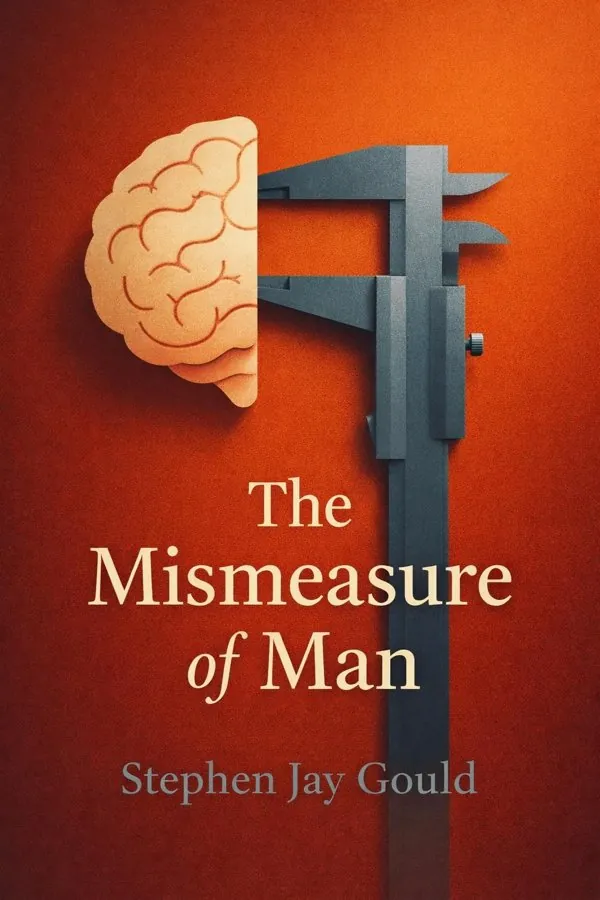
The Mismeasure of Man: Summary & Key Insights
 10 min10 chaptersAudio available
Key Takeaways from The Mismeasure of Man
A society that already believes in inequality will often ask science to confirm it.
Bias does not need fraud to do damage; it only needs a researcher who cannot see his own assumptions.
The more precise a method looks, the easier it is to mistake it for truth.
A tool created for support can become a weapon when its purpose is forgotten.
Large-scale testing can create social myths when weak results are treated as deep truths.
What Is The Mismeasure of Man About?
The Mismeasure of Man by Stephen Jay Gould is a popular_sci book spanning 10 pages. The Mismeasure of Man is Stephen Jay Gould’s powerful investigation into one of science’s most troubling habits: turning social prejudice into “objective” measurement. In this book, Gould traces the history of biological determinism—the belief that intelligence, worth, and social rank are fixed by biology—and shows how scientists repeatedly used skull measurements, IQ tests, and statistical techniques to support existing hierarchies of race, class, and gender. His central claim is not that measurement is inherently bad, but that measurement becomes dangerous when it is guided by hidden assumptions, cultural bias, and a desire to rank human beings. What makes the book so important is its combination of scientific detail, historical perspective, and moral clarity. Gould writes as a trained evolutionary biologist and historian of science, uniquely equipped to examine both the data and the ideas behind them. He reveals how respected researchers often mistook their own social values for natural facts. The result is a book that challenges readers to think more carefully about intelligence, inequality, and the authority of science itself. It remains essential reading for anyone interested in psychology, education, race, ethics, and how numbers can be used to mislead as easily as to illuminate.
This FizzRead summary covers all 10 key chapters of The Mismeasure of Man in approximately 10 minutes, distilling the most important ideas, arguments, and takeaways from Stephen Jay Gould's work. Also available as an audio summary and Key Quotes Podcast.
The Mismeasure of Man
The Mismeasure of Man is Stephen Jay Gould’s powerful investigation into one of science’s most troubling habits: turning social prejudice into “objective” measurement. In this book, Gould traces the history of biological determinism—the belief that intelligence, worth, and social rank are fixed by biology—and shows how scientists repeatedly used skull measurements, IQ tests, and statistical techniques to support existing hierarchies of race, class, and gender. His central claim is not that measurement is inherently bad, but that measurement becomes dangerous when it is guided by hidden assumptions, cultural bias, and a desire to rank human beings.
What makes the book so important is its combination of scientific detail, historical perspective, and moral clarity. Gould writes as a trained evolutionary biologist and historian of science, uniquely equipped to examine both the data and the ideas behind them. He reveals how respected researchers often mistook their own social values for natural facts. The result is a book that challenges readers to think more carefully about intelligence, inequality, and the authority of science itself. It remains essential reading for anyone interested in psychology, education, race, ethics, and how numbers can be used to mislead as easily as to illuminate.
Who Should Read The Mismeasure of Man?
This book is perfect for anyone interested in popular_sci and looking to gain actionable insights in a short read. Whether you're a student, professional, or lifelong learner, the key ideas from The Mismeasure of Man by Stephen Jay Gould will help you think differently.
- ✓Readers who enjoy popular_sci and want practical takeaways
- ✓Professionals looking to apply new ideas to their work and life
- ✓Anyone who wants the core insights of The Mismeasure of Man in just 10 minutes
Want the full summary?
Get instant access to this book summary and 100K+ more with Fizz Moment.
Get Free SummaryAvailable on App Store • Free to download
Key Chapters
A society that already believes in inequality will often ask science to confirm it. Gould begins by placing biological determinism in its historical setting: the 19th century, when European and American intellectual life was deeply shaped by colonialism, class division, racism, and the urge to classify everything in nature. In that atmosphere, many scientists did not neutrally study human difference. They assumed that social rankings reflected natural rankings and then looked for evidence to support that belief.
This matters because the scientific questions themselves were often biased from the start. Instead of asking how environments shape development or how intelligence may take many forms, researchers asked which race was superior, whether the poor were biologically inferior, or whether women were naturally less capable than men. Their methods varied, but the assumption of hierarchy remained constant.
Gould’s historical insight is practical as well as scholarly. Today, we still see similar patterns when data is used to justify unequal school funding, hiring discrimination, or simplistic narratives about “merit.” The lesson is not that science always serves power, but that science can be distorted when social assumptions go unexamined.
In modern life, this means asking a few hard questions whenever a study claims to rank groups of people: What exactly is being measured? Who defined the categories? What assumptions shaped the research design? And who benefits from the conclusion?
Actionable takeaway: When you encounter scientific claims about human ability, look beyond the numbers and examine the social assumptions that shaped the question in the first place.
The more precise a method looks, the easier it is to mistake it for truth. Gould explores the work of Paul Broca, a celebrated French scientist who also used brain size and cranial measurements to argue for differences in intelligence among races and between men and women. Broca’s prestige mattered because it showed how even highly skilled and respected scientists can confuse culturally accepted beliefs with biological realities.
Broca did not merely measure skulls; he participated in a broader scientific culture that equated size with worth and assumed that anatomy could reveal destiny. Women were said to have smaller brains and therefore lesser intellectual ability. Certain racial groups were described as less evolved. These claims sounded empirical, but they rested on shaky reasoning. Brain size varies with body size, age, nutrition, and many other factors. More importantly, intelligence is not reducible to a single physical trait.
Gould uses Broca to illustrate a recurring pattern: once a society assumes superiority and inferiority, technical methods are built to validate those categories. The method then gains prestige because it appears mathematical, anatomical, or statistical. This is why flawed metrics can survive for so long in schools, workplaces, and public policy.
A modern example is the overreliance on a single performance metric to judge complex talent. Standardized test scores, productivity dashboards, and citation counts can be useful, but they become misleading when treated as complete portraits of human capability.
Actionable takeaway: Be wary of any system that compresses human complexity into one supposedly decisive measurement, especially when that metric conveniently mirrors existing social hierarchies.
A tool created for support can become a weapon when its purpose is forgotten. Gould pays close attention to the rise of intelligence testing, especially the work of Alfred Binet, who originally designed tests to identify children needing educational assistance. Binet did not believe he had discovered a fixed, inborn essence of intelligence. He saw intelligence as complex and changeable, and he understood that test results reflected context as well as ability.
According to Gould, the problem began when later psychologists, especially in the United States, transformed Binet’s pragmatic educational tool into a device for ranking innate worth. Intelligence was reimagined as a single measurable quantity, often treated as hereditary, stable, and comparable across all persons. This shift had enormous consequences. Test scores started to influence schooling, immigration, military placement, and beliefs about social class.
The key issue is not whether tests can provide useful information. They can. The issue is what people claim the test means. A reading assessment may reveal current reading proficiency; it does not automatically reveal overall intelligence, future value, or biological destiny. A math score may show performance on a particular day under specific conditions; it does not define a person’s full cognitive capacity.
Gould’s critique remains highly relevant in educational policy, where single metrics are often asked to do too much. When one score determines access to programs, opportunities, or labels, complexity gets lost.
Actionable takeaway: Use tests as limited diagnostic tools, not as final judgments about a person’s fixed potential, worth, or natural rank.
Large-scale testing can create social myths when weak results are treated as deep truths. Gould examines the Army Mental Tests of World War I, one of the most influential episodes in the history of intelligence testing. Millions of recruits were tested, and the resulting scores were used to make sweeping claims about the intelligence of immigrants, racial groups, and the American population as a whole.
Gould argues that these conclusions were deeply flawed. The tests were administered under inconsistent conditions, many recruits were unfamiliar with the language or format, and cultural knowledge played a huge role in performance. Yet the results were presented as evidence of innate mental differences. This helped fuel restrictive immigration policies and reinforced racial stereotypes.
The episode shows how institutions can convert messy, context-bound data into grand political narratives. Once the tests produced rankings, policymakers and commentators treated them as objective proof rather than tentative findings shaped by environment, literacy, stress, and cultural background.
This pattern is still visible today. Consider international education rankings, workplace aptitude assessments, or algorithmic risk scores. Without careful interpretation, such instruments can easily be used to naturalize inequality rather than investigate its causes. Poor performance may reflect language barriers, unequal preparation, or structural disadvantage rather than lower ability.
Gould’s deeper point is that scale does not guarantee validity. A massive dataset can still rest on poor assumptions. Bigger numbers may amplify confidence without improving truth.
Actionable takeaway: When institutions use test results to justify broad claims about groups, look closely at test conditions, cultural context, and what alternative explanations may better account for the outcomes.
Human minds are diverse, but science often longs for one master number. Gould challenges the concept of general intelligence, or “g,” especially when it is treated not as a statistical summary but as a real, single, inherited thing that defines a person’s mental worth. He critiques the use of factor analysis, a statistical technique that identifies correlations among test performances, arguing that many researchers turned a mathematical abstraction into a biological essence.
This is one of the book’s most intellectually demanding and important arguments. If people who do well on one cognitive test often do well on others, that pattern may be interesting. But it does not automatically prove that a single inner force called intelligence causes all performance. Correlation is not identity. A pattern in data can reflect overlapping skills, educational background, motivation, familiarity with testing, and many other influences.
Gould’s warning applies far beyond psychology. In business, education, and technology, people often take a composite score or statistical factor and treat it as if it were a concrete substance. University rankings become proxies for quality. Credit scores become proxies for character. Performance indices become proxies for human value.
The practical insight is that simplification is useful only when we remember it is simplification. A model may help organize complexity, but it should not erase the many dimensions that make individuals capable in different ways.
Actionable takeaway: Whenever a single score claims to summarize a whole person, ask what forms of talent, context, and potential have been excluded in the process.
A statistic about populations can easily be twisted into a verdict about people. Gould strongly criticizes how heritability studies are often misunderstood in debates about intelligence. Heritability refers to the proportion of variation in a trait within a particular population and environment that is associated with genetic differences. It does not tell us how changeable a trait is, nor does it explain differences between groups living in unequal conditions.
This distinction is crucial. A trait can be highly heritable within one context and still be greatly influenced by environment. For example, if most children in a community receive similar nutrition, differences in height may appear strongly heritable there. But height can still change dramatically across generations when nutrition improves. Gould argues that many writers used heritability estimates to suggest that social inequalities were biologically fixed, which is a serious misuse of the concept.
The confusion persists today. People often hear that a trait has a high genetic component and conclude that interventions are pointless. But education, healthcare, family stability, stress levels, toxins, and opportunity all shape development. Genes influence outcomes; they do not write simple destinies.
Gould’s point is both scientific and political: statistics can become ideological when they are used to shut down concern for justice. A number that describes variation under present conditions should not be used to excuse those conditions.
Actionable takeaway: When you hear claims about genetics and intelligence, ask whether the speaker is confusing variation within a group with differences between groups, and whether they are ignoring the power of environment.
Bad ideas rarely disappear; they return wearing new technical clothing. One of Gould’s lasting contributions is to show biological determinism not as a single mistaken theory, but as a recurring pattern of thought. Again and again, scholars have tried to explain social inequality by locating fixed natural differences in the people at the bottom rather than examining institutions, history, and power.
This pattern survives because it is psychologically and politically convenient. If poverty, poor school performance, imprisonment, or exclusion can be attributed to innate deficiency, then society does not need to confront discrimination, unequal resources, or inherited advantage. Biological determinism offers a simple story in place of a difficult moral reckoning.
Gould’s historical examples—craniometry, IQ testing, ranking by race, assumptions about sex differences—show how easily scientific language can be recruited to preserve the status quo. In the present, the same impulse may appear in genetic reductionism, oversold neuroscience, algorithmic predictions, or claims that social outcomes merely reflect natural talent distributions.
The practical lesson is to notice when explanation becomes excuse. Not every biological claim is wrong, but claims about human limits should be examined especially carefully when they align with existing privilege. Scientific ideas deserve more scrutiny, not less, when they are politically convenient.
For educators, leaders, and citizens, Gould encourages a broader view of causation. Human outcomes emerge from biology, culture, institutions, chance, effort, and history interacting together.
Actionable takeaway: Resist explanations of inequality that leap too quickly from social outcome to biological destiny, especially when they reduce complex problems to supposedly natural limits.
Difference is real, but hierarchy is a choice. Gould does not argue that all people are identical or that variation is meaningless. Instead, he insists that human differences need not be interpreted as ladders of value. One of the book’s most humane and important themes is that variation should be understood descriptively rather than ranked morally. People differ in strengths, development, interests, experiences, and modes of thinking, but such diversity does not justify fixed scales of superiority.
This idea challenges a deep cultural habit: treating difference as deficiency whenever it departs from a favored norm. In education, one student may excel in abstract reasoning while another thrives in social understanding, spatial judgment, memory, or practical problem-solving. In work, one person may be a brilliant strategist while another is an exceptional builder of teams. A narrow metric can miss these distinctions and reward only what the system already values.
Gould’s perspective invites more pluralistic institutions. Schools can broaden assessments beyond test scores. Employers can recognize varied forms of competence. Policymakers can focus less on ranking populations and more on expanding conditions under which people can flourish.
The ethical force of this argument is profound. Once we stop asking who is naturally above whom, we can ask more useful questions: What environments help different people thrive? What barriers suppress talent? How can systems be designed to support many forms of excellence?
Actionable takeaway: Replace ranking-based thinking with context-based thinking—ask not who is inherently better, but what kinds of strengths people show and what conditions allow those strengths to develop.
Every measurement of human ability carries a moral choice about what counts. Gould closes the circle between science and society by showing that debates over intelligence are never just technical. They shape educational access, public policy, immigration rules, employment decisions, and everyday beliefs about who deserves opportunity. For that reason, measurement must be judged not only by statistical rigor but also by ethical awareness.
A test, classification system, or predictive model can help allocate support, identify needs, or improve decision-making. But it can also stigmatize, harden labels, and create self-fulfilling prophecies. If a child is told early that their score defines their ability, opportunities may narrow. If a community is labeled low-performing, underinvestment may follow. If an employer treats one metric as destiny, hidden talent is lost.
Gould does not reject science; he demands a better science—one that recognizes complexity, uncertainty, and the danger of converting averages into destinies. His critique is especially relevant in an age of data-driven systems. Algorithms may appear less biased than people, but they inherit the categories, assumptions, and historical inequities built into their training data and design.
The practical application is straightforward: institutions should use measures humbly, transparently, and in combination with qualitative judgment. Scores should inform decisions, not replace thought. And any system that ranks people should be regularly audited for fairness, validity, and unintended harm.
Actionable takeaway: Before accepting any measure of human ability, ask not only whether it predicts something, but whether it respects human complexity and leads to fairer, wiser decisions.
All Chapters in The Mismeasure of Man
About the Author
Stephen Jay Gould (1941–2002) was an American paleontologist, evolutionary biologist, historian of science, and one of the most celebrated science writers of his generation. He spent most of his academic career at Harvard University, where he taught zoology, geology, and the history of science. Gould became widely known for combining deep scientific expertise with a rare gift for clear, elegant explanation. Along with Niles Eldredge, he helped develop the theory of punctuated equilibrium, a major contribution to evolutionary biology. He also wrote hundreds of essays for Natural History magazine, introducing broad audiences to ideas about evolution, human nature, and scientific reasoning. Across his work, Gould consistently emphasized complexity, historical context, and the dangers of reducing rich biological and social realities to simplistic theories.
Get This Summary in Your Preferred Format
Read or listen to the The Mismeasure of Man summary by Stephen Jay Gould anytime, anywhere. FizzRead offers multiple formats so you can learn on your terms — all free.
Available formats: App · Audio · PDF · EPUB — All included free with FizzRead
Download The Mismeasure of Man PDF and EPUB Summary
Key Quotes from The Mismeasure of Man
“A society that already believes in inequality will often ask science to confirm it.”
“Bias does not need fraud to do damage; it only needs a researcher who cannot see his own assumptions.”
“The more precise a method looks, the easier it is to mistake it for truth.”
“A tool created for support can become a weapon when its purpose is forgotten.”
“Large-scale testing can create social myths when weak results are treated as deep truths.”
Frequently Asked Questions about The Mismeasure of Man
The Mismeasure of Man by Stephen Jay Gould is a popular_sci book that explores key ideas across 10 chapters. The Mismeasure of Man is Stephen Jay Gould’s powerful investigation into one of science’s most troubling habits: turning social prejudice into “objective” measurement. In this book, Gould traces the history of biological determinism—the belief that intelligence, worth, and social rank are fixed by biology—and shows how scientists repeatedly used skull measurements, IQ tests, and statistical techniques to support existing hierarchies of race, class, and gender. His central claim is not that measurement is inherently bad, but that measurement becomes dangerous when it is guided by hidden assumptions, cultural bias, and a desire to rank human beings. What makes the book so important is its combination of scientific detail, historical perspective, and moral clarity. Gould writes as a trained evolutionary biologist and historian of science, uniquely equipped to examine both the data and the ideas behind them. He reveals how respected researchers often mistook their own social values for natural facts. The result is a book that challenges readers to think more carefully about intelligence, inequality, and the authority of science itself. It remains essential reading for anyone interested in psychology, education, race, ethics, and how numbers can be used to mislead as easily as to illuminate.
More by Stephen Jay Gould

The Desert Evolution
Stephen Jay Gould
10 min
Ever Since Darwin: Reflections in Natural History
Stephen Jay Gould
10 min
The Panda’s Thumb: More Reflections in Natural History
Stephen Jay Gould
10 min
Full House: The Spread of Excellence from Plato to Darwin
Stephen Jay Gould
10 minYou Might Also Like

Structures: Or Why Things Don"t Fall Down
J.E. Gordon
10 min
The Road to Wigan Pier
George Orwell
10 min
Bonk: The Curious Coupling of Science and Sex
Mary Roach
10 min
First Bite: How We Learn to Eat
Bee Wilson
10 min
In Pursuit Of The Unknown: 17 Equations That Changed The World
Ian Stewart
10 min
Napoleon's Buttons: 17 Molecules That Changed History
Penny Le Couteur and Jay Burreson
10 minBrowse by Category
Ready to read The Mismeasure of Man?
Get the full summary and 100K+ more books with Fizz Moment.