
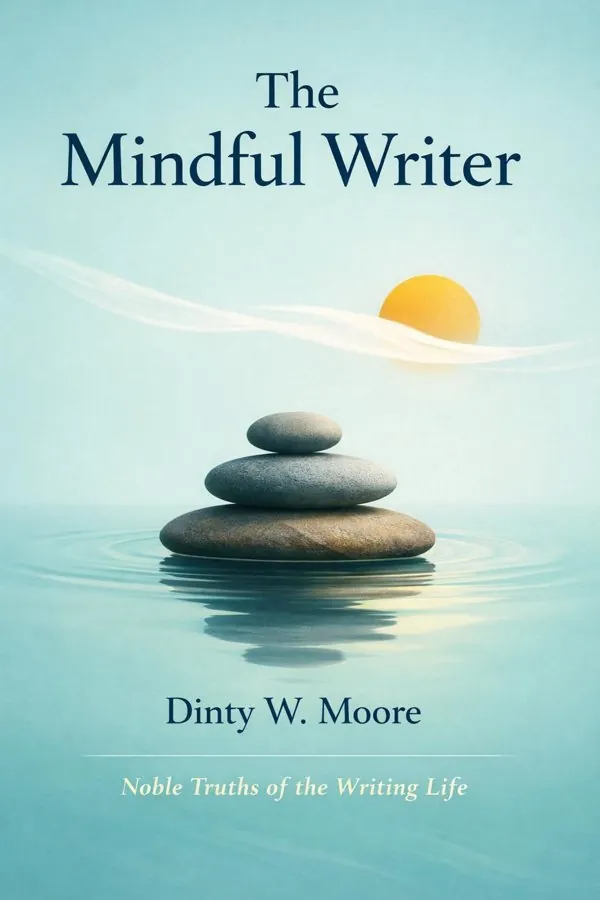
The Mindful Writer: Noble Truths of the Writing Life: Summary & Key Insights
 10 min6 chaptersAudio available
What Is The Mindful Writer: Noble Truths of the Writing Life About?
The Mindful Writer: Noble Truths of the Writing Life by Dinty W. Moore is a writing book spanning 6 pages. In this reflective and practical guide, Dinty W. Moore explores how mindfulness can transform the writing process. Drawing on Buddhist principles, he offers short meditations and essays that help writers cultivate awareness, patience, and compassion toward their craft. The book encourages a balanced approach to creativity, emphasizing presence and acceptance over perfectionism.
This FizzRead summary covers all 6 key chapters of The Mindful Writer: Noble Truths of the Writing Life in approximately 10 minutes, distilling the most important ideas, arguments, and takeaways from Dinty W. Moore's work. Also available as an audio summary and Key Quotes Podcast.
The Mindful Writer: Noble Truths of the Writing Life
In this reflective and practical guide, Dinty W. Moore explores how mindfulness can transform the writing process. Drawing on Buddhist principles, he offers short meditations and essays that help writers cultivate awareness, patience, and compassion toward their craft. The book encourages a balanced approach to creativity, emphasizing presence and acceptance over perfectionism.
Who Should Read The Mindful Writer: Noble Truths of the Writing Life?
This book is perfect for anyone interested in writing and looking to gain actionable insights in a short read. Whether you're a student, professional, or lifelong learner, the key ideas from The Mindful Writer: Noble Truths of the Writing Life by Dinty W. Moore will help you think differently.
- ✓Readers who enjoy writing and want practical takeaways
- ✓Professionals looking to apply new ideas to their work and life
- ✓Anyone who wants the core insights of The Mindful Writer: Noble Truths of the Writing Life in just 10 minutes
Want the full summary?
Get instant access to this book summary and 100K+ more with Fizz Moment.
Get Free SummaryAvailable on App Store • Free to download
Key Chapters
Every writer, no matter how experienced, eventually sits before the blank page and feels the ache of inadequacy. I have felt it countless times: that tightening in the chest when words won’t come, or when they come twisted and inadequate. In Buddhist teaching, the First Noble Truth acknowledges that life is filled with suffering. This is not a bleak observation but an honest beginning. For writers, this suffering arises from the tension between what we imagine and what is. We envision brilliance, yet we face only the stumbling imperfection of drafts.
The suffering of the writer takes many forms — self-doubt, envy, impatience, fear of failure. Often it hides beneath perfectionism: the belief that if we just try harder, we can bypass difficulty. But the truth is, struggle is inherent in the creative process. Each story or essay demands we sit with uncertainty, and that sitting can feel uncomfortable, even painful. Yet only by acknowledging that discomfort can we move beyond it.
In my own experience, I’ve come to see that writerly frustration is not proof of inadequacy but evidence of engagement. The mind rebels when asked to stay with a task that resists easy answers; that rebellion is suffering, yes, but also a signal that something real is happening. Just as meditation begins with noticing the restless mind, writing begins with recognizing the restless desire for control. The mindfulness approach does not deny this restlessness; it regards it with compassion.
When we stop fighting the fact that writing is hard, we free ourselves to investigate why it’s hard — what fear or attachment lies beneath the struggle. This investigation transforms suffering from an obstacle into a teacher. Each blank page becomes an opportunity to practice patience. Each revision becomes an act of humility. Slowly, the writer learns to inhabit the process with acceptance rather than demand. That, to me, is the first awakening of mindful writing.
If the First Noble Truth invites honesty about suffering, the Second helps us look at its source. For the writer, the cause is often attachment — to success, to recognition, to an ideal image of ourselves as artists. We suffer not because writing itself hurts but because we cling to ideas of how it should feel or what it should yield. I have spent years chasing the illusion that if I worked hard enough, the next sentence would redeem me, the next publication would confirm my worth. That constant grasping only distanced me from the joy of writing.
Mindfulness teaches that suffering arises from craving and aversion. We crave perfection, we resist imperfection. In the creative life, this duality manifests as the endless loop of striving and self-judgment. The ego whispers: this sentence must prove you are talented; this book must justify your effort. The moment we identify too tightly with these ideas, writing ceases to be an exploration and becomes a test of identity.
What, then, is the antidote? Awareness. To notice the ego’s demands, to see them clearly for what they are — thoughts, not truth — is the beginning of freedom. When I admit that my desire for control is only fear disguised as ambition, I can loosen my grip. I remember that I am not writing to impress but to discover. The creative act, at its best, is an inquiry into experience, not a defense against it.
Letting go of attachment does not mean abandoning aspiration. It means understanding that art cannot flourish in the shadow of anxiety. When I release my expectations — when I write simply to pay attention — my language grows more authentic, my stories more alive. The cause of writerly suffering is our belief that we can force insight or guarantee approval; but writing, like life, unfolds only when we trust the moment. The pen moves when we breathe, not when we strain.
+ 4 more chapters — available in the FizzRead app
All Chapters in The Mindful Writer: Noble Truths of the Writing Life
About the Author
Dinty W. Moore is an American essayist, editor, and teacher known for his works on creative nonfiction and mindfulness in writing. He is the author of several books, including 'Between Panic and Desire' and 'Crafting the Personal Essay,' and serves as editor of Brevity: A Journal of Concise Literary Nonfiction.
Get This Summary in Your Preferred Format
Read or listen to the The Mindful Writer: Noble Truths of the Writing Life summary by Dinty W. Moore anytime, anywhere. FizzRead offers multiple formats so you can learn on your terms — all free.
Available formats: App · Audio · PDF · EPUB — All included free with FizzRead
Download The Mindful Writer: Noble Truths of the Writing Life PDF and EPUB Summary
Key Quotes from The Mindful Writer: Noble Truths of the Writing Life
“Every writer, no matter how experienced, eventually sits before the blank page and feels the ache of inadequacy.”
“If the First Noble Truth invites honesty about suffering, the Second helps us look at its source.”
Frequently Asked Questions about The Mindful Writer: Noble Truths of the Writing Life
The Mindful Writer: Noble Truths of the Writing Life by Dinty W. Moore is a writing book that explores key ideas across 6 chapters. In this reflective and practical guide, Dinty W. Moore explores how mindfulness can transform the writing process. Drawing on Buddhist principles, he offers short meditations and essays that help writers cultivate awareness, patience, and compassion toward their craft. The book encourages a balanced approach to creativity, emphasizing presence and acceptance over perfectionism.
You Might Also Like
The Art of Perspective
Christopher Castellani
10 min
Making a Point: The Persnickety Story of English Punctuation
David Crystal
10 min
The Elements Of Eloquence: How To Turn The Perfect English Phrase
Mark Forsyth
10 min
The Pocket Muse: Ideas and Inspirations for Writing
Monica Wood
10 min
A Little Book on Form: An Exploration into the Formal Imagination of Poetry
Robert Hass
10 min
Adventures In The Screen Trade: A Personal View Of Hollywood And Screenwriting
William Goldman
10 minBrowse by Category
Ready to read The Mindful Writer: Noble Truths of the Writing Life?
Get the full summary and 100K+ more books with Fizz Moment.