
The Medusa and the Snail: More Notes of a Biology Watcher: Summary & Key Insights
by Lewis Thomas
 10 min10 chaptersAudio available
Key Takeaways from The Medusa and the Snail: More Notes of a Biology Watcher
One of the most important truths in biology is that no creature is truly alone.
Words do not merely describe life; they behave like life.
A society’s brightest minds are not automatically its wisest.
How we display animals says a great deal about how we understand ourselves.
Some of life’s greatest achievements arise not from flawless design, but from productive error.
What Is The Medusa and the Snail: More Notes of a Biology Watcher About?
The Medusa and the Snail: More Notes of a Biology Watcher by Lewis Thomas is a life_science book spanning 12 pages. What if biology were not just a science of organs, cells, and species, but a way of seeing the world with greater humility, wonder, and intelligence? In The Medusa and the Snail, Lewis Thomas invites readers into exactly that experience. This elegant collection of essays explores life at many scales, from symbiotic marine creatures to human language, from medical institutions to the moral habits of modern society. Thomas does not treat science as a dry inventory of facts. Instead, he presents it as an ongoing conversation with mystery, complexity, and beauty. What makes this book matter is its rare combination of scientific literacy and human insight. Thomas shows that biology can illuminate not only the workings of organisms, but also the character of culture, the limits of certainty, and the deep interconnectedness of life. His reflections remain relevant because they resist oversimplification in an age addicted to it. Thomas writes with unusual authority. A physician, researcher, educator, and former president of Memorial Sloan-Kettering Cancer Center, he brought firsthand experience of medicine and science to prose of remarkable grace. The result is a book that rewards both curious general readers and serious students of life science.
This FizzRead summary covers all 10 key chapters of The Medusa and the Snail: More Notes of a Biology Watcher in approximately 10 minutes, distilling the most important ideas, arguments, and takeaways from Lewis Thomas's work. Also available as an audio summary and Key Quotes Podcast.
The Medusa and the Snail: More Notes of a Biology Watcher
What if biology were not just a science of organs, cells, and species, but a way of seeing the world with greater humility, wonder, and intelligence? In The Medusa and the Snail, Lewis Thomas invites readers into exactly that experience. This elegant collection of essays explores life at many scales, from symbiotic marine creatures to human language, from medical institutions to the moral habits of modern society. Thomas does not treat science as a dry inventory of facts. Instead, he presents it as an ongoing conversation with mystery, complexity, and beauty.
What makes this book matter is its rare combination of scientific literacy and human insight. Thomas shows that biology can illuminate not only the workings of organisms, but also the character of culture, the limits of certainty, and the deep interconnectedness of life. His reflections remain relevant because they resist oversimplification in an age addicted to it.
Thomas writes with unusual authority. A physician, researcher, educator, and former president of Memorial Sloan-Kettering Cancer Center, he brought firsthand experience of medicine and science to prose of remarkable grace. The result is a book that rewards both curious general readers and serious students of life science.
Who Should Read The Medusa and the Snail: More Notes of a Biology Watcher?
This book is perfect for anyone interested in life_science and looking to gain actionable insights in a short read. Whether you're a student, professional, or lifelong learner, the key ideas from The Medusa and the Snail: More Notes of a Biology Watcher by Lewis Thomas will help you think differently.
- ✓Readers who enjoy life_science and want practical takeaways
- ✓Professionals looking to apply new ideas to their work and life
- ✓Anyone who wants the core insights of The Medusa and the Snail: More Notes of a Biology Watcher in just 10 minutes
Want the full summary?
Get instant access to this book summary and 100K+ more with Fizz Moment.
Get Free SummaryAvailable on App Store • Free to download
Key Chapters
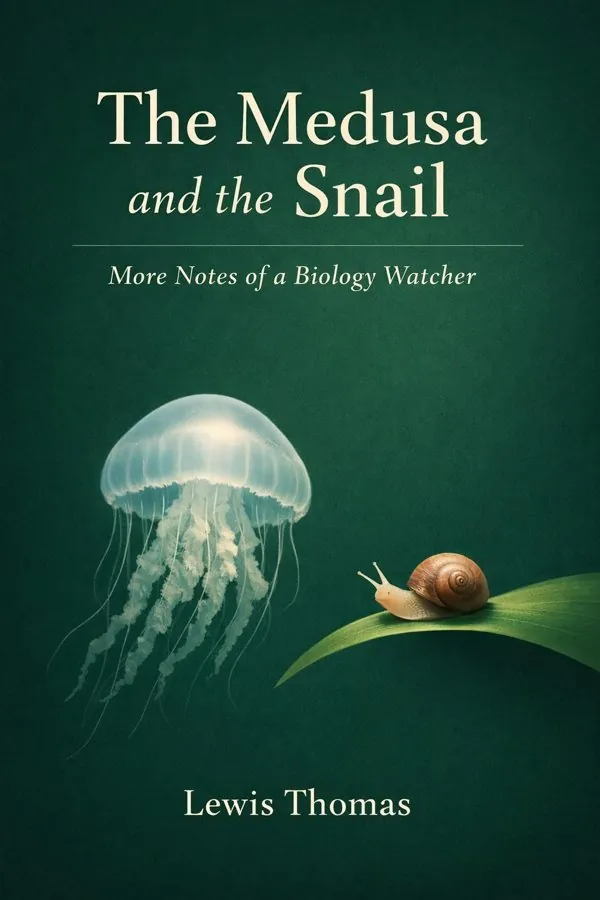
One of the most important truths in biology is that no creature is truly alone. In the title essay, Lewis Thomas reflects on the partnership between a jellyfish and a small snail, using this relationship as an emblem for a much larger biological reality: life is built through association, dependence, and mutual adjustment. What appears at first to be an odd little marine anecdote becomes a lens through which to view ecosystems, bodies, and even human societies.
Thomas’s point is not simply that some species cooperate. It is that cooperation is often more fundamental than competition. Organisms live within webs of exchange. Bacteria inhabit our intestines and help us digest food. Pollinators and flowering plants shape each other’s survival. Even the cells in our bodies are descendants of ancient mergers and partnerships. To understand life, then, we must move beyond the fantasy of isolated self-sufficiency.
This idea has practical force. In medicine, it encourages attention to the microbiome, ecological context, and system-level thinking. In environmental policy, it reminds us that damage to one species can ripple through many others. In daily life, it challenges the assumption that strength means independence. Families, workplaces, and communities also thrive through reciprocal support rather than solitary brilliance.
Thomas writes with wonder because symbiosis reveals a world more intricate and generous than simple survival stories suggest. The lesson is not sentimental; many partnerships are unstable or unequal. But they are real, powerful, and often indispensable.
Actionable takeaway: when evaluating any living system, ask not only what the organism is, but also what relationships make its existence possible.
Words do not merely describe life; they behave like life. In “On Various Words,” Thomas treats language as a biological phenomenon—something that mutates, adapts, spreads, and occasionally goes extinct. This is more than a clever metaphor. Language evolves under pressures much like those that shape organisms: utility, environment, social transmission, and the unpredictable creativity of variation.
Thomas’s insight expands the meaning of biology. Human speech is not outside nature; it is one of nature’s most sophisticated expressions. Words emerge in communities, compete for relevance, and change form over time. Scientific terms sharpen understanding, while bureaucratic jargon can suffocate it. Sloppy language often signals sloppy thought. Precise language, by contrast, makes discovery possible.
This matters in practical ways. In science, naming influences what researchers notice and what they ignore. In medicine, the words used to describe illness can comfort patients or estrange them. In public life, slogans can spread faster than evidence, shaping collective behavior long before truth catches up. If language is alive, then we bear responsibility for its ecology.
Thomas also celebrates the delight of words—their texture, history, and capacity to hold complexity. He resists the modern urge to flatten speech into mere efficiency. Rich language enlarges thought because it offers more subtle tools for perceiving reality.
For readers today, the essay feels especially relevant in an era of algorithmic speech, viral phrases, and constant compression. We are surrounded by linguistic environments that influence how we think about science, politics, and ourselves.
Actionable takeaway: pay close attention to the words you use and consume; clearer, more humane language leads to clearer, more humane thinking.
A society’s brightest minds are not automatically its wisest. In “The Youngest and Brightest Thing Around,” Thomas reflects on youthful brilliance with admiration tempered by caution. Talent, speed, and technical competence can dazzle institutions, but without judgment, patience, and ethical seriousness, intelligence alone becomes unreliable. Biology teaches that rapid growth is not the same as mature function; the same may be true of human achievement.
Thomas is especially alert to cultures that celebrate precocity as if early performance were the highest good. Scientific and professional systems often reward the quick answer, the impressive résumé, and the aura of brilliance. Yet many of the most consequential decisions in medicine, research, and public life demand something slower: perspective, self-doubt, and awareness of complexity.
The practical implication is clear. Education should cultivate not only excellence, but also character. A brilliant student in a laboratory must learn responsibility alongside technique. A gifted physician must develop listening, not just diagnostic skill. A high-performing organization should not confuse raw mental horsepower with trustworthiness.
Thomas’s broader point is deeply biological: development takes time. Living systems do not achieve stability through acceleration alone. They mature through layered interactions, feedback, and adaptation. Human beings are no exception. The fascination with “the youngest and brightest” can become a cultural distortion if it blinds us to the value of seasoned wisdom.
This insight applies far beyond elite institutions. In any team, family, or community, the loudest or fastest thinker may not be the best guide. Often, the most valuable person is the one who sees second-order effects and asks the inconvenient question.
Actionable takeaway: when evaluating talent—your own or others’—look beyond brilliance and ask whether it is paired with humility, maturity, and responsibility.
How we display animals says a great deal about how we understand ourselves. In “The Tucson Zoo,” Thomas uses the zoo as more than a site of entertainment. It becomes a cultural mirror, showing the human desire both to admire nature and to contain it. We bring wild creatures into carefully managed spaces, then act as though observation alone is a kind of relationship. Thomas invites readers to notice the tension in that arrangement.
A zoo can inspire awe, curiosity, and conservation. It can also expose the distance between genuine ecological understanding and staged encounters. Looking at a caged animal is not the same as comprehending the world that animal inhabits. A desert cat behind glass has been separated from prey, climate, territory, risk, and freedom—the very conditions that make its life meaningful.
Thomas’s essay encourages a more mature environmental consciousness. Nature is not merely a collection of specimens available for our inspection. It is a set of living systems, each defined by context and interaction. This has practical consequences for conservation policy. Protecting species means preserving habitats, food webs, migration routes, and behavioral patterns, not simply keeping organisms alive in isolation.
The essay also has a psychological edge. Human beings often domesticate what they fear by turning it into display. We do this with animals, but also with ideas. We prefer representations we can manage over realities that challenge us.
Today, the lesson extends to digital culture, where curated images of nature can replace actual ecological knowledge. Thomas reminds us that reverence without understanding is incomplete.
Actionable takeaway: whenever you encounter nature in a curated form, ask what living context is missing—and seek ways to support the real ecosystems behind the display.
Some of life’s greatest achievements arise not from flawless design, but from productive error. In “The Wonderful Mistake,” Thomas turns attention to accidents, deviations, and biological missteps that become sources of novelty. This is a profound reversal of ordinary thinking. We tend to view mistakes as failures to be eliminated. Biology shows that, under the right conditions, they can also generate adaptation, diversity, and invention.
Mutations are the obvious example. Most changes in genetic material are neutral or harmful, yet the long history of evolution depends on variation, including imperfect copying. Without error, life would be stable but stagnant. The same principle appears in science and medicine. Unexpected results often open new lines of inquiry. A failed experiment can expose hidden assumptions. A puzzling symptom can lead to a better model of disease.
Thomas’s point does not romanticize carelessness. Precision matters deeply in laboratory work, surgery, and public health. But there is a difference between negligence and generative uncertainty. Systems that permit learning from deviation are often more robust than systems built on the illusion of total control.
The practical value of this insight is broad. Teachers can normalize revision rather than shame mistakes. Managers can build cultures where anomalies are investigated instead of buried. Researchers can treat surprise as data. On a personal level, people can reframe setbacks as information about how complex systems actually behave.
In a technological culture obsessed with optimization, Thomas offers a corrective. Life advances through improvisation as much as through order. We should be careful, but not so fearful of error that we extinguish creativity.
Actionable takeaway: the next time something goes wrong, ask not only how to fix it, but what new understanding the deviation might reveal.
The human body is not a monarchy ruled by a single commanding center; it is a federation of astonishingly coordinated parts. In “The Lives of a Cell Revisited,” Thomas returns to one of his most famous themes: that the cell offers a model for thinking about cooperation, identity, and interdependence. Each cell carries out its own specialized tasks, yet no cell makes sense apart from the larger organism. Life depends on communication, restraint, timing, and shared purpose.
Thomas’s biological lesson becomes a social and philosophical one. Modern culture often imagines the individual as self-contained, but multicellular life tells a different story. Complex wholes emerge from coordinated units that remain distinct while participating in something larger. Cells do not lose their identity by cooperating; they fulfill it.
This perspective has practical applications in organizational life and public health. A hospital, for instance, works well only when specialists communicate across disciplines. A city remains healthy only when infrastructure, policy, and citizen behavior align. During disease outbreaks, the logic of the cell becomes obvious: individual actions have collective consequences.
Thomas also reveals how fragile coordination can be. Cancer, in one sense, is a breakdown of cellular citizenship. Cells cease respecting shared limits and begin acting as if only their own multiplication matters. The metaphor is powerful because it links biological malfunction to social irresponsibility without forcing a simplistic equivalence.
To read Thomas here is to be reminded that life is an achievement of disciplined collaboration. The miracle is not just that cells exist, but that they manage to live together at all.
Actionable takeaway: in any group you belong to, ask how your specialized role can better support the health of the whole rather than merely advancing local interests.
Even in a scientifically described universe, people continue to search for pattern, rhythm, and significance. In ��The Music of This Sphere,” Thomas explores the ancient human longing to hear order in the cosmos. While modern science has replaced mystical harmonies with measurable processes, the desire itself remains revealing. We want the world to make sense not only mathematically, but aesthetically.
Thomas does not reject science in favor of romance. Instead, he suggests that scientific understanding can deepen wonder rather than destroy it. The regularities of nature—orbital motions, biological cycles, neural rhythms, migratory patterns—are not less beautiful because they are explicable. The universe may not literally sing to us, but it is structured in ways that invite reverence.
This matters because people often imagine a false choice between scientific realism and meaningful experience. Thomas refuses that split. A biologically informed life can still be attentive to mystery, proportion, and beauty. In fact, careful knowledge often heightens appreciation. Knowing how hearing works does not ruin music. Knowing how ecosystems function does not diminish forests.
Practically, this essay encourages interdisciplinary thinking. Scientists benefit from aesthetic sensitivity because patterns are often first noticed as forms. Artists benefit from scientific literacy because reality offers richer material than cliché. Ordinary readers benefit by resisting the reduction of knowledge to utility alone.
In an age of distraction, Thomas’s essay invites a slower way of noticing. The world becomes more coherent when we attend to recurring forms across scale: pulse, sequence, balance, variation, return.
Actionable takeaway: cultivate a habit of observing patterns in nature and daily life; the discipline of noticing order can deepen both scientific curiosity and personal meaning.
Human behavior is more fragile than moralists often admit. In “The Iks,” Thomas considers a community described as having suffered profound social disintegration, using the case to reflect on what happens when the structures supporting human reciprocity collapse. His concern is not to condemn a people from a distance, but to ask a harder question: how much of what we call virtue depends on stable social conditions?
This is a deeply biological and social question. Human beings are not abstract moral units floating above circumstance. We are organisms shaped by environment, stress, scarcity, upbringing, and communal norms. If the conditions for cooperation are destroyed, even basic forms of care can erode. Thomas’s unsettling insight is that civilization is not a permanent possession; it is a maintained achievement.
The practical implication is urgent. Policies that generate chronic insecurity, displacement, or social atomization do not merely create economic problems. They can corrode the habits that make social life possible: trust, patience, generosity, and responsibility toward the vulnerable. Public health, food systems, education, and local institutions all contribute to the moral ecology of a community.
Thomas’s essay also warns readers against easy self-congratulation. It is comforting to believe we would remain humane under any pressure. History suggests otherwise. The line between civility and breakdown may be thinner than we imagine.
This does not lead to pessimism. It leads to stewardship. If moral behavior depends partly on supportive conditions, then building decent societies is not secondary to ethics—it is one of ethics’ main tasks.
Actionable takeaway: support institutions and local practices that reduce social precarity, because stable conditions are among the hidden foundations of human compassion.
Punctuation seems trivial until you notice how much thought depends on it. In “The Problem of Punctuation,” Thomas uses marks on a page to open a broader reflection on clarity, rhythm, and intellectual honesty. Commas, semicolons, pauses, and sentence boundaries do more than organize text. They shape emphasis, relation, and pace. In this sense, writing mechanics are not cosmetic; they are cognitive tools.
Thomas’s insight extends beyond grammar. Scientific communication, medical records, policy documents, and everyday correspondence all rely on form to convey meaning accurately. Ambiguity can be fruitful in poetry, but dangerous in prescription instructions. A misplaced phrase can distort evidence. An overloaded sentence can conceal weak thinking. Good style is not decoration after the fact; it is a way of disciplining the mind.
The essay also celebrates the human side of prose. Punctuation gives writing breath and music. It reflects temperament, precision, and care for the reader. Thomas resists sterile communication because he believes language should carry both intelligence and personality. This matters especially in science, where impersonal style can sometimes hide confusion rather than guarantee objectivity.
There is a practical lesson here for anyone who writes. Editing for structure often improves the idea itself. Reading aloud can expose where logic falters. Clear formatting, sensible pauses, and concise transitions make complex ideas more accessible without oversimplifying them.
In a world of rushed messages and automated text generation, Thomas’s attention to punctuation feels newly relevant. Slowing down enough to shape a sentence is often the first step toward shaping a thought.
Actionable takeaway: revise your writing for rhythm and structure, not just correctness; better form will often reveal better thinking.
The greatest threat to science is not ignorance alone, but a style of expertise that loses curiosity, humility, and moral imagination. Across essays such as “The Long Habit,” “The Unnatural Science,” and “The Medusa and the Snail Reconsidered,” Thomas returns to this concern. Science at its best is a disciplined form of astonishment. At its worst, it becomes narrow, overconfident, and estranged from the living world it seeks to understand.
Thomas is not anti-science; he is defending science from its own temptations. Specialization is necessary, but it can harden into tunnel vision. Technical power is useful, but it can create the illusion that whatever can be done should be done. Professional habits are valuable, but they can become ritual without reflection. The “unnatural” science he worries about is science detached from context, language, ethics, and reverence.
This criticism has practical importance today. Researchers need cross-disciplinary conversation to avoid blind spots. Medical professionals need to remember that patients are persons, not cases. Institutions need incentives for long-term understanding, not only short-term output. Citizens need scientific literacy that includes not just facts, but a feel for how inquiry works and where its limits lie.
Thomas’s enduring gift is his refusal to separate intelligence from awe. To watch biology well is to remain teachable. The more one learns, the less plausible arrogance becomes. Complexity should make us more careful, not more triumphant.
For readers, this idea unifies the whole book. The essays are not random reflections; they are a sustained argument for a wiser scientific culture—one that honors precision without sacrificing mystery.
Actionable takeaway: practice a form of inquiry that combines expertise with humility—ask better questions, respect complexity, and resist the seduction of certainty.
All Chapters in The Medusa and the Snail: More Notes of a Biology Watcher
About the Author
Lewis Thomas (1913–1993) was an American physician, educator, administrator, poet, and essayist best known for bringing scientific thought into conversation with literature and philosophy. Trained in medicine, he held prominent academic and research positions and later served as president of Memorial Sloan-Kettering Cancer Center. Thomas wrote with a rare combination of clinical authority and lyrical intelligence, making complex biological ideas accessible to general readers without oversimplifying them. His essay collections, including The Lives of a Cell and The Medusa and the Snail, helped define modern science writing by showing that biology could illuminate not only the body, but also language, ethics, and human society. He remains admired for his clarity, humility, and enduring sense of wonder about the natural world.
Get This Summary in Your Preferred Format
Read or listen to the The Medusa and the Snail: More Notes of a Biology Watcher summary by Lewis Thomas anytime, anywhere. FizzRead offers multiple formats so you can learn on your terms — all free.
Available formats: App · Audio · PDF · EPUB — All included free with FizzRead
Download The Medusa and the Snail: More Notes of a Biology Watcher PDF and EPUB Summary
Key Quotes from The Medusa and the Snail: More Notes of a Biology Watcher
“One of the most important truths in biology is that no creature is truly alone.”
“Words do not merely describe life; they behave like life.”
“A society’s brightest minds are not automatically its wisest.”
“How we display animals says a great deal about how we understand ourselves.”
“Some of life’s greatest achievements arise not from flawless design, but from productive error.”
Frequently Asked Questions about The Medusa and the Snail: More Notes of a Biology Watcher
The Medusa and the Snail: More Notes of a Biology Watcher by Lewis Thomas is a life_science book that explores key ideas across 10 chapters. What if biology were not just a science of organs, cells, and species, but a way of seeing the world with greater humility, wonder, and intelligence? In The Medusa and the Snail, Lewis Thomas invites readers into exactly that experience. This elegant collection of essays explores life at many scales, from symbiotic marine creatures to human language, from medical institutions to the moral habits of modern society. Thomas does not treat science as a dry inventory of facts. Instead, he presents it as an ongoing conversation with mystery, complexity, and beauty. What makes this book matter is its rare combination of scientific literacy and human insight. Thomas shows that biology can illuminate not only the workings of organisms, but also the character of culture, the limits of certainty, and the deep interconnectedness of life. His reflections remain relevant because they resist oversimplification in an age addicted to it. Thomas writes with unusual authority. A physician, researcher, educator, and former president of Memorial Sloan-Kettering Cancer Center, he brought firsthand experience of medicine and science to prose of remarkable grace. The result is a book that rewards both curious general readers and serious students of life science.
More by Lewis Thomas
You Might Also Like
The Selfish Gene
Richard Dawkins
10 min
Awakenings
Oliver Sacks
10 min
Parasite Rex: Inside the Bizarre World of Nature's Most Dangerous Creatures
Carl Zimmer
10 min
The Atlas of Life on Earth
Various
10 min
The Book of Humans: The Story of How We Became Us
Adam Rutherford
10 min
The Horse
Wendy Williams
10 minBrowse by Category
Ready to read The Medusa and the Snail: More Notes of a Biology Watcher?
Get the full summary and 100K+ more books with Fizz Moment.