
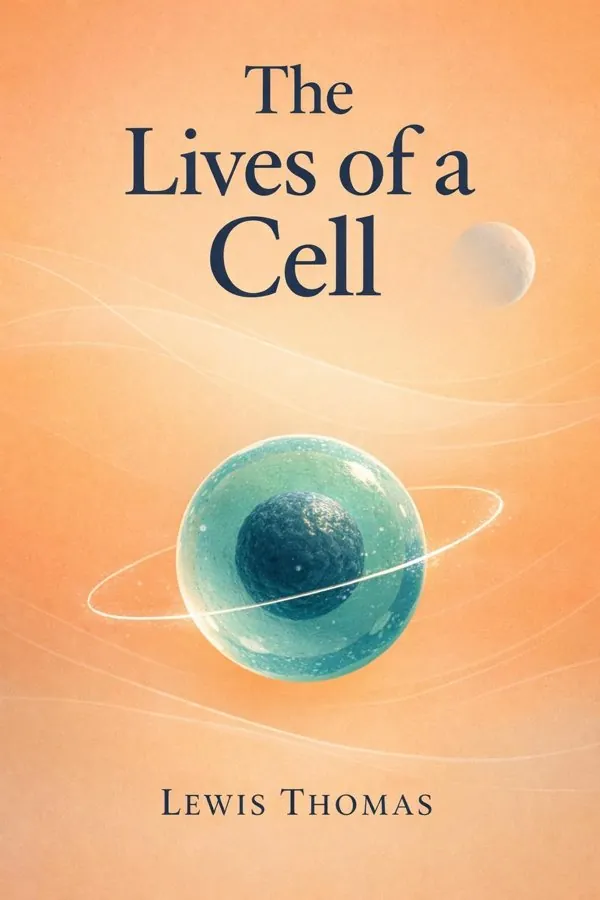
The Lives of a Cell: Notes of a Biology Watcher: Summary & Key Insights
by Lewis Thomas
 10 min9 chaptersAudio available
Key Takeaways from The Lives of a Cell: Notes of a Biology Watcher
A single cell can be read as a miniature portrait of the planet.
Language is one of humanity’s greatest inventions, yet Thomas suggests it may also be one of our most biological phenomena.
A society is not literally an organism, but Thomas argues that it behaves in ways strikingly similar to one.
What if the world is held together less by force than by rhythm?
One of Thomas’s most important correctives is his treatment of germs.
What Is The Lives of a Cell: Notes of a Biology Watcher About?
The Lives of a Cell: Notes of a Biology Watcher by Lewis Thomas is a life_science book spanning 11 pages. The Lives of a Cell: Notes of a Biology Watcher is a luminous collection of essays in which Lewis Thomas invites readers to see life not as a set of isolated organisms, but as a vast, interconnected web of systems, signals, and shared dependencies. Moving easily between microbiology, medicine, evolution, language, ecology, and philosophy, Thomas shows that even the smallest cell reflects the logic of the whole living world. His subject is biology, but his deeper concern is how humans fit into the intricate fabric of life on Earth. What makes this book enduring is its unusual combination of scientific rigor and literary grace. Thomas does not write like a textbook author; he writes like a physician-scientist astonished by what biology reveals about order, cooperation, fragility, and mystery. He challenges the assumption that humans stand apart from nature and instead argues that we are composed, sustained, and defined by relationships—with microbes, with one another, and with the planet itself. As a physician, researcher, medical leader, and celebrated essayist, Thomas brings exceptional authority to these reflections. The result is a short but profound book that expands how we think about science, society, and our place in the living world.
This FizzRead summary covers all 9 key chapters of The Lives of a Cell: Notes of a Biology Watcher in approximately 10 minutes, distilling the most important ideas, arguments, and takeaways from Lewis Thomas's work. Also available as an audio summary and Key Quotes Podcast.
The Lives of a Cell: Notes of a Biology Watcher
The Lives of a Cell: Notes of a Biology Watcher is a luminous collection of essays in which Lewis Thomas invites readers to see life not as a set of isolated organisms, but as a vast, interconnected web of systems, signals, and shared dependencies. Moving easily between microbiology, medicine, evolution, language, ecology, and philosophy, Thomas shows that even the smallest cell reflects the logic of the whole living world. His subject is biology, but his deeper concern is how humans fit into the intricate fabric of life on Earth.
What makes this book enduring is its unusual combination of scientific rigor and literary grace. Thomas does not write like a textbook author; he writes like a physician-scientist astonished by what biology reveals about order, cooperation, fragility, and mystery. He challenges the assumption that humans stand apart from nature and instead argues that we are composed, sustained, and defined by relationships—with microbes, with one another, and with the planet itself.
As a physician, researcher, medical leader, and celebrated essayist, Thomas brings exceptional authority to these reflections. The result is a short but profound book that expands how we think about science, society, and our place in the living world.
Who Should Read The Lives of a Cell: Notes of a Biology Watcher?
This book is perfect for anyone interested in life_science and looking to gain actionable insights in a short read. Whether you're a student, professional, or lifelong learner, the key ideas from The Lives of a Cell: Notes of a Biology Watcher by Lewis Thomas will help you think differently.
- ✓Readers who enjoy life_science and want practical takeaways
- ✓Professionals looking to apply new ideas to their work and life
- ✓Anyone who wants the core insights of The Lives of a Cell: Notes of a Biology Watcher in just 10 minutes
Want the full summary?
Get instant access to this book summary and 100K+ more with Fizz Moment.
Get Free SummaryAvailable on App Store • Free to download
Key Chapters
A single cell can be read as a miniature portrait of the planet. This is the central imaginative leap Lewis Thomas asks us to make: instead of seeing the cell as a sealed, independent unit, he invites us to view it as a bustling community shaped by exchange, coordination, and constant dependence on its surroundings. A human cell is not simply a tiny bag of chemicals. It is an active system with membranes, energy producers, internal messengers, and specialized structures that cooperate much like organisms in an ecosystem.
Thomas uses this image to challenge the myth of biological independence. The body itself is less like a machine assembled from separate parts and more like a living society whose order emerges from communication and mutual reliance. The same pattern scales upward. Organisms depend on habitats, species depend on one another, and the biosphere functions through countless forms of reciprocity. Looking closely at the cell teaches us that life is organized through networks, not isolation.
This idea has practical relevance beyond biology. In medicine, it encourages systems thinking: symptoms in one organ may reflect problems elsewhere. In environmental science, it reminds us that disrupting one part of an ecosystem can affect the whole. In everyday life, it nudges us to reconsider individualism and recognize how much our wellbeing depends on invisible support systems such as soil, water, microbes, institutions, and community.
Actionable takeaway: When facing a complex problem, whether personal, medical, or social, stop looking for a single isolated cause and ask what larger system the problem belongs to.
Language is one of humanity’s greatest inventions, yet Thomas suggests it may also be one of our most biological phenomena. Rather than treating language as a static tool we consciously control, he portrays it as something that grows, adapts, mutates, and spreads through communities much like a living system. Words emerge, shift in meaning, disappear, and recombine; dialects branch like species; expressions survive because they fit social environments.
This biological view of language deepens our understanding of culture. Language is not merely a medium for transmitting ideas; it is a collective habitat of thought. It shapes what can be noticed, named, remembered, and shared. Just as organisms evolve through interaction with their environment, language evolves through usage, need, contact, and invention. Scientific language especially matters because it gives us ways to think about complexity. The names we assign to phenomena influence how we study them.
The insight is practical in education, leadership, and daily communication. In medicine, for example, the words used to describe illness can either clarify reality or obscure it. In public life, slogans can spread faster than understanding. In families and organizations, repeated phrases create emotional climates. If language is alive, then we participate in its evolution each time we speak or write.
Thomas’s point is ultimately humbling. We do not stand outside language as engineers manipulating a neutral instrument; we live inside it and are shaped by it. Paying attention to words is therefore a form of biological awareness.
Actionable takeaway: Notice the language you use repeatedly, and deliberately replace vague, hostile, or mechanical phrases with words that create clarity, precision, and connection.
A society is not literally an organism, but Thomas argues that it behaves in ways strikingly similar to one. Human groups coordinate, specialize, communicate, repair damage, and adapt under pressure. Cities resemble metabolic centers, institutions function like organs, and cultural norms act as regulatory signals. This comparison does not erase individual agency, but it helps explain why collective life often seems to have properties no single person designed.
Thomas is interested in emergence: the way larger forms of order arise from many local interactions. Ant colonies, beehives, bacterial populations, and human civilizations all display this phenomenon. No central mind needs to oversee every detail for patterns to appear. That insight is especially important when we consider social problems. Traffic congestion, public health crises, misinformation, and political polarization are not always caused by one villain or one policy failure. They often result from systemic interactions.
Viewing societies biologically can improve how we design institutions. Public health provides a clear example. Vaccination programs, sanitation systems, and disease surveillance work because they treat communities as interconnected networks, not piles of separate individuals. The same principle applies to workplaces. Strong organizations depend on healthy communication pathways, distributed competence, and feedback mechanisms.
Thomas also implies a moral lesson. If societies act like living systems, then neglecting any major part of the social body can weaken the whole. Poverty, exclusion, and environmental degradation are not peripheral issues; they alter the collective organism.
Actionable takeaway: In any group you belong to, look for the communication patterns, incentives, and feedback loops shaping behavior before blaming individuals alone.
One of Thomas’s most important correctives is his treatment of germs. Modern culture often imagines microbes as invaders to be feared and eliminated, but biology tells a more complex story. Yes, some microorganisms cause disease. Yet many are indispensable companions. They digest food, shape immunity, recycle matter, influence ecosystems, and may even help regulate mood and development. To live is to live in relationship with microbial life.
Thomas’s broader insight is that hostility is only one form of biological interaction. Symbiosis, coexistence, and mutual adaptation are just as fundamental. Human beings are not biologically pure individuals defending fixed boundaries; we are composite creatures inhabiting a negotiated world. This was a striking perspective when Thomas wrote, and it has become even more persuasive in the age of microbiome research.
The practical implications are significant. In medicine, indiscriminate use of antibiotics can damage beneficial microbial communities. In public health, hygiene should be guided by context rather than generalized fear. In agriculture and environmental management, healthy systems often depend on microbial diversity in soil and water. Even on a personal level, this idea can soften our instinct to treat all uncertainty as threat.
Thomas does not romanticize pathogens. He recognizes disease, suffering, and danger. But he resists the simplistic narrative that life advances by pure exclusion. More often, it advances through managed coexistence.
Actionable takeaway: Adopt a more ecological view of health by asking not only what should be removed, but also what beneficial relationships need to be protected or restored.
The long habit of life is continuity through change. Thomas repeatedly emphasizes that humans are not late arrivals who escaped biology; we are built from ancient inheritances. The molecules in our cells, the structure of metabolism, the logic of reproduction, and the vulnerabilities of the body all connect us to a very long biological past. Evolution is not just a historical theory about fossils. It is an explanation for the living architecture inside us.
This perspective has philosophical force. It undercuts human exceptionalism without diminishing human dignity. We are extraordinary, Thomas suggests, not because we are separate from life, but because life has become capable of reflecting on itself through us. The same evolutionary processes that shaped bacteria and forests also shaped language, consciousness, and culture. That continuity makes biology more intimate than abstract.
The idea also has practical uses. In health, it helps explain why modern habits can clash with ancient physiology. Bodies shaped for one set of conditions now live in another. In conservation, it reminds us that biodiversity is not decorative; it represents long-developed solutions to survival. In ethics, evolutionary continuity can widen sympathy by revealing kinship across species.
Thomas’s tone here is often one of wonder rather than reduction. To be an evolved creature is not to be less meaningful. It is to belong to a drama far older and larger than ourselves.
Actionable takeaway: Make at least one decision about food, movement, rest, or environment by asking what kinds of conditions the human organism was broadly shaped to handle over long evolutionary time.
Some of the most essential parts of us may once have been independent beings. Thomas reflects on mitochondria, the structures inside cells that generate energy, as evidence of one of biology’s most astonishing possibilities: major evolutionary innovations can arise through partnership, incorporation, and coexistence. The cell may not be a solitary invention at all, but a negotiated union of once-separate forms of life.
This insight changes the emotional texture of biology. We often imagine progress as competition selecting winners and eliminating losers. But the history of life also includes mergers, alliances, and durable integrations. Mitochondria are not incidental details of cell biology; they symbolize a wider truth that cooperation can be as foundational as struggle.
The modern relevance of this idea is broad. In science, it encourages researchers to look for layered origins and unexpected collaborations. In organizations, it suggests that combining distinct capabilities can produce systems more powerful than any single part. In personal life, it challenges the assumption that strength means self-sufficiency. Often, resilience comes from well-integrated dependence.
Thomas’s deeper point is that identity itself may be composite. What we call an individual can contain histories of union. The self is less a fortress than a federation. That notion can feel unsettling, but it is also liberating. It means connectedness is not an accident added onto life; it is built into life’s architecture.
Actionable takeaway: When solving a difficult problem, look for complementary alliances or integrations instead of relying only on isolated effort and competition.
Much of existence depends on forms of talk that occur below the level of ordinary hearing. Thomas is fascinated by signaling: cells sending chemical messages, organisms exchanging cues, people building social order through conversation, rumor, ritual, and shared language. Whether in biology or society, communication is not a decorative layer added after the fact. It is the medium through which coordination becomes possible.
This idea helps explain why breakdowns in signaling can be so damaging. In the body, faulty communication can produce immune dysfunction, hormonal imbalance, or developmental errors. In public life, distorted communication can lead to mistrust, fragmentation, and collective paralysis. Information alone is not enough; the credibility, timing, and structure of communication matter just as much.
Thomas’s essays on social talk suggest that conversation itself has biological significance. Humans are social animals whose survival has long depended on attention to one another’s signals. Gossip, storytelling, teaching, warnings, and shared myths are not trivial. They are part of the social nervous system.
The practical lesson is powerful in a time of information overload. Better communication is not merely more messaging. It requires feedback, listening, context, and mutual interpretability. Families, teams, and communities stay healthy when signals can travel, be understood, and be corrected.
Thomas encourages us to respect communication as infrastructure. We notice roads and buildings, but we often overlook the invisible pathways by which trust, knowledge, and coordination circulate.
Actionable takeaway: Improve one relationship or team dynamic by creating a clearer feedback loop—ask, listen, confirm understanding, and invite correction.
All Chapters in The Lives of a Cell: Notes of a Biology Watcher
About the Author
Lewis Thomas (1913–1993) was an American physician, immunologist, educator, administrator, and acclaimed essayist whose writing helped bring the beauty of biology to a broad audience. He studied medicine at Harvard and built a distinguished career in research and academic leadership, serving in roles such as dean of Yale School of Medicine and president of Memorial Sloan-Kettering Cancer Center. Beyond his medical achievements, Thomas became widely known for essays that combined scientific insight with philosophical reflection and literary elegance. His work often explored the interconnectedness of life, the limits of human knowledge, and the wonder embedded in ordinary biological processes. Through books such as The Lives of a Cell, he established himself as one of the twentieth century’s most influential interpreters of science for general readers.
Get This Summary in Your Preferred Format
Read or listen to the The Lives of a Cell: Notes of a Biology Watcher summary by Lewis Thomas anytime, anywhere. FizzRead offers multiple formats so you can learn on your terms — all free.
Available formats: App · Audio · PDF · EPUB — All included free with FizzRead
Download The Lives of a Cell: Notes of a Biology Watcher PDF and EPUB Summary
Key Quotes from The Lives of a Cell: Notes of a Biology Watcher
“A single cell can be read as a miniature portrait of the planet.”
“Language is one of humanity’s greatest inventions, yet Thomas suggests it may also be one of our most biological phenomena.”
“A society is not literally an organism, but Thomas argues that it behaves in ways strikingly similar to one.”
“What if the world is held together less by force than by rhythm?”
“One of Thomas’s most important correctives is his treatment of germs.”
Frequently Asked Questions about The Lives of a Cell: Notes of a Biology Watcher
The Lives of a Cell: Notes of a Biology Watcher by Lewis Thomas is a life_science book that explores key ideas across 9 chapters. The Lives of a Cell: Notes of a Biology Watcher is a luminous collection of essays in which Lewis Thomas invites readers to see life not as a set of isolated organisms, but as a vast, interconnected web of systems, signals, and shared dependencies. Moving easily between microbiology, medicine, evolution, language, ecology, and philosophy, Thomas shows that even the smallest cell reflects the logic of the whole living world. His subject is biology, but his deeper concern is how humans fit into the intricate fabric of life on Earth. What makes this book enduring is its unusual combination of scientific rigor and literary grace. Thomas does not write like a textbook author; he writes like a physician-scientist astonished by what biology reveals about order, cooperation, fragility, and mystery. He challenges the assumption that humans stand apart from nature and instead argues that we are composed, sustained, and defined by relationships—with microbes, with one another, and with the planet itself. As a physician, researcher, medical leader, and celebrated essayist, Thomas brings exceptional authority to these reflections. The result is a short but profound book that expands how we think about science, society, and our place in the living world.
More by Lewis Thomas
You Might Also Like
The Selfish Gene
Richard Dawkins
10 min
Awakenings
Oliver Sacks
10 min
Parasite Rex: Inside the Bizarre World of Nature's Most Dangerous Creatures
Carl Zimmer
10 min
The Atlas of Life on Earth
Various
10 min
The Book of Humans: The Story of How We Became Us
Adam Rutherford
10 min
The Horse
Wendy Williams
10 minBrowse by Category
Ready to read The Lives of a Cell: Notes of a Biology Watcher?
Get the full summary and 100K+ more books with Fizz Moment.