
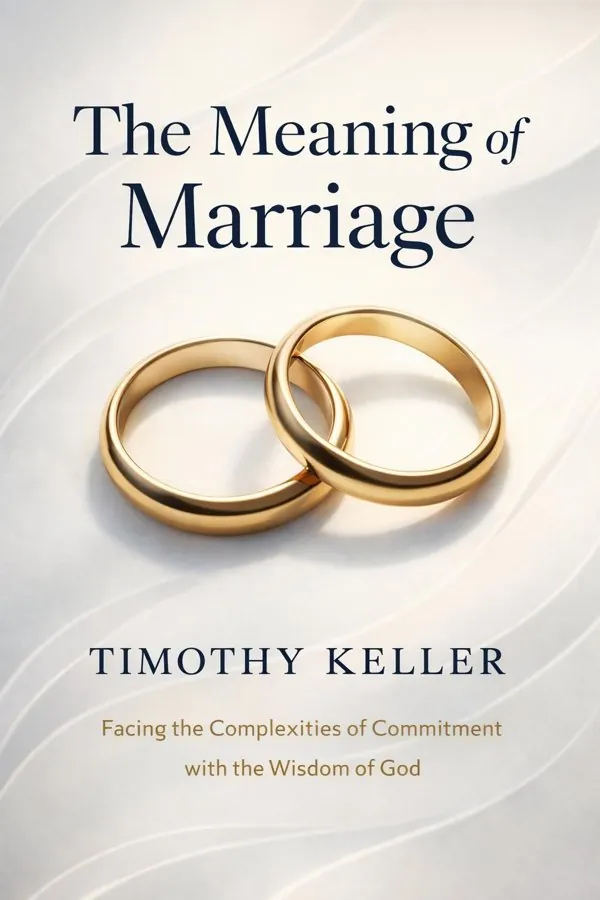
The Meaning of Marriage: Facing the Complexities of Commitment with the Wisdom of God: Summary & Key Insights
 10 min8 chaptersAudio available
What Is The Meaning of Marriage: Facing the Complexities of Commitment with the Wisdom of God About?
The Meaning of Marriage: Facing the Complexities of Commitment with the Wisdom of God by Timothy Keller is a relationships book spanning 8 pages. Drawing from the Bible and decades of counseling experience, Timothy Keller explores the profound meaning of marriage as a reflection of God’s relationship with humanity. The book addresses modern misconceptions about love, commitment, and partnership, offering a vision of marriage grounded in grace and mutual self-giving.
This FizzRead summary covers all 8 key chapters of The Meaning of Marriage: Facing the Complexities of Commitment with the Wisdom of God in approximately 10 minutes, distilling the most important ideas, arguments, and takeaways from Timothy Keller's work. Also available as an audio summary and Key Quotes Podcast.
The Meaning of Marriage: Facing the Complexities of Commitment with the Wisdom of God
Drawing from the Bible and decades of counseling experience, Timothy Keller explores the profound meaning of marriage as a reflection of God’s relationship with humanity. The book addresses modern misconceptions about love, commitment, and partnership, offering a vision of marriage grounded in grace and mutual self-giving.
Who Should Read The Meaning of Marriage: Facing the Complexities of Commitment with the Wisdom of God?
This book is perfect for anyone interested in relationships and looking to gain actionable insights in a short read. Whether you're a student, professional, or lifelong learner, the key ideas from The Meaning of Marriage: Facing the Complexities of Commitment with the Wisdom of God by Timothy Keller will help you think differently.
- ✓Readers who enjoy relationships and want practical takeaways
- ✓Professionals looking to apply new ideas to their work and life
- ✓Anyone who wants the core insights of The Meaning of Marriage: Facing the Complexities of Commitment with the Wisdom of God in just 10 minutes
Want the full summary?
Get instant access to this book summary and 100K+ more with Fizz Moment.
Get Free SummaryAvailable on App Store • Free to download
Key Chapters
The greatest secret about marriage is that it was never intended to be a mere social arrangement or a romantic partnership—it is a covenant. In pastoral conversations, I often hear people describe marriage as a contract: two parties negotiating terms, balancing rights, and withdrawing when the agreement no longer benefits them. But a biblical covenant is something entirely different; it is a vow of self-giving love based on grace, not performance.
Paul’s letter to the Ephesians tells us that marriage is meant to mirror the relationship between Christ and the Church. That means the husband’s love, like Christ’s, must be sacrificial, and the wife’s response, like the Church’s, must be trusting and receptive. This is not about hierarchy; it is about mutual self-surrender for the sake of one another’s flourishing.
When we see marriage as covenant, we understand that love is not sustained by feeling but by promise. Feelings change; promises anchor. When Kathy and I stood before God and vowed to love each other 'for better or worse', we were entering a lifelong covenant witnessed by the Creator Himself. And that vow becomes the soil in which real love grows—not sentimental love, but the kind that endures hardship and brings transformation.
This covenantal view removes fear. The modern contract model says, 'I will love you if you love me.' The covenant says, 'I will love you even when you fail, because that is how God has loved me.' It creates the space for forgiveness, maturity, and deep emotional stability.
Marriage, then, is not the fulfillment of romantic fantasy but the school of love—a place where grace becomes flesh and promise becomes daily choice.
Every couple eventually asks, 'Where do we get the power to love this way?' Modern marriage places unbearable expectations on emotion. We think love must feel effortless, passion must stay constant, and happiness must always be mutual. But those expectations crumble when life delivers disappointment, fatigue, or betrayal.
The gospel gives us a different source of power—it teaches that our identity is secure not in our spouse’s approval but in God’s unconditional love. When I understand that I am loved and accepted because of grace, I become free to give that same grace to my spouse. This is the secret energy that sustains marriage. Forgiveness becomes possible because we ourselves have been forgiven. Service becomes natural because we have been served by Christ.
In pastoral counseling, I’ve seen countless marriages transformed, not through clever technique, but through rediscovering the gospel. When a husband stops demanding perfection from his wife because he knows Christ has borne his imperfections, when a wife stops seeking ultimate satisfaction from her husband because she has found it in her Redeemer, love gains its true strength.
Humility, another fruit of the gospel, allows us to listen, repent, and grow. Without humility, each spouse lives as judge and victim. But humility created by grace turns arguments into opportunities for intimacy.
The gospel is not merely the starting point of Christian marriage—it is its continuing power source. Every time we come to the end of ourselves, we find that grace stands ready to renew the covenant we made.
+ 6 more chapters — available in the FizzRead app
All Chapters in The Meaning of Marriage: Facing the Complexities of Commitment with the Wisdom of God
About the Author
Timothy Keller (1950–2023) was an American pastor, theologian, and author, best known as the founding pastor of Redeemer Presbyterian Church in New York City. He wrote extensively on faith, culture, and Christian living, and his works have influenced readers worldwide.
Get This Summary in Your Preferred Format
Read or listen to the The Meaning of Marriage: Facing the Complexities of Commitment with the Wisdom of God summary by Timothy Keller anytime, anywhere. FizzRead offers multiple formats so you can learn on your terms — all free.
Available formats: App · Audio · PDF · EPUB — All included free with FizzRead
Download The Meaning of Marriage: Facing the Complexities of Commitment with the Wisdom of God PDF and EPUB Summary
Key Quotes from The Meaning of Marriage: Facing the Complexities of Commitment with the Wisdom of God
“The greatest secret about marriage is that it was never intended to be a mere social arrangement or a romantic partnership—it is a covenant.”
“Every couple eventually asks, 'Where do we get the power to love this way?”
Frequently Asked Questions about The Meaning of Marriage: Facing the Complexities of Commitment with the Wisdom of God
The Meaning of Marriage: Facing the Complexities of Commitment with the Wisdom of God by Timothy Keller is a relationships book that explores key ideas across 8 chapters. Drawing from the Bible and decades of counseling experience, Timothy Keller explores the profound meaning of marriage as a reflection of God’s relationship with humanity. The book addresses modern misconceptions about love, commitment, and partnership, offering a vision of marriage grounded in grace and mutual self-giving.
More by Timothy Keller

You Might Also Like

The 5 Love Languages
Gary Chapman
10 min
Men Are from Mars, Women Are from Venus
John Gray
10 min
She Comes First
Ian Kerner
10 min
No More Mr Nice Guy
Robert Glover
10 min
Hold Me Tight
Sue Johnson
10 min
Mating in Captivity
Esther Perel
10 minBrowse by Category
Ready to read The Meaning of Marriage: Facing the Complexities of Commitment with the Wisdom of God?
Get the full summary and 100K+ more books with Fizz Moment.