
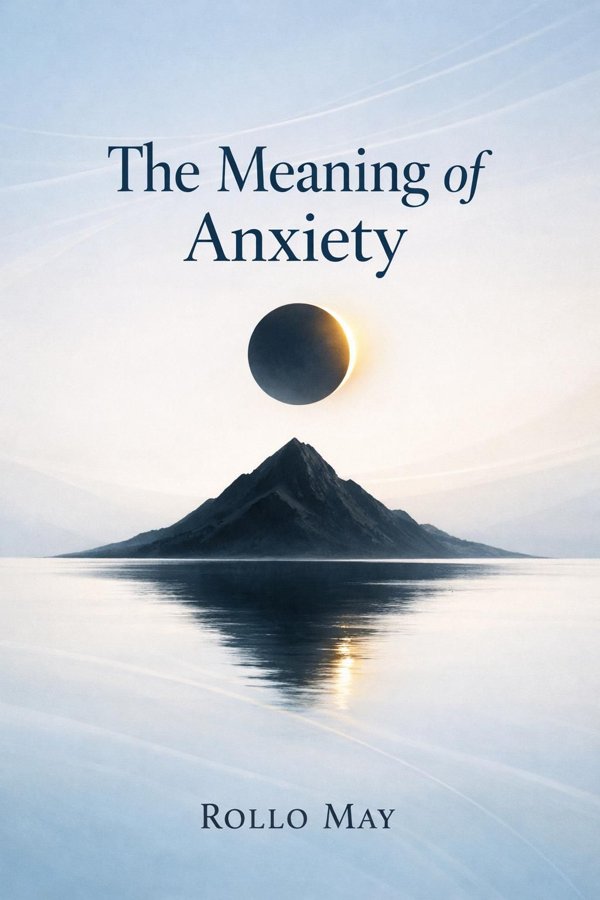
The Meaning of Anxiety: Summary & Key Insights
by Rollo May
 10 min8 chaptersAudio available
What Is The Meaning of Anxiety About?
The Meaning of Anxiety by Rollo May is a psychology book spanning 8 pages. In this influential work, Rollo May explores the nature, causes, and significance of anxiety in human life. Drawing from existential psychology, he argues that anxiety is not merely a symptom to be eliminated but a vital part of the human condition that can lead to growth, creativity, and self-realization when properly understood and faced. The book examines both normal and neurotic anxiety, offering insights into how individuals can confront fear and uncertainty to achieve authentic existence.
This FizzRead summary covers all 8 key chapters of The Meaning of Anxiety in approximately 10 minutes, distilling the most important ideas, arguments, and takeaways from Rollo May's work. Also available as an audio summary and Key Quotes Podcast.
The Meaning of Anxiety
In this influential work, Rollo May explores the nature, causes, and significance of anxiety in human life. Drawing from existential psychology, he argues that anxiety is not merely a symptom to be eliminated but a vital part of the human condition that can lead to growth, creativity, and self-realization when properly understood and faced. The book examines both normal and neurotic anxiety, offering insights into how individuals can confront fear and uncertainty to achieve authentic existence.
Who Should Read The Meaning of Anxiety?
This book is perfect for anyone interested in psychology and looking to gain actionable insights in a short read. Whether you're a student, professional, or lifelong learner, the key ideas from The Meaning of Anxiety by Rollo May will help you think differently.
- ✓Readers who enjoy psychology and want practical takeaways
- ✓Professionals looking to apply new ideas to their work and life
- ✓Anyone who wants the core insights of The Meaning of Anxiety in just 10 minutes
Want the full summary?
Get instant access to this book summary and 100K+ more with Fizz Moment.
Get Free SummaryAvailable on App Store • Free to download
Key Chapters
To understand our modern confusion about anxiety, we must begin by tracing how thought about it has evolved. In ancient Greece, thinkers like Plato and Aristotle already sensed anxiety’s place in the human soul, even if they described it in moral or cosmological terms. For the Stoics, fear of circumstances outside our control was the genesis of anxiety; serenity came only through the discipline of reason. Later, Christian theology transformed anxiety into spiritual conflict—anguish over sin and separation from God. Augustine’s writings, for example, are filled with the tension between human freedom and divine grace, a conflict that prefigures our modern existential struggle.
In the nineteenth century, Søren Kierkegaard named anxiety explicitly as the 'dizziness of freedom.' He saw it as the emotional awareness of possibility itself—the knowledge that one can choose good or evil, authenticity or despair. Freud later reframed anxiety within psychological theory, viewing it as a signal of inner conflict among id, ego, and superego. While Freud’s focus was on repression and neurotic symptom formation, Kierkegaard’s insight was existential: anxiety is not the product of sickness but of being human.
By the time we reached the twentieth century, anxiety had become a cultural epidemic, reflecting the rapid disintegration of traditional values and the rise of technological uncertainty. The existentialists—Heidegger, Sartre, and others—recognized anxiety not merely as a clinical problem but as the mood that discloses the truth of existence. My own work builds on this foundation: anxiety reveals to us that to exist is to be finite, free, and responsible amid ambiguity. It is not pathology—it is a condition of awareness.
In existential psychology, anxiety is stripped of its stigma and reconsidered as the pulse of self-awareness. Anxiety arises when one confronts the boundaries of one’s being—when all the safe assurances of habit dissolve. In that moment, anxiety is not an intruder but a sign of potential awakening. It accompanies freedom: as soon as I realize I am free to shape my life, I must also face the terror that comes with responsibility and uncertainty.
Existential thinkers differ from positivist psychologists in that they do not seek to eliminate anxiety. To exist authentically means to accept anxiety as the cost of awareness. When I avoid anxiety, I also avoid growth; when I face it, I move closer to truth. Anxiety asks me a single, relentless question: what will you do with your freedom? In that question lies the birth of individuality. Without anxiety, there can be no courage; without courage, no authentic life.
Many people misinterpret existential psychology as pessimistic. The opposite is true. To say that anxiety is intrinsic to existence is to say that life is meaningful enough to challenge us. It is out of the tension between possibility and limitation that creativity, morality, and love arise. The purpose of understanding anxiety is therefore not to be rid of it but to live it more deeply—until it becomes an ally in the process of becoming oneself.
+ 6 more chapters — available in the FizzRead app
All Chapters in The Meaning of Anxiety
About the Author
Rollo May (1909–1994) was an American existential psychologist and author known for introducing existential psychology to the United States. His works, including 'Love and Will' and 'The Courage to Create,' emphasize the importance of human choice, creativity, and responsibility in the face of existential challenges.
Get This Summary in Your Preferred Format
Read or listen to the The Meaning of Anxiety summary by Rollo May anytime, anywhere. FizzRead offers multiple formats so you can learn on your terms — all free.
Available formats: App · Audio · PDF · EPUB — All included free with FizzRead
Download The Meaning of Anxiety PDF and EPUB Summary
Key Quotes from The Meaning of Anxiety
“To understand our modern confusion about anxiety, we must begin by tracing how thought about it has evolved.”
“In existential psychology, anxiety is stripped of its stigma and reconsidered as the pulse of self-awareness.”
Frequently Asked Questions about The Meaning of Anxiety
The Meaning of Anxiety by Rollo May is a psychology book that explores key ideas across 8 chapters. In this influential work, Rollo May explores the nature, causes, and significance of anxiety in human life. Drawing from existential psychology, he argues that anxiety is not merely a symptom to be eliminated but a vital part of the human condition that can lead to growth, creativity, and self-realization when properly understood and faced. The book examines both normal and neurotic anxiety, offering insights into how individuals can confront fear and uncertainty to achieve authentic existence.
More by Rollo May


You Might Also Like
The Body Keeps the Score
Bessel van der Kolk
10 min
Surrounded by Idiots
Thomas Erikson
10 min
Emotional Intelligence
Daniel Goleman
10 min
Attached
Amir Levine
10 min
Why Does He Do That
Lundy Bancroft
10 min
Women Who Run with the Wolves
Clarissa Pinkola Estés
10 minBrowse by Category
Ready to read The Meaning of Anxiety?
Get the full summary and 100K+ more books with Fizz Moment.