
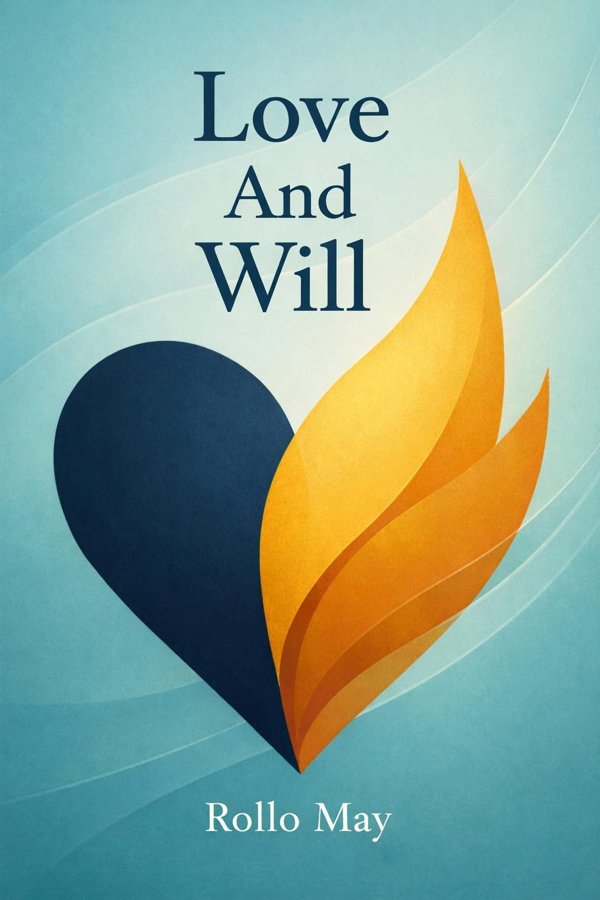
Love And Will: Summary & Key Insights
by Rollo May
 10 min9 chaptersAudio available
Key Takeaways from Love And Will
One of May’s most powerful insights is that love without will cannot endure, and will without love becomes hollow.
May believed that modern society produces a strange contradiction: people are surrounded by opportunities for contact, yet often feel less capable of real intimacy.
May places enormous emphasis on care, arguing that authentic love begins not in romance or sentiment but in the capacity to care deeply.
A central existential theme in Love And Will is that freedom is not simply the absence of limits; it is the capacity to choose oneself within reality.
May was writing during a period of changing sexual norms, and he offers a nuanced critique that still resonates.
What Is Love And Will About?
Love And Will by Rollo May is a psychology book. Love And Will is one of Rollo May’s most important works, a searching psychological study of why modern people often struggle to love deeply, choose clearly, and act courageously. Writing as an existential psychologist, May argues that love and will are not opposing forces—feeling versus control—but two human capacities that must work together if we are to live fully. When love is separated from will, affection becomes shallow, unstable, or sentimental. When will is separated from love, action becomes empty, rigid, or dominating. The result is anxiety, alienation, and a weakening of personal freedom. First published in a time of rapid social change, the book still feels strikingly relevant in an age of emotional confusion, overchoice, and fragile relationships. May combines clinical insight, philosophy, cultural criticism, and deep human sympathy to explore the roots of apathy, desire, care, freedom, and responsibility. Love And Will matters because it helps readers understand not only intimacy and commitment, but also creativity, moral courage, and the difficult art of becoming a whole person.
This FizzRead summary covers all 9 key chapters of Love And Will in approximately 10 minutes, distilling the most important ideas, arguments, and takeaways from Rollo May's work. Also available as an audio summary and Key Quotes Podcast.
Love And Will
Love And Will is one of Rollo May’s most important works, a searching psychological study of why modern people often struggle to love deeply, choose clearly, and act courageously. Writing as an existential psychologist, May argues that love and will are not opposing forces—feeling versus control—but two human capacities that must work together if we are to live fully. When love is separated from will, affection becomes shallow, unstable, or sentimental. When will is separated from love, action becomes empty, rigid, or dominating. The result is anxiety, alienation, and a weakening of personal freedom. First published in a time of rapid social change, the book still feels strikingly relevant in an age of emotional confusion, overchoice, and fragile relationships. May combines clinical insight, philosophy, cultural criticism, and deep human sympathy to explore the roots of apathy, desire, care, freedom, and responsibility. Love And Will matters because it helps readers understand not only intimacy and commitment, but also creativity, moral courage, and the difficult art of becoming a whole person.
Who Should Read Love And Will?
This book is perfect for anyone interested in psychology and looking to gain actionable insights in a short read. Whether you're a student, professional, or lifelong learner, the key ideas from Love And Will by Rollo May will help you think differently.
- ✓Readers who enjoy psychology and want practical takeaways
- ✓Professionals looking to apply new ideas to their work and life
- ✓Anyone who wants the core insights of Love And Will in just 10 minutes
Want the full summary?
Get instant access to this book summary and 100K+ more with Fizz Moment.
Get Free SummaryAvailable on App Store • Free to download
Key Chapters
One of May’s most powerful insights is that love without will cannot endure, and will without love becomes hollow. Many people imagine these forces as opposites: love feels warm, spontaneous, and receptive, while will sounds cold, deliberate, and forceful. May rejects this split. He argues that mature human life requires their union. Love gives us the capacity to value, cherish, and affirm another person or purpose. Will gives us the ability to choose, commit, persist, and shape action over time. Without will, love collapses into passing emotion or wishful fantasy. Without love, will degenerates into manipulation, self-assertion, or sterile discipline.
May sees this division reflected in modern life. People may long for intimacy yet fear commitment. They may admire freedom while avoiding the choices that make freedom real. In relationships, someone might sincerely care for a partner but refuse to make concrete decisions that sustain trust, such as honest communication or long-term responsibility. At work, a person may feel inspired by meaningful goals yet lack the resolve to pursue them through frustration and sacrifice. In both cases, the split creates inner conflict and disappointment.
May’s broader argument is existential: human beings become themselves through intentional acts rooted in what they truly value. Love tells us what matters. Will enables us to stand by it. The healthiest life is not one of constant emotional intensity, but one of chosen devotion.
A practical way to apply this idea is to examine one area where your feelings and actions are misaligned. Ask yourself: What do I say I care about, and what consistent decisions prove it? Then make one concrete commitment that joins genuine feeling with deliberate action.
May believed that modern society produces a strange contradiction: people are surrounded by opportunities for contact, yet often feel less capable of real intimacy. His insight is that intimacy requires more than attraction or access. It requires inner presence, vulnerability, and the courage to encounter another person as fully real. When individuals feel fragmented, anxious, or emotionally numb, relationships easily become substitutes for connection rather than expressions of it.
He describes a cultural climate in which traditional values are weakening, roles are shifting, and individuals are expected to invent themselves. This can create freedom, but also confusion. Without a stable inner center, people may seek relationships mainly for reassurance, status, escape from loneliness, or confirmation of identity. Under these conditions, love becomes burdened by hidden demands. Instead of seeing the other person clearly, we unconsciously turn them into a solution for our insecurity.
This helps explain why closeness can be both desired and feared. Genuine intimacy threatens our defenses because it asks us to be known, changed, and responsible. It exposes dependence, longing, and ambivalence. So people may oscillate between pursuit and withdrawal—wanting fusion one moment and distance the next. The problem is not that intimacy is impossible, but that it asks for a degree of selfhood many people have not fully developed.
In everyday life, this insight applies to dating, marriage, friendship, and even family bonds. If you notice patterns of idealizing others, withdrawing when things become real, or expecting someone else to stabilize your identity, the work may need to begin within. Lasting intimacy grows from two people who can each tolerate solitude, uncertainty, and honesty.
Actionable takeaway: Before asking how to find better relationships, ask how you can become more emotionally present. Practice one conversation this week in which you speak honestly about what you feel without blaming, performing, or hiding behind roles.
May places enormous emphasis on care, arguing that authentic love begins not in romance or sentiment but in the capacity to care deeply. To care means that something genuinely matters to us, enough to command our attention, concern, and energy. This may sound simple, but it is psychologically profound. A person who cannot care is not merely detached; they are cut off from a basic source of meaning and vitality. Apathy, cynicism, and chronic indifference often signal a deeper disturbance in one’s relation to self and world.
For May, care is the bridge between inner life and outward action. It is what awakens commitment. We do not will abstractly; we will in relation to what we care about. This is why emotional deadness can lead to paralysis. If nothing matters, choice becomes arbitrary and effort feels empty. Conversely, when care returns, energy follows. Someone who rediscovers concern for a child, a craft, a cause, or a community often also rediscovers direction.
May’s view expands love beyond personal affection. Care can be expressed in friendship, parenting, creative work, citizenship, and moral responsibility. A teacher who prepares thoughtfully for students, a friend who remembers what someone is struggling with, or a nurse who treats a patient as a person rather than a task—all embody love through care. This kind of love is less dramatic than passion, but often more sustaining.
In practical terms, one antidote to emotional numbness is to ask not, “What do I feel intensely?” but “What am I willing to care for consistently?” Care grows through attention. If you regularly turn toward what matters rather than away from it, feeling and meaning deepen together.
Actionable takeaway: Choose one person, project, or responsibility you value and give it undivided attention for a set period each day. Consistent care is often the beginning of stronger love, clearer purpose, and steadier will.
A central existential theme in Love And Will is that freedom is not simply the absence of limits; it is the capacity to choose oneself within reality. May warns that many people romanticize freedom while resisting the burden that comes with it. Real freedom always includes responsibility, because every meaningful choice excludes alternatives and commits us to consequences. Without this acceptance, freedom becomes endless hesitation, superficial experimentation, or escape into impulse.
May is especially insightful about the anxiety tied to choice. To choose is to reveal what matters to us, and that can be frightening. A decision exposes us. It means we can no longer hide behind indecision, blame circumstances entirely, or imagine that all futures remain open. This is why some people cling to passivity. They call it openness, but it may actually be fear of authorship.
In relationships, avoiding choice can look like staying emotionally ambiguous, refusing to define commitments, or keeping one foot out the door. In work, it can mean drifting between options without developing mastery. In personal growth, it appears as constant analysis without decisive action. May does not deny that circumstances constrain us. Rather, he insists that psychological health depends on discovering the sphere in which we can still respond deliberately.
His understanding of will is not brute force. It is the organized capacity to affirm one direction among competing possibilities. This is liberating because it means strength grows through exercised choice. You become more able to act by acting.
Actionable takeaway: Identify one unresolved decision you have postponed. Instead of waiting for certainty, define the values involved, choose the direction that best honors them, and accept one concrete consequence of that choice. Responsibility does not shrink freedom; it turns freedom into reality.
May was writing during a period of changing sexual norms, and he offers a nuanced critique that still resonates. His point is not prudishness or moral panic. Rather, he argues that sexuality can be either an expression of genuine encounter or a defense against loneliness, anxiety, and emotional deadness. When sex is severed from care, tenderness, and inward presence, it may provide stimulation without communion. The experience can be exciting in the moment yet strangely empty afterward.
May believed modern culture often confuses liberation with detachment. If people are taught to avoid vulnerability while pursuing pleasure, sexual experience may become depersonalized. Partners can be treated as instruments for affirmation, release, conquest, or distraction. In this pattern, the body is used, but the self remains defended. The tragedy is not simply moral; it is existential. We seek contact while preventing true meeting.
This insight applies broadly today, especially in environments shaped by performance, image, and instant gratification. A person may engage in many romantic or sexual interactions yet still feel unseen. Another may avoid deeper intimacy by keeping everything at the level of chemistry. May’s point is that erotic life is healthiest when it participates in the wider life of the person—when desire, respect, imagination, and care are not split apart.
He does not deny the power or beauty of sexuality. On the contrary, he takes it seriously enough to insist that it matters how it is lived. Sexuality becomes richer when it is connected to tenderness, honesty, and mutual recognition.
Actionable takeaway: Reflect on whether your intimate life expresses your deeper values or merely distracts you from discomfort. Before entering or deepening a sexual relationship, ask what kind of human connection you are actually creating, not just what experience you are seeking.
May is one of the great psychologists of anxiety, and in Love And Will he treats it not only as a symptom to be eliminated but also as a signal of human aliveness. Anxiety arises when something essential to our existence is at stake—our identity, freedom, love, meaning, or future. Because of this, anxiety is not always pathological. Sometimes it is the emotional cost of growth. The problem begins when anxiety becomes so overwhelming that it leads to avoidance, numbness, compulsive behavior, or despair.
This distinction matters because many people respond to anxiety by trying to erase it immediately. May suggests a more mature approach: ask what the anxiety is revealing. Are you anxious because a relationship matters? Because a decision will define your life? Because a change is requiring you to become someone new? In such cases, anxiety is bound up with possibility. It marks the edge of expansion.
In therapy and in ordinary life, this means the goal is not to become fearless, but to increase one’s capacity to bear tension consciously. A student anxious about choosing a career, a parent anxious about raising a child, or an artist anxious before showing work may all be confronting something meaningful. If they can remain present rather than retreat automatically, anxiety can become a teacher.
May does not glamorize suffering. Severe anxiety can be deeply painful. But he insists that courage is not the absence of anxiety; it is the decision to move forward despite it. This view restores dignity to struggle.
Actionable takeaway: The next time anxiety appears, pause before labeling it as purely negative. Write down what value, risk, or possibility it may be pointing to. Then take one small action toward that meaningful challenge instead of away from it.
A subtle but important idea in May’s work is intentionality—the human capacity to direct consciousness toward meaning, possibility, and action. Intentionality connects desire with the world. It is not mere wish or impulse. It is the inner orientation through which we perceive, value, and move toward something. Without intentionality, desire becomes scattered, reactive, or self-defeating. We may want many things, but we do not know what we are truly aiming at.
May uses this concept to explain why people can feel both flooded with impulses and strangely directionless. Modern life offers endless stimulation, but stimulation is not purpose. Intentionality organizes our energies. It allows us to say, “This is what I am reaching toward, and this is how I mean to engage it.” In love, intentionality means seeing the beloved as a real person and choosing relation, not merely craving emotional gratification. In work, it means aligning effort with a purpose larger than immediate reward. In personal development, it means living by orientation rather than drift.
A practical example is the difference between wanting companionship and intentionally building a loving relationship. The first may lead to endless swiping, fantasy, or dependency. The second involves clarifying values, communicating honestly, and behaving in ways that make mutual trust possible. Likewise, wanting to be creative is different from intentionally making time, tolerating imperfection, and finishing work.
May’s insight is that intentionality is a bridge between inner life and outer form. It helps transform vague longing into embodied commitment. It also strengthens identity, because we become partly through what we consistently aim ourselves toward.
Actionable takeaway: Choose one desire you keep talking about but not embodying. Define its deeper intention in a sentence beginning with “I am committed to...” Then shape one recurring behavior each week that expresses that intention in visible form.
A recurring danger in love, according to May, is the temptation to turn another person into an extension of our needs. We may idealize them, depend on them to stabilize our self-worth, or pressure them to fit an imagined role. But mature love requires something harder and nobler: recognizing the other as fully separate, with their own freedom, interiority, and destiny. This kind of love is not possession. It is affirmation without control.
Such love includes desire and closeness, but it also includes reverence for difference. The beloved is not valuable only because they satisfy us. They are valuable in themselves. This insight protects against many common distortions of intimacy, including jealousy rooted in ownership, resentment when a partner changes, or disappointment when reality fails to match fantasy. When love is immature, difference feels threatening. When love matures, difference becomes part of what makes encounter real.
This has practical implications for conflict. In an unhealthy pattern, one partner argues mainly to win, to restore comfort, or to force agreement. In a healthier one, both people remain curious about the other’s experience even while defending their own position. Parents can apply this by guiding children without treating them as personal projects. Friends can apply it by supporting one another’s growth even when it leads in unexpected directions.
May’s vision of love is demanding because it requires self-transcendence. We must loosen our grip on fantasy and learn to meet actual persons. Yet this is also what makes love transformative. We are changed when we encounter another’s reality rather than consuming an image.
Actionable takeaway: In one important relationship, notice where you may be loving an image instead of a person. Ask one open, non-defensive question that helps you understand who the other person really is now, not who you need them to be.
Although Love And Will focuses heavily on intimacy and moral psychology, May also links love and will to creativity. He sees creativity not as a rare talent but as a human response to tension, conflict, and possibility. New forms of life emerge when a person faces reality honestly, cares deeply, and dares to shape something meaningful. In this sense, creativity is an existential act. It requires both openness to experience and the will to give that experience form.
May understood that creative living involves anxiety. To create is to risk failure, rejection, misunderstanding, and self-exposure. It asks us to leave the familiar and enter uncertainty. This is why many people remain consumers of life rather than makers of it. Yet the refusal to create has costs too: stagnation, resentment, and the feeling that one’s life is being lived by default.
His idea of creativity extends beyond art. A couple repairing a damaged relationship, a teacher redesigning a classroom, an entrepreneur building a humane company, or an individual constructing a more truthful life after crisis are all engaging in creativity. They are bringing into being something that did not exist before. Love supplies the caring involvement; will supplies the discipline and perseverance.
This concept is especially useful when life feels blocked. Instead of asking only how to feel better, one can ask what wants to be created from the tension. A painful transition may contain the raw material for a more honest identity. A conflict may become the basis for a new pattern.
Actionable takeaway: Take one unresolved tension in your life and treat it as creative material. Ask, “What form, practice, conversation, or project could transform this conflict into something life-giving?” Then begin with the smallest possible first step.
All Chapters in Love And Will
About the Author
Rollo May was an American existential psychologist and psychotherapist whose work helped bring existential thought into mainstream psychology in the twentieth century. Born in 1909, he studied theology as well as psychology, and his writing reflects a rare combination of clinical insight, philosophy, and literary depth. May became widely known for exploring themes such as anxiety, freedom, courage, creativity, love, and the search for meaning in modern life. His major books include The Meaning of Anxiety, Love And Will, and The Courage to Create. Unlike more mechanistic models of psychology, May emphasized the lived experience of the person and the moral, emotional, and spiritual dimensions of human struggle. He remains one of the most respected voices in existential psychology.
Get This Summary in Your Preferred Format
Read or listen to the Love And Will summary by Rollo May anytime, anywhere. FizzRead offers multiple formats so you can learn on your terms — all free.
Available formats: App · Audio · PDF · EPUB — All included free with FizzRead
Download Love And Will PDF and EPUB Summary
Key Quotes from Love And Will
“One of May’s most powerful insights is that love without will cannot endure, and will without love becomes hollow.”
“May believed that modern society produces a strange contradiction: people are surrounded by opportunities for contact, yet often feel less capable of real intimacy.”
“May places enormous emphasis on care, arguing that authentic love begins not in romance or sentiment but in the capacity to care deeply.”
“A central existential theme in Love And Will is that freedom is not simply the absence of limits; it is the capacity to choose oneself within reality.”
“May was writing during a period of changing sexual norms, and he offers a nuanced critique that still resonates.”
Frequently Asked Questions about Love And Will
Love And Will by Rollo May is a psychology book that explores key ideas across 9 chapters. Love And Will is one of Rollo May’s most important works, a searching psychological study of why modern people often struggle to love deeply, choose clearly, and act courageously. Writing as an existential psychologist, May argues that love and will are not opposing forces—feeling versus control—but two human capacities that must work together if we are to live fully. When love is separated from will, affection becomes shallow, unstable, or sentimental. When will is separated from love, action becomes empty, rigid, or dominating. The result is anxiety, alienation, and a weakening of personal freedom. First published in a time of rapid social change, the book still feels strikingly relevant in an age of emotional confusion, overchoice, and fragile relationships. May combines clinical insight, philosophy, cultural criticism, and deep human sympathy to explore the roots of apathy, desire, care, freedom, and responsibility. Love And Will matters because it helps readers understand not only intimacy and commitment, but also creativity, moral courage, and the difficult art of becoming a whole person.
More by Rollo May
You Might Also Like
The Body Keeps the Score
Bessel van der Kolk
10 min
Surrounded by Idiots
Thomas Erikson
10 min
Emotional Intelligence
Daniel Goleman
10 min
Attached
Amir Levine
10 min
Why Does He Do That
Lundy Bancroft
10 min
Women Who Run with the Wolves
Clarissa Pinkola Estés
10 minBrowse by Category
Ready to read Love And Will?
Get the full summary and 100K+ more books with Fizz Moment.